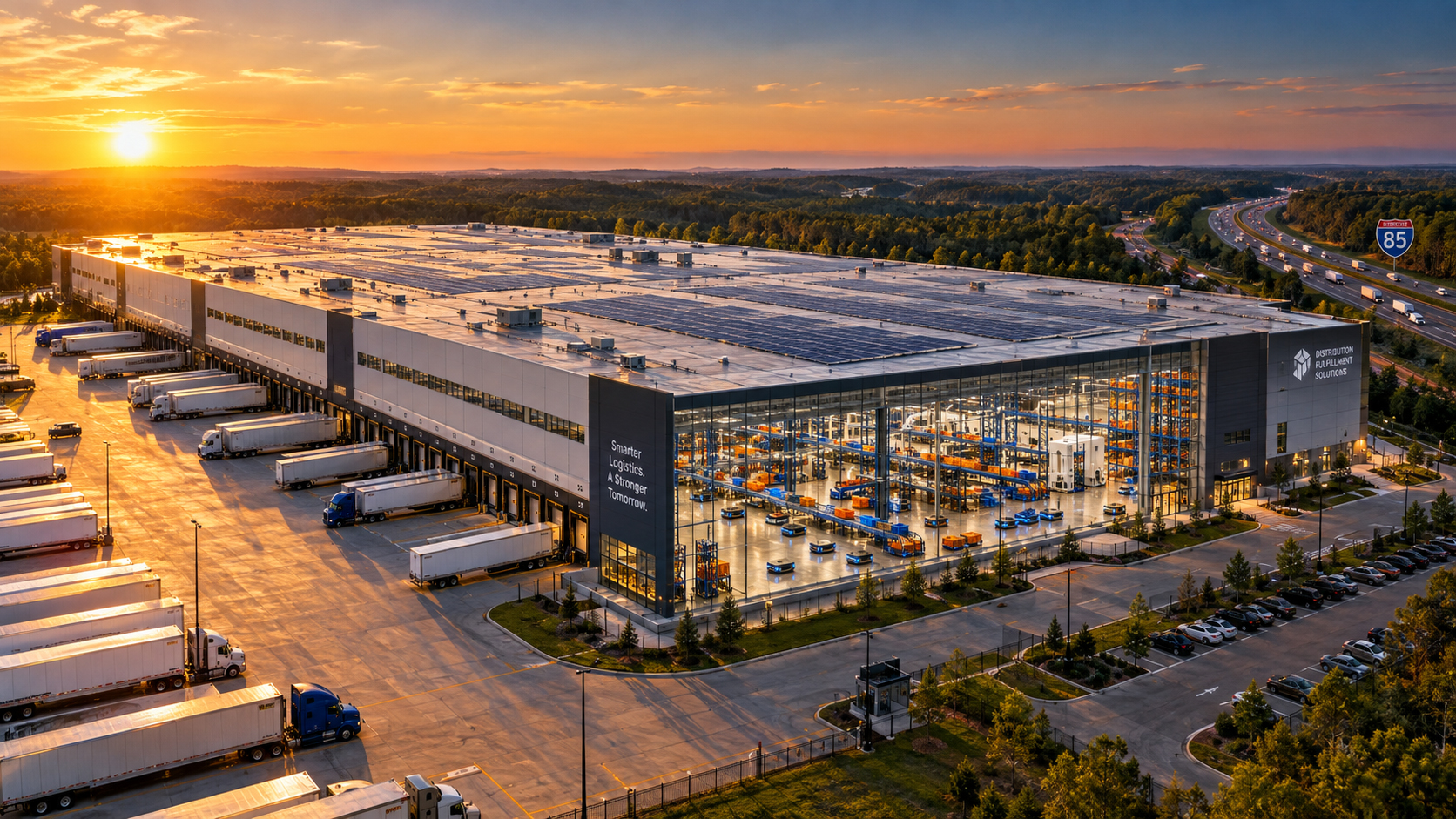
Supply chain and the multi-billion dollar spare parts logistics market: How Parts Town Unlimited is conquering the American Southeast – Creative image on the topic, with AI: Xpert.Digital
50,000 square meters of the future: How this AI-powered center in the USA is transforming logistics
2-hour delivery time: The radical strategy behind the new logistics giant in Georgia
More than just a building: How a single warehouse is reshaping the US economy
An unassuming lease for a massive warehouse in the US state of Georgia might not sound particularly remarkable at first glance. But Parts Town Unlimited's new mega-fulfillment center in Pendergrass is far more than just a local real estate project. Spanning approximately 50,000 square meters, it encapsulates the crucial economic megatrends of our time: the unstoppable boom in the spare parts economy, the physical relocation of global supply chains to the American Southeast, the widespread adoption of AI and robotics, and the urgent race for energy efficiency. This comprehensive analysis illuminates why delivering a simple spare part in just two hours can determine the fate of multi-billion-dollar markets, how highly automated mega-centers are redefining the logistics industry, and what essential lessons the European market, and German SMEs in particular, must learn from this American blueprint. Anyone who wants to understand how tomorrow's global value creation is changing needs to look to the Interstate 85 corridor.
The occasion: A record-breaking building on Interstate 85
When Parts Town Unlimited signed the full lease for a 538,450-square-foot building in the Jackson 85 North Business Park in Pendergrass, Georgia, at the end of August 2026, the announcement initially seemed like just another ordinary real estate transaction. A parts distributor is leasing a warehouse, creating around 140 jobs, and promising faster deliveries—the kind of news that appears in local newspapers and usually stays there. But a closer look at the announcement reveals a condensed snapshot of several profound economic upheavals currently overlapping in the American and European economies. The space equates to roughly 50,000 square meters and makes the location the company's largest fulfillment center, surpassing its existing facilities in Chicago, Phoenix, and Munich.
The conversion of the area figure requires a brief clarification, as it was incorrectly presented in the original report. 538,450 square feet does not correspond to 538,450 square meters, but rather to approximately 50,023 square meters; one square foot measures roughly 0.0929 square meters. This size is certainly substantial for a modern distribution center, but it falls within the range of what is currently common along major US logistics corridors. The adjacent, still-available Building 2 in the same park alone already measures a good 1.01 million square feet, and the first construction phase encompasses a total of over 1.55 million square feet on 215 acres of land. The new site thus fits into a landscape where warehouses are among the largest man-made structures in their respective regions.
The facility is scheduled for completion by the end of the year and will be the first in the company's network to receive LEED certification, the internationally recognized standard for energy-efficient and resource-conserving construction. Once operational, Parts Town aims to reach 93 percent of the US population within two days and provide local customers in the Southeast with critical spare parts in just two hours via same-day pickup and delivery. This combination of national reach and ultra-fast local response is the core strategic message of the announcement and the guiding principle for the following analysis.
The invisible backbone: What spare parts logistics means economically
To grasp the significance of this project, one must first understand that spare parts logistics is a distinct, highly profitable sector of the economy with its own unique set of rules. Unlike original equipment manufacturing, the focus here is not on selling a new device, but on maintaining the functionality of one that has already been sold. This is precisely where the economic impact lies: A defective part in a commercial kitchen, an air conditioning system, or a large household appliance doesn't just cripple a single component, but an entire revenue stream. A restaurant with a broken fryer doesn't lose the value of the fryer itself, but rather the revenue of every customer who cannot be served during that time.
This asymmetry between low part value and high downtime costs explains why speed justifies almost any price in this market. Industry analyses put the cost of unplanned downtime in industrial environments at $22,000 to $260,000 per hour, while commercial vehicle fleets incur downtime costs of $448 to $760 per vehicle per day. In logistics terms, the key metric is Mean Time to Repair (MTTR), and the biggest lever for reducing it is not the technician, but the availability of the right part in the right place. Forward stocking locations reduce delivery times from days to two to four hours, transforming logistics from a cost center into a revenue generator.
The market size of this segment varies considerably depending on the definition used, but the direction of growth is clear. Conservative estimates project the global spare parts logistics market to reach approximately US$49 to US$52 billion in 2025, with an annual growth rate of roughly five to seven percent until the early 2030s. The US submarket alone is expected to grow to around US$15 billion by 2030, remaining the largest single national market worldwide. It is particularly noteworthy that the independent aftermarket is growing faster than the original equipment manufacturer (OEM) channel, reflecting the structural shift towards repair, maintenance, and longer service life.
The competitive advantage, measured in kilometers
The real competition in spare parts distribution isn't decided by the price of the parts, but by the geography of the inventory. The key figures cited by Parts Town – 93 percent of the US population within two days, local delivery in two hours – are therefore not marketing slogans, but precise statements about geographic positioning. Every distribution center defines a radius within which a company undercuts its competitors' time and cost curves. Extending this radius beyond an existing network of Chicago, Phoenix, and Munich to include the southeastern US closes a geographic gap that previously could only be served with longer and more expensive transport routes.
The underlying business logic is that of a hybrid delivery model, combining two previously separate service worlds. At the national level, nationwide two-day shipping ensures cost efficiency and inventory consolidation, while at the local level, pickup and two-hour delivery serve a premium segment for time-critical orders. This very division is how established competitors like Genuine Parts Company operate, whose dense network of over 6,000 NAPA branches enables same-day delivery in metropolitan areas. Parts Town attempts to achieve this level of service not through thousands of small branches, but through a few, highly automated large centers – a fundamentally different strategic approach to the same customer promise.
The economic core of this approach lies in managing a classic logistics trade-off: the contradiction between centralized inventory management and decentralized customer proximity. Centralized warehouses reduce capital commitment and storage costs but lengthen transport routes; decentralized warehouses shorten routes but increase inventory levels and their financing costs. Automation and data analytics shift this trade-off because they allow a single large center to achieve such a high product variety and throughput speed that it can function as several smaller warehouses without incurring their disadvantages.
Georgia as a symptom: The rise of the American Southeast
The choice of Pendergrass as the location is no coincidence, but rather reflects one of the most significant regional economic shifts in the United States in recent years. The town lies along Interstate 85, approximately 57 to 60 miles northeast of Atlanta, in an economic region that is increasingly transforming from a purely distribution hub into a center of advanced manufacturing. Atlanta itself is one of the five major intermodal rail-road hubs in the US and serves as the Southeast's distribution center for national and international freight traffic.
The 33 counties along the I-85 corridor between Atlanta and the North Carolina-Virginia border generate approximately $543.5 billion in regional gross value added, according to CoStar analysis. This represents 43 percent of the economic output of the three states traversed. The northeastern portion of the corridor in the greater Atlanta area is now considered its most concentrated industrial sub-segment, with a vacancy rate below seven percent and net absorption of 3.4 million square feet in the first quarter of 2026 alone. Grade A rents there range from approximately $10 to $12 per square foot on a triple-net basis, with prime last-mile locations reaching the upper end or more.
Behind this dynamic lies a bundle of structural location advantages that the Southeast possesses over the older industrial regions of the North and West. A lack of union affiliation, lower taxes, less regulation, and, above all, lower energy costs make the region attractive for business development. Added to this is the proximity to the Port of Savannah, Hartsfield-Jackson International Airport, and a dense network of highways, which, together with I-95, I-85, I-75, I-65, I-26, and I-40, forms a continuous logistics corridor from the Gulf Coast to the Northeast. With the planned opening in spring 2026 of the $127 million Blue Ridge Connector inland terminal near Gainesville, Northeast Georgia will also gain a direct rail connection, thus relieving road traffic congestion on the I-85 corridor.
Your intralogistics experts

Consulting, planning and implementation of complete solutions for high-bay warehouses and automated storage systems - Image: Xpert.Digital
More information here:
Parts Town Unlimited: Strategic Investments in the Context of North American Supply Chain Reorganization
Reshoring, nearshoring and the reorganization of supply chains
The establishment of Parts Town cannot be understood without considering the broader context of the reshaping of North American supply chains. Since the trade policy decisions of President Donald Trump's second term and the comprehensive tariff package of spring 2025, the flow of investment into domestic manufacturing has increased significantly. Along the I-85 corridor, multi-billion-dollar projects have been announced or are already underway, including Toyota's $13.9 billion battery plant in Liberty, North Carolina; Rivian's $5 billion electric vehicle factory near Social Circle, Georgia; and facilities operated by JetZero, Eli Lilly, and Google.
Experts are increasingly distinguishing precisely between three parallel movements that are often conflated in public discourse. Reshoring refers to the physical relocation of manufacturing back to the USA and is occurring in practice, but in a sector-specific manner, primarily in semiconductors, electric vehicles and batteries, and defense electronics. Nearshoring refers to the relocation of production to Mexico, where foreign direct investment is reaching record levels. Finally, regionalization describes the overarching consolidation of North American supply chains, in which goods are moved within the USA-Mexico-Canada zone rather than across the Pacific.
For spare parts logistics, this shift is doubly significant. First, every new factory, battery plant, and data center along the corridor generates additional demand for maintenance, servicing, and spare parts, thus directly creating new demand for distributors like Parts Town. Second, regionalization itself is shifting volume inland: According to freight analyses, the I-85 corridor is experiencing volume growth of 22 percent, driven by life sciences and high-tech manufacturing. Distributors who bring spare parts closer to these growing industrial clusters position themselves precisely where future demand will arise.
At the same time, experienced market observers urge caution. A significant portion of the announced reshoring projects are being postponed, scaled back, or canceled altogether, and there is often a considerable gap between press releases and the actual start of construction. The increasingly limiting factor is no longer the available land area, but rather the available electrical capacity, which industry associations now describe as the most critical bottleneck in site selection. Anyone assessing the dynamics of the Southeast should therefore distinguish between actual capital allocation and mere announcements – a distinction that also applies to the classification of the Parts Town investment itself.
Automation as a business calculation
Perhaps the most revealing detail of the announcement is the planned technical equipment for the center. The plans include a modular design with robot-assisted conveying, AI-controlled robotics solutions, and automation at packing stations, in shipping sorting, and in goods receiving. The fact that such a highly automated system will initially only create around 140 jobs is not a contradiction, but rather the key point: Value creation per employee increases, while the number of hands required for a given throughput decreases.
The economic justification for this investment can be seen in reliable industry figures. McKinsey estimates that AI-supported warehouse automation reduces operating costs by 20 to 25 percent, driven by increased work efficiency, error reduction, and energy optimization. Picking errors decrease by 25 to 35 percent, and labor productivity increases by 15 to 25 percent. In live applications, autonomous mobile robots achieve a return on investment in under 24 months with a yield exceeding 250 percent, and order picking itself is considered the area with the highest revenue potential and the shortest payback period.
These figures explain why automation has long since left the pilot phase and become the operational standard. Nearly nine out of ten warehouses now use some form of AI or advanced automation, and 60 percent integrate AI into their daily operations. The global warehouse automation market is estimated at around US$30 billion for 2026 and is projected to grow to approximately US$59.5 billion by 2030, at an annual growth rate of around 18.7 percent. More than 4.6 million warehouse robots are already in operation worldwide, and North American companies alone ordered around 18,000 robots worth approximately US$1.2 billion in the first half of 2026.
For a company like Parts Town, whose business model relies on managing an extremely wide range of products, automation is more than just cost reduction. A distributor of genuine manufacturer parts has to stock tens of thousands of items, some of which are rarely requested, and yet be able to locate and pack each one within a very short time. This combination of a deep product range and high access speed is hardly economically feasible with manual processes anymore, which is why automation here affects not only the profit margin, but also the very viability of the service promise itself.
Green logistics: between conviction and calculation
The fact that this facility is the first LEED-certified in the company's network deserves a more nuanced assessment beyond mere sustainability marketing. LEED certification signifies energy efficiency, resource conservation, and healthier indoor environments, and it is no longer simply a reputational tool. In an environment where available electrical power is becoming a decisive location factor, energy efficiency is both a business and a strategic necessity.
In this context, it is revealing that the buildings of Jackson 85 North Park were equipped from the outset with a roof system that allows for the later retrofitting of solar panels and have a generously sized electrical supply. The interplay between automation, which increases electricity demand, and sustainability standards, which aim to reduce or even cover it independently, is not a contradiction, but rather one of the central design challenges of modern logistics properties. Here, sustainability appears less as an idealistic end in itself than as a response to a real physical bottleneck and rising energy prices.
The ownership structure: Private equity as a growth engine
A complete picture of the economic logic requires examining Parts Town's ownership structure. The Addison, Illinois-based company is wholly privately held and supported by a dual private equity model. Berkshire Partners acquired a majority stake in 2016, Leonard Green & Partners made a significant investment in 2021, and management holds an estimated minority stake of 10 to 20 percent. As early as 2022, Berkshire Partners raised $1.5 billion in a secondary transaction to extend its exposure to the high-growth portfolio company.
This structure explains a significant part of the expansion pace. Parts Town recorded revenue growth of 33 percent in 2021, surpassing the billion-dollar mark, with an expected increase to over $1.8 billion for the following year. Estimates for 2024 and 2025 place revenue in the range of $2.5 billion to $4.0 billion. This growth was driven by a combination of organic expansion, numerous acquisitions, international bolt-on acquisitions, and the expansion of master distribution programs with leading manufacturers.
The Georgian fulfillment center can thus be understood as a building block of a classic private equity-driven platform strategy. Well-capitalized financial investors consolidate a fragmented distribution market through acquisitions and scaling, invest in technology and reach, and thereby create a market leader with structural advantages over smaller, regionally limited competitors. The rebranding from Parts Town to Parts Town Unlimited in 2023 marks the transition from a foodservice-focused parts specialist to a global platform that serves not only commercial catering but also household appliances and HVAC technology.
A critical assessment: opportunities, risks and open questions
Despite the strategic coherence of the project, a sober assessment of the risks is warranted. The most obvious concern is the discrepancy between announcement and implementation, which is characteristic of the entire reshoring wave in Southeast Asia. Commissioning by the end of 2026 is ambitious, and the actual realization of the promised service levels – especially two-hour delivery – depends on the smooth ramp-up of the complex automation technology, whose implementation phases are known to be prone to disruptions.
A second risk lies in the cyclical nature of the real estate and logistics markets. The Southeast has experienced exceptional supply growth, and although the northeastern I-85 corridor is considered particularly robust, analysts caution against distinguishing between already stabilized submarkets and speculative new developments. The electrical capacity shortage could increase the cost or delay future expansions and particularly affects highly automated, energy-intensive facilities.
A third, more structural risk concerns the employment impact. The initial 140 jobs created are remarkably few for a facility of this size and illustrate the fundamental shift in logistics value creation. This sends a mixed message to local economic development agencies, as the investment generates capital and tax revenue, but comparatively few jobs per dollar invested. Furthermore, the resulting positions increasingly require the ability to work with automated systems, thus shifting the job profile away from simple manual labor.
However, these risks are offset by compelling opportunities. The structural demand for rapid spare parts supply is growing along the corridor, driven by aging equipment inventories, extended service life, and the expansion of industrial capacity. In a market where downtime costs far exceed part prices, the competitive advantage of speed is exceptionally defensible and immune to pure price competition. Furthermore, early investment in automation and energy efficiency positions the company for an environment where labor costs and energy availability are the decisive constraints.
What this case teaches us about Europe and German SMEs
For a European observer, the Parts Town case is more than just an American footnote, as it illuminates patterns that are directly relevant to the German and European economies as well. The fact that the company operates one of its global fulfillment centers in Munich demonstrates that the described logic of spare parts logistics is not exclusively American. According to some surveys, Europe even dominates the global spare parts logistics market with a share of around 46 percent, underscoring the importance of this segment for the continent.
The crucial lesson for German industry lies in the connection between service speed and added value. The traditional strength of German SMEs, mechanical and plant engineering, increasingly relies not solely on machine sales, but on service throughout the entire lifecycle. A highly available, data-driven, and automated spare parts network is not a cost factor, but rather a prerequisite for securing maintenance contracts and customer loyalty in international competition. The logic of forward stocking locations and digital shipment tracking, promoted by DHL with over 98 percent on-time delivery, is precisely the standard that European manufacturers must also achieve.
The logic behind location is equally instructive. Just as the American Southeast benefits from lower costs, good infrastructure, and proximity to growing manufacturing clusters, European companies face the question of the optimal distribution of their distribution and service locations as value creation shifts to Central and Eastern Europe. Nearshoring considerations, for example to Bulgaria or other countries with cost advantages and growing infrastructure, essentially follow the same economic calculation that led Parts Town to Pendergrass: the search for the point at which cost advantage, accessibility, and proximity to future demand optimally overlap.
A warehouse as a cipher for the present
The establishment of Parts Town Unlimited in Pendergrass, upon closer examination, represents a confluence of several defining economic trends of our time. It demonstrates how the seemingly prosaic task of spare parts supply has transformed into a highly profitable, technology-driven business where competition is decided by hours and kilometers. It illustrates the rise of the American Southeast to an industrial powerhouse, fueled by reshoring, favorable location conditions, and a dense logistics corridor. And it reveals how automation, artificial intelligence, and energy efficiency have evolved from optional improvements to the determining factors of logistical competitiveness.
The rationale behind this analysis is that Parts Town's investment is strategically sound, but not without risk. The company is positioning itself precisely at the intersection of the strongest structural trends – growing demand for spare parts, regional relocation of industrial value creation, and productivity leaps through automation – and, with its strong ownership structure, possesses the resources to expand this position. The remaining uncertainties lie less in the strategy itself than in its implementation: in the timely ramp-up of the technology, in managing energy constraints, and in whether the euphoric growth assumptions of the Southeast will hold up in reality.
For the observant European, the most important insight remains that the future of industrial value creation lies less and less in the product itself and more and more in its availability, maintenance, and life cycle. A warehouse in Georgia thus reveals more about the direction of the global economy than many a business cycle forecast, because it shows where capital, technology, and geographical logic are actually converging today.
Your global marketing and business development partner
☑️ Our business language is English or German
☑️ NEW: Correspondence in your native language!

Konrad Wolfenstein
I and my team are happy to be available to you as your personal advisor.
You can contact me by filling out the contact form here wolfenstein@xpert.digital:or simply call me at +49 7348 4088 965. My email address is
I'm looking forward to our joint project.