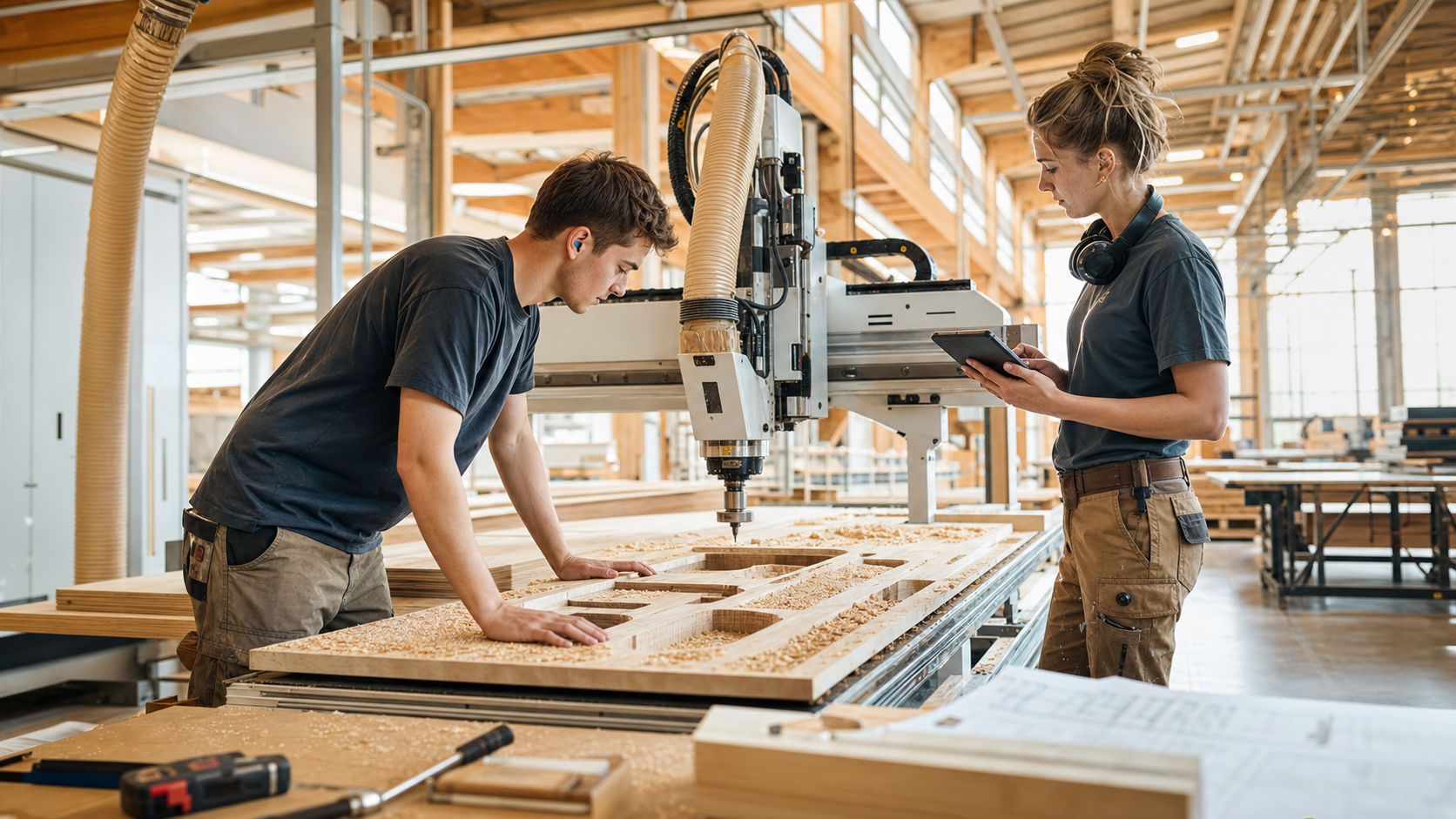
University studies are a thing of the past? Why skilled trades are the secret winners of the crisis – a creative image on the topic, created with AI: Xpert.Digital
AI threatens office jobs: Why young people are suddenly flocking back to skilled trades
Despite the economic crisis: Why German skilled trades are experiencing an unexpected boom
Surprising turnaround in the job market: This is why more young Germans want to become tradespeople again
While the German economy stagnates and industry increasingly struggles with job cuts and reluctance to invest, the country's most traditional sector is experiencing an unexpected comeback. For the fourth year in a row, the skilled trades have recorded rising apprenticeship numbers. But what might at first glance appear to be a statistical anomaly in times of crisis reveals itself upon closer inspection as a profound structural and societal transformation. Driven by the enormous challenges of the energy transition, growing concerns about artificial intelligence in traditional office jobs, and the realization that practical work is both recession-proof and lucrative, young people are rethinking their career paths. This development, however, also sheds light on a decades-long educational policy misconception – and reveals what Germany now urgently needs to learn from its neighbors.
Related to this:

Crisis-proof and in demand: How skilled trades are suddenly competing with university studies
The historical misconception: Why Germany underestimated its skilled tradespeople (and why that is now changing)
There are figures that don't seem to add up at first glance, and that's precisely why they warrant a closer look. Germany's economy is in a phase that could charitably be described as stagnation, and less charitably as creeping erosion. Industry is cutting jobs, investment decisions are being postponed, and the mood in the executive suites of many companies is more subdued than it has been for years. Anyone looking for an upward trend in this complex situation would probably not intuitively expect to find it in the country's most traditional sector. And yet, it is precisely there, in the skilled trades, that a development can be observed that has surprised many observers.
Between January and June, nearly 67,800 new apprenticeship contracts were signed in the skilled trades across Germany. This represents an increase of 4.9 percent compared to the same period last year and marks the fourth consecutive year of rising contract numbers. In an economy that is generally stagnating, this is an outlier that requires explanation. While other sectors are reducing their apprenticeship positions, the skilled trades are doing the exact opposite, and this is not the first time they have done so, but rather a continuous trend over several years. This is not mere statistical noise, but a structural trend that deserves both economic and social analysis.
Related to this:
The economic contradiction that isn't really one
At first glance, it seems paradoxical that an industry can grow in a weak economic environment while the overall economy shrinks or stagnates. However, this apparent contradiction dissolves upon closer examination, as soon as one considers the structure of the German economy in a more nuanced way, rather than treating it as a homogeneous entity. Industry, particularly mechanical engineering, the automotive supply industry, and parts of the chemical sector, is struggling with high energy costs, international competitive pressure, accelerated technological change, and a reluctance to invest, which directly impacts the number of apprenticeships offered. Companies that have to question their future viability are more cautious in their training programs than companies with a stable order book.
The skilled trades, on the other hand, draw their income from a different demand structure. They are regionally rooted, often family-run, and largely less dependent on international supply chains and global price competition. Above all, the skilled trades operate in sectors where demand is driven not by cyclical fluctuations, but by structural and long-term factors. Energy-efficient building renovations, the installation of heat pumps, the modernization of power grids, the expansion of charging infrastructure, and housing construction are not issues that will simply disappear with the next economic downturn. They are politically mandated, legally enshrined, and socially unavoidable. Those who want to implement these projects need people who can work practically, and this explains precisely why the skilled trades continue to attract new talent even in economically turbulent times.
Artificial intelligence as an unexpected advertising partner for the skilled trades
One of the most interesting aspects of this development is the role that artificial intelligence plays – albeit in an indirect and almost ironic way. While in recent years the prevailing concern was that academic and commercial professions were the most likely to be safe from automation, this picture has now shifted significantly. Language models and generative AI systems have demonstrated in a very short time that they can take over parts of text work, research, simple analyses, and even programming tasks. This development has led an entire generation of young people to reassess the perceived security of traditional office jobs.
At the same time, it has become clear that physically demanding, hands-on tasks are hardly affected by this wave of automation. A heat pump isn't installed by a chatbot, a roof isn't covered by an algorithm, and a faulty power grid isn't repaired by text input. The more the debate surrounding artificial intelligence has gained momentum in recent months, the more clearly many young people have been shown the value of practical, location-based, and technically demanding work. The skilled trades are thus benefiting from a debate that actually originated in entirely different sectors, and this is one of the most surprising side effects of the current AI wave.
Why training campaigns alone cannot explain the numbers
However, it would be too simplistic to attribute the increase in apprenticeship numbers solely to the success of clever image campaigns. Undoubtedly, chambers of commerce and industry associations have invested heavily in recent years to modernize the image of skilled trades, for example through campaigns portraying these professions as creative, digital, and future-proof. Such campaigns are effective, but rarely to the extent necessary to explain a robust, multi-year upward trend on their own. Advertising can generate attention, but it cannot close a structural wage gap or create genuine job security where it doesn't already exist.
It would be equally unconvincing to explain this development solely by the crisis in industry, as if young people were simply turning to skilled trades because other options were closed to them. This explanation falls short because it assumes that skilled trades are merely a last resort. In reality, it is the confluence of several, partly independent, developments: Industry is training more cautiously, skilled trades continue to invest steadfastly in young talent, the public debate about automation is changing the risk assessment of entire occupational groups, and a growing number of young people are fundamentally re-evaluating their career prospects. Only the combination of these factors explains the dynamics reflected in the figures.
The long shadow of an educational policy error
To truly understand current developments, one must look further back than the latest education statistics suggest. For decades, a fundamental assumption of German education policy prevailed, one that was rarely questioned: more high school diplomas, more university studies, more academic degrees meant societal progress. This assumption wasn't fundamentally wrong, because a country like Germany naturally needs excellent universities and outstandingly trained academics to remain internationally competitive.
This assumption became problematic, however, because it gradually led to a hierarchization of educational pathways. In the public perception, the path to social advancement was increasingly equated with university studies, while vocational training lost prestige. This devaluation had nothing to do with an actual decline in the quality of training, but was purely a matter of perception. The Federal Institute for Vocational Education and Training aptly summarized this problem by stating that for many young people, vocational training seems to be only a second choice after university studies. This formulation gets to the heart of the problem, because it describes a ranking that has become entrenched in people's minds, even though it is no longer economically justified.
Why the country needs skilled tradespeople more urgently than ever before
The economic reality has changed so fundamentally in recent years that the old hierarchy between academic and vocational education is becoming increasingly difficult to justify. Germany faces a transformation task of historic proportions: The energy transition requires the restructuring of entire supply networks, housing construction must be accelerated, large parts of the transport infrastructure are in need of renovation, and the digitalization of industry demands people who can translate digital concepts into physical reality. All these tasks have one thing in common: They cannot be solved at a desk, but only with hands-on work, with technical understanding and skilled craftsmanship.
This shift in economic priorities is fundamentally changing earning potential and career prospects in the skilled trades. Where previously an academic degree was almost automatically equated with higher income and greater social recognition, it is now increasingly evident that well-trained tradespeople, particularly in shortage occupations such as electrical engineering or plumbing, heating, and air conditioning, earn above-average wages and rarely face unemployment. This economic reality is slowly but noticeably gaining traction in the public consciousness, and this explains precisely why more and more young people are reconsidering their career choices.
Our EU and German expertise in business development, sales and marketing

Our EU and German expertise in business development, sales and marketing - Image: Xpert.Digital
Industry focus areas: B2B, digitalization (from AI to XR), mechanical engineering, logistics, renewable energies and industry
More information here:
A thematic hub offering insights and expertise:
- Knowledge platform covering global and regional economies, innovation and industry-specific trends
- A collection of analyses, insights, and background information from our key areas of focus
- A place for expertise and information on current developments in business and technology
- A hub for companies seeking information on markets, digitalization, and industry innovations
Stop the obsession with academic degrees: Why vocational education is crucial for Germany's future
A political initiative with far-reaching consequences
From this changed situation, the German Confederation of Skilled Crafts (ZDH) is making a demand that would have garnered little political attention just a few years ago: the legal anchoring of the equivalence of vocational and academic education. This demand is more than symbolic politics. It aims to correct a decades-long imbalance in the financing of educational institutions. While universities have received substantial state investment for years, many vocational training centers are struggling with outdated equipment and the need for renovation.
Behind this demand lies not merely a debate about the allocation of budget funds, but a fundamental question about the future importance of vocational training in Germany. If a country is serious about modernizing its infrastructure and achieving its climate goals, it simply cannot afford to neglect the training of those who will be implementing these tasks in practice. Legal equality would therefore be less a symbolic act than an economic necessity.
Related to this:


What Germany can learn from its neighbors
A look beyond Germany's borders reveals that the current German debate has long since been conducted and resolved in other countries. Switzerland has organized its education system according to a fundamentally different principle than Germany. Around two-thirds of each year group there begin vocational training, and those who later wish to pursue higher education can do so at any time via the vocational baccalaureate and universities of applied sciences. Crucially, the equivalence of vocational and general education is explicitly enshrined in the Swiss Federal Constitution. In Switzerland, apprenticeships do not have to compete with or defend themselves against university studies, but are an integral and equal component of the same education system.
Austria also traditionally places significantly higher value on dual vocational training than Germany. The master craftsman's certificate enjoys a prestige there that had long been lost in Germany; companies consistently train apprentices for their own needs, and vocational education is understood as an independent, equal career path, not as a last resort for those who didn't make it to university. In both neighboring countries, vocational education is deeply rooted in the economic and social self-image, and both countries are now internationally regarded as role models for their successful recruitment and retention of skilled workers.
What educational research says about the equivalence of both paths
This view is increasingly supported by German educational research. Key voices in this field explicitly warn against pitting university studies and apprenticeships against each other, as if it were a zero-sum competition for the brightest minds of a given year group. The crucial point, they argue, is not to produce fewer university graduates, but to recognize both educational pathways as truly equivalent and to significantly facilitate the transitions between them. A system in which switching seamlessly between apprenticeships and university studies would enhance the attractiveness of both paths, rather than pitting them against each other.
According to leading educational researchers, the binding and visible recognition of this equivalence would send a strong signal to the younger generation that both paths are equally valuable to society. This demand is not directed against the university system, but against an unspoken hierarchy that has developed over decades and that many young people unconsciously carry with them into their career choices, even though it is no longer economically justified.
The deeper question behind the numbers
Ultimately, the 67,800 new apprenticeship contracts tell a story far more than just that of an industry that is once again attracting more young talent. They raise a fundamental question about Germany's educational policy over the past decades. Has the country, for many years, given vocational training less social and political priority than those countries that are now considered role models for securing skilled workers? There is much to suggest that this question must be answered with a resounding yes.
While Germany is only just beginning to publicly discuss this question, Switzerland and Austria have long since firmly anchored their answer in their education systems. The current boom in skilled trades can thus also be seen as a belated correction of a long-standing misconception: the assumption that societal progress can be measured solely by the number of university degrees, while practical, technical, and craft skills were treated as secondary. The reality of an aging infrastructure, a necessary energy transition, and an increasingly automated office environment now clearly demonstrates how costly this misconception could be for the country if it is not consistently corrected.
A fragile success that needs political support
While the current figures are certainly cause for celebration, it would be premature to speak of a lasting turnaround without addressing the structural risks. The increase in apprenticeship contracts by no means fully solves the fundamental problem of the skilled worker shortage in the trades, because even with rising numbers, thousands of apprenticeships and significantly more skilled worker positions remain unfilled. Moreover, the situation within the trades sector is quite uneven: while professions related to building technology and the energy transition are in high demand, demand in other sub-sectors is already cooling again, particularly where the construction industry is weakening or where political frameworks, such as the pace of the energy transition, are creating uncertainty.
The current upward trend is therefore less a given than a fragile window of opportunity that must be actively used by policymakers. If the equivalence of vocational training and university studies is not consistently underpinned by legislation and funding, the positive trend risks quickly reversing with the next economic downturn. Investments in modern vocational training centers, a reliable and long-term funding policy for the energy transition, and an honest societal debate about the value of practical work are necessary to transform this surprising boom into a lasting structural shift.
A possible shift in thinking
The coming years will show whether the current boom in skilled trades is truly the beginning of a deeper societal shift or merely a temporary reaction to a particularly uncertain economic situation. However, there are many indications that the structural drivers behind this development—the energy transition, aging infrastructure, and the increasing automation of academic office work—are not just temporary but will continue to shape the country. If Germany consistently seizes this opportunity and not only discusses the equivalence of vocational and academic education but actually enshrines it institutionally, the surprising boom in skilled trades could indeed give rise to the structural change that many economists have considered necessary for years. The young people who are consciously choosing vocational training in skilled trades today are already sending a clear signal that policymakers must now heed.
📈🚀 From visibility to trust 👀🤝 Your scalable path with Xpert.Digital


From visibility to trust: Your scalable path with Xpert.Digital - Image: Xpert.Digital
In industrial B2B, sustainable business relationships rarely emerge overnight. They develop step by step – through visibility, professional relevance, recurring touchpoints, and growing trust. Xpert.Digital's 4-stage model addresses precisely this: It offers a structured path that begins with a manageable entry point and can evolve into deeper collaboration in business development if needed.
Instead of relying on loud marketing promises, this model puts the relationship at the forefront. Companies start with clearly defined, easily calculable measures and then decide, based on their own experience, how far they want to expand the collaboration. A key factor for this undisturbed trust-building process: The platform completely avoids annoying advertising ads, so the editorial focus remains solely on the companies' expertise.
More information here:
Consulting - Planning - Implementation

Konrad Wolfenstein
I would be happy to serve as your personal advisor.
You can contact me at wolfenstein∂xpert.digital or
Just call me on +49 7348 4088 965 .