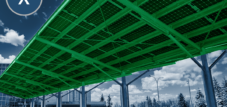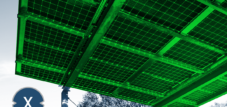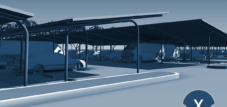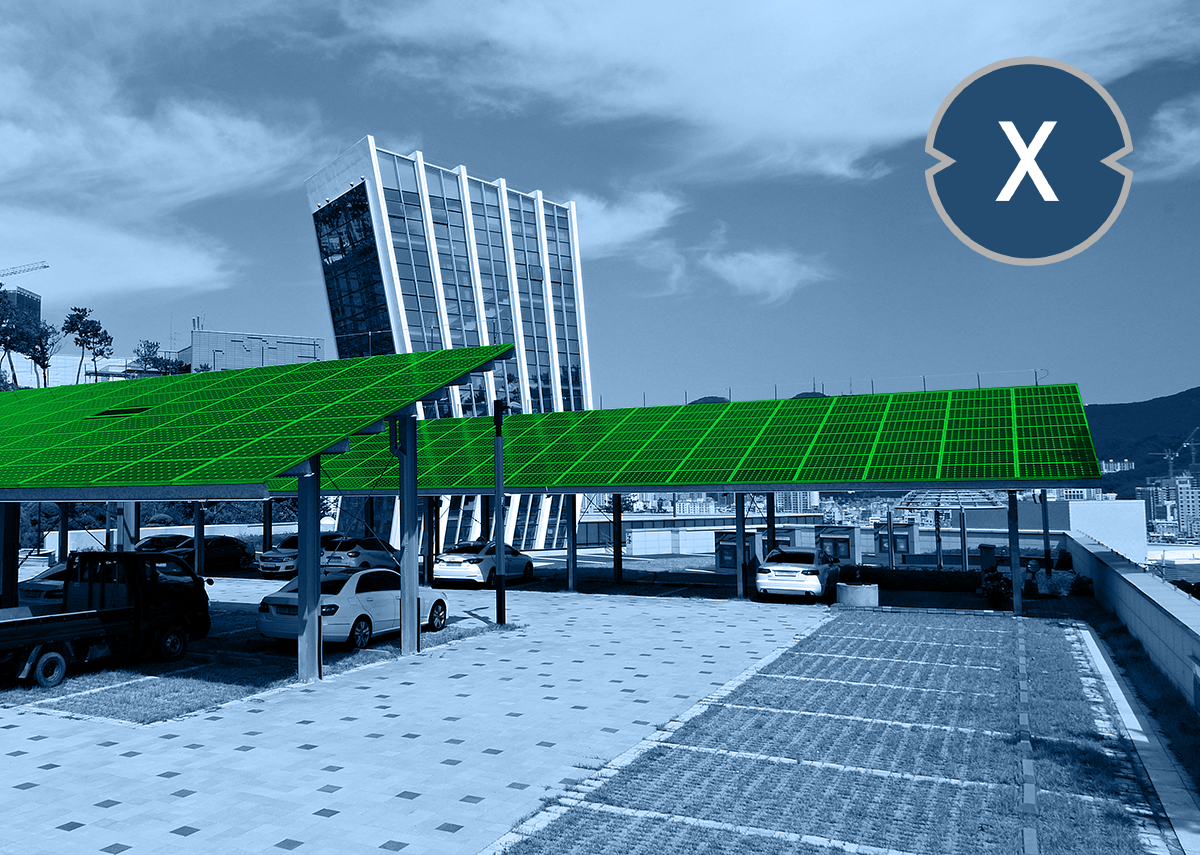
Solar carport for customers and employees – Image: Xpert.Digital & seo byeong gon|Shutterstock.com
Electric vehicles are on the rise. The issue of mandatory solar panels for carports, the impending end of combustion engine vehicles, and the further increase in environmental bonuses are driving the market.
In Baden-Württemberg, solar panels legally mandated for open parking lots with 75 or more spaces, for both private and company parking areas. Unlike the mandatory photovoltaic system requirement for new non-residential buildings, there is no alternative. Photovoltaic systems cannot be installed on other outdoor areas or in the immediate vicinity, and the resulting area cannot be credited towards fulfilling the requirement.
There is still very little statistics and data available on solar carports. Furthermore, the limited information that does exist is often shared reluctantly, partly for strategic reasons, as a new market in the photovoltaic sector is emerging.
More information here: Photovoltaics Library (PDF)
Did you know that the greatest interest in solar power systems comes from small towns with 5,000 to under 20,000 inhabitants?
According to projections, around 3.31 million people in Germany were definitely or possibly planning to modernize or purchase a new solar/photovoltaic system in 2020. Within this group, approximately 33.2 percent lived in a town or village with 5,000 to under 20,000 inhabitants. This figure was around 26.6 percent for the general population. The same applies to individuals with a net household income of €5,000 or more, where the proportion is 37.1 percent.
This applies primarily to solar panels for roofs, including garage roofs. Gasoline and diesel vehicles will no longer be manufactured in the near future, making the increase in electric vehicles a logical consequence. A significant upswing in electric car registrations is already evident. While the share of electric car sales had been rather sluggish in recent years, the electric car market is now experiencing a tremendous surge, further fueled by the increased environmental bonuses introduced during the COVID-19 pandemic.
As early as 2016, a survey revealed that 21% of respondents had a positive attitude towards the environmental bonus. 28% of respondents indicated that they had a rather positive attitude towards the environmental bonus.
Survey on attitudes towards the environmental bonus for electric cars in Germany 2016
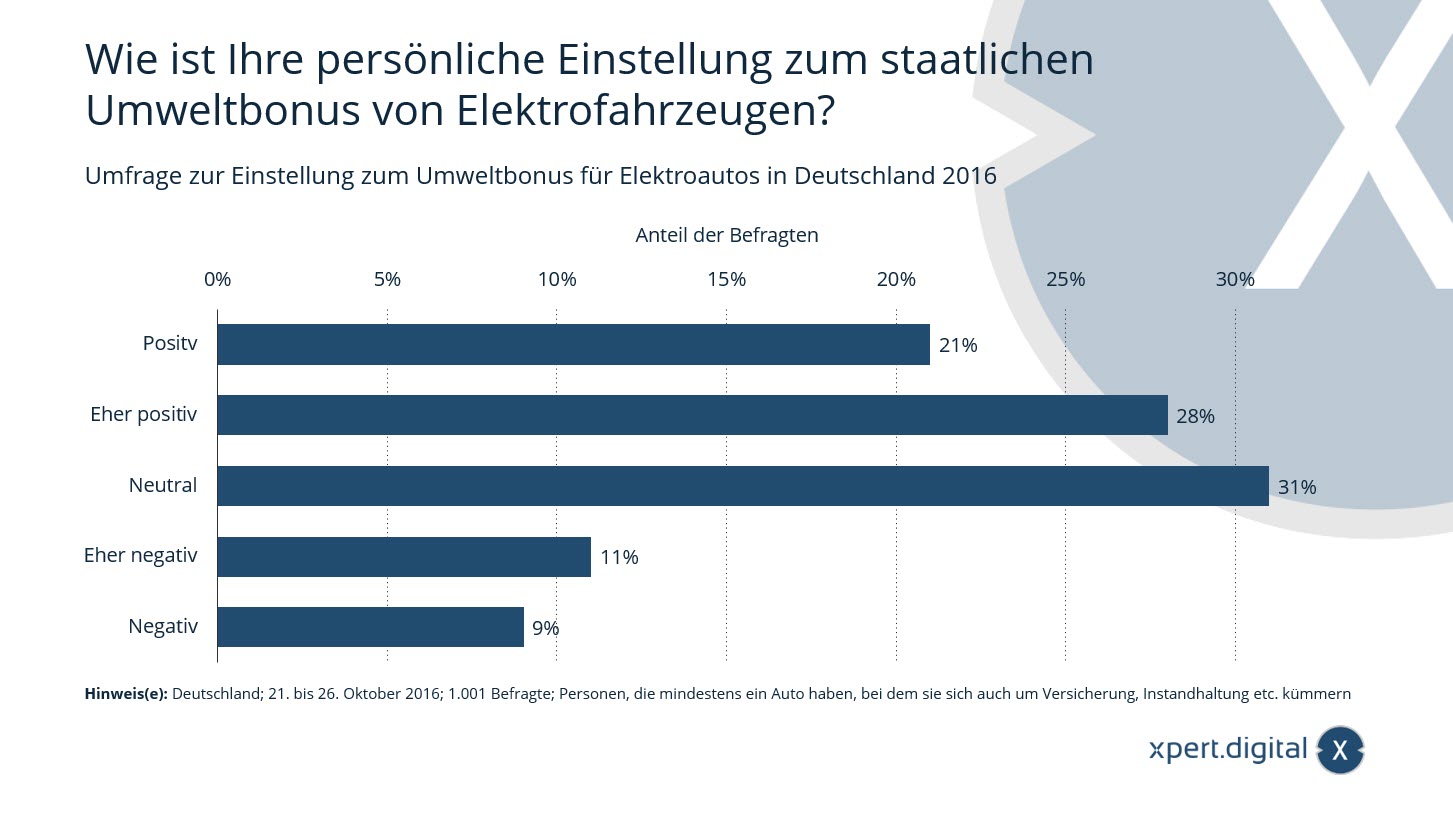
Survey on attitudes towards the environmental bonus for electric cars in Germany – Image: Xpert.Digital
What is your personal opinion on the government's environmental bonus for electric vehicles?
- 21% – Positive
- 28% – Rather positive
- 31% – Neutral
- 11% – Rather negative
- 9% – Negative
The statistic shows the results of a survey conducted in October 2016 regarding attitudes toward the German government's environmental bonus for electric vehicles. 1,001 people who own at least one car and are responsible for its insurance and maintenance were surveyed. The bonus applies to the acquisition (purchase or lease) of an electric vehicle that is being registered for the first time and whose net list price for the base model does not exceed €60,000. The bonus is shared equally between the federal government and the car manufacturer. 28 percent of respondents indicated that they had a rather positive attitude toward the environmental bonus.
Amount of the environmental bonus for the purchase of electric vehicles in Germany (as of June 10, 2020)
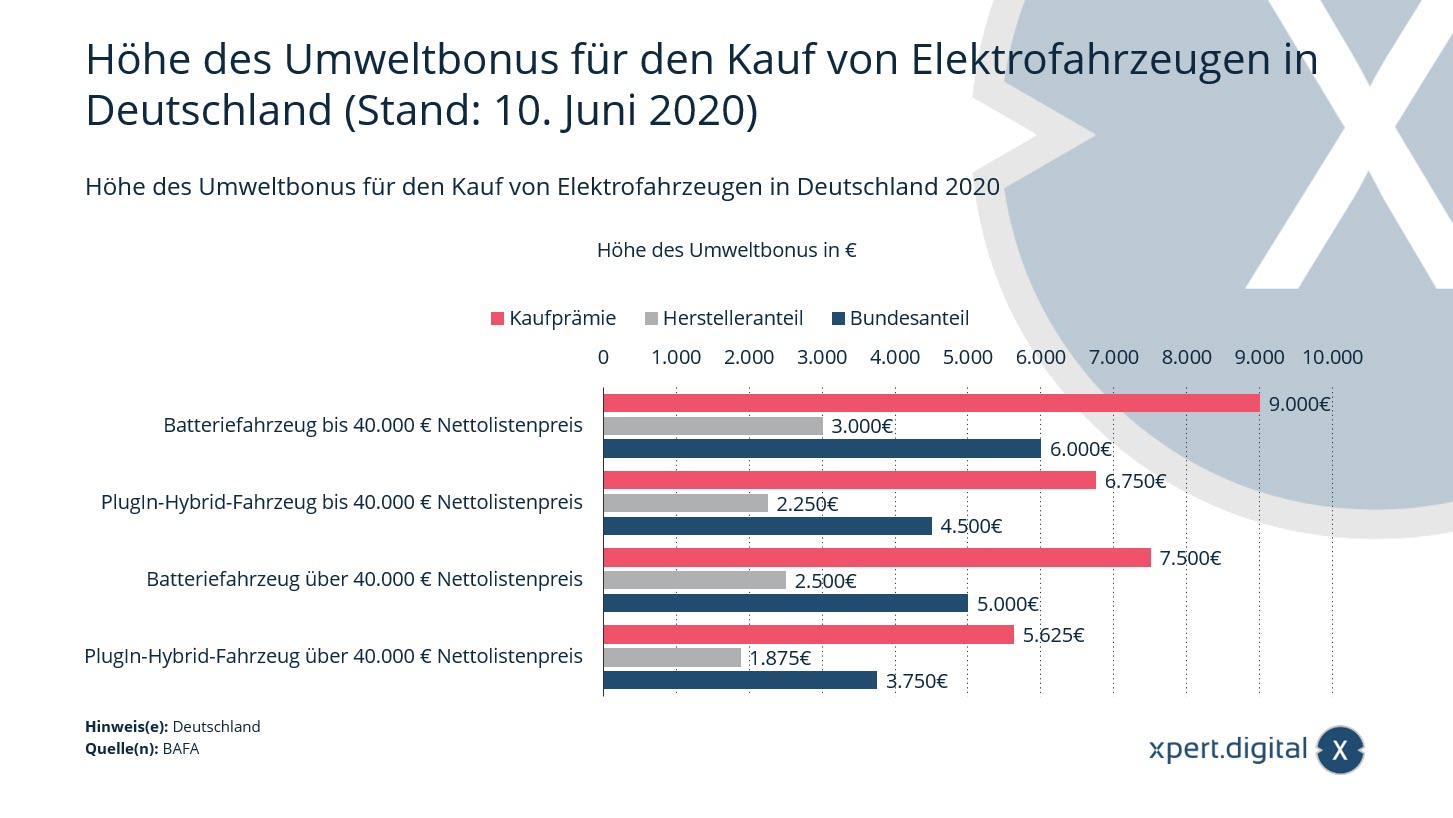
Amount of the environmental bonus for the purchase of electric vehicles – Image: Xpert.Digital
This statistic shows the amount of the purchase premium for electric vehicles, also known as the environmental bonus, by type of electric vehicle in Germany in 2020. The purchase (buying or leasing) of an electric vehicle, as well as corresponding used vehicles, are eligible for funding. The premium is shared equally between the federal government and the vehicle manufacturer. The environmental bonus for purely battery-electric vehicles with a net list price of up to €40,000 amounted to €9,000 per vehicle in 2020.
The stated subsidy rates apply retroactively to vehicles registered from June 4th onwards. According to BAFA, eligible vehicles include pure electric cars, plug-in hybrids, fuel cell cars, and corresponding used vehicles.
Amount of the environmental bonus for the purchase of electric vehicles in Germany in 2020
Federal share
- Battery-powered vehicle up to €40,000 net list price: €6,000
- Plug-in hybrid vehicle up to €40,000 net list price: €4,500
- Battery-powered vehicle over €40,000 net list price: €5,000
- Plug-in hybrid vehicle over €40,000 Net list price: €3750
Manufacturer share
- Battery-powered vehicle up to €40,000 net list price: €3,000
- Plug-in hybrid vehicle up to €40,000 net list price: €2250
- Battery-powered vehicle over €40,000 net list price: €2,500
- Plug-in hybrid vehicle over €40,000 Net list price: €1875
Purchase premium
- Battery-powered vehicle up to €40,000 net list price: €9,000
- Plug-in hybrid vehicle up to €40,000 net list price: €6,750
- Battery-powered vehicle over €40,000 net list price: €7,500
- Plug-in hybrid vehicle over €40,000 Net list price: €5625
We advise companies affected by the solar obligation for solar carports, as well as solar installers:
The solution is the HELIOS solar carport system from T.Werk:
- Quick and easy assembly
- Stable strip foundation as impact protection
- Customizable design (color, materials, surface, size, etc.)
- Installation of charging stations and inverters is possible at any time
- Scalable & modular: Available as a single, double or infinitely scalable row carport
- Even in its standard version, it can be used for very high wind and snow loads (sk= 2.2 kN/m²).
- Extra-large and wide parking spaces and very easy parking thanks to W-shaped supports
- High-quality design for demanding and long-lasting requirements: Hot-dip galvanized steel construction (DIN EN 10346, DIN EN 1461)
Related to this:
Why solar carports are becoming important now
Not long ago, typical solar panels were in high demand, either for pitched roofs on houses or for flat roofs on production and industrial buildings. Solar parks and solar fields also enjoyed widespread acceptance. In a survey, 62% of respondents stated that they would prefer a solar park as a power generation facility in their neighborhood to, for example, a nuclear power plant. Only 5% expressed support for nuclear energy.
With the rise of electromobility and the lack of charging infrastructure, the idea of solar carports in open parking lots .
Related to this:
- Best Practice Solar Carport: What trade and industry in Baden-Württemberg need to know now
- Charging stations and solar carports together make sense: The circle is complete
Price development for a fully installed solar power system* in Germany
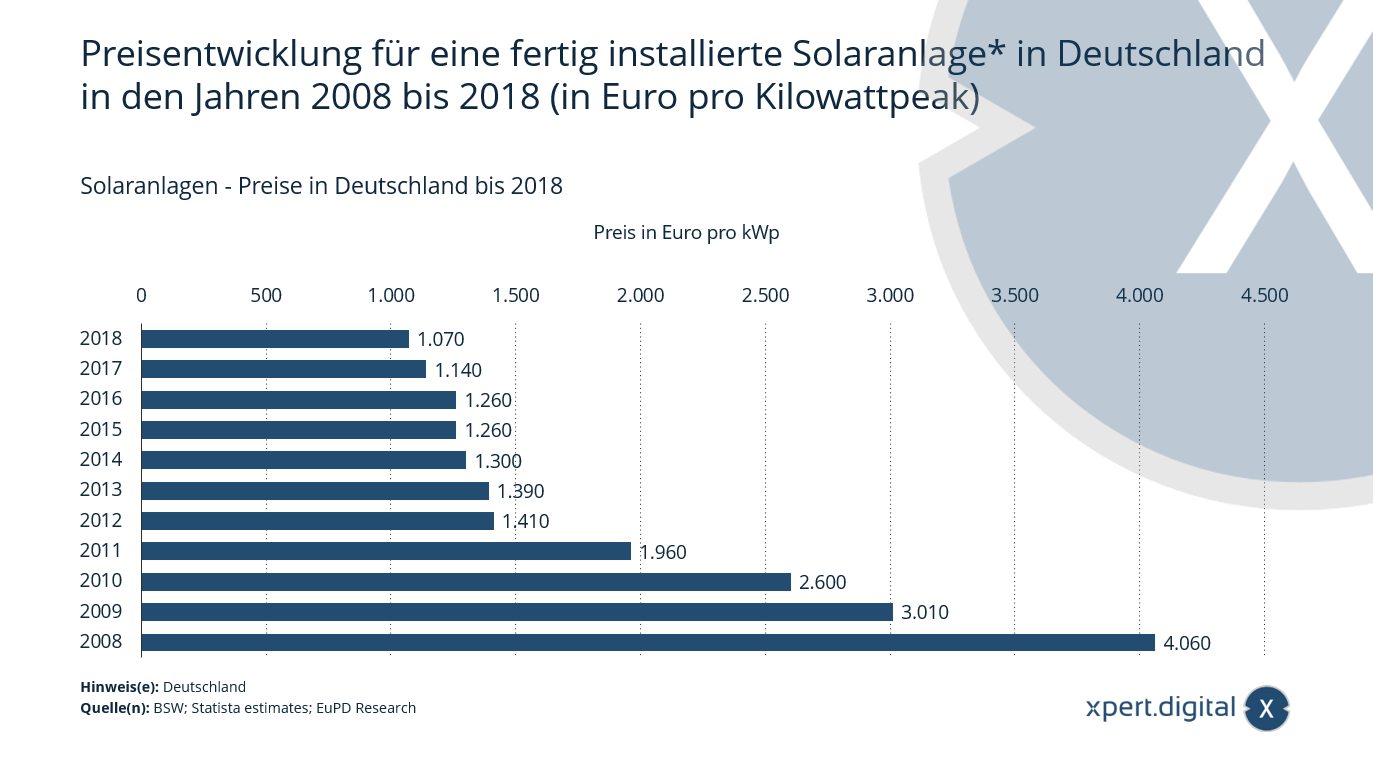
Solar panels – prices in Germany – Image: Xpert.Digital
The statistic shows the price development for a fully installed solar power system in Germany from 2008 to 2018. In 2018, a fully installed roof-mounted solar power system with a capacity of ten to 100 kilowatt peak cost 1,070 euros per kilowatt peak in Germany in the fourth quarter of the year.
*Net system price for a rooftop system from 10 to 100 kWp. The values refer to the fourth quarter of the year.
Solar power systems – prices in Germany until 2018 (in euros per kilowatt peak)
- 2018 – 1.070 €
- 2017 – 1.140 €
- 2016 – 1.260 €
- 2015 – 1.260 €
- 2014 – 1.300 €
- 2013 – 1.390 €
- 2012 – 1.410 €
- 2011 – 1.960 €
- 2010 – 2.600 €
- 2009 – 3.010 €
- 2008 – 4.060 €
That's why Xpert.Solar offers advice on solar carports for customer and employee parking spaces

Konrad Wolfenstein
I would be happy to serve as your personal advisor.
You can contact me by filling out the contact form below or simply call me on +49 7348 4088 965 .
I'm looking forward to our joint project.
Write to me


Xpert.Digital – Konrad Wolfenstein
Xpert.Digital is a hub for industry focusing on digitalization, mechanical engineering, logistics/intralogistics and photovoltaics.
With our 360° Business Development solution, we support renowned companies from new business to after-sales.
Market intelligence, smarketing, marketing automation, content development, PR, mail campaigns, personalized social media and lead nurturing are part of our digital tools.
You can find more information at: www.xpert.digital – www.xpert.solar – www.xpert.plus
Keep in touch