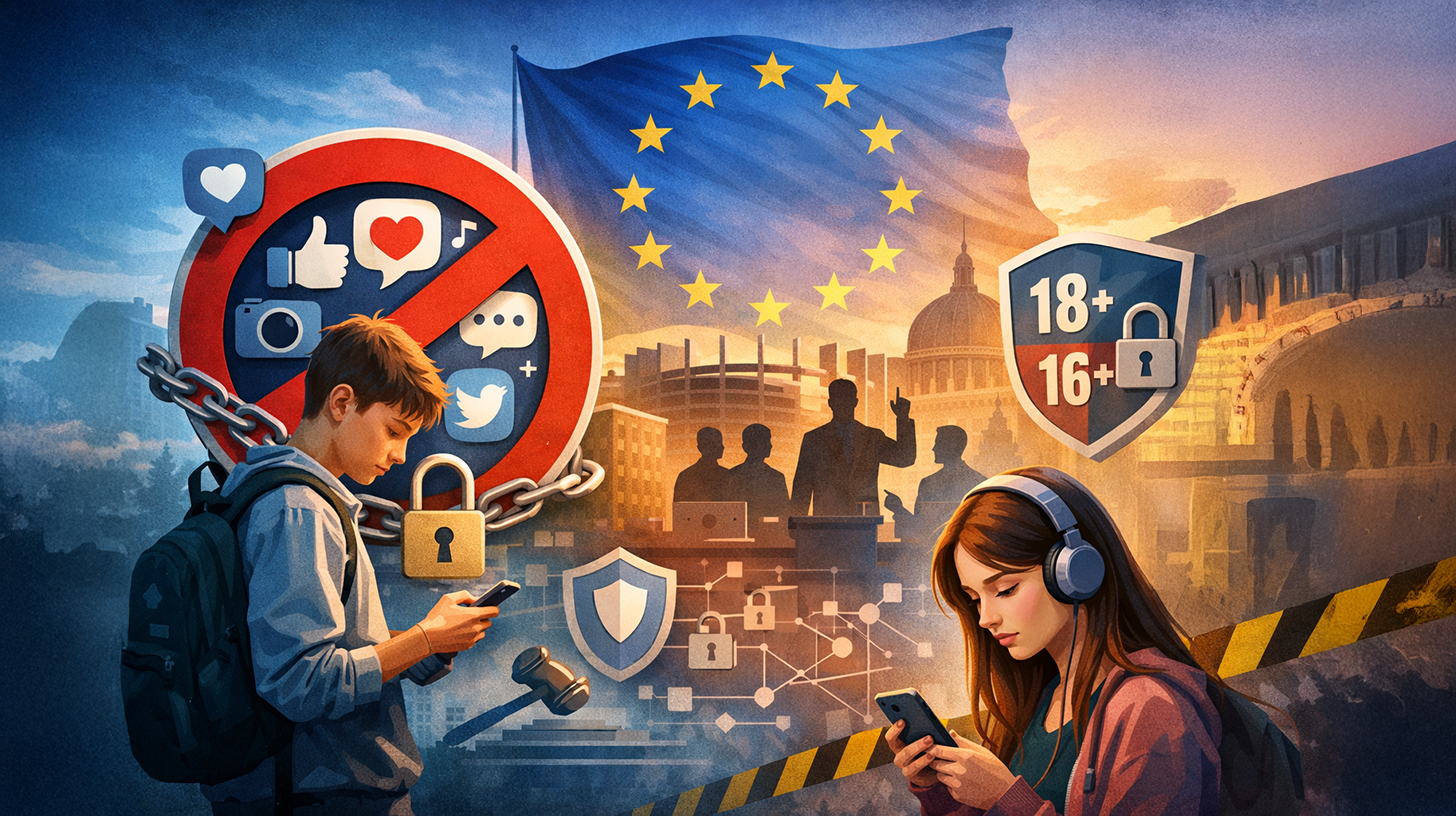
Social media ban? Trend towards social media bans: How Europe wants to protect minors – current status and developments – Image: Xpert.Digital
Greece blocks, France and Spain plan: The patchwork of social media bans in Europe
Protection from addiction or loss of participation? The debate over digital age limits is intensifying
Europe is currently experiencing a dynamic political debate about the future of children and young people in the digital sphere. Inspired by Australia's global initiative, pressure is growing within the European Union to drastically restrict minors' access to social networks such as TikTok, Instagram, and Snapchat. Driven by alarming research findings on psychological stress, addictive behavior from "endless scrolling," and cyberbullying, member states are searching for effective protective mechanisms. However, the path forward is far from uniform: While the European Parliament is calling for a general minimum age of 16 and the Commission is working on technical solutions for age verification, the reality on the ground is already fragmented.
Greece, a pioneer in this area, has already implemented a ban for those under 16, while France and Spain are on the verge of introducing similar legislation for 15- and 16-year-olds, respectively. Other countries, such as Denmark and Austria, are discussing differentiated models requiring parental consent, while Germany remains hesitant due to complex technical and media-pedagogical issues. The central challenge remains the same everywhere: How can effective protection against manipulative platform designs and harmful content be technically enforced without completely preventing young people's digital participation and the development of their media literacy? The debate exists within a difficult tension between necessary repression of tech companies and the freedoms of the younger generation.
framework of the debate in the EU
In the European Union, the question of the minimum age for children and young people to use social networks has been increasingly treated as a political priority since 2024/2025. The decisive factor was initially Australia's global initiative, which was the first country to introduce a comprehensive ban for those under 16. This model has served as a political benchmark in the EU, encouraging both the Commission and several member states to discuss or even adopt their own rules.
In November 2025, the European Parliament adopted an own-initiative report calling, among other things, for a uniform minimum age of 16 for social media use. At the same time, it proposes that children and young people aged 13 to 15 should only be allowed to use social media with parental consent. However, this resolution is not yet legally binding; rather, it is addressed to the European Commission, urging it to develop concrete proposals for a statutory minimum age and mandatory age verification.
The debate in Brussels is based on research showing that around a quarter of minors in Europe exhibit problematic smartphone and social media usage. Criticisms focus primarily on endlessly scrolling feeds, automatic autoplay functions, aggressive recommendation algorithms, and monetary reward systems designed to encourage excessive use. At the summit level, EU member states are calling for more effective protection of children and young people against psychological stress, online bullying, sexualized violence, and manipulative content – and are considering legal access restrictions as one option.
European legal framework: DSA and planned additions
The central instrument is the Digital Services Act (DSA), which has been in effect since February 2024. For very large online platforms, the DSA requires them to conduct systematic risk analyses for children and young people and to take appropriate measures, such as special child protection settings, age verification, and increased moderation. However, it has been criticized that these regulations are insufficient to completely ban certain harmful practices, such as addictive design elements or overly personalized advertising for young people.
Against this backdrop, the European Parliament and several governments are pushing for more extensive amendments to the rules. Plans include, among other things:
- uniform age limits for social media,
- a mandatory use of age verification systems,
- a ban on certain addictive features for minors, such as endless scrolling or autoplay videos,
- as well as stronger liability and, if necessary, sanctions up to and including access restrictions for platforms that do not comply with the requirements.
In parallel, the EU Commission is working on a verification app that will allow users to check whether they are over the minimum age without disclosing their exact date of birth. This app is currently in the testing phase and is intended to serve as the technical basis for a Europe-wide age verification system.
France: Ban on travel for those under 15
In France, the debate over a social media ban for children is furthest advanced. President Emmanuel Macron's government has submitted a draft law that would make online platforms like Instagram, TikTok, Facebook, and Snapchat inaccessible to children under 15. The National Assembly has already passed the core principle of a ban for those under 15; the draft law now needs to pass the Senate and is expected to come into effect on September 1, 2026, at the end of the summer holidays.
Educational and scientific resources, online encyclopedias, and private messaging services such as WhatsApp or messaging functions of platforms are exempt from the ban. The government's justification cites numerous studies that establish a link between intensive social media use and psychological stress, changes in sleep patterns, cyberbullying, and access to problematic content.
However, the legal implementation is subject to the Digital Services Act and potential reviews by the European Court of Justice. France has thus positioned itself as one of the leading countries in Europe that want to explicitly establish age limits for online platforms by law.
Greece: ban already in place for those under 16
Greece is currently the only country in Europe where a social media ban for children and teenagers is already in effect. From the end of October 2025, social networks such as Facebook, TikTok, Instagram, and X (formerly Twitter) were blocked for all users under 16. This is implemented via a government app that prevents access to social media on smartphones used by those under 16; messaging services generally remain usable.
The Greek government justifies the regulation with the need to protect children from psychological stress, online bullying, and access to violent or sexually explicit content. At the same time, it emphasizes that children should not be completely excluded from the internet, but rather that they should have access to safe educational and communication platforms.
The Greek model has served as an example of widespread technical implementation in other EU countries, such as Spain and Portugal. However, critics have raised concerns regarding technical monitoring capabilities and practical enforceability; in particular, alternative devices or the use of VPNs could circumvent the block.
Spain: planned ban for under-16s
In Spain, a similarly comprehensive ban for those under 16 has been announced. The government plans to prevent children and teenagers under 16 from having direct access to social networks such as Instagram, TikTok, or Facebook. Prime Minister Pedro Sánchez has emphasized that this approach is in line with the EU directive on the protection of minors and, at the same time, places greater emphasis on the platforms' responsibility to implement age verification.
Spain is thus positioning itself as part of a "coalition of those willing to embrace digital regulatory policy," advocating for common age limits across the EU. At the same time, discussions are underway in Madrid on how to strengthen the liability of social media operators for illegal content such as hate speech or child abuse.
The Spanish draft law has not yet been fully implemented, but the political objective – a technically enforceable ban for those under 16 – is clearly defined.
Denmark: Age limit of 15 years with parental consent
In Denmark, a national model is being discussed that also proposes an age limit of 15 for access to certain social networks. Children under 15 would no longer have unrestricted access to platforms like Instagram or TikTok; an exception would be possible for 13- to 14-year-olds with parental consent.
The Danish government argues that this will protect children and young people from the primary economic interests of platform operators and from psychological stress, which manifests itself in concentration problems, sleep disorders, and increased mental strain. Parliamentary debates have been largely conflict-free, as most parties share the concept of a "digital safe space" for children.
At the same time, it is critically noted that enforcing an age limit in a global platform landscape is technically challenging, and the role of parents and schools in media literacy education is emphasized more strongly.
🎯🎯🎯 Benefit from Xpert.Digital's extensive, five-fold expertise in one comprehensive service package | BD, R&D, XR, PR & Digital Visibility Optimization

Benefit from Xpert.Digital's extensive, five-fold expertise in a comprehensive service package | R&D, XR, PR & Digital Visibility Optimization - Image: Xpert.Digital
Xpert.Digital possesses in-depth knowledge across various industries. This allows us to develop tailored strategies precisely aligned with the requirements and challenges of your specific market segment. By continuously analyzing market trends and monitoring industry developments, we can act proactively and offer innovative solutions. The combination of experience and expertise generates added value and provides our clients with a decisive competitive advantage.
More information here:
Europe on the brink of change: Will there be a general ban on social media for children?
Other EU Member States: Debates and Drafts
Several other EU countries are considering or discussing similar regulations, but some are proceeding more cautiously than France, Greece or Spain.
- Austria is considering lowering the minimum age for unrestricted access to social media to 14, while more strictly controlling the use of younger children. The government has observed similar initiatives in France and Spain, but emphasizes the need for an institutional framework that safeguards the independence of the judiciary and freedom of expression.
- Portugal has introduced a bill that would require children under 16 to use social media only with explicit parental consent. This regulation would supplement existing platform terms of service, which already require a minimum age of 13 but are rarely enforced in practice.
- Italy is debating stricter age restrictions, particularly in connection with platform control and the fight against shock content and advertising that glorifies violence. However, no outright ban like those in Greece or France has yet been passed.
Overall, it is evident that EU member states are moving in a direction where age limits, age verification, and protection against psychological stress are becoming central elements of regulation. At the same time, there are growing calls for the EU level to set uniform standards in order to avoid national variations and to keep implementation manageable for platform operators.
Germany: Advice and political positions
In Germany, there is currently no general ban on social media for children and young people. While the federal government recognizes the need for action regarding youth protection online, it does not consider a legally mandated minimum age of 16 realistic in the short term. In a public hearing of the Petitions Committee, it was emphasized that the legal, practical, and media education issues are too complex for a simple ban to be implemented immediately.
The CDU, however, has submitted a motion to the Bundestag party conference demanding a legal minimum age of 16 for open social media platforms with mandatory age verification. This is justified by the need to protect against psychological stress, hate speech, extremist propaganda, and manipulative advertising. The SPD tends to reject this approach, arguing that a blanket ban is unrealistic and could hinder media literacy development.
Alongside the political debate, an expert commission was appointed to examine the risks and opportunities of social media for minors and to develop recommendations for legal and educational measures. This commission is expected to submit concrete proposals by autumn 2025, which could serve as the basis for a potential amendment to the law.
Technical implementation and practical challenges
A key problem with any social media ban is the technical implementation. Most platforms already require a minimum age of 13 in their terms of service, but experience shows that children often falsify their birthdate to use accounts. Without mandatory age verification, a ban is difficult to enforce in practice.
The EU Commission and several member states are therefore relying on a combination of:
- mandatory age verification (online or via apps),
- Verification tools that work without handing over sensitive data,
- Plastic IDs for children and young people are banned and
- Partnerships with schools and local communities to support bans.
Critics point out that any form of age verification raises questions about data protection and surveillance. At the same time, they emphasize that technical blocks are only part of the solution; media literacy, parental involvement, school curricula, and expert advice remain crucial.
Effects, criticism and social discussion
The introduction of social media bans for children and teenagers is highly controversial. Proponents argue that such bans are a necessary protective measure against mental health problems, online bullying, eating disorders, sleep disorders, and extremist content. Australia and Germany have cited as examples of positive effects, noting that since the introduction of such bans, several million accounts belonging to those under 16 have been blocked and the use of certain platforms by young people has decreased significantly.
Critics, however, see risks:
- Children and young people might retreat to less controlled spaces or dark networks.
- A ban could hinder the development of media literacy and not reduce usage, but merely push it into the background.
- Platform operators could scale back their existing youth protection measures after a ban, because they rely on the legal blockade.
- Children and young people would have fewer opportunities to use digital media consciously and responsibly, which could weaken media literacy in the long term.
Media education agencies and youth organizations therefore warn against a purely repressive approach. They emphasize that social media not only offers risks, but also important spaces for exchange, identity development, political participation, and creative expression. Simply blocking access can shift problems without addressing their root causes – such as manipulative designs, addictive mechanisms, or a lack of media literacy support in schools and families.
Positions of young people
Young people themselves are divided in the debate. Many consider social media an essential part of their daily lives and social connections – they organize meetups, exchange information about school-related topics or political issues, and use the platforms as spaces for creative expression. At the same time, many report massive distractions, concentration problems, lack of sleep, and the feeling of being trapped in loops of scrolling and videos.
Some interview studies show that young people themselves recognize the need for boundaries, but prefer binding school rules, clear rules at home, or improved media literacy to a blanket legal ban. Some fear that a ban would lead to a "game of hide-and-seek" with parents and schools, instead of helping them navigate the digital space confidently and critically.
Political and social context
The European debate surrounding social media bans has become part of a broader discourse on digital self-determination, children's rights, and platform regulation. On the one hand, it is argued that young people have a right to protection from psychological overload, bullying, and manipulative business models. On the other hand, it is emphasized that children and young people simultaneously have a right to digital participation, education, and the development of media literacy – and that the latter is hardly possible without access to digital spaces.
Many stakeholders therefore advocate a mixed approach:
- clear legal age limits and binding rules for platforms,
- an increased technical implementation of youth protection features (filters, time limits, shutdowns),
- more education and media literacy programs in schools and extracurricular institutions, as well as
- greater involvement of children and young people themselves in the design of rules and design principles.
A fragmented but dynamic path in Europe
Currently, there is no uniform social media ban for minors in Europe, but a clear trend towards age limits and increased blocking for young people under 15 or 16. Greece has already taken this step completely and implemented a ban for those under 16, while France and Spain are moving in a similar direction. Other countries, such as Denmark, Portugal, and Austria, are examining or discussing age limits, usually with the option of parental consent for younger teenagers.
At the EU level, the focus is on developing a common framework that makes age verification, minimum ages, and uniform safeguards mandatory, without requiring each country to build its own blocking infrastructure. At the same time, the role of media literacy, parental guidance, and school education is being given greater emphasis, so that bans are not an end in themselves, but rather part of a broader protection strategy.
The situation in Europe is still evolving: Initial national bans are already in place, many other countries are drafting legislation or engaged in public debate, and a longer-term, more binding regulatory framework is being prepared at the EU level. The question of whether a social media ban for minors will be implemented across Europe in the long term, or whether policymakers will focus on more differentiated rules, age limits, and educational approaches, therefore remains open – but the direction is clear: Protecting children and young people in the digital sphere is understood as a central political task that will be further strengthened and defined in the coming years.
Your global marketing and business development partner
☑️ Our business language is English or German
☑️ NEW: Correspondence in your native language!

Konrad Wolfenstein
I and my team are happy to be available to you as your personal advisor.
You can contact me by filling out the contact form here wolfenstein@xpert.digital:or simply call me at +49 7348 4088 965. My email address is
I'm looking forward to our joint project.
☑️ SME support in strategy, consulting, planning and implementation
☑️ Creation or realignment of the digital strategy and digitization
☑️ Expansion and optimization of international sales processes
☑️ Global & Digital B2B trading platforms
☑️ Pioneer Business Development / Marketing / PR / Trade Fairs
Our EU and German expertise in business development, sales and marketing
Our EU and German expertise in business development, sales and marketing - Image: Xpert.Digital
Industry focus areas: B2B, digitalization (from AI to XR), mechanical engineering, logistics, renewable energies and industry
More information here:
A thematic hub offering insights and expertise:
- Knowledge platform covering global and regional economies, innovation and industry-specific trends
- A collection of analyses, insights, and background information from our key areas of focus
- A place for expertise and information on current developments in business and technology
- A hub for companies seeking information on markets, digitalization, and industry innovations