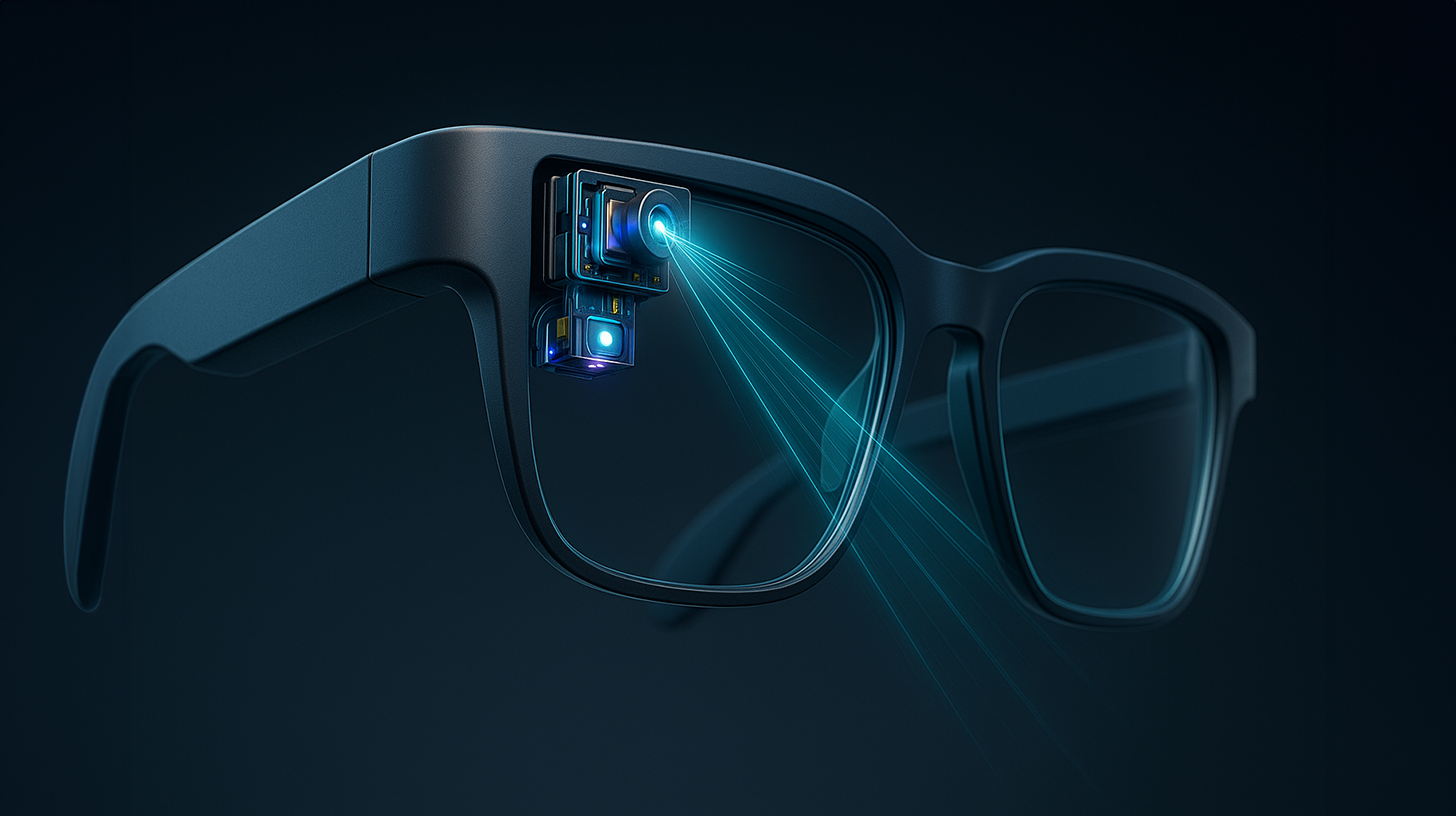
Smart glasses miniaturization: Mini laser modules as a key technology for more compact and lighter AR glasses – Image: Xpert.Digital
Pioneers for everyday AR glasses: Compact laser modules in focus
Technological milestones: Mini laser modules and their importance for smart glasses
The miniaturization of laser modules is considered one of the key technological drivers for the next generation of smart glasses. While previous models often disappointed expectations for everyday augmented reality (AR) glasses due to bulky designs, high weight, and limited battery life, novel, extremely compact laser modules are now enabling designs that can compete with conventional glasses in terms of form factor and wearing comfort. Leading companies such as TDK and ams OSRAM have developed mini-laser modules in recent years that are not only significantly smaller and lighter but also boast low energy consumption and high optical quality. These innovations open up new possibilities for the mass market, as they address key challenges such as energy efficiency, image quality, integration into fashionable frames, and customizability. This analysis examines the technological development, challenges, and opportunities of laser module miniaturization and its significance for the future of smart glasses.
Related to this:

Technological background and market overview
Historical development and current status of smart glasses
Smart glasses, especially those with augmented reality functionality, have undergone remarkable development in the past decade. While earlier attempts like Google Glass or Snap Spectacles demonstrated the technology's potential, they often failed due to practical hurdles such as insufficient miniaturization, high power consumption, and limited everyday usability. The first generations were typically bulky, offered a restricted field of view, and failed to gain widespread acceptance in either the consumer or professional sectors. The reasons for this lay primarily in the size and weight of the optical components, the need for large batteries, and the limited image quality and visibility of projected content in daylight.
In recent years, however, market dynamics have changed noticeably. Companies like Meta, Apple, and various startups have developed prototypes that are significantly more wearable thanks to lighter materials and improved display technologies. Nevertheless, the integration of the projection unit—especially the laser modules—remained a key obstacle to a true breakthrough in the consumer market. Current developments in the miniaturization of laser modules therefore mark a turning point, opening the door to compact, lightweight, and stylish smart glasses.
The importance of miniaturization for AR glasses
The miniaturization of laser modules is not just a matter of design, but has fundamental implications for functionality, energy efficiency, wearing comfort, and ultimately the everyday acceptance of smart glasses. Smaller laser modules make it possible to integrate all the electronics into frames that are virtually indistinguishable from conventional sunglasses or prescription glasses. At the same time, the weight of the glasses is significantly reduced, increasing wearing comfort and allowing for longer periods of use without fatigue.
Another advantage of miniaturization lies in its reduced energy consumption. Modern mini-laser modules, such as those developed by TDK and ams OSRAM, require only a fraction of the energy of conventional projection systems, allowing for longer battery life and smaller, lighter batteries. Furthermore, the compact design improves optical properties, for example through more precise alignment of the laser beams and better integration into the overall glasses system.
Market relevance and outlook
The market relevance of miniaturizing laser modules is evident in the significant resources that leading companies in the electronics and optics industries are investing in developing the corresponding technologies. TDK, ams OSRAM, and other players have presented prototypes and market-ready products in recent years that, for the first time, enable the integration of full-color laser modules into standard eyeglass frames. Experts consider these developments a crucial step toward the breakthrough of smart glasses in the consumer sector, as they lay the foundation for fashionable, practical, and functionally compelling AR glasses.
Technological principles of mini laser modules
Related to this:
Principles of laser projection in smart glasses
Today, images are predominantly projected into smart glasses using laser beams directed onto the user's retina or a waveguide display via specialized optical systems – usually MEMS-based mirrors or planar lightwave circuits (PLCs). Unlike traditional display technologies such as LCDs or OLEDs, laser projection systems offer the advantage of always producing sharply focused images, regardless of the user's visual acuity. This is particularly important for AR applications, where digital content is seamlessly integrated into the user's real-world field of vision.
The basic principle is that an RGB laser module (consisting of red, green, and blue laser diodes) generates light that is directed via a MEMS mirror or a PLC onto the desired projection surface – usually the retina or a transparent waveguide display. The laser intensity and mirror movement are controlled synchronously, allowing the desired color and brightness to be generated for each pixel. Modern systems thus enable the display of millions of colors and a wide field of view with minimal energy consumption.
Advances in miniaturization: TDK and ams OSRAM
Recent breakthroughs in miniaturization have been largely achieved by companies such as TDK and ams OSRAM. TDK, in collaboration with QD Laser, developed a full-color laser module that, with dimensions of only about 9 mm in length and 1.9 mm in width, is smaller than a fingernail. The integration of planar lightwave circuits, originally developed for telecommunications, enabled a drastic reduction in size while maintaining high optical quality.
The ams OSRAM Vegalas™ module also sets new standards in miniaturization. With a volume of only 0.7 cm³, it is compact enough to be integrated into standard eyeglass frames. The combination of three high-performance laser diodes (red: 640 nm, green: 520 nm, blue: 450 nm) in a hermetically sealed housing ensures high color depth, durability, and resistance to environmental influences.
Energy efficiency and optical quality
A key feature of the new mini laser modules is their extremely low energy consumption. While conventional LCD or mini-LCD projection systems often require several hundred milliwatts, modern mini laser modules operate in the microwatt range. This is achieved through the precise control of the laser beams and the high efficiency of the laser diodes used. At the same time, the optical quality remains high: The modules offer high brightness, a wide color spectrum, and precise focusing, which is particularly crucial for use in daylight and under varying environmental conditions.
Integration into the overall system of smart glasses
Miniaturizing laser modules is only practically beneficial if it is accompanied by equally compact integration into the overall eyeglass system. This includes not only the laser modules themselves, but also the power supply, control electronics, sensors, and potentially other optical components such as waveguides or MEMS mirrors. Modern designs therefore rely on highly integrated modules that combine multiple functions in a single component, further reducing complexity and space requirements.
Challenges and solutions in miniaturization
Technological hurdles: heat, precision and reliability
The miniaturization of laser modules presents a number of technical challenges. One of the biggest hurdles is thermal management: despite their high efficiency, laser diodes generate a significant amount of heat that must be reliably dissipated within a compact housing to ensure the modules' lifespan and performance. Innovative housing designs, hermetic seals, and new materials help to overcome this challenge.
Another critical factor is the precision of the optical alignment. Since the modules are extremely small, the laser beams must be aligned with the highest accuracy onto the MEMS mirrors or waveguides to ensure a distortion-free and sharp projection. Advances in microfabrication and automated assembly now enable alignment accuracy in the micrometer range, allowing for the mass production of high-precision modules.
The reliability of the modules is of paramount importance, especially in the consumer market. The modules must not only have a long lifespan but also be resistant to dust, moisture, and mechanical stress. Hermetically sealed housings and robust materials are therefore standard in the latest generations of mini laser modules.
Manufacturing technologies and automation
The production of miniature laser modules requires highly precise manufacturing technologies and extensive automation. Modern production lines enable the assembly of a single laser die in just a few seconds – a process more than a hundred times faster than with conventional systems. This not only reduces production costs but also allows for scaling up to the high volumes required for the consumer market.
The integration of planar lightwave circuits (PLCs) and MEMS technologies into the modules places additional demands on manufacturing. Tight tolerances and precise coordination of the individual components are required to achieve optimal optical performance. However, advances in semiconductor manufacturing and microsystems technology have made it possible to overcome these challenges and realize the industrial-scale production of miniaturized laser modules.
Energy supply and system integration
A key goal of miniaturization is to reduce energy consumption to enable smaller and lighter batteries. Modern mini-laser modules are so efficient that they can be powered by batteries that fit inside a conventional eyeglass frame. At the same time, integrating them into the overall eyeglass system requires intelligent power management to ensure an optimal balance between brightness, runtime, and safety.
System integration also includes the incorporation of sensors, for example for eye tracking or gesture control, as well as wireless communication modules for connecting to smartphones or other devices. The miniaturization of the laser modules creates the necessary space for additional components without affecting the overall weight or wearing comfort.
🎯🎯🎯 Benefit from Xpert.Digital's extensive, five-fold expertise in one comprehensive service package | BD, R&D, XR, PR & Digital Visibility Optimization

Benefit from Xpert.Digital's extensive, five-fold expertise in a comprehensive service package | R&D, XR, PR & Digital Visibility Optimization - Image: Xpert.Digital
Xpert.Digital possesses in-depth knowledge across various industries. This allows us to develop tailored strategies precisely aligned with the requirements and challenges of your specific market segment. By continuously analyzing market trends and monitoring industry developments, we can act proactively and offer innovative solutions. The combination of experience and expertise generates added value and provides our clients with a decisive competitive advantage.
More information here:
Advances in miniature technology: Smart glasses are becoming smarter and more stylish
Application areas and impact on the design of smart glasses
New design possibilities through miniaturization
The drastic miniaturization of laser modules opens up entirely new possibilities for the design of smart glasses. While earlier models were characterized by large, conspicuous projection systems, the latest generations can be integrated into fashionable frames that are barely distinguishable from regular glasses. This is a crucial factor for acceptance in the consumer market, as many users value discreet, stylish, and practical designs.
Miniaturization also enables the development of smart glasses with a wider field of view and higher image quality. The compact design of the modules allows them to be positioned closer to the eye, resulting in better utilization of the field of view and a more realistic display of digital content. At the same time, it leaves more room for additional features such as cameras, sensors, or audio modules.
Improved wearing comfort and everyday usability
A key advantage of miniaturization lies in the significantly improved wearing comfort. Lighter glasses cause less fatigue and can be worn for longer periods without becoming uncomfortable. The weight reduction and the even distribution of components within the frame contribute to the glasses remaining stable and comfortable even during intensive use.
The longer battery life and increased robustness of the modules further enhance their everyday usability. Modern mini laser modules are insensitive to environmental influences and can be operated reliably even under changing light conditions or in dusty environments. This makes them ideal for outdoor use, at work, or during sports.
New application scenarios and individualization
The miniaturization of laser modules not only opens up new design possibilities but also entirely new application scenarios for smart glasses. Direct projection onto the retina, for example, allows information to be displayed without the user having to shift their focus. This is particularly advantageous for applications in navigation, sports, or safety-critical situations.
Furthermore, the compact design allows for greater customization of the glasses. Users can choose between different designs, colors, and functions without compromising performance. The space savings facilitate the integration of additional sensors and communication modules, enabling smart glasses to be increasingly used as multifunctional wearables.
Comparative analysis of leading mini laser modules
TDK Full-Color Laser Module
The full-color laser module developed by TDK in collaboration with QD Laser is considered one of the world's smallest of its kind. Measuring just 9 mm in length and 1.9 mm in width, it is smaller than a fingernail and can be integrated directly into standard eyeglass frames. The use of planar lightwave circuits enables precise control of the laser beams and high color depth. The module is characterized by extremely low energy consumption in the microwatt range and is designed for direct retinal scanning, ensuring consistently sharp images regardless of the user's visual acuity.
Related to this:
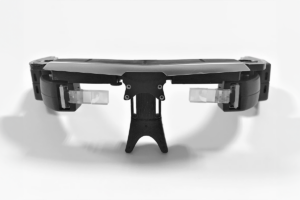
The following table compares key technical data of the TDK module with other leading mini laser modules:
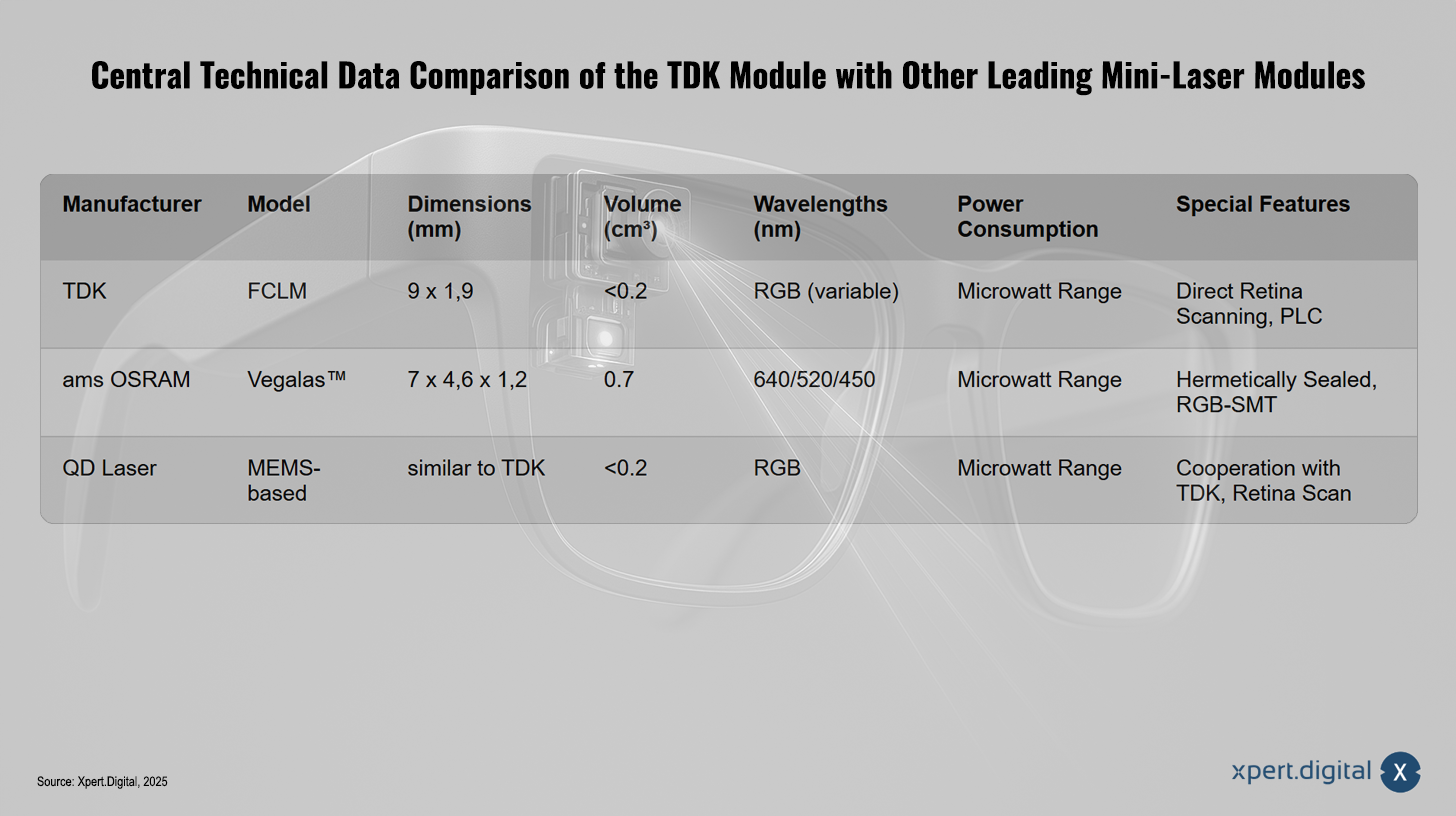
Comparative analysis of leading mini laser modules – Image: Xpert.Digital
The table compares the key technical specifications of the TDK module with other leading mini-laser modules. The TDK FCLM module measures 9 x 1.9 mm and has a volume of less than 0.2 cm³. It operates with variable RGB wavelengths and has a power consumption in the microwatt range. Its special features include direct retina scanning and PLC technology. In contrast, the ams OSRAM Vegalas™ model measures 7 x 4.6 x 1.2 mm, has a volume of 0.7 cm³, uses fixed wavelengths of 640, 520, and 450 nm, and is hermetically sealed, while integrating RGB SMT technology. The MEMS-based model from QD Laser is similar in dimensions to the TDK module, also has a volume of less than 0.2 cm³, and supports RGB wavelengths. Of particular note is the cooperation with TDK and the functionality for retina scanning.
ams OSRAM Vegalas™ module
The ams OSRAM Vegalas™ module sets new standards in miniaturization and integration. With a footprint of just 7 mm x 4.6 mm and a height of 1.2 mm, it is compact enough to be integrated into standard eyeglass frames. The combination of three high-performance laser diodes in a hermetically sealed housing ensures high color depth, durability, and resistance to environmental influences. Optimized for use in MEMS-based laser scanning systems, the module enables high-precision projection with low energy consumption.
A key feature of the Vegalas™ module is its ability to reduce the size of the projection unit in AR and MR glasses by up to half, without compromising image quality or brightness. This opens up new possibilities for stylish, practical, and high-performance smart glasses.
MEMS and PLC-based systems
Besides TDK and ams OSRAM, other manufacturers are also relying on MEMS- and PLC-based approaches for the miniaturization of laser modules. MEMS mirrors enable highly precise control of the laser beams and flexible adjustment of the field of view. Planar lightwave circuits offer additional possibilities for integrating multiple optical functions into a single component, further reducing complexity and space requirements.
These technologies complement the miniaturized laser modules perfectly and enable the development of smart glasses that set new standards in terms of both design and functionality.
Future prospects and open challenges
Further development of miniaturization
Although current mini laser modules already represent a significant advancement, the potential for miniaturization has not yet been exhausted. Future developments will focus on further reducing the size, integrating additional functions, and improving energy efficiency. Advances in semiconductor manufacturing, new materials, and innovative packaging technologies will enable the development of even smaller and more powerful modules.
Another focus is on integrating additional sensors and communication modules to further develop smart glasses into multifunctional wearables. Miniaturizing the laser modules provides the necessary foundation for this by freeing up space and energy for additional components.
Safety and regulatory requirements
With the increasing prevalence of laser modules in consumer products, safety and regulatory issues are also coming into focus. The direct projection of laser beams onto the retina requires the highest precision and reliable protective mechanisms to eliminate health risks. Manufacturers must therefore adhere to strict safety standards and develop innovative protective mechanisms to ensure safe everyday use.
Furthermore, regulatory requirements in various markets must be considered, which can affect the approval and distribution of smart glasses with laser modules. Cooperation with regulatory authorities and the development of international standards will therefore become increasingly important in the coming years.
Market potential and societal impact
The miniaturization of laser modules not only opens up new technological possibilities but also has the potential to fundamentally change the smart glasses market. Experts see the next generation of smart glasses as a possible replacement for the smartphone as the primary mobile device. The integration of augmented reality into everyday life could revolutionize numerous areas – from navigation and communication to education and entertainment, and even medicine and industry.
At the same time, the proliferation of smart glasses raises new societal questions, such as those concerning data privacy, social interaction, and the impact on public life. The miniaturization of laser modules is making smart glasses more discreet and suitable for everyday use, which should increase their acceptance among the general public.
How miniaturization makes smart glasses suitable for everyday use: Innovation through laser miniaturization
The miniaturization of laser modules represents a crucial milestone on the path to compact, lightweight, and practical smart glasses. Leading companies like TDK and ams OSRAM have demonstrated with their innovative mini-laser modules that it is possible to integrate high-performance, full-color projection systems into standard eyeglass frames without compromising image quality, energy efficiency, or wearing comfort. The combination of extremely small size, low energy consumption, and high optical quality opens up new possibilities for the design, functionality, and everyday usability of smart glasses.
Current developments mark a turning point for the augmented reality glasses market and lay the foundation for widespread consumer acceptance. At the same time, manufacturers and developers face new challenges, such as those related to safety, regulation, and the integration of additional features. The coming years will reveal how quickly and to what extent the miniaturization of laser modules will prevail – however, the potential for a fundamental transformation of mobile communication and interaction is already clearly evident.
Related to this:


The power of tiny lasers: Augmented Reality reimagined
The miniaturization of laser modules is key to realizing compact, lightweight, and powerful smart glasses. Recent technological breakthroughs now enable designs that rival conventional glasses in form factor and comfort, without compromising image quality or functionality. Integrating advanced mini-laser modules into smart glasses opens up new application scenarios, improves comfort, and enhances everyday usability. At the same time, it lays the foundation for the next generation of mobile devices, which could replace the smartphone as the primary communication and information medium.
The coming years will be crucial in determining how quickly these technologies gain traction in the mass market and what new applications and societal changes will result. The miniaturization of laser modules will remain the central driver of innovation for the future of smart glasses and augmented reality as a whole.
We are here for you - Consulting - Planning - Implementation - Project Management
Xpert.Digital - Pioneer Business Development
Smart Glasses & AI - XR/AR/VR/MR industry expert
Consumer Metaverse or Metaverse in general
If you have any questions, require further information or advice, please feel free to contact me at any time.

Konrad Wolfenstein
I would be happy to serve as your personal advisor.
You can contact me by filling out the contact form below or simply call me on +49 7348 4088 965 .
I'm looking forward to our joint project.
Write to me


Xpert.Digital - Konrad Wolfenstein
Xpert.Digital is a hub for industry focusing on digitalization, mechanical engineering, logistics/intralogistics and photovoltaics.
With our 360° Business Development solution, we support renowned companies from new business to after-sales.
Market intelligence, smarketing, marketing automation, content development, PR, mail campaigns, personalized social media and lead nurturing are part of our digital tools.
You can find more information at: www.xpert.digital - www.xpert.solar - www.xpert.plus
Keep in touch