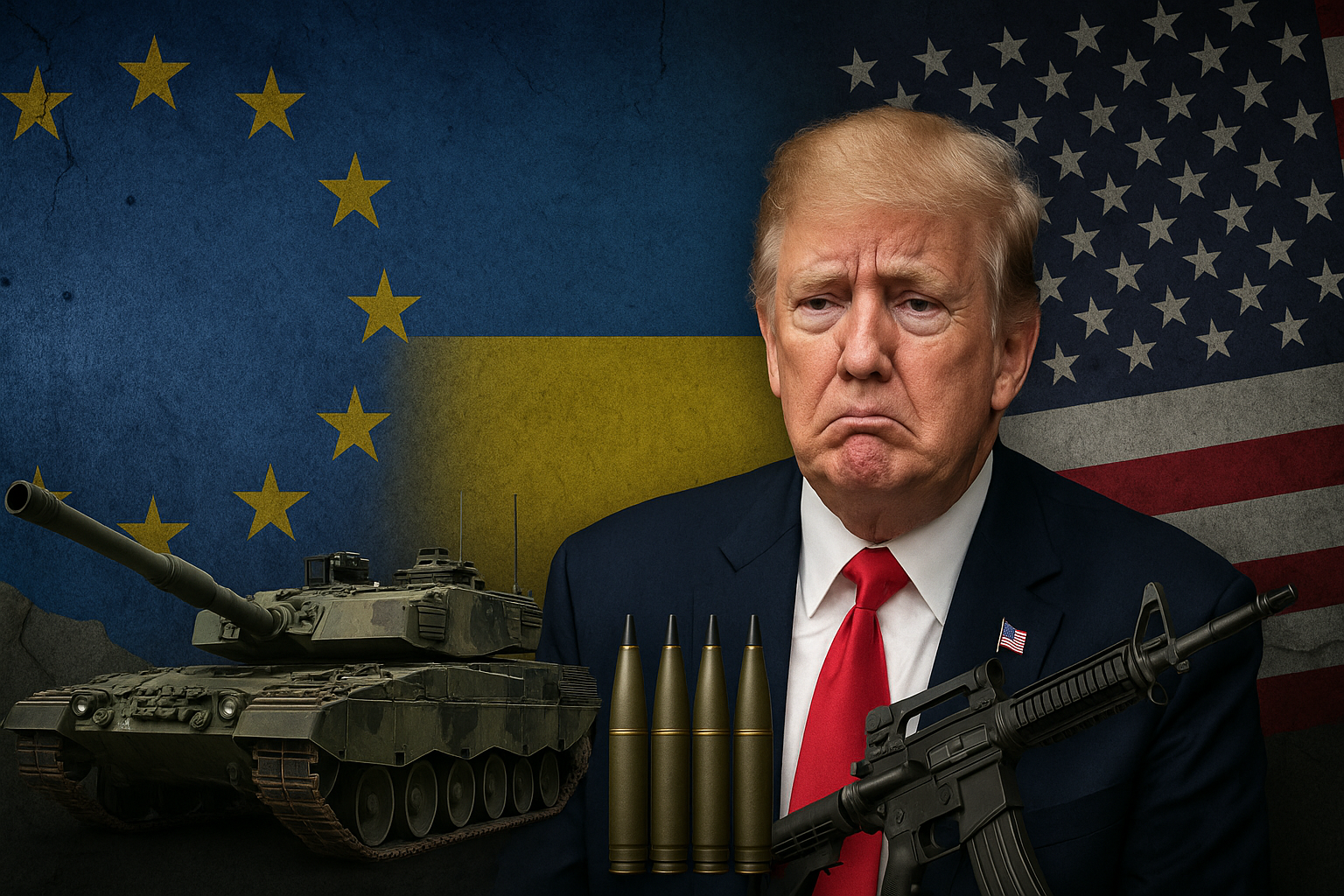
Setback for Donald Trump: EU arms financing for Ukraine at the center of tensions between the US and Europe – Creative image: Xpert.Digital
More than just money: How Trump's weapons demand exposes the rivalry between the EU and the USA
Why is the EU resisting Trump's demand for sole financing of weapons for Ukraine?
The answer lies in the fundamental philosophy of transatlantic burden-sharing. EU High Representative Kaja Kallas put it succinctly: "We welcome President Trump's announcement to send more weapons to Ukraine, although we would prefer the US to share the burden." This statement illustrates the dilemma Europe faces: On the one hand, Ukraine urgently needs military support; on the other hand, Europe does not want to serve solely as a source of funding for American arms companies.
The issue of cost is at the heart of the discussion
Trump described the value of the planned Patriot air defense systems and other weapons as "billions of dollars." A single PAC-3 missile costs about four million dollars. A complete system with ammunition is estimated to cost around one billion dollars. Germany has indicated its willingness to finance two more Patriot systems, but the Europeans are demanding a fair cost-sharing arrangement.
Which countries reject Trump's financing model and why?
The front of opposition in Europe is broader than expected. France is leading the refusal and, according to Politico, has categorically refused to participate in the purchase of American weapons for Ukraine. The French government prefers instead to increase its own defense budget and strengthen the European arms industry.
The Czech Republic
Ukraine has also issued a clear rejection. Prime Minister Petr Fiala stated that his country is focusing on its own munitions initiative and is "not currently considering participation in this project." The Czech Republic has already launched a substantial initiative of its own: Since the beginning of the year, the country has delivered half a million large-caliber shells to Ukraine. The Czech munitions initiative, which is supported by 18 countries, aims to provide 500,000 artillery shells by the end of the year.
Hungary
Hungary is taking a particularly uncompromising stance. Foreign Minister Péter Szijjártó made it unequivocally clear: "No Hungarian money, no Hungarian weapons, and no Hungarian soldiers will be sent to Ukraine." Budapest is already the only EU country to have blocked the disbursement of €6.5 billion from the European Peace Facility for arms deliveries to Ukraine.
Italy
Italy justifies its reluctance with financial constraints. The newspaper La Stampa reported that Italy has practically no room for new arms purchases. The only US weapons Italy will buy in the next ten years are several F-35 fighter jets for its own use.
What economic interests lie behind the European refusal?
The rejection is not solely financially motivated, but reflects deeper strategic rivalries in the global arms market. The Stockholm International Peace Research Institute determined that France has significantly increased its market share and, with 9.6 percent, ranks second only to the United States in the international arms market. France has thus displaced Russia from second place for the first time in over 30 years.
The figures illustrate the scale of the competition
Between 2019 and 2023, France increased its arms exports by 47 percent. Europe as a whole accounted for 28 percent of US arms exports, while only 11 percent of European arms imports came from the US between 2014 and 2018. This dependence is growing steadily: 55 percent of all European arms imports now come from the US.
France is deliberately focusing on European alternatives
President Emmanuel Macron promised to nearly double the 2017 defense budget by 2027. This strategy aims to strengthen the European defense industry and reduce dependence on American weapons systems.
How are the few supporting countries reacting to Trump's proposal?
Germany is proving itself to be a reliable partner
and announced it would finance two more Patriot systems. Defense Minister Boris Pistorius appealed to other European NATO states: "Everyone needs to open their wallets, so to speak." The German government has already delivered three Patriot systems to Ukraine and has indicated its willingness to invest billions more.
The Netherlands
They are pursuing an innovative approach: They launched an initiative to assemble a Patriot system from components of various countries. Defense Minister Kajsa Ollongren appealed to other Patriot user nations to contribute components from their stockpiles. This strategy allows for faster delivery, as there is no need to wait for new production.
Denmark
Denmark has indicated its willingness to pay "a very, very large sum in the billions." Defense Minister Troels Lund Poulsen argues: "This is about European security, and it's about our security in Denmark." The Danish government sees this as an investment in its own security.
Sweden, Norway and Canada
NATO Secretary General Mark Rutte also signaled support. However, two of the aforementioned countries reportedly only learned of their supposed willingness through Rutte, highlighting the coordination difficulties within the alliance.
What historical precedents explain the French position?
The AUKUS scandal of 2021
This casts a long shadow over American-French relations. At the time, Australia terminated a $66 billion contract with the French company Naval Group. The agreement covered the construction of twelve conventional submarines, as well as the creation of infrastructure and training over five decades.
The abrupt change came without warning
Australia withdrew from the treaty and joined the new AUKUS security alliance with the US and Great Britain. Paris felt betrayed, as the Australian government had assured the French shortly before the announcement of the AUKUS pact that it intended to maintain cooperation.
The cost of the breach of trust was immense
The original French project was valued at US$66 billion, while the AUKUS alternative is estimated at up to AU$368 billion (approximately €224 billion). For France, this meant not only the loss of a multi-billion-dollar contract but also a diplomatic affront.
This experience shapes the current French attitude
Paris is increasingly relying on European partners and the development of an independent defense industry. Its refusal to finance American weapons for Ukraine is also a signal of strategic autonomy.
Hub for Security and Defense - Advice and Information

Hub for Security and Defense - Image: Xpert.Digital
The Security and Defence Hub offers expert advice and up-to-date information to effectively support companies and organizations in strengthening their role in European security and defence policy. Working closely with the SME Connect Defence Working Group, it particularly promotes small and medium-sized enterprises (SMEs) that wish to further develop their innovative capacity and competitiveness in the defence sector. As a central point of contact, the Hub thus creates a crucial bridge between SMEs and European defence strategy.
Related to this:
Between dependence and autonomy: Europe's military dividing line
What role does the threat of tariffs play in the overall strategy?
Trump strategically links support for Ukraine and trade policy
At a meeting with NATO Secretary General Mark Rutte, he threatened Russia's allies, such as China and India, with punitive tariffs of 100 percent if there was no ceasefire within 50 days. At the same time, he announced tariffs of 30 percent for the EU starting August 1st.
The connection is no coincidence
Trump is using trade pressure as a diplomatic tool. "I use trade for many things," Trump said. "But it's great for ending wars." The tariff threat against the EU could also be a punitive measure for its reluctant participation in financing Ukraine.
Europe is caught in a dilemma
On the one hand, the EU wants to avoid retaliatory tariffs, but on the other hand, it does not want to serve solely as a source of funding for American arms companies. The EU had already prepared counter-tariffs on US goods worth €21 billion, but suspended them until August.
The economic impact would be considerable
For around 2,000 product categories, the US import share from the EU is more than two-thirds. Germany alone exported goods worth €161 billion to the US in 2024. A trade war would harm both sides, but their dependencies are unevenly distributed.
How is Europe's military dependence on the USA developing?
The numbers are alarming
64 percent of arms imports by European NATO members come from the USA. This dependence has increased dramatically in recent years. While Europe sourced only 35 percent of its arms imports from the USA between 2014 and 2018, this share rose to 55 percent between 2019 and 2023.
The F-35 fighter jet symbolizes this dependency
The US aircraft accounts for nearly a quarter of all American arms exports worldwide. Germany ordered the system as part of its €100 billion special defense fund. Many NATO countries opted for the F-35, which increases interoperability but also reinforces their dependence on American technology.
The European arms industry is fighting for market share
While American corporations like Lockheed Martin generate twice the revenue of Europe's largest defense contractor, BAE Systems, European companies are trying to catch up. Rheinmetall's share price has almost tripled since the beginning of the year.
Europe is investing in alternatives
The European Commission established the European Defence Fund in 2017, albeit with a comparatively small budget. National projects such as the Franco-German FCAS air combat system or the European missile defense system are intended to reduce dependence in the long term.
What impact does the split have on NATO solidarity?
The differing positions on financing Ukraine reveal deeper cracks in the alliance
While Germany, the Netherlands, and Denmark are prepared to invest billions, France, Italy, the Czech Republic, and Hungary are refusing. This division weakens the West's united response to Russian aggression.
NATO Secretary General Mark Rutte is trying to mediate
He praised Trump and declared the US to be "the world's policeman with the most powerful army in the world." At the same time, he noted that Europeans would now intensify their efforts. But reality paints a different picture: only a few countries are prepared to comply with Trump's demands.
NATO's credibility is at stake
If Europe does not respond unanimously to American demands, Trump could make good on his threats and reduce military support for Europe. The announcement of 100 percent tariffs on Russian trading partners shows that Trump is prepared to use economic means as leverage.
The question of time intensifies the pressure
Trump gave Russia a 50-day deadline for a ceasefire. This short timeframe leaves little room for diplomatic solutions and forces Europeans to make quick decisions. Ukraine cannot afford months of discussions about financing arrangements.
How sustainable is the European resistance strategy?
The European position is fragile, but not unfounded
The refusal to serve solely as a source of funding for American defense companies reflects a growing awareness of strategic autonomy. Europe has invested significantly in its own defense industry in recent years and does not want to jeopardize this progress through one-sided dependencies.
The Czech munitions initiative shows alternative ways
With 500,000 artillery shells by the end of the year, the Czech Republic is making a substantial contribution to support for Ukraine. This initiative utilizes global supply chains and avoids dependence on American manufacturers. Germany has already financed 180,000 rounds under this framework.
France's strategy of industrial strengthening is bearing its first fruit
The 47 percent increase in arms exports shows that European alternatives to American systems are gaining in importance. Countries like India are increasingly turning to French suppliers, which underscores the global competitiveness of the European arms industry.
However, the question of cost remains central
Europe is already spending considerable sums on support for Ukraine. The EU is still seeking €19 billion to finance the Ukrainian budget. Additional billions for American weapons systems would place an extra burden on budgets without benefiting European industry.
What long-term consequences can be expected for transatlantic relations?
The current conflict marks a turning point in transatlantic relations
Trump's demand for full European funding of American weapons challenges the traditional model of burden-sharing. Europe is increasingly seen as a customer and financier of American military technology, less as an equal partner.
The European response suggests a reorientation
The emphasis on European alternatives and the refusal to exclusively finance American systems signal a change. Europe is prepared to forge its own path, even if this leads to short-term tensions with Washington.
The Ukraine crisis is becoming a litmus test for the future of NATO
Can the alliance function despite differing approaches to burden-sharing? Or will the diverging interests lead to a lasting division? The answer to these questions will shape Europe's security architecture for decades to come.
The irony of the situation is obvious
While Trump demands greater European responsibility in defense, he rejects European independence in arms policy. This contradiction forces Europe to choose between dependence and autonomy – a decision that extends far beyond the Ukraine crisis.
The current dispute over the financing of weapons for Ukraine is more than a conflict over billions of euros. It reveals fundamental disagreements about the future of the transatlantic security partnership and Europe's role in the global defense architecture. The outcome of this debate will have a decisive influence on whether Europe embarks on a path toward greater strategic autonomy or remains even more dependent on American military technology.
Consulting - Planning - Implementation

Markus Becker
I would be happy to serve as your personal advisor.
Head of Business Development
Chairman SME Connect Defense Working Group
Consulting - Planning - Implementation
Konrad Wolfenstein
I would be happy to serve as your personal advisor.
You can contact me at wolfenstein∂xpert.digital or
Just call me on +49 7348 4088 965 .