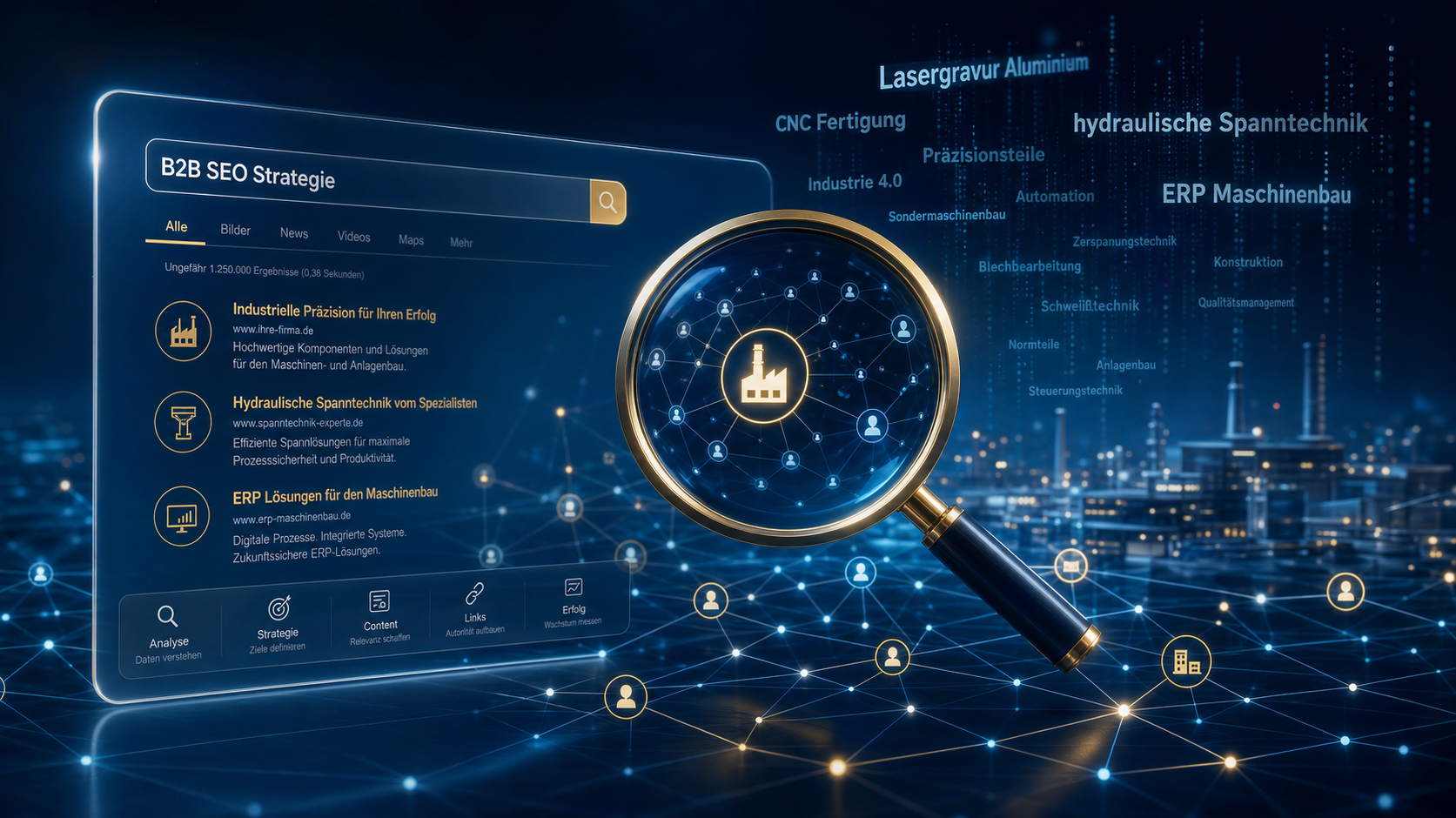
Why lucrative B2B customers aren't searching for your product (and how you can find them anyway) – Image: Xpert.Digital
Two worlds, one search engine: What fundamentally distinguishes B2B SEO from B2C
"Zero-volume keywords": The secret to highly profitable B2B contracts on Google
Those who approach search engine optimization (SEO) in the B2B sector like they would in traditional B2C not only burn through valuable marketing budgets but also surrender lucrative market share to the competition without a fight. While the mantra of maximum search volume may hold true in the B2C sector, in B2B, highly specific niche queries, complex buying centers, and the absolute necessity of building trust determine business success. Moreover, the rules of the game have fundamentally changed due to the rapid rise of generative AI searches (GEO): buyers, engineers, and CEOs now conduct more targeted and sophisticated research than ever before. This article delves into why a lack of search volume in B2B is often a misleading metric, how you can convince real decision-makers with solution-oriented content, and which serious technical and strategic SEO mistakes industrial companies absolutely must avoid now. Discover how B2B SEO can transform from a mere IT task into a genuine, long-term growth engine for five- to six-figure sales.
Why industrial companies are giving away millions in revenue with false assumptions
Anyone working in the B2B sector who believes search engine optimization (SEO) operates according to the same principles as in the consumer goods segment is making a costly mistake. The structural differences are not merely gradual, but fundamental. In B2C, spontaneous, emotional purchasing decisions by individuals dominate, and the search volume for relevant keywords is in the five- to six-figure range. In B2B, however, the decision-making process is rational, lengthy, and collaborative. According to recent data from Forrester, a typical B2B purchasing decision today involves an average of 13 internal stakeholders and nine external influencers—a level of complexity that is all too often underestimated in marketing.
While a T-shirt in the B2C sector attracts 50,000 monthly search queries, its B2B counterpart, "T-shirt wholesaler," receives only around 70 monthly searches. However, these 70 searches represent potential business customers with a specific need – and a single won order can translate into five- to six-figure revenues and repeat business. Companies generate roughly 60 to 70 percent of their website traffic through organic channels, and especially in B2B, the quality of this traffic is crucial – not its sheer quantity.
The most expensive misconception: Why "Our target audience doesn't search on Google" is a dangerous misconception
The reality is different: Complex products and services, in particular, are researched very thoroughly. A technical buyer preparing a decision for a new production plant, an ERP system, or a specialized packaging solution doesn't search for "buy machine," but rather for "laser engraving aluminum series production," "automated hydraulic clamping technology," or "DIN EN ISO 13485 packaging solution." The more explanation a product requires, the greater the need for information—and the more likely a significant portion of this information search will take place via search engines.
A recent finding is particularly revealing: 51 percent of B2B buyers now begin their supplier research using an AI tool – compared to 29 percent a year ago. According to Forrester's State of Business Buying report, generative AI is now the most frequently used source of information in the B2B buying process – even ahead of supplier websites, subject matter experts, and direct sales contact. Furthermore, according to 6sense's B2B Buyer Experience Report, 94 percent of buyers sort their shortlist by preference before even contacting a supplier – the top-ranked supplier wins four out of five deals. Those who are not present at this early stage of research have virtually no chance of entering the decision-making process.
The Economics of Niches: Why Low Search Volume Can Mean Higher Revenue
In B2B, a good keyword isn't necessarily the one with the highest search volume, but rather the one with the highest business value. A keyword like "ERP system" with thousands of search queries attracts students, journalists, and competitors—people who will never become customers. The keyword "ERP for mechanical engineering companies," on the other hand, addresses a highly specific, intent-driven query with minimal competition and maximum business value. The conversion rate for such precise queries is significantly higher in a B2B context.
The phenomenon of so-called zero-volume keywords is particularly interesting. Practical experience shows that in B2B projects, Google Search Console regularly reveals that 70 to 80 percent of actual clicks are generated by keywords that were not previously identified as relevant by any tool. These search terms are so specific that no analytics tool detects them – but they are used by people who know exactly what they are looking for. In B2B e-commerce, this is especially true for article numbers: customers don't search for the product name, but directly for the identifier. Consistently placing the article number in the title tag or H1 heading can lead to significant increases in traffic and sales in niche markets, even without any prior demonstrable search volume.
Solution-oriented content as a foundation: How real problems become searchable knowledge
The most strategically important question for B2B content creation isn't, "Which keyword has the highest search volume?" but rather, "What real problems and challenges does our product solve for our customers?" Companies are sitting on a goldmine of relevant content material that they systematically ignore. Sales teams have daily conversations with prospects and receive direct feedback on problems and decision-making criteria. Support teams deal with recurring technical challenges every day. Trade fair conversations provide unfiltered, real-time insights. LinkedIn comments reveal the pain points that the target audience themselves articulate. All these sources are more valuable than even the most elaborate keyword analysis because they reflect the actual language of customers – and that's precisely the language used in search engines.
Many companies describe their services in their own language, not in the language of their customers. They use internal jargon that may be unfamiliar to their target audience. Those who don't speak the customer's language won't be found in organic search results—and therefore won't be recommended by AI systems. The economic logic behind this is clear: When SEO is properly combined with content marketing, returns of up to 748 percent can be achieved over several years. 58 percent of B2B marketers report revenue increases directly attributable to content marketing.
The Architecture of Relevance: How Target Group and Industry-Specific Content Creates Visibility
Instead of creating a generic service page that appeals to all potential customers in the same way and therefore doesn't truly reach any of them, dedicated landing pages should be built for specific segments. An ERP provider that creates a separate, in-depth landing page for each relevant industry—crafts, mechanical engineering, electrical engineering—generates high semantic relevance for precisely those search queries. This holds true even if the search volume for the corresponding keywords is minimal, because in B2B, a single conversion can potentially generate very high business value.
The same logic applies to segmentation by intended use and target audience. B2B purchasing decisions are rarely made by a single person. The example of a temperature sensor illustrates this perfectly: Management asks about ROI and investment security – case studies and management summaries are appropriate here. The technical buyer needs pricing information, compatibility data, and certifications. The engineer is interested in interfaces, materials, and CAD files. Anyone who addresses all three perspectives on a single landing page significantly increases the conversion rate – because no member of the decision-making body has to leave the page to satisfy their specific information needs.
🎯🎯🎯 Data-driven B2B industry hub as a quasi-in-house solution


The quasi-in-house solution: How Xpert.Digital closes operational gaps in B2B marketing and sales – Smart Content-Driven Business - Image: Xpert.Digital
Xpert.Digital is a data-driven B2B industry hub led by Konrad Wolfenstein . The company acts as an external, quasi-in-house solution for industrial partners, closing operational gaps in marketing, content, and sales – without requiring additional resources on the client side.
More information here:
Why security is the most important SEO signal in B2B purchasing
Security as a decisive purchasing factor: The psychology of B2B buying and its SEO implications
From an economic perspective, B2B decision-makers primarily buy security. A wrong decision in the B2B context—an unsuitable ERP system, a faulty production facility—can have significant financial, operational, and legal consequences. This psychology of risk avoidance is directly reflected in SEO-relevant content. Studies show that over 90 percent of consumers consult online reviews before making a purchase decision. Social proof in the form of customer testimonials, company logos, detailed case studies, and verified reviews is therefore not just a marketing gimmick, but a crucial prerequisite for purchasing decisions.
The SEO value of these trust elements is also directly noticeable through improved ranking signals. Google evaluates pages according to the EEAT principle (Experience, Expertise, Authoritativeness, Trustworthiness). Case studies, certifications, author profiles, and external mentions are precisely the signals that boost this score. And ultimately, in B2B, people buy from people, not abstract companies from abstract companies. Anyone who completely strips their website of any personality and reduces it to anonymous corporate language loses a crucial anchor of trust—in the eyes of visitors as well as in the eyes of search engines.
Typical cost traps: The most common SEO mistakes in B2B and their economic consequences
The lack of industry-specific landing pages is the most common and consequential SEO mistake in B2B. Pages that are moderately relevant for too many keywords, instead of being highly relevant for specific search queries, don't rank well anywhere. Closely related to this is insufficient informational content: A lack of case studies, FAQ pages, and technical detail pages signals a lack of depth to both search engines and visitors.
A technically easy-to-avoid but economically significant mistake is using PDFs instead of HTML for important content. Product data sheets and certificates available only as PDF downloads are practically invisible to search engines. The information they contain should also be available as indexable HTML content. Added to this is the flawed keyword strategy: Optimizing for "ERP system" means competing with thousands of results from the entire ERP topic spectrum. Optimizing for "ERP for electrical engineering companies with 50 or more employees" addresses a highly specific search intent with minimal competition. Finally, treating SEO as a purely technical project—without clear content positioning or content written in the target audience's language—is strategically ineffective: A fast-loading website that delivers the wrong content remains invisible.
Technical fundamentals and the desktop myth in B2B
The technical basics apply across all industries: fast loading times, no error pages, a clean internal linking structure, and a fully functional mobile version. Since the introduction of the mobile-first index, Google primarily evaluates the mobile version for rankings. However, there is a B2B-specific nuance: the desktop remains dominant. Depending on the company and industry, 65 to 85 percent of B2B visitors access the website via desktop, not smartphone. Those with limited development resources should prioritize optimizing the desktop experience in the B2B sector while simultaneously ensuring that the mobile version is technically complete.
Internal linking is often the underestimated quick win with the best cost-benefit ratio in technical SEO. A well-structured internal linking architecture enables search engines to efficiently crawl all relevant pages and recognize the thematic connection between content. At the same time, it guides visitors through the information-gathering process and increases dwell time. Significant ranking improvements can be achieved with relatively little effort – especially for newer pages without strong external backlinks.
B2B SEO beyond your own website: The underestimated off-page dimension
Top lists and independent comparison articles are playing an increasingly important role in the B2B decision-making process. Articles such as "The Best CRM Software for Medium-Sized Manufacturing Companies" are actively consulted by decision-makers to identify and pre-qualify suppliers. This is even more true for AI systems, which use such comparison articles as sources to generate recommendations. A mention in such a list can lead to sustained, regular recommendations from AI systems—a multiplier effect that is difficult to achieve with traditional advertising.
When choosing a review platform, the business model is crucial: Clutch, with its exclusively verified B2B reviews, is particularly relevant for B2B service providers; Trustpilot is suitable for e-commerce and SaaS companies; and Google reviews are indispensable for all businesses with a local focus. According to Trustpilot, AI-powered search results in a 4.4 times higher probability of converting visitors into buyers compared to traditional search – a finding that underscores the strategic importance of reviews for the next generation of search. Articles in industry publications are the most sustainable form of off-page SEO: Publishing as an expert in relevant trade journals builds authority – in the eyes of the target audience, search engines, and AI models alike.
The AI factor: Why B2B SEO in 2026 also means Generative Engine Optimization
With the rapid spread of AI-powered search systems, a new dimension of visibility is emerging: Generative Engine Optimization (GEO). AI systems like ChatGPT, Perplexity, and Gemini generate answers by using existing web content as a foundation. In a B2B context, this means that if a buyer asks a web search engine manager (LLM) which suppliers are suitable for a specific industrial product, the recommendations will focus precisely on those companies that are present in thematically relevant, in-depth, and externally cited web content. The principles of good traditional SEO—thematic depth, clear positioning, and structured content—are the same ones that promote AI-driven visibility.
However, there is a crucial shift: AI recommendations are primarily driven by content clarity and semantic unambiguity. An AI system must quickly and unambiguously understand who a company is, what it offers, who it is suitable for, and how it differs from competitors. Unclear, generic, and interchangeable web content is categorized less effectively and recommended less frequently. Ten precise, clearly positioned, and in-depth pages beat a hundred vague, generic texts—a direct implication of how AI systems are used, with far-reaching consequences for B2B content strategy.
Strategic prioritization and the time factor: When does B2B SEO pay off?
SEO is not an instant fix – and companies that misunderstand this often abandon their investments too soon. For established companies with high domain authority, it typically takes six to nine months for SEO measures to lead to a significantly measurable ROI. For new websites or highly competitive markets, this period can be twelve months or more. This isn't a weakness of the channel, but rather its structural characteristic: SEO builds cumulative competitive advantages that become increasingly valuable over time and are difficult for competitors to quickly replicate.
The comparison with paid search is revealing: A SEA campaign generates immediate visibility – but only as long as the budget is flowing. SEO-generated traffic, on the other hand, is an accumulated asset that continuously generates leads over the years without ongoing costs. With an average B2B content marketing return on investment of 3:1 and the documented potential of up to 748 percent ROI with a consistently implemented content strategy, the long-term capital efficiency of SEO is hard to beat. Ultimately, B2B SEO is not an isolated discipline, but rather the digital extension of a compelling market positioning. A company that occupies a clear niche, solves real problems, speaks its customers' language, and demonstrably documents its expertise will become visible in organic search – because this visibility is the direct digital equivalent of its actual market relevance.
Your global marketing and business development partner
☑️ Our business language is English or German
☑️ NEW: Correspondence in your native language!

Konrad Wolfenstein
I and my team are happy to be available to you as your personal advisor.
You can contact me by filling out the contact form here wolfenstein@xpert.digital:or simply call me at +49 7348 4088 965. My email address is
I'm looking forward to our joint project.
☑️ SME support in strategy, consulting, planning and implementation
☑️ Creation or realignment of the digital strategy and digitization
☑️ Expansion and optimization of international sales processes
☑️ Global & Digital B2B trading platforms
☑️ Pioneer Business Development / Marketing / PR / Trade Fairs
B2B support and SaaS for SEO and GEO (AI search) combined: The all-in-one solution for B2B companies


B2B support and SaaS for SEO and GEO (AI search) combined: The all-in-one solution for B2B companies - Image: Xpert.Digital
AI search changes everything: How this SaaS solution will revolutionize your B2B ranking forever.
The digital landscape for B2B companies is undergoing rapid change. Driven by artificial intelligence, the rules of online visibility are being rewritten. For companies, it has always been a challenge not only to be visible in the digital mass, but also to be relevant to the right decision-makers. Traditional SEO strategies and managing local presence (geo-marketing) are complex, time-consuming, and often a battle against constantly changing algorithms and intense competition.
But what if there were a solution that not only simplified this process but also made it smarter, more predictive, and far more effective? This is where the combination of specialized B2B support with a powerful SaaS (Software as a Service) platform comes into play, specifically designed for the demands of SEO and GEO in the age of AI search.
This new generation of tools no longer relies solely on manual keyword analysis and backlink strategies. Instead, it leverages artificial intelligence to more accurately understand search intent, automatically optimize local ranking factors, and conduct real-time competitive analysis. The result is a proactive, data-driven strategy that gives B2B companies a decisive advantage: they are not only found, but perceived as the leading authority in their niche and location.
Here's the symbiosis of B2B support and AI-powered SaaS technology that transforms SEO and GEO marketing, and how your company can benefit from it to grow sustainably in the digital space.
More information here: