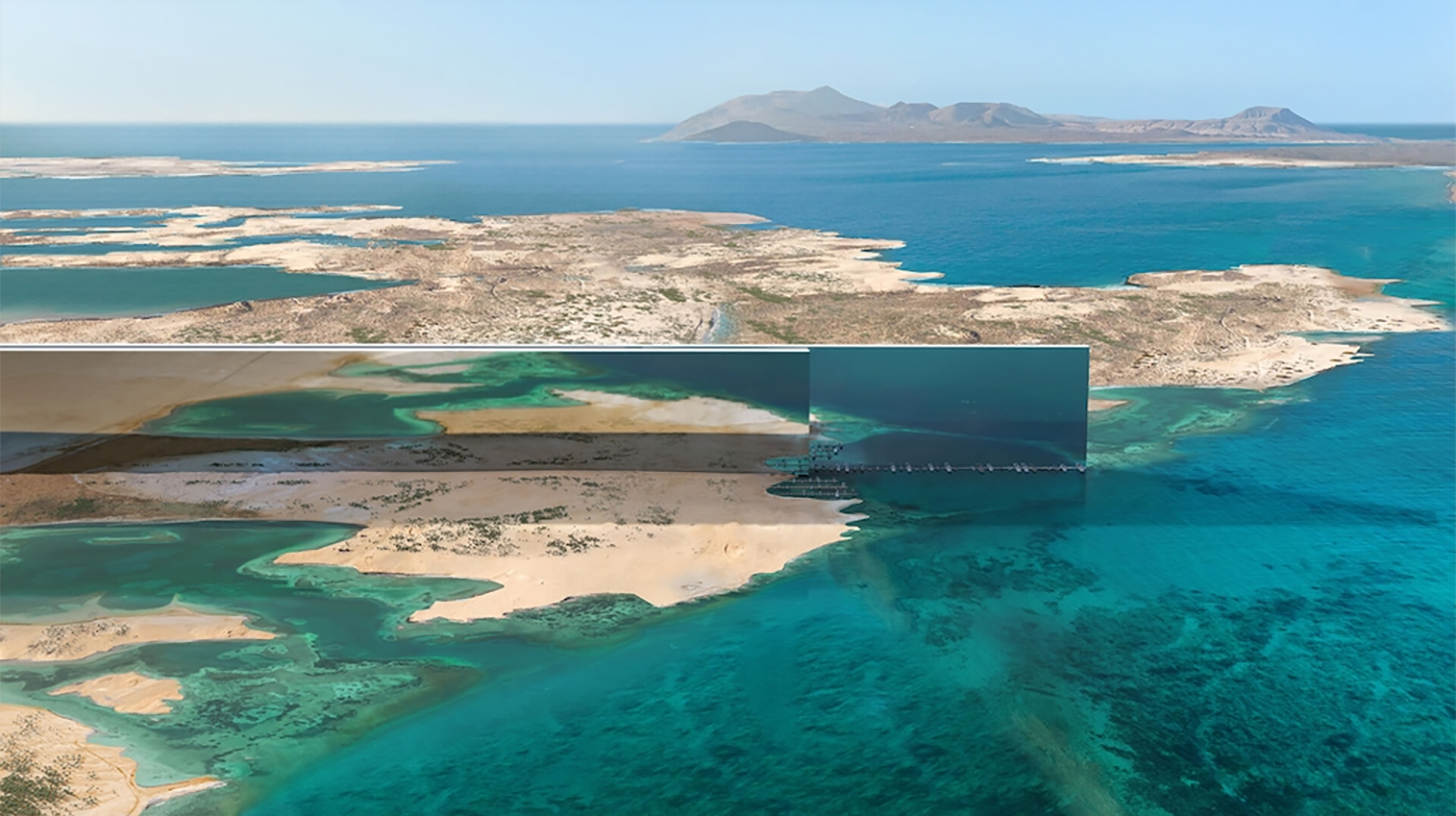
The real reason why Saudi Arabia's 170 km megacity "The Line" is failing – megalomania and lies: From 170 km to 2.4 km – Image: neom.com
An $8.8 trillion debacle: How the Saudi Crown Prince completely gambled away his money with 'The Line'
From futuristic wonder to symbol of failure: What really happened to "The Line"
It was meant to be a revolution in urban life, the crown jewel of a nation in transition: "The Line," the 170-kilometer-long, futuristic linear city in the Saudi Arabian desert. Spectacular images and ambitious promises painted a picture of a new era, fueled by the kingdom's oil billions and Crown Prince Mohammed bin Salman's "Vision 2030." But the glittering facade has developed deep cracks. The project of the century has become a symbol of shattered dreams and boundless megalomania.
Reality has brutally overtaken the ambitious plans. An unimaginable cost explosion, which catapulted estimates from $500 billion to almost $9 trillion, dwindling cash reserves, and a lack of international investors are forcing Saudi Arabia to radically change course. The result is a financial debacle and a drastic reduction of the project by over 98 percent. Instead of a metropolis for 1.5 million people, only a tiny fragment will be realized by 2030. This article examines the background of this spectacular failure, analyzes the fatal miscalculations and management errors, and explains why the end of "The Line" is jeopardizing the kingdom's entire future strategy.
Everything is becoming too expensive: The end of a megalomaniacal project – What actually happened to "The Line"?
Anyone who has followed the news in recent years will surely be familiar with the spectacular images of the planned Saudi megacity, "The Line." This futuristic, 170-kilometer-long city in the desert was intended to be the flagship of Saudi Arabia's transformation. But what actually became of this monumental project?
The answer is sobering: Saudi Arabia has halted work on "The Line" and other major projects of the Neom complex. What was once hailed as a symbol of a new era has become a financial disaster that even the kingdom's oil billions cannot withstand.
Why did the sheikhs fail?
The failure of "The Line" is symptomatic of a larger problem: a complete miscalculation of costs and feasibility. Originally, the entire Neom project was projected to cost around 500 billion US dollars. However, after internal reviews, the cost estimates skyrocketed.
An internal report obtained by the Wall Street Journal estimated the total cost at an astronomical $8.8 trillion. That's more than 25 times the annual Saudi Arabian state budget. Construction would take longer than the originally planned 25 years, extending to over 60 years, with completion not expected until 2080.
These figures illustrate the extent of the miscalculations. Even for an oil-rich country like Saudi Arabia, such sums are simply unaffordable. The Saudi sovereign wealth fund PIF, which was supposed to finance the projects, had cash reserves of only $15 billion in September 2023 – a fraction of what would be needed for the first phase alone.
How dramatic is the reduction in the plans?
Reality forced Saudi Arabia to make drastic cuts. Instead of the originally planned 170 kilometers of "The Line," only 2.4 kilometers are now to be completed by 2030 – a reduction of more than 98 percent. The projected population for 2030 has been reduced from 1.5 million to less than 300,000.
These drastic cuts are more than just adjustments – they are an admission of failure. The project, once intended to be a testament to Saudi Arabia's capacity for modernization, has become a symbol of megalomania and poor planning.
What are the reasons for the financial debacle?
Oil price collapse and budget deficits
Saudi Arabia is in a precarious financial situation. The kingdom needs an oil price of at least $96 per barrel to balance its budget. In reality, the break-even point is over $100 when expenditures for megaprojects are factored in. In fact, the oil price has been significantly lower in recent years, resulting in substantial budget deficits.
In the first half of 2025, Saudi Arabia recorded a budget deficit of 93 billion Saudi riyals (US$24.8 billion), more than three times the previous year's deficit. Oil revenues fell by 24 percent, while spending on megaprojects continued to rise.
Lack of foreign investment
Saudi Arabia initially expected foreign investors to provide the majority of the financing for Neom. This hope was not fulfilled. Foreign direct investment fell far short of expectations. In the first quarter of 2025, it even declined by seven percent compared to the previous quarter.
International skepticism towards the Saudi megaprojects had several reasons: the kingdom's questionable human rights record, the unrealistic plans, and, last but not least, doubts about the feasibility of the projects.
Problems with the state investment fund
The Public Investment Fund (PIF), Saudi Arabia's main financier of the megaprojects, also came under pressure. Its cash reserves reached their lowest level in years in 2023. At the same time, the fund had to drastically reduce its profits – by 60 percent to just US$6.9 billion in 2024.
What role did management errors play?
In addition to macroeconomic problems, serious management errors also contributed to the company's failure. According to reports in the "Wall Street Journal," there was systematic manipulation of financial reporting. Executives allegedly included unrealistic assumptions in business plans to conceal cost increases.
For example, the planned hotel prices at the resorts were inflated many times over to generate higher revenues on paper. A project manager who openly criticized these cost estimates was dismissed. The original architect of "The Line," Thom Mayne, wanted to inform the Crown Prince about the true costs but was prevented from doing so by Neom management.
These “mutual deceptions” meant that Crown Prince Mohammed bin Salman was kept in the dark for a long time about the true costs and problems of his prestige project.
How does failure affect other areas?
Sporting events at risk
The failure of these megaprojects is already impacting other ambitious Saudi Arabian plans. The 2029 Asian Winter Games were supposed to take place in Trojena, a planned ski resort in the desert. Due to the delays, the Olympic Committee has cautiously approached South Korea as a potential replacement host.
Similar problems loom for the 2034 FIFA World Cup. A stadium for the tournament was planned for "The Line." The project's halt to construction is forcing Saudi Arabia to already begin looking for alternative venues.
Staff reduction and restructuring
The financial problems led to massive staff reductions. Reports indicate that 1,000 Neom employees were relocated to Riyadh and hundreds more were laid off. Key managers were transferred from failed projects like "The Line" to still viable ventures like "Trojena.".
This restructuring is more than just a reorganization – it's an admission that the original concept has failed. The viable projects will now be transferred to established state institutions that can implement them more efficiently.
What does this mean for Saudi Arabia's Vision 2030?
A strategy in times of crisis
"The Line" was a key component of Saudi Arabia's "Vision 2030," the plan to diversify the economy away from oil. The failure of this project calls the entire strategy into question. If even the oil billions aren't enough to finance such projects, how can the economic transformation possibly succeed?
Vision 2030 is already struggling with massive funding problems. The PIF has seen its profits plummet while the costs of its megaprojects have skyrocketed. Analysts warn that further drastic cuts will be unavoidable if oil prices remain low.
Reality check for delusions of grandeur
The failure of "The Line" is a long overdue reality check on Saudi Arabia's megalomania. For years, the Saudis presented spectacular plans – from flying taxis and artificial moons to ski slopes in the desert. These science fiction dreams have now collided brutally with the reality of limited resources and the laws of physics.
Crown Prince Mohammed bin Salman, who portrayed himself as a visionary, now has to admit that his ambitions have proven unrealistic. Experts say he has "overplayed his hand.".
What lessons can be learned from this?
The limits of what is possible
The failure of "The Line" vividly demonstrates the limits of what is possible even with enormous financial resources. Money alone is not enough to overcome the laws of physics, logistics, and economics. Projects of this magnitude require not only financial resources but also realistic planning, competent execution, and long-term sustainability.
Transparency vs. Autocracy
The manipulations in financial reporting highlight a fundamental problem with autocratic systems: when critical voices are suppressed and unpleasant truths are concealed, catastrophic misjudgments can result. In a more transparent system, the unrealistic plans could have been corrected earlier.
Sustainability before spectacle
The project also demonstrates that sustainable economic practices are more important than spectacular showcase projects. Instead of investing billions in futuristic fantasies, a gradual and realistic diversification of the economy would have been more sensible.
Your container high-bay warehouse and container terminal experts

Container high-bay warehouses and container terminals: The logistical interplay – expert advice and solutions - Creative image: Xpert.Digital
This innovative technology promises to fundamentally change container logistics. Instead of stacking containers horizontally as before, they will be stored vertically in multi-story steel racking structures. This not only allows for a drastic increase in storage capacity within the same area, but also revolutionizes all processes at the container terminal.
More information here:
The Line failed – end of the megacity era?
What are the global implications?
Loss of investor confidence
The failure of Saudi Arabia's megaprojects has already led to a loss of confidence among international investors. The Saudi stock market was among the weakest in the world in 2025, as investors increasingly doubted the feasibility of Vision 2030.
Impact on the energy transition
Ironically, the failure of "The Line" could have positive implications for the global energy transition. The project was intended to serve as a showcase for a post-fossil future and bolster Saudi Arabia's image as a forward-thinking nation. Instead, its failure highlights the limitations of such PR projects and shifts the focus to genuine, sustainable solutions.
New power dynamics in the Middle East
The financial debacle weakens Saudi Arabia's position in the Middle East. Other countries in the region could seize the opportunity to strengthen their own role as regional economic hubs. The United Arab Emirates, for example, is pursuing a more pragmatic approach to diversification.
What will happen to Saudi Arabia next?
Return to reality
Saudi Arabia will have no choice but to drastically scale back its plans. Instead of spectacular megaprojects, the country will have to focus on smaller, more feasible initiatives. The restructuring of Neom, in which viable projects are transferred to established institutions, is a first step in this direction.
Financial consolidation
The kingdom needs to stabilize its public finances. This likely means further cuts to megaprojects, a stronger focus on profitable investments, and possibly higher borrowing. Public debt has already risen from $280 billion in 2023 to $320 billion in 2024.
New economic strategy
Vision 2030 needs a fundamental overhaul. Instead of focusing on spectacular projects, Saudi Arabia should concentrate on proven diversification strategies: education, infrastructure, small and medium-sized enterprises, and a gradual opening of society.
What can we learn about modern megaprojects?
The illusion of feasibility
"The Line" isn't the first failed megaproject in history, but it's one of the most spectacular. It demonstrates how dangerous the illusion of unlimited possibilities can be. In an age where technology seems to break all boundaries, we sometimes forget the fundamental limitations of resources, time, and human capabilities.
Size isn't everything
This project also illustrates that size does not automatically equate to success. Often, smaller, well-thought-out projects are more sustainable and successful than gigantic undertakings. History is full of examples of failed megaprojects – from the Tower of Babel to modern infrastructure disasters.
The meaning of realism
Ultimately, the failure of "The Line" teaches us the importance of realism in project planning. Visions are important, but they must be supported by a solid foundation of facts, expertise, and financial responsibility.
What parallels exist with other failed projects?
Historical comparisons
History offers many similar examples of megalomania. The Jeddah Tower, another Saudi megaproject, stalled as early as 2018, when it was not even half finished. International examples such as Berlin's BER airport or the Stuttgart 21 rail project also demonstrate how quickly megaprojects can spiral out of control.
Common patterns
These projects exhibit common patterns: unrealistic timelines, exploding costs, lack of transparency, and an inability to make timely course corrections. Often, warnings from experts are ignored until it is too late.
What does this mean for the future of megaprojects?
New standards are needed
The failure of "The Line" could help establish new standards for megaprojects. These include more rigorous feasibility studies, independent audits, transparent reporting, and realistic cost estimates.
The role of technology
While technology opens up many possibilities, this example also shows its limitations. Not everything that is technically conceivable is also practically feasible or economically viable.
What impact does this have on global architecture?
The end of gigantomania?
The failure of "The Line" could herald the end of an era of architectural gigantomania. Instead of building ever higher, longer, and more spectacular structures, architects and urban planners could once again focus more on sustainability, quality of life, and human needs.
New priorities in urban planning
The future of urban planning may not lie in spectacular megacities, but in well-thought-out, sustainable concepts that improve and expand existing cities.
What are the societal consequences?
Loss of trust in visions
The failure of such megaprojects can lead to a general loss of trust in grand visions and transformation projects. This is problematic because the world certainly has major challenges to address, such as climate change, which also require comprehensive transformations.
Lessons for the future
It is important to distinguish between unrealistic, megalomaniacal projects and necessary, but well-thought-out transformations. The energy transition, for example, is a necessary transformation, but one that should be achieved through realistic planning and gradual implementation.
The failure of "The Line" is more than just the end of a spectacular construction project. It is a symbol of the limits of human ambition and a wake-up call for greater realism in a time when everything seems possible. The lessons of this debacle should inform the planning of future large-scale projects so that visions don't once again turn into nightmares.
The story of "The Line" ultimately demonstrates that even the world's richest countries are not immune to the consequences of poor planning and unrealistic ambitions. At a time when many countries and companies are planning similarly ambitious projects, the Saudi debacle should serve as a warning: size alone does not guarantee success, and even oil billions have their limits.
We are here for you - Consulting - Planning - Implementation - Project Management
☑️ Our business language is English or German
☑️ NEW: Correspondence in your native language!

Konrad Wolfenstein
I and my team are happy to be available to you as your personal advisor.
You can contact me by filling out the contact form here wolfenstein@xpert.digital:or simply call me at +49 7348 4088 965. My email address is
I'm looking forward to our joint project.