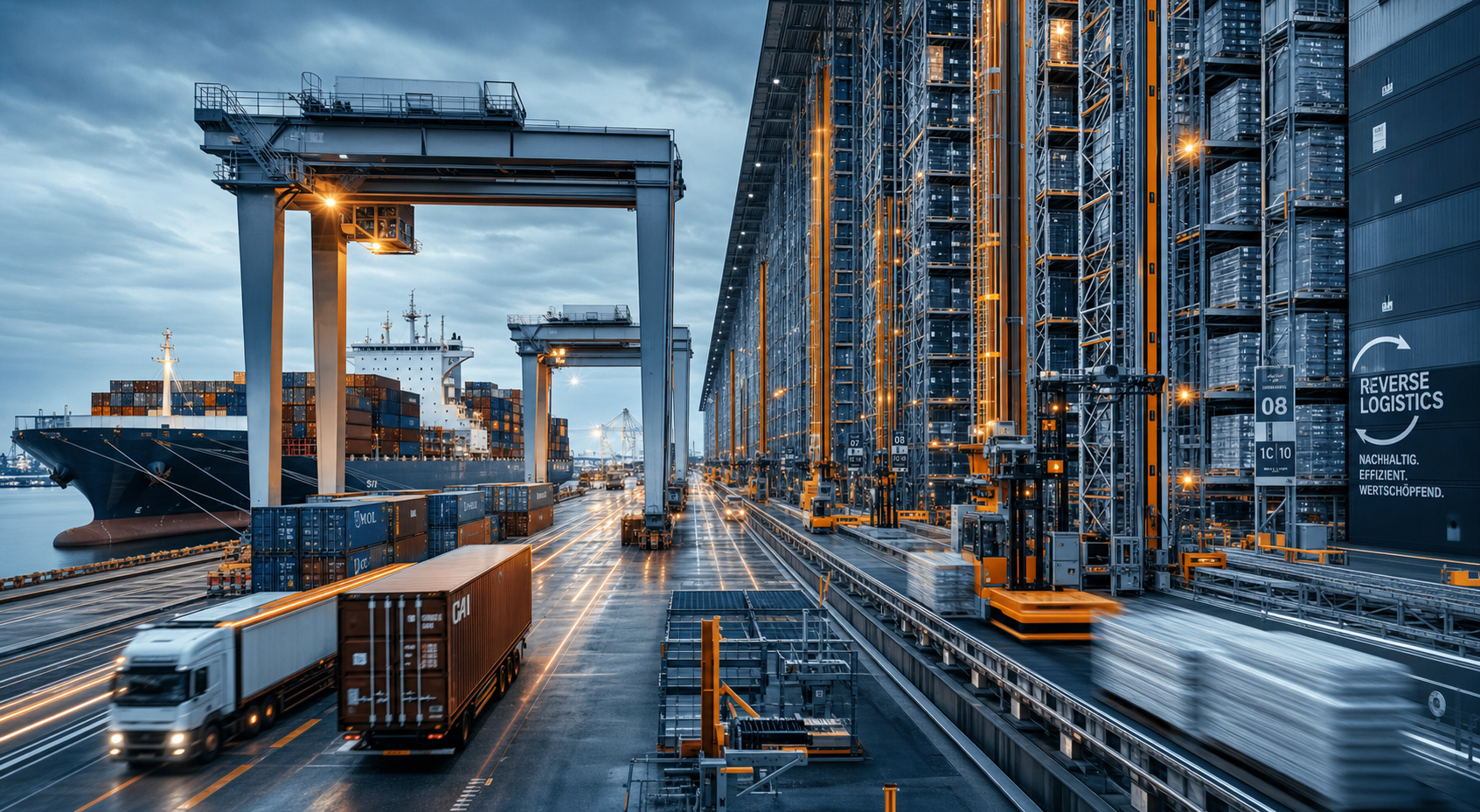
Reverse Logistics: From the supply chain to container logistics and high-bay warehouses in intralogistics – creative image on the topic, with AI: Xpert.Digital
Transformation in the supply chain: Why the return journey of packages is now becoming more important than the outward journey
The end of the global supply chain? Why the factory of the future must be regional
For a long time, returns and exchanges were seen in the business world primarily as one thing: an expensive nuisance. They were a necessary evil that squeezed profit margins and caused logistics companies headaches. But this perception is currently changing radically. Fueled by new, strict EU regulations, a shift in consumer awareness, and enormous technological leaps, so-called "reverse logistics" is developing into a global trillion-dollar market. Whether it's smart high-bay warehouses in intralogistics, newly structured container routes around the globe, or the lucrative resale on recommerce platforms – the reverse movement of goods has evolved from a bothersome obligation to the hidden growth engine of the modern economy. Anyone who still believes that the value of a product ends with its initial sale is misjudging the new economic reality. The following article comprehensively examines why the supply chains of the future will become more regional, why used goods are increasingly improving balance sheets, and why companies that ignore the principle of the circular economy will soon have to fear for their existence.
When the return journey becomes more valuable than the outward journey: Why no one should turn up their nose at returns anymore
For decades, the return of goods was considered a necessary evil, an add-on to an otherwise smoothly functioning flow of goods. Anyone who still thinks that way today hasn't grasped the transformation of global logistics. Reverse logistics, the organization of all returns of products, packaging, components, and recyclables from the end consumer or trading partner back into the value chain, has evolved from a peripheral operational detail to one of the industry's central strategic areas of focus. The global market for reverse logistics is quantified with widely varying, but consistently impressive, figures, depending on the market research institute. While some analysts place the market at around 700 to 900 billion US dollars by 2025, other estimates already project well over one trillion US dollars, with growth rates ranging from just under five to over seventeen percent per year, depending on the segment. This range demonstrates one thing above all: The industry is in a phase of dynamic restructuring, in which the traditional boundaries between disposal, reprocessing, resale, and conventional forward logistics are increasingly blurring.
To understand its economic significance, one must grasp reverse logistics for what it truly is: an integral, inseparable component of the entire supply chain. Anyone discussing return logistics inevitably talks about container logistics, because a significant portion of global goods returns, particularly those from cross-border e-commerce, automotive parts returns, or product recalls, travel along the same intercontinental container routes used for outbound shipments. Equally inextricably linked is intralogistics, the internal organization of goods flows using high-bay warehouses, conveyor technology, order picking systems, and automated sorting facilities. Without efficient high-bay warehouses capable of recording, inspecting, repackaging, and reintegrating returned goods into inventory, any reverse logistics strategy remains a theoretical concept devoid of operational substance.
This interconnectedness is particularly evident in the automotive spare parts logistics and electronics industries. Returns from warranty claims, defective components from repair shops, or decommissioned industrial machines undergo complex testing and reprocessing before they are either resold as spare parts, recycled as raw materials, or disposed of properly. Each of these steps requires its own logistics infrastructure, dedicated IT systems for traceability, and dedicated personnel resources. Companies that fail to view these processes as a strategic, integrated system, instead treating them as a collection of isolated individual measures, are missing out on both cost-saving potential and revenue opportunities.
Figures that should be taken seriously: How a bothersome mandatory program became an engine of global economic growth
Market figures for reverse logistics vary considerably depending on the study design and definition, but the common denominator of all current surveys is unmistakable: it is one of the fastest-growing sub-sectors of the global logistics industry. One analysis estimates the global market at around US$936 billion for 2026, with an expected doubling to US$1.75 trillion by 2035, corresponding to an annual growth rate of approximately 7.3 percent. Other institutes arrive at more conservative figures of around US$880 billion for the same period, with a growth rate of approximately 4.6 percent. Still others, based on a broader definition that also includes recommerce platforms and AI-supported decision-making systems, predict a market volume of almost US$2 trillion by 2034, with an annual growth rate of almost ten percent. This divergence in the figures is not a sign of methodological weakness, but reflects the fact that reverse logistics is not a uniformly defined market, but a cross-cutting issue that affects transport, warehousing, repair services, resale platforms and waste management alike.
A look at the regional distribution reveals interesting shifts in economic power. According to several surveys, North America currently holds the largest market share, accounting for almost half of global sales volume, driven by the enormous return rate in American online retail and the presence of globally operating logistics companies. The Asia-Pacific region, on the other hand, is experiencing the most dynamic growth, with annual growth rates exceeding eight percent. This is largely attributable to the rapidly expanding fashion industry, the booming online retail sector in countries like India and Indonesia, and an increasingly younger, consumer-oriented demographic. Europe occupies a stable middle position with a market share of approximately one-third, but is expected to gain disproportionately in importance in the coming years due to the regulatory dynamism of the European Union.
Within the industry, a clear segment structure is evident. Returns management represents the largest sub-sector, accounting for almost sixty percent, while the transport sector, as the operational backbone, contributes over eighty percent of the resources deployed. Particularly noteworthy is the share of the retail and e-commerce sector, which, at over forty percent, represents the largest end-consumer market for reverse logistics services and is also the fastest growing. The automotive industry also deserves special attention, as recalls and the associated complex logistics for the return of vehicle parts are growing at one of the highest rates within the overall market, which is hardly surprising given the increasing number of recalls due to the electrification of powertrains.
This growth dynamic has direct consequences for the investment decisions of large logistics providers. Companies like UPS, FedEx, DHL Supply Chain, and DSV are systematically expanding their capacities for returns management and spare parts logistics, recognizing that the margin in the returns business is often higher than in traditional shipping, because customers are increasingly willing to pay a premium for speed, transparency, and simple return processes. Furthermore, the integration of artificial intelligence into the decision-making processes of so-called replenishment—that is, the decision as to whether a returned product is repairable, resalable, or only suitable for raw material use—offers significant efficiency gains, as it reduces human errors in sorting and shortens throughput times.
LTW Intralogistics Solutions

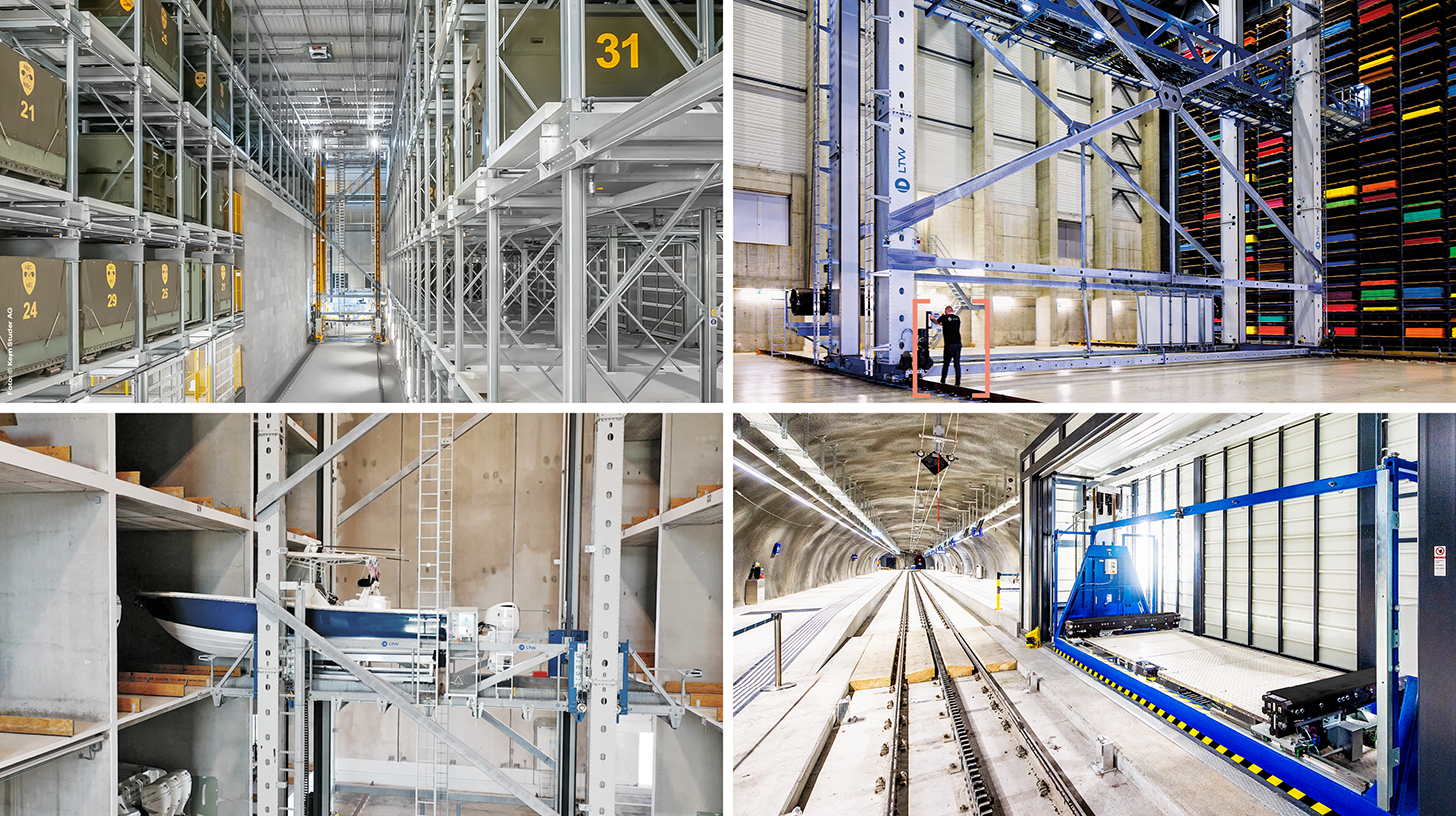
LTW Intralogistics – Engineers of Flow - Image: LTW Intralogistics GmbH
LTW offers its customers not individual components, but integrated complete solutions. Consulting, planning, mechanical and electrotechnical components, control and automation technology, as well as software and service – everything is networked and precisely coordinated.
In-house production of key components is particularly advantageous. This allows for optimal control of quality, supply chains, and interfaces.
LTW stands for reliability, transparency, and collaborative partnership. Loyalty and honesty are firmly anchored in the company's philosophy – a handshake still means something here.
Related to this:
Nearshoring and circular logistics: How regional production secures the supply chain
Turning waste into revenue: How resourceful companies transform the reverse movement of goods into cash
The true economic revolution of reverse logistics lies not only in market growth, but in the fundamental reassessment of the value of returned or obsolete products. For a long time, returns, old devices, and production waste were recorded in balance sheets solely as cost items, linked to depreciation, disposal fees, and storage costs for slow-moving goods. Today, more and more companies are recognizing the significant, previously untapped economic potential hidden within these flows of goods. Refurbished electronic devices now achieve sales prices on specialized platforms that are often only slightly below the price of new products, while the production costs for refurbishment are significantly lower than those for manufacturing a new product. Textile companies are discovering the resale of used clothing as an independent business segment that not only generates additional revenue but also strengthens customer loyalty through a credible sustainability promise.
This development is being massively accelerated by European legislation. The European Union's Ecodesign Regulation, officially designated as Regulation 2024/1781, which entered into force in July 2024, obliges companies to cease destroying unsold consumer products in the clothing, clothing accessories, and footwear categories from July 19, 2026. This obligation will apply to medium-sized companies from July 2030; small and micro-enterprises are currently exempt. This regulation marks a fundamental break with previous practice, in which unsold or returned goods were simply destroyed on a significant scale because this appeared more economically viable than costly reprocessing or reuse. Anyone who does not have a functioning reverse logistics infrastructure in the future will simply be violating applicable law and risks substantial sanctions from market surveillance authorities.
This regulation is complemented by the digital product passport, which will be introduced gradually and become mandatory from 2027 onwards. This passport will provide detailed information on a product's material composition, repairability, CO₂ footprint, and recommended disposal routes via a QR code or RFID chip. For the reverse logistics industry, this represents a significant simplification, as the previously often cumbersome and costly identification and assessment of returned products can now be largely automated. This regulatory framework is expected to be further enhanced by the Circular Economy Act, announced for 2026, which aims to establish a European single market for secondary raw materials and waste, thereby considerably simplifying the legal framework for trade in recycled materials.
For companies with a forward-looking strategy, this offers a twofold advantage. Firstly, systematic backward management can lead to significant cost savings, for example, by reducing disposal fees, recovering valuable raw materials such as rare earth elements from electronic waste, or avoiding penalties under extended producer responsibility. Secondly, it opens up entirely new revenue streams not considered in traditional business models, ranging from repair services and spare parts marketing to proprietary second-hand sales platforms. Particularly innovative companies combine these approaches with subscription models, where customers don't buy products but use them and automatically return them at the end of their lifespan. This allows the manufacturer to retain complete control over the material cycle while simultaneously securing a predictable, recurring revenue stream.
Why the factory of the future is closer to the customer than to the cheapest supplier
The growing importance of reverse logistics and the circular economy as a whole cannot be considered in isolation from a larger structural shift in the global economic order. The past three decades have been characterized by a radical globalization of supply chains, in which production locations were consistently selected based on the lowest manufacturing costs, regardless of geographical distance to the sales market. Container ships transported raw materials and semi-finished products tens of thousands of kilometers before the finished products once again traveled long distances to reach consumers. However, this linear model of making, consuming, and discarding has reached its limits in recent years, triggered by a series of disruptions ranging from the COVID-19 pandemic and the Suez Canal blockade to geopolitical tensions and protectionist trade measures.
These upheavals have triggered a reassessment of the location question, which is discussed under terms such as nearshoring, reshoring, and friendshoring. Companies are increasingly relocating production capacities to geographical or political proximity to their most important sales markets in order to shorten delivery times, reduce dependence on individual supplier countries, and increase the resilience of their supply chains to external shocks. This regionalization of production is closely intertwined with the circular economy, because short distances not only facilitate the outbound journey but also significantly ease the return journey of goods. A product that is manufactured and sold regionally can be returned, repaired, or recycled at the end of its useful life considerably more easily and cost-effectively than a product whose components were manufactured across multiple continents.
This merges two seemingly separate trends into a shared economic logic. The regionalization of supply chains and the establishment of closed-loop material cycles reinforce each other and together form the foundation of a new industrial paradigm that could be described as a regional circular economy. In this model, the vast, highly efficient, but also extremely vulnerable global container routes lose relative importance, while smaller, decentralized logistics networks with shorter transport routes, local high-bay warehouses, and regional processing centers gain in significance. For intralogistics, this means a considerable need for investment, as existing warehouse structures have been largely optimized for one-way goods receipt and now need to be converted for bidirectional goods flow, i.e., simultaneous incoming new goods and returning goods.
Skeptics rightly argue that a complete abandonment of global supply chains would be neither realistic nor economically viable, as certain raw materials and manufacturing expertise are simply not available everywhere, and the economies of scale of global mass production continue to offer significant cost advantages. The reality, therefore, will likely not be a complete end to the linear, global economy, but rather a hybrid structure in which strategically important, time-critical, or highly recyclable product categories are regionalized, while bulk goods with low traceability continue to be moved via global container routes. Nevertheless, the direction of development is clear: the era in which supply chains were optimized solely for the lowest purchase price, without regard for traceability, repairability, and regulatory requirements, is irrevocably coming to an end. Those who invest today in warehouse automation, regional processing centers, and digital traceability systems are positioning themselves for an economic model in which the value of a product no longer ends with its sale, but can be realized again and again throughout its entire life cycle.
In summary, reverse logistics is no longer a fringe topic in business administration, but has developed into a core competency that determines competitiveness, regulatory compliance, and long-term profitability. Its interconnectedness with container logistics, high-bay warehouse technology, and regional production structures makes it clear that this is a systemic issue that cannot be solved by isolated measures. Companies that recognize these interrelationships early on and integrate them into a circular economy strategy will be the winners of the coming industrial transformation, while those that remain stuck in linear thinking patterns expose themselves to increasing regulatory, economic, and reputational risks.
Consulting - Planning - Implementation

Konrad Wolfenstein
I would be happy to serve as your personal advisor.
You can contact me at wolfenstein∂xpert.digital or
Just call me on +49 7348 4088 965 .
Your intralogistics experts

Consulting, planning and implementation of complete solutions for high-bay warehouses and automated storage systems - Image: Xpert.Digital
More information here: