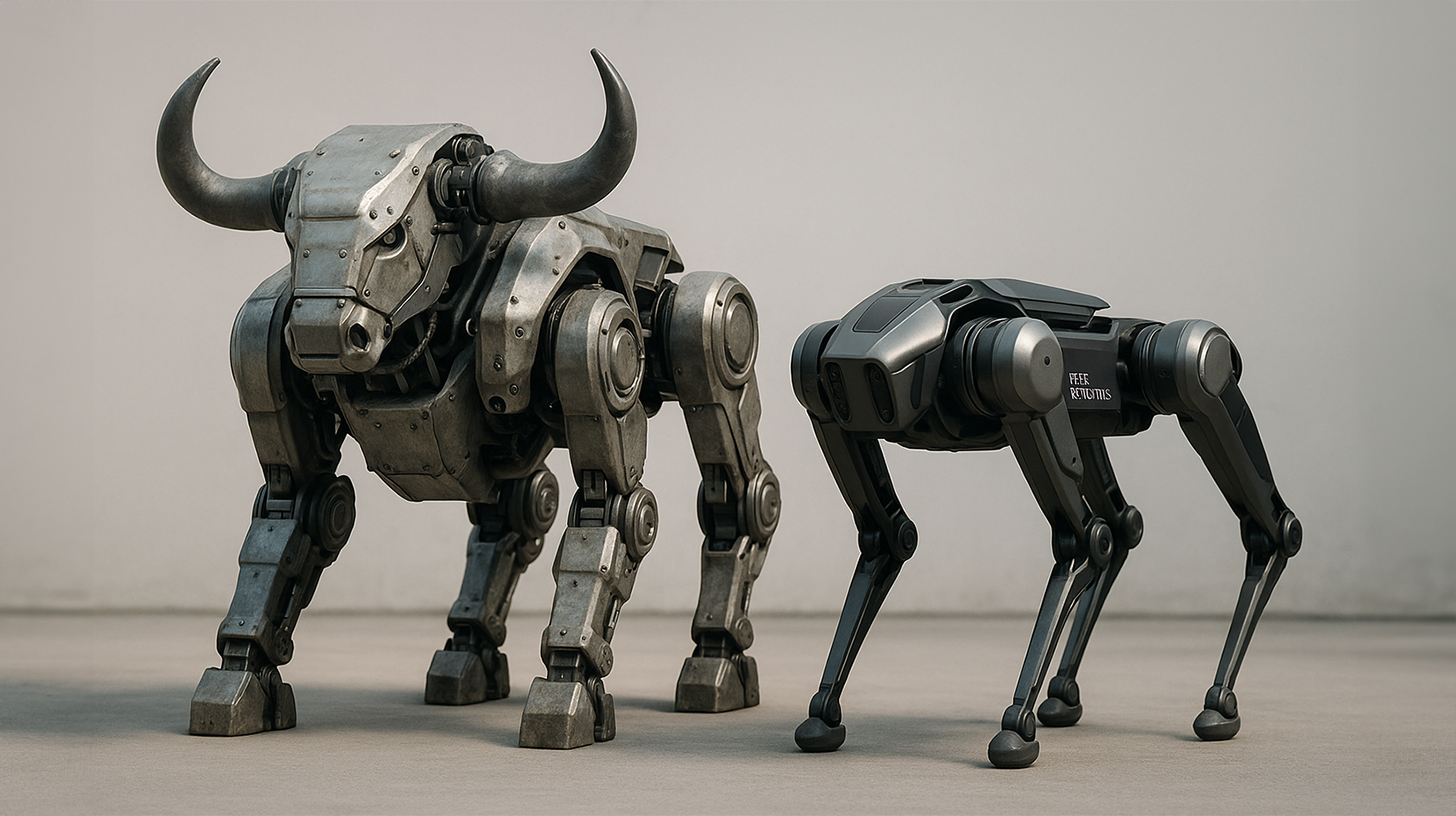
Military quadrupled robots compared: The “mechanical yak” and the “Lynx” robot dog from Deep Robotics – stock image: Xpert.Digital
Quadruped robots in focus: Military giants meet industrial innovations
The future on four legs: The world's largest military robot and the versatile "Lynx"
The field of quadruped robots has seen significant progress in recent years. Two particularly noteworthy developments are China's "mechanical yak," considered the world's largest quadruped military robot, and the versatile "Lynx" robotic dog from the Chinese company Deep Robotics. These robots represent different approaches and application scenarios in military and industrial robotics.
Related to this:


The “mechanical yak” – China’s heavyweight military robot
The so-called "mechanical yak," an electrically powered quadrupedal bionic robot, was unveiled by China in 2022 as "the world's largest and heaviest quadrupedal bionic robot." This imposing machine was specifically designed for military purposes and is distinguished by its impressive payload capacity and off-road capabilities.
Technical specifications and capabilities
The mechanical yak can carry a considerable load of up to 160 kilograms and, despite its size, reaches a top speed of approximately 10 kilometers per hour. The device features 12 joint modules, giving it versatile mobility. It can move forwards and backwards, turn, walk diagonally, sprint, and even jump.
Particularly noteworthy is the robot's adaptability to various terrains. It can operate on challenging surfaces such as steps, trenches, cliffs, muddy roads, snowfields, deserts, and grasslands. This versatility makes it a valuable tool for military operations in remote or difficult-to-access areas.
Military applications
The Chinese military plans to use the mechanical Yak primarily for two purposes. First, it will be used for reconnaissance missions in complex environments that would be too dangerous for soldiers, including remote border regions and high-conflict combat zones. Second, it is designed as a transport system to move supplies such as ammunition and food into difficult terrain.
Furthermore, the robot can be equipped with weapons, which would significantly expand its operational capabilities. The combination of off-road capability, payload capacity, and potential armament makes the mechanical Yak a versatile platform for various military applications.
The "Lynx" robot dog – A hybrid with unique mobility
In contrast to the heavy military yak, the Lynx robotic dog from Deep Robotics presents itself as a more agile and versatile alternative. This robot, unveiled in 2024/2025, innovatively combines the characteristics of a four-legged robot with the speed of a wheeled vehicle.
Innovative wheel-leg combination
The Lynx features a unique design: instead of conventional feet, it has four large, knobby wheels that can be individually locked. This allows it exceptional flexibility in movement. On level surfaces, it can roll quickly on its wheels, while in difficult terrain, the wheels can be locked, and it can be used like feet.
This adaptive mobility allows the Lynx to overcome obstacles up to 80 cm high, climb stairs with steps up to 22 cm, and manage inclines of up to 45 degrees. With a top speed of 5 m/s (18 km/h), it is significantly faster than many other quadruped robots.
Technical specifications and acrobatics
Weighing 30 kg, the Lynx is considerably lighter than the mechanical Yak, yet it can still carry a payload of 12 kg. Its battery life is approximately 3 hours, and it has a range of 15 km. Thanks to its IP54 rating, it is protected against dust and splashing water, allowing it to be used in various weather conditions.
One particularly impressive feature of the Lynx is its ability to perform acrobatic movements, including somersaults. It can move not only on all four legs, but also on three, two, or even just one. This versatility is made possible by intelligent motion control algorithms that allow the robot to autonomously select the optimal mode of locomotion for the given terrain.
Related to this:


Applications
Unlike the primarily military-oriented Yak, the Lynx targets a broader range of applications. It is designed for use in areas such as emergency rescue, hazardous area reconnaissance, remote sensing, and industrial inspection. Its high-definition camera, which transmits real-time video streams, makes it particularly useful for surveillance and inspection tasks.
Its ability to recognize and react to dangerous situations – for example by detecting and avoiding obstacles – makes it an autonomous helper in complex environments.
Comparison and historical context
Both robots represent significant advances in the development of quadruped robots, but have different focuses. While the mechanical Yak specializes in heavy loads and military applications, the Lynx is distinguished by its hybrid mobility and versatility.
In a historical context, both robots are part of a development that began with Boston Dynamics' BigDog, developed in 2005 and capable of carrying up to 150 kg. The Lynx is often compared to other modern robot dogs such as Boston Dynamics' Spot and Unitree's Go2.
Robots for extreme conditions: The next generation of robotics
The development of the "mechanical yak" and the Lynx robotic dog demonstrates the rapid progress in quadruped robotics. The yak showcases China's ambitions in military robotics and could revolutionize logistics and reconnaissance in difficult terrain. The Lynx, on the other hand, represents an innovative hybrid approach that combines the advantages of wheeled and legged locomotion, thereby opening up new operational possibilities.
These robots are harbingers of a future in which autonomous and semi-autonomous robot systems will increasingly take over complex tasks in difficult terrain – whether for military, industrial or civilian purposes.
Related to this: