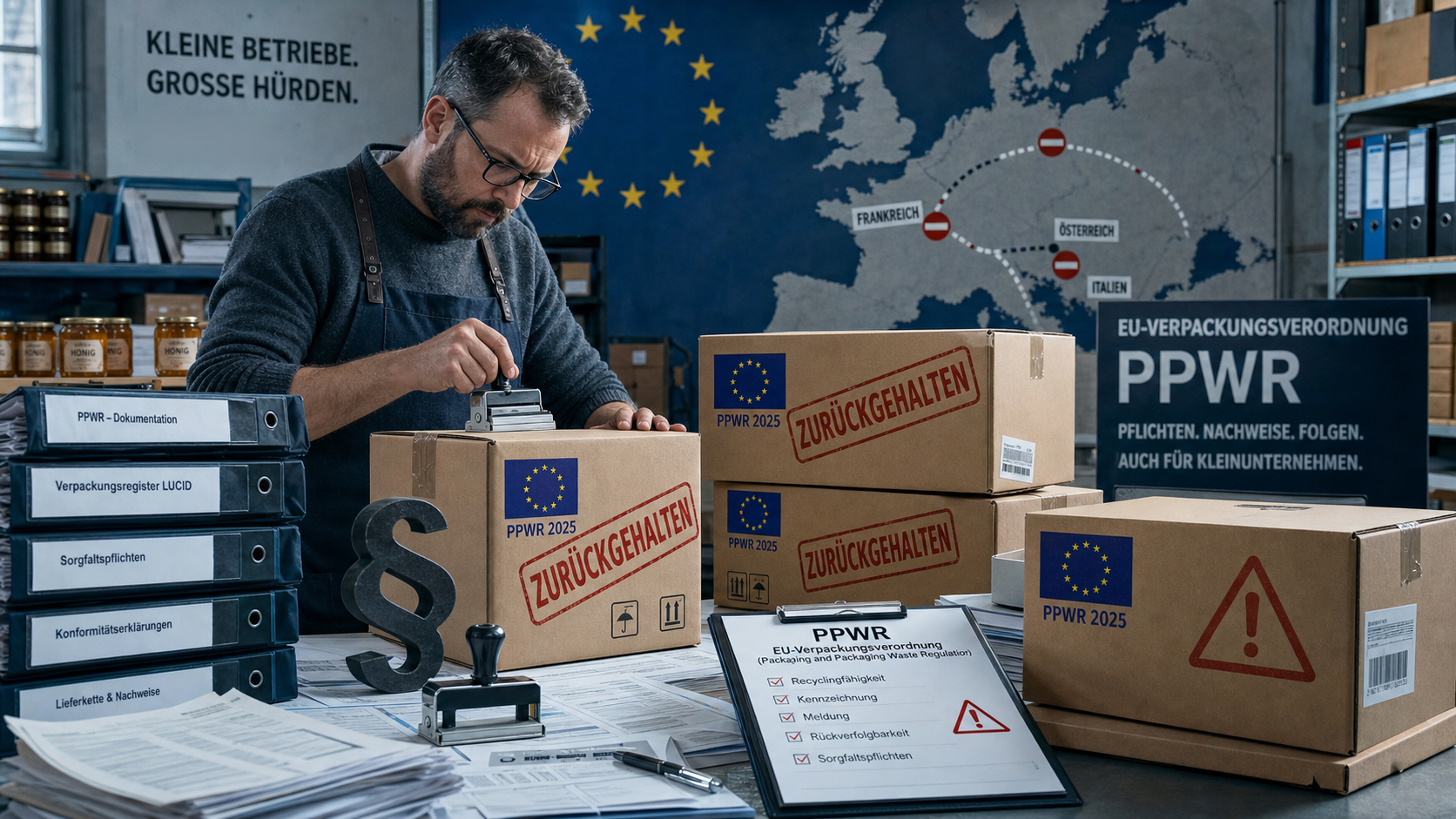
Bureaucratic madness from Brussels: Packaging Regulation PPWR – How Brussels is cutting off SMEs from the EU single market – Image: Xpert.Digital
New packaging law excludes small companies from the EU single market: Because of new EU rule – Why hundreds of German retailers are now stopping shipping abroad
Well-intentioned, disastrously executed: How a new EU environmental law is destroying free trade in Europe – a cost shock for small businesses
Brussels' admission of failure: EU admits errors in new law – but for retailers it is often too late
Well-intentioned, but in practice an economic disaster: Since mid-August 2026, the new Packaging Regulation (PPWR) has been in effect throughout the EU. What was intended as an ecological milestone for a more circular economy and less waste is currently proving to be an unprecedented bureaucratic nightmare for German SMEs. Because small retailers, manufacturers, and craft businesses now have to appoint expensive authorized representatives and complete complex registrations for exports in every single EU destination country, hundreds of them are completely ceasing cross-border shipping. The absurd consequence: Those businesses with the smallest ecological footprint are paying the highest price. A close look at how an environmental law is effectively dismantling the European single market for small businesses, why even the EU Commission admits its mistakes – and what affected businesses can do now.
When the single market becomes a border: Why Brussels of all places is currently dismantling the free movement of goods in Europe
A law with good intentions but bad consequences
Since August 12, 2026, the new Packaging and Packaging Waste Regulation (PPWR) has been in effect throughout the European Union. It replaces the old Packaging Directive from 1994 and aims to finally establish a uniform foundation for the circular economy in Europe. The regulation entered into force on February 11, 2025, allowing for a transition period of one and a half years before it became directly applicable in all 27 member states. The stated goal is ambitious and, at its core, sensible: less packaging waste, more recycling, more reuse, and a noticeable reduction in resource consumption on a continent that has been packaging more than it recycles for years.
The figures cited by the European Commission to justify its actions are indeed impressive and alarming. In 2023, the European Union generated almost 80 million tons of packaging waste, which corresponds to an average of around 178 kilograms per capita. Germany, with approximately 215 kilograms per capita, is significantly above the European average and ranks among the top producers of packaging waste in the EU. Since 2005, the per capita amount of packaging waste in Germany has increased by about 15 percent, a trend that has not been reversed despite waste separation, the yellow bag system, and deposit return schemes. Against this backdrop, the regulatory intervention from Brussels initially appears understandable, indeed, long overdue.
The real problem with the PPWR, however, lies not in its objective, but in its implementation. A well-intentioned law can, in practice, achieve precisely the opposite of its intended effect if the burdens of regulation are unequally distributed and small market participants are structurally disadvantaged. This is exactly what is currently emerging, and the consequences extend far beyond the packaging industry to the very core of the European idea of a free internal market.
Registration requirement and mandatory use of a representative as a new trade barrier
The real bombshell of the regulation lies in a seemingly technical detail. Anyone selling packaged goods to end consumers in another EU member state is legally considered a packaging manufacturer in that destination country and must independently register the packaging there, participate in a disposal system, and report the quantities placed on the market. What is new and particularly burdensome is that companies without their own establishment in the destination country must also appoint an authorized representative there to monitor compliance with extended producer responsibility. This obligation applies across the board to every single cross-border sale, regardless of whether a company ships a thousand packages or just one package a year to another EU country. There is no minimum quantity and no automatic exemption for small businesses.
The resulting costs are a mere rounding error in the balance sheet for a large international corporation, but for a beekeeping operation in the Lüneburg Heath or a small brewery in the Bavarian Forest, they represent an existential hurdle. According to industry associations, registration in a single EU destination country alone can cost more than €500, in addition to several hundred euros annually for appointing a local representative – and that's per country. Those who, like many German direct marketers, historically offer their products in five or six neighboring countries, must therefore expect several thousand euros in fixed annual additional costs before a single extra package has even been shipped. These fixed costs have a degressive effect: they are hardly noticeable for a wholesaler with millions in revenue, but completely ruin the calculations of a micro-enterprise with only a few thousand euros in foreign sales.
This imbalance is particularly evident in the case of the Lower Saxony-based honey manufacturer Eggers. The family business has decided to temporarily suspend shipping its products to other EU countries. Owner Christian Eggers told the tabloid press that the affected goods had already had to be removed from their online shop, resulting in a four-figure loss in revenue. Owner Nevena Eggers succinctly summarized the core issue when she stated that their company already pays for its packaging in Germany and that it is simply unacceptable to be charged again in every single EU destination country. This is not an isolated case; according to reports from industry associations and business media, hundreds of small businesses have joined forces on social media to publicly announce the temporary suspension of cross-border shipping to other EU countries. According to consistent reports, booksellers, breweries, small manufacturers, and numerous beekeepers are particularly affected – precisely those businesses that form the economic backbone of rural regions.
Brussels' self-criticism as a declaration of bankruptcy
What is remarkable about this case is the reaction from Brussels itself. A high-ranking EU official admitted to a German daily newspaper that the regulations in their current form were clearly disproportionate and that the European Commission was already working on amendments. In the future, a single registration for the entire European Union might suffice, and the separate requirement to appoint national representatives would be eliminated. At the same time, the same official urged member states to refrain from applying the new rules for the time being and to avoid imposing penalties, while formally emphasizing that no one would have to cease exports.
This behavior is remarkable from a rule-of-law perspective and sheds a revealing light on the workings of the European legislative machinery. A regulation that applies directly in 27 member states is publicly denounced as disproportionate by one of its own architects, even before it has fully come into effect. At the same time, there are informal calls for its non-application, while formal legal certainty is suggested. For businesses that rely on planning security, this state of limbo is fatal. Who will invest in compliance processes, registrations, and authorized representatives when official sources simultaneously signal that the rules might change again in a few months? And who will forgo international business altogether because the risk of subsequent sanctions is simply incalculable? This very uncertainty explains why numerous small businesses have opted for the most radical, yet safest, option: a complete withdrawal from cross-border trade.
In fact, at the end of 2025, the European Commission had already proposed, as part of a so-called simplification package (internally referred to as the Omnibus Package), to temporarily suspend the obligation for companies established in the EU to appoint national representatives until 2035. This proposal covered not only packaging but also batteries, electrical and electronic equipment, textiles, and certain single-use plastic products. However, the Council of the European Union suspended deliberations on this proposal in the summer of 2026 because a large majority of member states had opposed the planned relief. As a result, the Product Safety and Compliance Regulation (PPWR) entered into force on August 12, 2026, in precisely the burdensome form that the Commission itself had deemed in need of reform just a few months earlier. The affected companies are thus caught between two opposing political levels, while the costs and uncertainties are already being fully borne by the businesses.
Why small businesses are the real losers
From an economic perspective, the PPWR (Product Packaging and Packaging Regulation) is a classic example of regressive regulatory costs. Fixed bureaucratic costs, such as registration fees or the remuneration of an authorized representative, are incurred regardless of sales volume. For a corporation with a Europe-wide distribution network and an existing compliance department, these costs are marginal and can be spread across a high sales volume. For a micro-enterprise with just a few employees, however, these same fixed costs quickly reach a level that exceeds the entire profit from international business. While Article 3 of the regulation provides some relief for micro-enterprises with fewer than ten employees and an annual turnover of less than two million euros, this exception primarily concerns the question of who qualifies as the domestic packaging manufacturer when standard packaging is sourced from a domestic supplier. This relief does not apply to cross-border direct sales to end consumers in other member states, as several specialized law firms have agreed that the distributor remains fully subject to registration and authorization requirements.
This creates a paradoxical effect: precisely those economic actors who, due to their small size, naturally produce the smallest ecological footprint, bear the highest regulatory burden relative to their revenue. The large online retailer with standardized logistics processes and specialized legal departments can integrate the new requirements into existing systems. The beekeeper who ships twenty jars of honey a year to France cannot. For him, the investment in registration and authorized representatives simply isn't worthwhile, even if there were demand from abroad. The economically rational reaction is withdrawal, and this withdrawal is precisely what we are currently witnessing in large numbers.
This development fundamentally contradicts the basic principle of the European single market, which, since the Treaties of Rome, has been based on the free movement of goods across national borders. A regulation that was actually intended to create a uniform European set of rules is, in practice, leading small suppliers to voluntarily withdraw to their national home markets because cross-border operations are simply becoming unprofitable. From the perspective of consumers in France, Austria, or Italy, this means a noticeable reduction in product variety. Anyone wanting to order German Manuka-like forest honey, a niche book from a small German publisher, or a craft beer from a regional microbrewery will more frequently find themselves facing closed virtual storefronts.
Our EU and German expertise in business development, sales and marketing


Our EU and German expertise in business development, sales and marketing - Image: Xpert.Digital
Industry focus areas: B2B, digitalization (from AI to XR), mechanical engineering, logistics, renewable energies and industry
More information here:
A thematic hub offering insights and expertise:
- Knowledge platform covering global and regional economies, innovation and industry-specific trends
- A collection of analyses, insights, and background information from our key areas of focus
- A place for expertise and information on current developments in business and technology
- A hub for companies seeking information on markets, digitalization, and industry innovations
EU Packaging Regulation: Regulation instead of a single market – How the PPWR is pushing small businesses out of foreign trade
The timing could hardly be worse
The timing of this new burden is particularly critical. The German economy has been in a period of structural weakness for several years, from which it is only tentatively beginning to recover. After two years of economic contraction, gross domestic product (GDP) grew by a mere 0.2 percent in 2025. The German government anticipates growth of around 1.0 percent for 2026, which, while a positive sign, does not yet represent a fundamental turnaround. At the same time, Germany is experiencing its highest number of corporate insolvencies in ten years, with small businesses and the industrial sector being hit hardest. According to associations representing small and medium-sized enterprises (SMEs), the first quarter of 2026 saw the highest number of insolvencies in twenty years, exacerbated by geopolitical shocks, rising wages, and a tax burden that is above average by international standards.
German industry has been steadily cutting jobs for years. Since 2019, the pre-pandemic year, more than 340,000 industrial jobs have disappeared, a decline of over six percent, and according to forecasts by auditing firms, another 150,000 jobs could be lost in 2026 alone. The Bundesbank, in its July 2026 monthly report, also documented that bureaucratic costs for companies, relative to annual revenue, rose from around five percent to approximately seven percent between 2022 and 2024, demonstrably hindering productivity growth across the entire business sector. In surveys, small and medium-sized enterprises (SMEs) regularly cite overregulation and bureaucracy as their greatest economic risk, even ahead of rising labor, raw material, and energy costs.
In this environment, the PPWR sends an additional signal that can hardly be described as helpful. While the German government, in its 2026 Annual Economic Report, identifies the reduction of excessive bureaucracy to the tune of billions of euros as a central reform goal and announces a modernization agenda, the European level, with the PPWR, is effectively creating a new trade barrier for precisely those business sizes that already suffer most from the cost burden. It is a prime example of the lack of coherence between national deregulation rhetoric and supranational regulatory practice. German politicians can announce as many red tape packages as they like, but if new, regressive regulations simultaneously emerge from Brussels, the net effect for small businesses remains negative.
Between circular economy and competitiveness
It would be too simplistic to dismiss the PPWR (Products Packaging and Films Directive) as mere unnecessary over-regulation. The underlying environmental problems are real, and the need for a circular economy on a continent with limited resources and growing waste volumes is undeniable. The regulation contains numerous sensible elements, such as limiting the empty space in shipping and transport packaging to a maximum of fifty percent, binding recycling quotas for individual materials like plastic, paper, and metal, and the introduction of a uniform EU-wide labeling system using QR codes, which provides consumers with information on material composition and recyclability. These elements genuinely address structural weaknesses in the previous European packaging legislation, which, through 27 different national implementations of the old directive, had created a patchwork of differing standards.
The real failure lies not in the objective, but in the lack of proportionality in its cross-border application. A European legislator who wants to strengthen the single market should have established a central, EU-wide registration procedure from the outset, instead of forcing companies to register separately in each individual target country and pay for their own representative in each one. It is precisely this lack of digitalization and centralization that turns a fundamentally sensible environmental law into a de facto trade barrier. Significantly, the European Commission itself has recognized this design flaw, as the above-quoted statement by the EU official demonstrates, but the political reaction speed of the European institutions is glaringly disproportionate to the speed at which affected small businesses have to adapt their business models.
On June 10, 2026, the Commission published guidelines on the interpretation of 33 key points of contention in the regulation, aiming to provide at least short-term legal certainty. However, further detailed regulations are not expected to follow for another two to three years through additional implementing acts. A more comprehensive review of extended producer responsibility was announced for autumn 2026, though it remains entirely unclear whether and when this will actually lead to any simplifications for cross-border online trade. For the affected businesses, this means months of uncertainty, while competitors from third countries, who are not subject to these requirements to the same extent, can continue to operate unhindered.
A structural problem of European legislation
The case of the Packaging Ordinance is instructive beyond its specific scope because it reveals a recurring pattern in European legislation. Regulations are frequently designed with large, pan-European companies in mind, companies that possess the organizational and financial resources to meet complex compliance requirements. The impact on small and micro-enterprises is either underestimated or addressed only retrospectively through selective exemptions that are often too narrowly defined in practice to be truly effective. Similar debates arose with the EU Supply Chain Directive, the withdrawal or weakening of which was perceived as a significant relief by German SMEs, and with the General Data Protection Regulation (GDPR), whose bureaucratic implementation burden disproportionately affected small businesses.
The fundamental dilemma lies in the fact that the European Union, as a legal area of 27 member states, strives for uniformity, yet administrative responsibilities in many areas remain with the member states. It is precisely this dual structure—EU-wide uniform substantive law coupled with persistent national administrative fragmentation—that creates the greatest burden for businesses. As long as each country maintains its own packaging register, its own reporting formats, and its own requirements for authorized representatives, the European single market remains, in practice, a patchwork of 27 national bureaucracies for small players, even if the substantive law has been formally harmonized.
From an economic policy perspective, genuine harmonization, for example through a central EU register modeled on existing digital single market instruments, would be the obvious solution. Such a system would allow a company to register once centrally, with this registration being valid EU-wide, similar to how certain VAT procedures in e-commerce already work. The original Commission proposal to suspend the requirement for authorized representatives, which was subsequently blocked by the Council, aimed precisely in this direction. The fact that it was the member states themselves, and not business lobbyists, that prevented this simplification points to a structural interest of national administrations in maintaining their own powers and fee revenues—a fact that has received too little attention in the public debate so far.
What's at stake for German companies now
For German small and micro-enterprises with cross-border business, the current situation presents several concrete courses of action, each with its own economic consequences. The most radical, but also the least risky option, is a complete withdrawal from international shipping, as the Eggers honey manufactory and apparently hundreds of other businesses have already implemented. While this strategy avoids any risk of fines, it means a permanent loss of international sales and, in the worst-case scenario, the loss of long-standing international customer relationships that cannot easily be regained once shipping resumes.
A second option is to bear the costs of registration and authorized representatives and factor them into the prices. However, this is only economically viable with a sufficiently large international volume and structurally excludes small providers with low cross-border sales. A third, increasingly used option is to collaborate with specialized service providers or industry associations that act as joint representatives for several small businesses simultaneously, thereby achieving economies of scale that can significantly reduce costs per individual company. Associations such as the German Retail Federation (HDE) are already heavily involved in this area and offer practical guidance to affected members.
In the long term, the answer to whether the current situation proves to be a temporary transitional difficulty or a permanent impairment of intra-European trade depends largely on the political will in Brussels and the member states. Should the review of extended producer responsibility announced for autumn 2026 actually lead to a centralized, EU-wide uniform registration system, the current burden could prove to be a transitional phenomenon. However, should every attempt at simplification fail in the Council of Member States, as already happened in summer 2026, there is a risk of a permanent shrinking of the European single market for small suppliers, with noticeable consequences for product diversity, regional value creation, and ultimately also for the confidence of small and medium-sized enterprises (SMEs) in European integration as a whole.
The packaging regulation itself will hardly be the last example of this kind. As long as European legislation systematically underestimates the implementation costs for small market participants and administrative procedures remain fragmented at the national level, the pattern of a creeping renationalization of economic activity will repeat itself, each time with the same result: Large corporations adapt, small businesses withdraw, and the much-vaunted European single market remains a promise without practical substance for precisely those companies that need it most to grow.
📈🚀 From visibility to trust 👀🤝 Your scalable path with Xpert.Digital


From visibility to trust: Your scalable path with Xpert.Digital - Image: Xpert.Digital
In industrial B2B, sustainable business relationships rarely emerge overnight. They develop step by step – through visibility, professional relevance, recurring touchpoints, and growing trust. Xpert.Digital's 4-stage model addresses precisely this: It offers a structured path that begins with a manageable entry point and can evolve into deeper collaboration in business development if needed.
Instead of relying on loud marketing promises, this model puts the relationship at the forefront. Companies start with clearly defined, easily calculable measures and then decide, based on their own experience, how far they want to expand the collaboration. A key factor for this undisturbed trust-building process: The platform completely avoids annoying advertising ads, so the editorial focus remains solely on the companies' expertise.
More information here:
Consulting - Planning - Implementation

Konrad Wolfenstein
I would be happy to serve as your personal advisor.
You can contact me at wolfenstein∂xpert.digital or
Just call me on +49 7348 4088 965 .