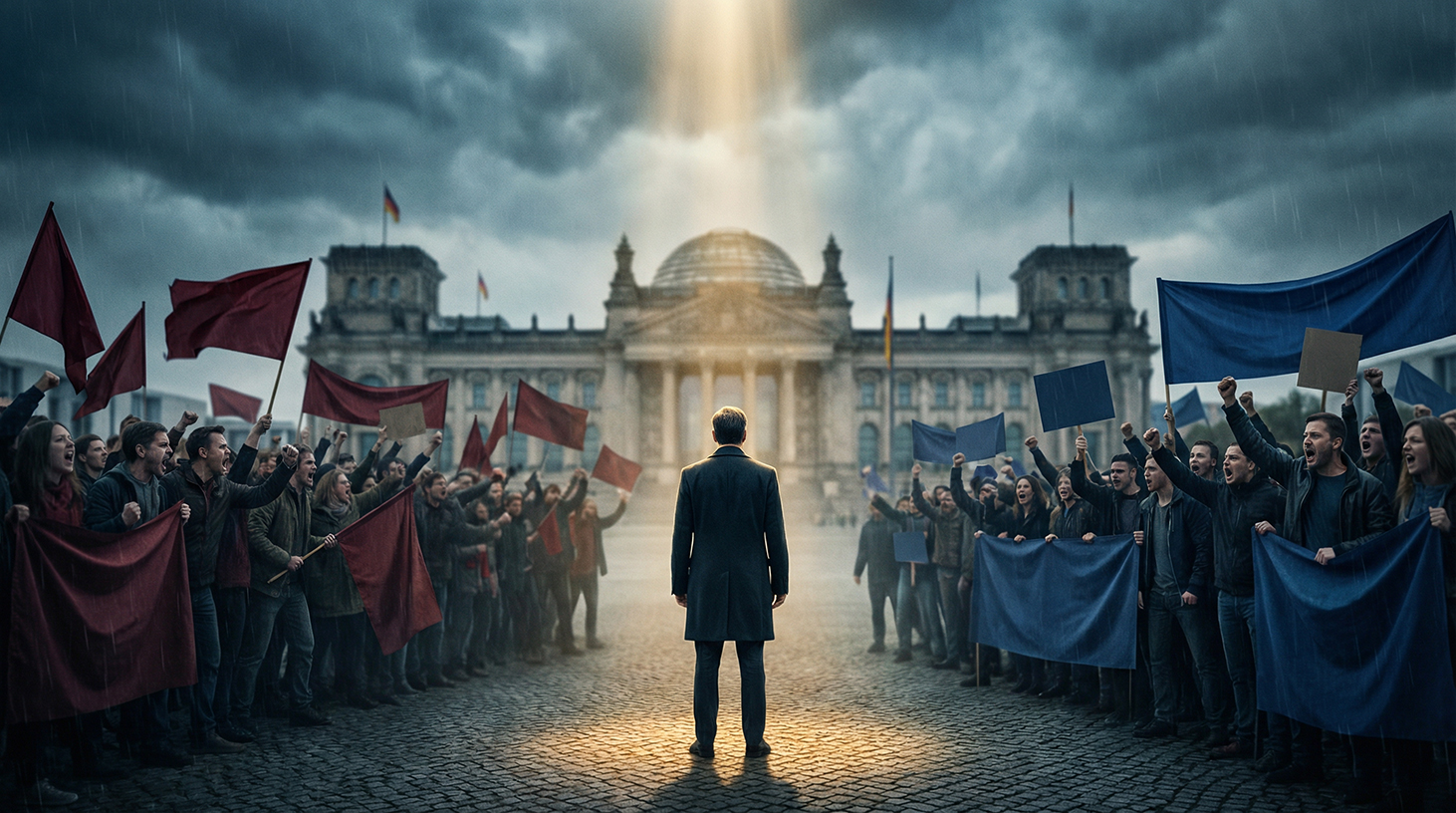
Outrage as a program – Why knee-jerk opposition undermines democracy – Image: Xpert.Digital
Historic loss of trust: Why Germans no longer believe in politics
Dangerous spiral: How social media and party tactics are radicalizing the political extremes
The Power of Uproar: Why Ideological Bluster Pays Off for Political Parties Today
The political debate in Germany is at a dead end. Instead of seeking viable solutions, the only point of contention is the loudest outrage. Parties are increasingly distinguishing themselves through reflexive confrontation and ideological intransigence, while public trust in democracy is plummeting to a historic low. But this affective polarization and tactics like the oft-cited "firewall" do not solve any real problems—on the contrary, they strengthen the political extremes and paralyze the country. This article analyzes the psychological, media, and economic mechanisms behind this constant outrage. It demonstrates why pragmatic compromises are not a sign of weakness and why Germany urgently needs a return to genuine political thinking if it is to master its future.
When violence becomes a matter of state policy and what is feasible falls by the wayside
The political climate in Germany has changed – not quietly and gradually, but with an acceleration that has even seasoned observers of parliamentary proceedings taking notice. Anyone looking at the political landscape today encounters a phenomenon that cuts across all camps: reflexive, ideologically charged opposition. Left and right alike no longer primarily argue for something, but rather shout against something. The result is a democratic culture in which volume has replaced substance and outrage has become the most important political currency. This article analyzes the economic, psychological, and political mechanisms behind this phenomenon – and asks what a responsible politics would have to achieve instead.
The phenomenon of reflexive contradiction: when no becomes the only answer
It begins with an observation that is astonishing in its simplicity: Almost every political initiative is reflexively followed by organized outrage – regardless of the measure's content. If it's an increase in the minimum wage, a chorus of those who see it as the downfall of the market economy forms. If the government plans investments in infrastructure, others immediately warn of a debt-ridden state. When climate protection is discussed, some rail against bans and paternalism, while others denounce any compromise as a betrayal of the planet. This pattern is not random – it follows an internal logic arising from the incentive structures of modern party competition.
What gets lost in this process is the capacity for nuanced positioning. Political thinking—that is, the ability to situate one's own stance within the broader context of the common good and to consistently consider potential solutions—is increasingly perceived as a weakness because it signals a willingness to compromise. But in a democracy, a willingness to compromise is not a weakness; it is the very condition of political action. Those who suppress this insight are no longer engaging in politics—they are merely staging a performance.
The economics of protest: Why ideological bluster pays off in the short term
To understand why knee-jerk opposition is so widespread in politics, one must analyze the incentive structure in which parties and politicians operate. The political market rewards visibility – and in today's media landscape, visibility arises from exaggeration, confrontation, and emotional clarity. A party that says, "We see the problem, but the solution is complex and requires careful consideration," generates little resonance. A party that says, "This is a betrayal of the German people," gets clicks, headlines, and airtime.
The 2025 federal election documented this dynamic in stark figures. The AfD achieved a historic record result with 20.8 percent of the vote, becoming the second-strongest party in the Bundestag. At the same time, the CDU/CSU and SPD together barely managed 45 percent – a provisional low point in the history of the Federal Republic. And the traffic light coalition, which had committed itself programmatically to differentiation and pragmatic governance, lost almost 19.5 percentage points. The message to all involved was clear: pragmatism is risky from an electoral perspective, while outrage pays off.
However, social psychologist Elmar Brähler, who co-authored the Leipzig study on authoritarianism, puts this finding into perspective: The rise of the AfD is based less on the increase in right-wing extremist attitudes within the population than on the failure of established parties to address people's concerns. This may sound like a semantic distinction, but it is politically fundamental. It means that a significant portion of the protest votes do not express programmatic agreement, but simply represent the consequence of political failure.
Loss of trust as a systemic crisis: What the numbers really say
The figures on the political crisis of confidence in Germany are well-known – but their depth is still underestimated. According to a representative survey conducted by the Körber Foundation in 2025, only 45 percent of Germans still have confidence in democracy as a system. Only one in ten says they have great confidence in political parties. And according to data from the Cologne Institute for Economic Research (IW Köln), a mere 14 percent of Germans believe that the next generation will be better off than the current one. These are not mere fluctuations in mood – this is a structural loss of trust that undermines the very foundation of legitimacy for democratic politics.
What is particularly alarming is that 62 percent of those surveyed doubt Germany's ability to tackle the key challenges of the future – an increase of 12 percentage points compared to 2023. And in a Forsa poll from March 2025, 43 percent of respondents believed that no single party possessed the competence to solve the most important political problems. This is no longer just dispassionate criticism – it is a form of political exhaustion manifesting itself in collective resignation.
But these figures are not a one-way street to democratic decline. They also serve as a diagnosis: Citizens sense very precisely when politics prioritizes self-promotion over problem-solving. When parties reflexively say no instead of constructively shaping policy. When outrage is sold as a substitute for a coherent plan. This public awareness is a valuable resource – if political actors are willing to take it seriously.
The polarization paradox: Emotional charge blocks the way out
The Mercator Forum on Migration and Democracy (MIDEM) at TU Dresden, in its 2025 Polarization Barometer – a survey of nearly 34,000 people in eight EU countries – introduced an important distinction that is indispensable for political analysis: the differentiation between ideological polarization (i.e., differences of opinion on content) and affective polarization (the emotional charge of these differences). More than 81 percent of Germans perceive society as divided. They attribute the greatest potential for division to the issues of immigration, climate protection measures, and support for Ukraine.
The dangerous aspect of this situation is this: there are indeed issues on which a certain consensus exists regarding the substance of the matter – but the emotional charge makes any constructive dialogue impossible. Political opponents become enemies. And, according to the political logic of current politics, one does not compromise with enemies. The constitutional scholar Carl Schmitt had already described this friend-enemy dichotomy as the core of politics – and the Weimar Republic best demonstrated where a democracy leads when this way of thinking triumphs. The political parties elevated the rejection of any willingness to compromise to a fundamental principle of German identity – with well-known consequences.
Empirical findings show that emotional tensions increase sharply during election campaigns and can be reduced again after elections – especially when voters feel like winners or their party is part of the government. This is not a law of nature, but it shows that affective polarization is not an inevitable fate, but rather a factor that can be shaped politically. Political thinking also means understanding this dynamic and not fueling it.
State-political thinking as a counter-model: The feasible as the benchmark
What exactly is meant by political thinking – and why is it superior to mere party-based thinking? Political science is familiar with the distinction between polity (institutional structures), politics (political processes and power issues), and policy (substantive policy decisions). Political thinking operates on all three levels simultaneously: It asks not only what one would like to achieve, but also what is feasible within the given institutional framework, what processes are necessary to achieve it, and what substantive compromises must be made. Politics that focuses on what is feasible is thus, by definition, pragmatic – without being devoid of substance.
In his lecture "Politics as a Vocation," Max Weber coined the term "ethics of responsibility," which aptly describes this political thinking. While the ethics of conviction focuses solely on the purity of one's intentions and ignores the consequences of actions, the ethics of responsibility places precisely these consequences at the center: What is the actual effect of my actions? What consequences does my position have for the community? Those who think politically cannot hide behind the purity of their convictions—they must share responsibility for the consequences of their stance.
The opposite is often demonstrated by current political practice: positions are chosen not for their feasibility, but for their impact on public opinion. Demands are made that the proponents know will never be implemented – precisely because implementation is not the goal. The goal is mobilization. The goal is outrage. The goal is to send a signal to their own constituency: We're fighting for you – regardless of whether there's any prospect of success or not. This form of political staging may be rationally sound from an electoral perspective, but it is destructive from a political standpoint.
Compromise as a core democratic virtue: strength, not weakness
In the public eye, compromise suffers from a massive image problem. It is seen as "lazy," a result of a lack of consistency, a sign of political spinelessness. This perception is wrong – and its prevalence is itself a symptom of the crisis described. Former Chancellor Willy Brandt put it succinctly: "Compromises are the essence of democracy." Konrad Adenauer added, after the final vote on the Basic Law, that a compromise always has the advantage of forcing cooperation and getting to know one's political opponent.
Political scientist Ulrich Willems formulated it more analytically: Where compromise is impossible, conflicts are either decided authoritatively by decree or provoke a violent solution. Democracy is therefore not strong despite its willingness to compromise – but because it is capable of compromise. Coalition parties find themselves in a constant tension between the need to represent their own position and the requirement to govern together. Anyone who flees from this tension by declaring unconditional intransigence a virtue abandons the foundations of democratic practice.
The demand for uncompromising principles has another, rarely considered dimension: it is elitist. It presupposes that one's own viewpoint is so completely correct that its implementation requires no consideration of other perspectives. This is fundamentally an anti-democratic stance, because democracy is based on the basic premise that no single group or party possesses the sole truth.
The digital amplification spiral: How social media brings out the worst in us
No phenomenon today can be fully understood without its digital dimension – and this is especially true for political polarization. Social media are not the cause of the crisis described, but they are its most powerful amplifier. The internet is considered a catalyst for emotions and outrage, and it is undisputed that digital communication plays a key role here. The logic of the platforms – reach is generated through engagement, engagement arises from emotional charge – systematically rewards the outrageous over the nuanced.
But the digital space doesn't just favor one side of the political spectrum. It creates echo chambers for all sides, where one's own viewpoint is constantly confirmed and the opposing one is caricatured. It's a confirmation bias spiral: people preferentially seek out information that supports their own opinions, which deepens political divides and further erodes common ground for discussion. Anyone who wants to think in terms of national policy must actively resist this spiral – through curiosity about the other side's arguments, through a willingness to revise their views, and through public intellectual discourse instead of digital displays of outrage.
Our EU and German expertise in business development, sales and marketing

Our EU and German expertise in business development, sales and marketing - Image: Xpert.Digital
Industry focus areas: B2B, digitalization (from AI to XR), mechanical engineering, logistics, renewable energies and industry
More information here:
A thematic hub offering insights and expertise:
- Knowledge platform covering global and regional economies, innovation and industry-specific trends
- A collection of analyses, insights, and background information from our key areas of focus
- A place for expertise and information on current developments in business and technology
- A hub for companies seeking information on markets, digitalization, and industry innovations
Between outrage and responsibility: Political thinking instead of knee-jerk reactions
The failure of the political center and the self-radicalization of the fringes
It would be convenient to place the blame for this situation solely on the political extremes. But that's too simplistic. The erosion of the political center is not a natural phenomenon—it has political causes rooted in the performance of the established parties. According to the Federal Agency for Civic Education, the party system has transformed into a fluid, pluralistic system characterized by polarization, fragmentation, and segmentation, thereby threatening the stability of democracy. The major parties, the CDU/CSU and the SPD—once engines of integration that held broad segments of society together—are steadily losing voter support, while challenger parties that prioritize political protest and anti-establishment positions are gaining ground.
What did the established parties do wrong? The empirical answer is sobering: they simply failed to address the concerns of significant segments of the population in a number of key policy areas. Migration, internal security, energy costs, fear of economic decline – for years, a gap existed in these areas between what the population perceived as the most pressing problems and what the political agenda primarily debated. Other parties grew out of this gap – not because their solutions were better, but because they recognized and named the gap in the first place.
The firewall: Democratic shield or “state-political” excuse?
No term has polarized German domestic politics in recent years as much as the so-called firewall. At its core, it refers to the joint decision of the democratic parties not to enter into any coalitions or parliamentary cooperation with the AfD. Today, after the 2025 federal election, the AfD garnered 20.8 percent of the vote and is the second-largest party in the Bundestag. The central question that must be asked here, with analytical honesty, is therefore: Is the firewall a sign of a resilient democracy – or has it primarily become a convenient instrument for evading the real challenges of political thought?
The answer demands an honesty that is regularly lacking in public debate. The most frequent argument used to legitimize the firewall is the classification of the AfD by the Federal Office for the Protection of the Constitution (BfV). This argument is cited like a law of nature – as if it renders all further discussion moot. But constitutional law expert Oliver Lepsius from the University of Munich points to a structural tension: One could simply accuse the BfV of being a political agency whose mandate to monitor and evaluate legal political activities is inconceivable in other Western democracies. Journalist and legal scholar Ronen Steinke puts it even more sharply: The BfV is an agency that can be politically instrumentalized – a problem that manifests itself not only against the right wing, but also when climate activists are targeted because they question the compatibility of climate protection and capitalism.
This very imbalance reveals one of the blind spots in the firewall debate. The youth organizations of the SPD, the Greens, and the Left Party publicly called for the complete abolition of the Office for the Protection of the Constitution (Germany's domestic intelligence agency) – after the Berlin state agency classified the climate group "Ende Gelände" as left-wing extremist. The Green Youth declared at the time that the Office for the Protection of the Constitution was confusing anti-capitalism with hostility towards democracy. That state surveillance is acceptable when it targets the political opponent, but should be abolished when it targets one's own camp – this is precisely the double standard that structurally corresponds to the knee-jerk opposition described in this article. Political thinking must apply a uniform standard: either one trusts the instrument, or one questions it – regardless of whom it affects.
Even if one considers the classification as a security risk to be reliable, the strategic record of the firewall is disastrous. Former CDU General Secretary Peter Tauber put it succinctly: the higher the firewall was built, the stronger the AfD became. He therefore recommends a new policy of red lines – one that allows for resolutions to which the AfD agrees without abandoning core policy positions. Democracy researcher Simon Franzmann adds a pragmatic point: how is day-to-day parliamentary work supposed to function with the large AfD factions if every form of cooperation is excluded? Every committee meeting requires a minimum number of parliamentarians – and every time AfD members make a meeting possible simply by their presence, this can be portrayed as a breach of the firewall strategy. This is not a theoretical debate, but parliamentary practice in East Germany, where the AfD holds over 35 percent of the vote and is thus virtually unavoidable in the legislative process.
The firewall can be legitimate from a political standpoint in certain situations – but it must not become a substitute for substantive political thought. If it serves to avoid engaging with the concerns that drove people to the AfD in the first place; if double standards in dealing with the Office for the Protection of the Constitution are accepted as long as they target the right target; if it serves as justification for simply refusing to talk to a fifth of the electorate – then the firewall is precisely what this article begins with: knee-jerk opposition as a substitute for substantive political discourse. A resilient democracy doesn't need higher walls. It needs better answers.
Integrity as political capital: The long-term economics of credibility
There is another, often overlooked argument against knee-jerk opposition: it is economically irrational in the long run, even if it scores points in the short term. Parties and politicians who constantly rely on outrage and rejection without offering constructive alternatives deplete their political capital faster than they build it up. Voters who vote today as a form of protest expect results sooner or later – and those who cannot or will not deliver them in the long term gain nothing.
A political profile is built on substance, not volume. Those who can explain their position, define its limitations, disclose conflicting objectives, and yet propose a viable path forward gain political credibility and acceptance – precisely because they don't promise everything the public wants to hear. Credibility isn't built on consistency in contradiction, but on consistency in substance. Someone who always says no is consistent in contradiction – but they haven't solved a single problem.
Publicity stunts and self-promotion: The legitimate and the illegitimate sides of the political trade
It would be naive to demand that political parties refrain from stirring up emotions. Party politics is, by definition, also communication politics, and the ability to set the agenda, generate emotional resonance, and mobilize one's electorate is part of the political craft. Stirring up emotions and clamoring for attention are legitimate tools – as long as they serve the ultimate goal: the struggle for the best policies for the common good.
The problem arises where fear-mongering becomes an end in itself. Where outrage no longer points to a political goal, but is itself the goal. Where the party no longer asks: "What can we change?" – but rather: "What will bring us the most attention?" This transition is fluid and difficult to discern in everyday politics. But it marks the difference between a party that wants to and can govern, and a party that wishes to remain permanently in the comfortable position of moral superiority – without having to bear the burden of responsibility.
The paradox of this attitude is that it systematically undermines one's own credibility. Anyone who is never willing to critically examine their own position, who perceives thinking focused on possible solutions as a betrayal of their own values – loses the trust of those voters who, while harboring fundamental sympathy for the political camp, are wise enough to distinguish between rhetoric and substance.
On the principle of what is feasible: Realpolitik as a democratic responsibility
The tradition of Realpolitik – shaped in Germany by August Ludwig von Rochau after the failed revolution of 1848 and later theoretically grounded by Max Weber's ethics of responsibility – does not consist of cynical power pragmatism, but rather of the sober realization that political action must be measured against reality. Realpolitik is oriented towards conditions and possibilities recognized as real and is aimed at making rapid decisions. The crucial step in this process is not the rejection of values, but the willingness to negotiate values and means from the perspective of what is achievable.
A policy that focuses on what is achievable is not a policy without convictions—it is a policy that takes its convictions seriously enough to confront them with reality. That is the difference between a program and a manifesto: The program must prove itself in the day-to-day work of governing, while the manifesto has it easy because it never has to be implemented. Those who write only manifestos evade the democratic test. And those who persistently evade this test should not be surprised when voters reward them—negatively.
Political thinking therefore means: recognizing limits without being defeated by them; identifying impossibilities without remaining trapped within them; seeking what is feasible without losing sight of what is desirable. This balance is more demanding than professing the purity of one's own convictions – but it is the only balance that truly has an impact in a democracy.
What constitutes a political profile: substance, nuance, solution-oriented approach
Ultimately, the question remains: What specifically needs to change? Three dimensions can be identified that distinguish a state-political profile from mere party activism.
First: The willingness to justify one's own position and to define its limits
A party that says, "We want X, but we recognize that Y and Z oppose it, and therefore we propose W as a pragmatic step"—this party demonstrates intelligence, not weakness. It shows that it respects the complexity of reality instead of trying to define it away.
Secondly: The ability to develop and offer solutions, instead of limiting oneself to criticism
Opposition is necessary and valuable in a democracy – but it only fulfills its function if it not only points out what is wrong, but also what could be better. Those who only criticize without actively shaping policy have little political influence.
Thirdly: The courage to challenge one's own electorate and not just confirm it
Democratic leadership also means speaking uncomfortable truths, explaining compromises, and presenting dialogue with political opponents not as betrayal, but as a normal part of democracy. This may be unpopular in the short term, but in the long run it builds the trust that current polling data so dramatically lacks.
Democracy needs maturity – not purity
The crisis of German democracy is real – but it is not a crisis of democracy as an idea. It is a crisis of its practice, fueled by political actors who have learned that emotions and outrage are more profitable than explanations, that rejection mobilizes and support paralyzes, that their own base is more easily held together by demonizing enemies than by proposing solutions. This logic is destructive – because it erodes precisely the credibility upon which democratic institutions depend.
What is needed is not a political purge, nor a return to an idealized past that never existed. What is needed is a democratic maturity that can tolerate thinking in contradictions, acknowledging shades of gray, and prioritizing the feasible over the perfect. Willy Brandt's dictum that compromise is the essence of democracy is not an invitation to arbitrariness. It is a description of the only political process that has thus far reliably been able to resolve social conflicts without violence. Anyone who abandons this process in favor of staging, ideology, and the management of outrage is sawing off the branch they are sitting on. Democracy does not need politicians who get everything right. It needs politicians who are prepared to fight for what is right—even if the path to achieving it leads through compromise.
Your global marketing and business development partner
☑️ Our business language is English or German
☑️ NEW: Correspondence in your native language!

Konrad Wolfenstein
I and my team are happy to be available to you as your personal advisor.
You can contact me by filling out the contact form here wolfenstein@xpert.digital:or simply call me at +49 7348 4088 965. My email address is
I'm looking forward to our joint project.
☑️ SME support in strategy, consulting, planning and implementation
☑️ Creation or realignment of the digital strategy and digitization
☑️ Expansion and optimization of international sales processes
☑️ Global & Digital B2B trading platforms
☑️ Pioneer Business Development / Marketing / PR / Trade Fairs
🎯🎯🎯 Data-driven B2B industry hub as a quasi-in-house solution


The quasi-in-house solution: How Xpert.Digital closes operational gaps in B2B marketing and sales – Smart Content-Driven Business - Image: Xpert.Digital
Xpert.Digital is a data-driven B2B industry hub led by Konrad Wolfenstein . The company acts as an external, quasi-in-house solution for industrial partners, closing operational gaps in marketing, content, and sales – without requiring additional resources on the client side.
More information here: