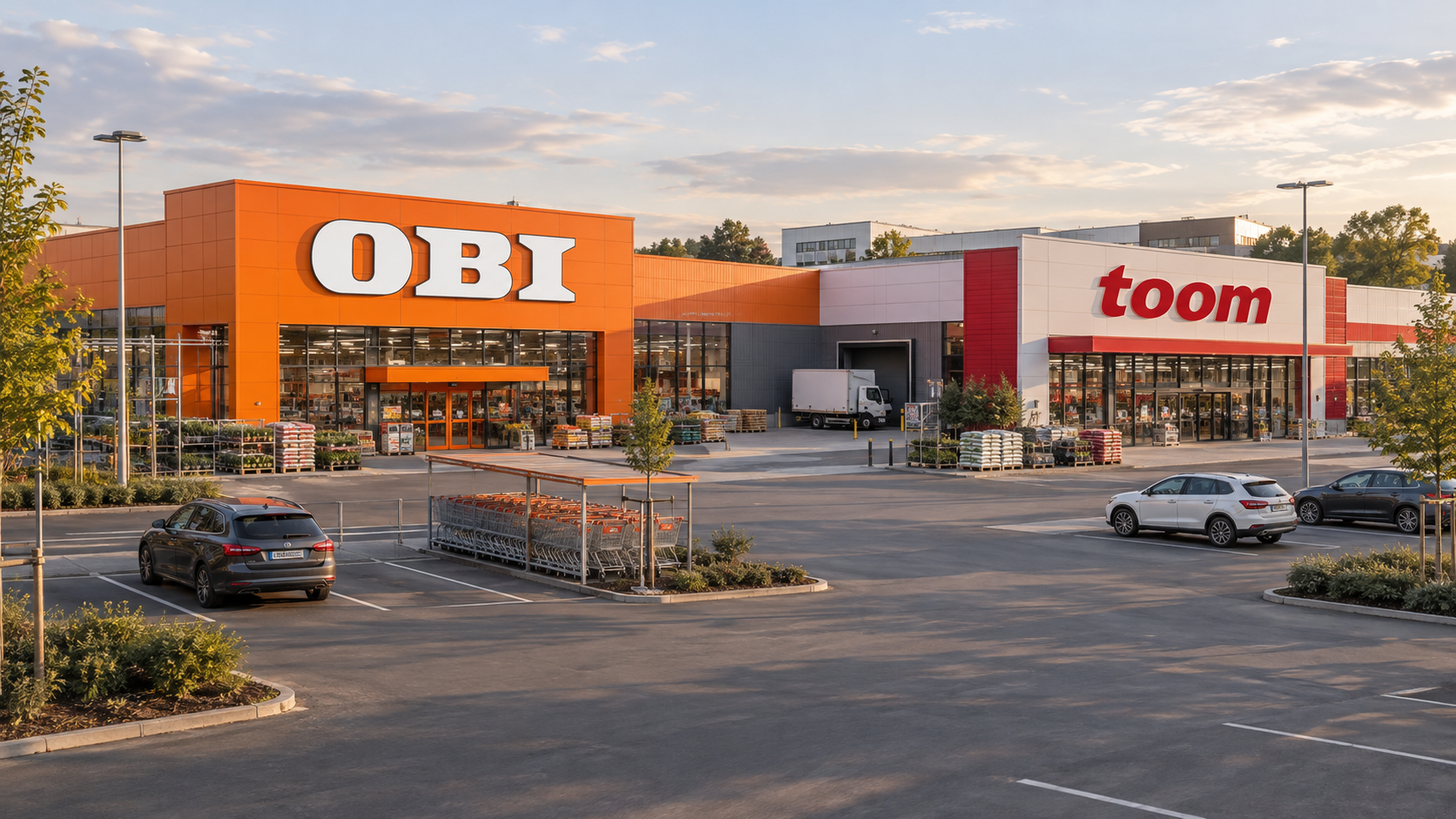
650 DIY stores under one brand: Obi takes over Toom – What will change for customers and the German DIY market – Creative image on the topic, created with AI: Xpert.Digital
Obi and Toom merge: How the merger is changing the DIY store industry
Can the merger really make the DIY store industry more efficient?
Less competition, greater choice? What the Obi-Toom merger means for customers
The planned merger of Obi and Toom is more than just a change of logos and storefronts. Toom DIY stores will operate under the Obi brand in the future; at the same time, Rewe will acquire a roughly 30 percent stake in Obi Group Holding, while Tengelmann will remain the majority shareholder. Together, the two chains would theoretically have around 650 locations in Germany. However, size alone doesn't guarantee lower prices or better business. The crucial question is whether Obi can actually improve its product supply, logistics, and digital offerings without losing its local strengths and established customer relationships. Furthermore, the merger still requires regulatory approval. Therefore, what the merger means for customers, employees, suppliers, and competitors depends primarily on how successful the integration is.
Toom disappears, market power grows – but size alone does not fix a business model
The planned merger of Obi and Toom is far more than just the merging of two store networks. It is changing the balance of power in an industry whose economic future no longer depends solely on additional retail space. Crucial factors will be the productivity of existing locations, the efficiency of logistics, the integration of online and brick-and-mortar retail, and the ability to develop comprehensive customer projects from individual product sales. Under these conditions, the merger is both an aggressive expansion strategy and a response to increasing economic pressure to adapt.
The basic outline of the agreement is clear: The Toom DIY stores will be integrated into the Obi structure and will operate under the Obi brand in the future. In return, the Rewe Group will receive approximately 30 percent of the Obi Group Holding and will provide additional financial support to the joint venture. Tengelmann will remain the majority shareholder. Financial details and the purchase price have not been disclosed. The merger is subject to regulatory approvals. The conversion of the Toom stores, which is expected to take approximately 12 to 18 months, will only begin after these approvals have been granted.
The merger is economically convincing if it enables permanently lower operating costs, better product availability, and a more attractive product range. Conversely, a development that primarily reduces competitive pressure and underestimates the costs of integration would be problematic. The central question, therefore, is not how many orange facades Germany will have in the future. It is whether two large retail organizations will actually create a more productive company.
Two competitors become a joint investment model
The transaction is not simply a sale for cash. While Rewe is separating from Toom as an independent DIY store organization and, in the long term, also from its market presence, the retail group remains financially involved in the DIY market through its stake in the expanded Obi company.
This changes the nature of the engagement. Direct responsibility for an individual chain is replaced by participation in a larger platform. This allows Rewe to share in potential efficiency gains and value increases of the entire network. At the same time, the company continues to bear economic risks, for example, if the integration becomes more expensive than expected or if business performance falls short of projections.
For Tengelmann, the advantage lies in retaining strategic leadership while simultaneously integrating additional operational resources and a financially strong partner. A majority stake generally allows for significant influence. However, the stake alone does not reveal which decisions will require special approval in the future and what co-determination rights Rewe will receive.
Similarly, the roughly 30 percent shareholding does not allow for a reliable valuation of Toom. This would require, among other things, knowledge of the precise transaction structure, additional capital contributions, financial liabilities, and other economic obligations. Simply interpreting the shareholding percentage as the value ratio between the existing companies would therefore be premature.
A denser branch network changes the economic landscape
The scale of the project is considerable. It mentions 358 Obi stores and 292 Toom stores in Germany. This equates to a total of 650 locations. The more general announcement of a network of over 600 stores thus describes a scale that goes far beyond simply supplementing existing stores in individual regions. However, the final structure will also depend on antitrust review and subsequent location decisions.
A larger network can improve accessibility, close regional supply gaps, and increase brand visibility. Especially for bulky products, urgent repair needs, or projects requiring extensive consultation, geographical proximity remains important. Someone who needs to purchase materials during a renovation will value a conveniently located store differently than a cheaper supplier who is far away.
However, the merger does not initially generate any additional demand. A customer who previously bought paint at Toom will not paint her apartment more frequently after switching brands. The immediate effect is simply the organizational consolidation of existing sales.
Economic added value only arises when the network operates more effectively than before. This can be achieved through coordinated product ranges, shared inventory, more efficient delivery routes, or more compelling customer communication. Conversely, where catchment areas overlap significantly, internal competition can emerge. Therefore, the quality of the location portfolio is more important than the sheer number of stores.
Why the merger is taking place in a barely growing market
The German DIY market operates in a challenging economic environment. Total gross sales for home improvement and DIY stores are projected to reach approximately €24.67 billion in 2025. The broader German core DIY market, which also includes specialist retailers and smaller specialist retailers, reached approximately €49.10 billion. Within the home improvement market statistics, a more narrowly defined sales figure of €20.58 billion is also reported. These different figures must not be conflated when calculating market share.
This distinction is crucial for evaluating the merger. A company can be very large within the traditional DIY market segment and simultaneously compete with numerous other sales channels in individual product categories. Tools are purchased differently than potting soil, and a heating fitting differently than a houseplant.
For the first nine months of 2026, the DIY store sector reported a sales increase of only 0.3 percent. Such a nominal increase does not yet indicate a noticeable improvement in sales volumes. Without corresponding price and volume data, no real growth can be inferred from this.
In a market with stagnant growth, mergers are gaining importance because organic expansion is becoming more difficult. New branches must increasingly compete with existing rivals for revenue. At the same time, rising costs for personnel, technology, and infrastructure are not automatically spread across a larger sales volume. Mergers are therefore also an attempt to generate growth at the company level, even though the overall market is experiencing limited expansion.
Size creates negotiating power, but not yet a guaranteed return
The most important economic lever lies initially in purchasing. By consolidating order volumes, a trading company can negotiate better terms, standardize delivery processes, and reduce the number of parallel agreements. Larger volumes can also make the development of in-house products more economical.
It's not just about lower invoice prices. Delivery times, minimum order quantities, payment terms, advertising cost subsidies, and the availability of scarce items also influence the result. Even reduced stockouts or fewer damaged deliveries can have significant economic benefits.
However, a larger purchasing organization can create new complexities. Products with similar functions are not automatically interchangeable. Differences in quality, packaging units, technical specifications, and evolving customer preferences limit simple consolidation.
Furthermore, potential benefits are distributed among several groups. Some can be channeled into lower sales prices, some into improved services, and some into higher margins. How this distribution unfolds depends on competitive pressure and the strategic priorities of company management.
The crucial distinction, therefore, is this: purchasing power initially creates potential. Sustainable productivity gains only occur when the entire value creation process improves. Merely increasing pressure on suppliers can raise profit margins in the short term, without making the system more efficient overall.
Why the closure of Toom makes business sense
Managing two national brands in parallel is costly. Advertising, digital platforms, store design, customer programs, and product range communication all need to be managed separately. A unified brand can reduce this duplication of effort and increase the impact of the marketing budget.
The rebranding also offers an opportunity to unify the company's public image. Ideally, customers should be able to recognize, regardless of their location, what services, quality levels, and service promises they can expect. A greater national presence can further strengthen brand perception.
This is offset by real conversion costs. Facades, signage, workwear, advertising materials, and digital touchpoints all need to be adapted. Training and the transfer of existing customer relationships are also required. Furthermore, a brand being abandoned also possesses economic value, for example through brand recognition, trust, and local ties.
A brand change is therefore not a free efficiency gain. It exchanges ongoing duplicate structures for one-off expenses and potential losses in customer loyalty.
The crucial factor is whether familiar strengths are maintained. Customers often evaluate a DIY store based on concrete experiences: Is the advice competent? Are the required products in stock? Is the returns process efficient? Is the staff still approachable? A new name will only be convincing if the actual shopping experience is at least as reliable as before.
The actual renovation is taking place behind the shelves
The visible transformation of the markets is only one part of the integration process. The merging of operational systems is more complex. Merchandise management, point-of-sale software, master data, supplier contracts, and inventory control must all be aligned.
Even the question of whether two items are truly identical can cause considerable effort. Different product numbers, package sizes, or quality characteristics complicate the merging process. Errors in the master data then affect many processes: ordering, shelf labeling, price calculation, and online display.
Inventory accuracy is particularly critical. If an item appears available digitally but is unavailable in-store, unnecessary trips are made and trust is lost. Conversely, if an existing item is not correctly recorded, the retailer may order additional stock and tie up capital, even though sufficient inventory exists.
Personnel and financial systems also require reliable transitions. A technically successful migration should not come at the cost of disrupting operational processes for weeks.
The announced 12 to 18 months should therefore not automatically be interpreted as a deadline for complete economic integration. The rebranding may be completed while work on processes, data quality, and organizational responsibilities continues behind the scenes for some time.
Logistics determines whether the larger network becomes more economical
DIY store product ranges place special demands on product supply. Screws are stored and transported differently than building panels, garden furniture, plants, or bags of building materials. Weight, volume, risk of breakage, and seasonality differ considerably.
A shared network can better utilize transport routes and distribute inventory more effectively. However, this requires an analysis of actual goods flows. Simply consolidating warehouse locations does not guarantee improvement.
Greater centralization can reduce costs by consolidating inventory and standardizing processes. However, it can also lengthen supply chains and increase dependence on individual facilities. Decentralized inventories are more expensive but can offer advantages in cases of short-term demand or regional specificities.
The larger branch network also opens up possibilities for using stores as collection points or regional delivery points. Whether this is economically viable depends on floor space, staffing, order volume, and transport costs. A store is not automatically an efficient distribution center.
For integration, a differentiated logistics architecture would therefore be beneficial: standardized processes where they create economies of scale, and regional flexibility where products or demand require it. Economic efficiency is not measured by having as few warehouses as possible, but by low overall costs combined with reliable availability.
More inventory can finance growth or tie up capital
An often underestimated factor in retail is tied-up working capital. Goods in storage or on shelves incur financing costs and can lose value before they are sold. With seasonal product ranges and changing product generations, the risk of additional price reductions increases.
The merger could reduce duplicate inventory. If both companies currently maintain similar safety reserves, joint planning could potentially require less overall inventory. However, this effect depends on accurate data and reliable supply chains.
During integration, the opposite can occur. Old product lines must be sold off while new ones are already being stockpiled. Increased safety stocks, taken as a precaution, can further strain liquidity. Thus, an economically viable merger may initially require more capital than a simple consideration of the restructuring costs would suggest.
Extended payment terms to suppliers do not provide a cost-free efficiency gain for the overall system. While they improve the retailer's liquidity, they shift financing needs to other companies.
A sound valuation must therefore distinguish between operating profit and actual cash flow. Rising sales or improved purchasing margins are insufficient if inventory levels, integration payments, and investments grow disproportionately at the same time.
Our EU and German expertise in business development, sales and marketing


Our EU and German expertise in business development, sales and marketing - Image: Xpert.Digital
Industry focus areas: B2B, digitalization (from AI to XR), mechanical engineering, logistics, renewable energies and industry
More information here:
A thematic hub offering insights and expertise:
- Knowledge platform covering global and regional economies, innovation and industry-specific trends
- A collection of analyses, insights, and background information from our key areas of focus
- A place for expertise and information on current developments in business and technology
- A hub for companies seeking information on markets, digitalization, and industry innovations
The opportunities of the merger for customers and markets
Digitalization must simplify customer projects, not just postpone sales
The economic importance of online business in the DIY and home improvement sector cannot be measured solely by shipping revenue. Many purchases begin with digital research and end in the store. Others start with personal consultation and are later completed online.
A unified digital presence can standardize product information, availability, and customer accounts. This reduces search costs and facilitates transitions between sales channels. The crucial question, however, is whether it simplifies the entire purchasing process.
One example is a bathroom renovation. The customer needs not only individual products, but also the right quantities, compatible materials, information on delivery times, and, if necessary, support with the execution. A platform that meaningfully connects these steps creates greater value than an additional discount on an isolated item.
Data analytics and artificial intelligence can help improve demand forecasts, structure product information, or answer search queries more clearly. However, such applications are only as good as their data foundation.
Merging two organizations can therefore initially create additional digital complexity. Economic benefits only arise when a reliable information base is created from disparate systems and technology eliminates specific inefficiencies.
Customers value performance, not the size of the company
From a customer perspective, the merger could bring advantages. A denser network, better product availability, and standardized service processes could simplify purchasing. More attractive prices are also conceivable if cost advantages are passed on and competitors respond accordingly.
However, this does not automatically lead to improvement. If Toom, an independent retailer, disappears, so too does the previously independent decision-making process regarding prices, promotions, product ranges, and service. This diversity has economic value, even if both chains sell similar products.
Furthermore, customer needs vary regionally. A market in a rural area may serve different projects than an inner-city location. Excessive standardization can therefore weaken local strengths.
The transition phase is particularly sensitive. Changes to returns, customer programs, or product availability must be communicated clearly. Without published details, it's impossible to predict exactly which regulations will apply.
Customer benefit can ultimately be measured by simple questions: Is the purchasing process reliable? Are the price and quality in line? Is the project completed with less effort? The economic size of the corporation is a possible prerequisite for this, but not an advantage in itself.
Why competitive testing must primarily think regionally
The antitrust review represents a crucial uncertainty factor. A large nationwide market position is relevant, but does not fully explain what choices customers actually have.
For many in-store purchases, the local catchment area is crucial. For heavy products and short-term needs, a distant competitor can only offer limited alternatives. Therefore, it's important to consider how Obi and Toom locations overlap geographically and what alternatives exist within easy reach.
The product categories also differ. For standardized power tools, online retail can generate significant competitive pressure. For plants, bulky building materials, or urgent repair supplies, other factors may be dominant. Therefore, equating all sales channels across the board would be just as inaccurate as completely ignoring online retail.
The announced number of branches does not guarantee approval or imply any specific conditions. A range of outcomes are possible, from approval to conditions or further objections. The actual assessment depends on the specific review.
From an economic perspective, this involves a trade-off: Are the potential efficiency gains large and demonstrable enough, while maintaining sufficient competition? Simply announcing synergies does not answer this question.
Suppliers are caught between greater sales opportunities and increased dependence
For manufacturers and importers, a joint Obi-Toom network can be attractive. Being part of a larger network means potentially reaching more customers with a centrally coordinated sales relationship. Uniform standards can also reduce administrative overhead.
At the same time, the importance of each individual trading partner is increasing. Delisting or a change in product range can affect larger shares of sales than before. This changes the negotiating position, especially for small and medium-sized suppliers.
The situation becomes particularly challenging when similar products from multiple suppliers are compared. Consolidating product ranges can lead to a concentration on fewer suppliers. This may increase efficiency, but it can also reduce variety and alternative options.
This also poses risks for the retailer. An excessively narrow supplier base makes supply more vulnerable to production disruptions or quality problems. Purchasing policy must therefore weigh short-term price advantages against long-term supply reliability.
The overall economic impact therefore depends on how the new purchasing power is used. More productive processes and more reliable planning can benefit both sides. However, simply shifting costs and risks to manufacturers does not necessarily strengthen the performance of the entire value chain.
Private labels become a lever for margin and market profile
Higher sales volumes can facilitate the development and maintenance of private label brands. Costs for product design, packaging, testing, and marketing can be spread across more units sold. At the same time, retailers can better differentiate their offerings from competitors.
Private label brands fulfill various functions. They can offer an affordable entry point, occupy specific quality levels, or provide exclusive solutions to problems. They are particularly attractive economically when price, quality, and trust are aligned.
Integrating two product lines, however, creates a need for decision-making. Existing product lines may overlap or convey different quality promises. A hasty streamlining carries the risk of removing proven products from the range and losing loyal customers.
Furthermore, higher profit margins do not necessarily equate to higher risk-adjusted returns. With private label brands, the retailer bears greater responsibility for specifications, quality assurance, procurement, and potential recalls. These tasks require expertise and resources.
A successful strategy would therefore not be to replace as many manufacturer products as possible. It would create a clear balance between branded and private-label products. The crucial factor is whether customers can find suitable and reliable solutions for different budgets.
Employees are the bottleneck for successful integration
The two organizations in Germany are said to employ around 20,000 people at Obi and approximately 18,000 at Toom. This results in a combined workforce of roughly 38,000 people. These figures describe the general size of the workforce, not the number of potential changes or job security. No specific personnel measures can be derived from this information.
Areas that currently exist independently in both companies are particularly relevant for integration. These can include purchasing, administration, marketing, IT, and logistics management. Whether tasks are merged, transferred, or reorganized depends on the final structure.
In the markets themselves, experiential knowledge is highly valued. Good customer service doesn't automatically result from a larger product range or more modern software. Employees are familiar with typical project mistakes, regional demand, and repeat customers.
A poorly managed restructuring can therefore cost more than a personnel cost calculation initially indicates. When experienced staff leave, customer service, processes, and customer loyalty may deteriorate. The burden increases further if new systems and product ranges are introduced while operations continue.
Human resources policy is therefore not a secondary social aspect, but a key factor for economic success. Training, clear responsibilities, and realistic restructuring plans directly influence whether the planned synergies can actually be achieved.
Renovation and maintenance of existing buildings remain the strategically interesting areas of demand
For DIY stores, new construction isn't the only relevant factor. Repairs, modernizations, garden maintenance, and the ongoing upkeep of existing buildings create their own demand. These areas differ in their economic logic from large new construction projects.
A leaking component or a damaged floor can often only be postponed for a limited time. A decorative renovation, on the other hand, can be more easily delayed if households need to save money. Therefore, it makes sense to differentiate between necessary and discretionary spending within the product range.
Energy efficiency improvements also offer starting points, but not as a blanket promise of growth. Whether a specific product is in demand depends on investment costs, technical suitability, the availability of skilled tradespeople, and the expectations of the owners.
The expanded network offers an opportunity to make such projects more understandable. Transparently explaining material requirements, applications, and costs can reduce uncertainty and facilitate purchasing decisions.
This results in a strategic shift: the focus is no longer on the largest possible number of individual items, but on the successful implementation of a project. This requires a combination of product range, information, consulting, and, where necessary, complementary services. It is precisely in this area that the larger organization could develop sustainable benefits.
Why the merger is not an engine of overall economic growth
A merger initially enlarges a company, not automatically the economy as a whole. Existing revenues are combined under a common umbrella. This alone does not create any additional value.
The process becomes positive for the economy as a whole when the same customer needs are met with fewer resources or better quality. Examples include less unnecessary transport, reduced product losses, and more accurate inventory management. Improved consulting can also be productive by preventing incorrect purchases and failed projects.
The situation is different if profits increase primarily due to less competition. In that case, income can shift between customers, suppliers, and owners without a corresponding increase in economic performance.
The way newly available resources are used also plays a role. If savings are invested in modern infrastructure, training, and improved services, the benefits can extend beyond the immediate cost reduction. Conversely, if necessary investments are not made, higher short-term results can mask weaker future viability.
An objective evaluation must therefore distinguish between corporate interests and overall economic benefit. These can coincide, but they don't have to. This is precisely why competition, investment behavior, and productivity growth are so important.
Which key performance indicators will show success?
Simply adding up the revenues provides only a starting point. A reliable performance evaluation requires several key performance indicators that go beyond the size of the group.
The first important step is to compare the sales performance of existing markets. This is a better indicator than total sales revenue of whether the locations are actually gaining strength. Additionally, it's necessary to consider what portion of any change is attributable to prices and what portion to sales volume.
Sales per square meter describe how much revenue is generated on the available sales area. However, this figure alone is insufficient for economic evaluation because different product ranges result in different margins and costs.
Additional factors include inventory turnover, product availability, write-offs, logistics costs, and the development of tied-up capital. On the customer side, repurchase rates, complaints, and the reliability of inventory displays are relevant.
The free cash flow after investments and integration costs is particularly important. It shows whether the merger actually creates financial flexibility.
One-off effects should be clearly distinguished from lasting improvements. A short-term sale of old stock can free up liquidity, but says little about long-term profitability. Conversely, high initial costs can be justifiable if they are offset by demonstrable and lasting benefits.
Three development paths between productivity leap and integration trap
In the best-case scenario, it will be possible to consolidate purchasing, improve the supply of goods, and standardize the digital infrastructure without damaging local strengths. Customers will benefit from more reliable offerings, while productivity and profitability will increase. The additional financial resources will support a transformation that goes beyond mere brand alignment.
A moderate scenario would be less spectacular. The rebranding works, some of the expected benefits are achieved, but legacy technical and organizational burdens persist for longer. The larger organization achieves greater market reach, but requires several years to develop a correspondingly higher level of performance.
In the worst-case scenario, high conversion costs coincide with weak demand and operational disruptions. Product range changes frustrate customers, inventory data is unreliable, and employees are overloaded by parallel change processes. In such cases, size can temporarily become a disadvantage because errors can have repercussions across a wider network.
None of these development paths are predetermined by the announcement. Crucial factors are the sequence of integration steps, the quality of leadership, and the willingness to address problems early. A realistic plan must therefore not only quantify potential synergies but also consider implementation costs, delays, and unforeseen negative surprises.
The new market size still needs to prove itself in everyday practice
The merger of Obi and Toom has a logical industrial rationale. A sluggish market, high demands on logistics and digitalization, and the need for financial strength all point in favor of pooling resources. Rewe retains a stake, Tengelmann maintains its leadership, and the combined organization has the opportunity to significantly expand its market presence.
The viable perspective, however, does not lie in size for its own sake. The promising model would be a network that combines central economies of scale with regional customer proximity. Purchasing, data, and technical standards can largely be pooled. Consulting, local demand, and location-specific strengths must not be neglected in the process.
The greatest risks lie in overestimating short-term savings and underestimating operational integration. Added to this is the competitive question of whether the loss of an independent provider will be offset by real performance improvements.
This merger will thus become a test for the modernization of the German DIY retail sector. It would be an economic success if it combines improved processes, more productively deployed capital, and greater customer benefits. If, however, it remains primarily a matter of a new ownership structure and uniform facades, two retail organizations would simply have become one larger one.
🎯🎯🎯 Data-driven B2B industry hub as a quasi-in-house solution


The quasi-in-house solution: How Xpert.Digital closes operational gaps in B2B marketing and sales – Smart Content-Driven Business - Image: Xpert.Digital
Xpert.Digital is a data-driven B2B industry hub led by Konrad Wolfenstein . The company acts as an external, quasi-in-house solution for industrial partners, closing operational gaps in marketing, content, and sales – without requiring additional resources on the client side.
More information here:
Your global marketing and business development partner
☑️ Our business language is English or German
☑️ NEW: Correspondence in your native language!

Konrad Wolfenstein
I and my team are happy to be available to you as your personal advisor.
You can contact me by filling out the contact form here wolfenstein@xpert.digital:or simply call me at +49 7348 4088 965. My email address is
I'm looking forward to our joint project.