
New super solar cells (perovskite) are expected to accelerate Japan's energy transition – Japan's solar strategy with Sekisui Chemical – Image: Xpert.Digital
Energy technology of the future: Japan's breakthrough with perovskite cells
Advanced solar energy: Japan's path to the energy transition
Japan is making significant strides in solar energy technology with the development of perovskite solar cells (PSCs), which have the potential to fundamentally transform the country's energy landscape. This innovative technology is expected not only to support Japan's ambitious climate goals but also to reduce its reliance on fossil fuels and nuclear power. With their flexible, lightweight, and highly efficient properties, these super solar cells could achieve an electricity generation capacity equivalent to 20 nuclear reactors by 2040, thus making a crucial contribution to Japan's energy transition.
The revolutionary perovskite technology
Perovskite solar cells differ fundamentally from conventional solar cells and promise a revolution in how solar energy is harnessed. Unlike traditional silicon-based solar panels, PSCs are characterized by their high adaptability, low weight, and flexibility in manufacturing. These properties make them particularly valuable for densely populated Japan, where conventional solar panels are often impractical due to limited available space.
The versatility of perovskite solar cells opens up entirely new application possibilities. Thanks to their semi-transparent and lightweight design, they can be installed on building walls and windows, on car roofs, and on streetlights, allowing these surfaces to be used for energy generation. This flexibility is particularly important in cities with limited space, where maximizing energy production without requiring additional land is crucial.
In terms of efficiency, perovskite solar cells have made impressive progress. With an efficiency of 26.1 percent, they are now on par with traditional silicon single-crystal panels, and this figure is continuing to rise, while silicon technology appears to have reached its limits. The possibility of using PSCs in combination with silicon panels is particularly promising, as it currently allows for efficiency to exceed 35 percent. Furthermore, the flexibility of PSCs enables the development of hybrid systems combining wind and solar power, which can further improve the efficiency of renewable energies.
Related to this:


Japan's strategic advantage through iodine production
A key factor strengthening Japan's position in the development of perovskite solar cells is its role as the world's second-largest iodine producer. Iodine is a necessary component in the production of perovskite solar cells. This resource advantage allows Japan to establish an independent supply chain and offers promising development opportunities for its domestic industry. By utilizing this natural resource, Japan could create a largely self-sufficient production chain to manufacture the enormous quantities of perovskite solar cells required.
Japan's ambitious solar plan
The Japanese government has unveiled an ambitious plan for utilizing perovskite technology. The country aims to install 20 gigawatts of solar capacity by fiscal year 2040, equivalent to the output of approximately 20 nuclear reactors. With this capacity, Japan could not only decommission its active nuclear reactors but also avoid building new nuclear power plants to meet future energy needs as fossil fuel-based power plants are phased out.
This initiative is part of a broader energy plan. On March 13, 2025, the Japanese government finalized a draft of a fundamental energy policy aimed at increasing the share of renewable energy in the electricity mix to up to 50 percent by 2040 to meet rising electricity demand. Japan had already updated its energy plan in October 2021, with renewable energy emerging as the main beneficiary. The sixth Strategic Energy Plan, for the first time, sets the goal of establishing solar, wind, and hydropower, as well as biomass, as the primary sources of energy generation in Japan from 2030 onward, with a planned share of 36 to 38 percent of the energy mix.
The driving role of Sekisui Chemical
A key player in implementing Japan's solar strategy is Sekisui Chemical. With support from the Development Bank of Japan (DBJ), Sekisui established a new company in early 2025 to develop, manufacture, and sell perovskite solar cells under Sekisui Chemical's license. The total cost of the project is estimated at over 310 billion yen (1.97 billion dollars), with half of the funding provided by government grants.
Sekisui plans a phased investment strategy, starting with 90 billion yen for the construction of a 100-megawatt production line by 2027, followed by a gigawatt-class production line by 2030. For this project, the company will purchase and utilize equipment at the Sharp plant in Sakai, western Japan. The goal is to achieve a production capacity of 1 gigawatt per year for novel cells, primarily perovskite solar cells, by fiscal year 2030.
The company has already defined clear application areas for its technology: "We want to leverage the system's lightweight and flexible properties to promote its use, especially in the public sector, for example, in sports halls that serve as evacuation centers in the event of disasters," the company stated. In the long term, Sekisui plans to expand its business by reducing costs through mass production while simultaneously boosting demand, focusing on roofs and exterior walls of factories and warehouses in the private sector.
Investments and production plans
Sekisui Chemical plans to establish a manufacturing capacity of 1 gigawatt per year for perovskite solar cells by 2030. The company will invest a total of approximately US$2 billion in this project, with the Japanese government covering half of the costs.
The first step is the construction of a production line with a capacity of 100 megawatts per year from 2025 to 2027. For this, Sekisui Chemical is investing 90 billion yen (approximately 570 million US dollars) and using parts of a former Sharp plant in Osaka.
Government support and partnerships
The Japanese government actively supports the project:
- The Ministry of Economic Affairs has granted Sekisui Chemical a grant under the program to expand supply chains for the green transformation.
- The state-owned Development Bank of Japan (DBJ) holds a 14% stake in the newly founded company Sekisui Solar Film, which will establish the manufacturing facility.
Technology and applications
Sekisui Chemical specializes in roll-to-roll manufacturing of thin, flexible perovskite solar cells. The current cell properties are:
- Efficiency: 15%
- Shelf life: 10 years
- Roll width: 30 centimeters
Future goals include an efficiency of 20% and a lifespan of 20 years. The lightweight and flexible solar cells will initially be installed on the roofs of public buildings, such as gymnasiums. Later, applications on the roofs and walls of factories and warehouses are planned.
Long-term goals
The Japanese government aims for new types of solar cells to contribute approximately 20 gigawatts of power generation by 2040. Sekisui Chemical plans to play a key role in achieving this government goal of establishing gigawatt-scale production by 2030.
Breakthrough in perovskite solar cells: Cheaper and longer-lasting than ever before
Despite their enormous potential, perovskite solar cells still face several obstacles. Their significantly limited lifespan compared to silicon and their high initial costs are two of the biggest challenges for PSCs. However, the technology is constantly improving, and researchers are working on solutions such as improved passivation technology and more stable material combinations.
A remarkable breakthrough was achieved in 2024 when a Chinese manufacturer presented the first commercial perovskite cells designed to operate for 12 years without any loss of performance, with the manufacturer offering a ten-year warranty. Over a 25-year period, the performance degradation is expected to be linear rather than sudden, thus improving predictability.
A positive trend is also emerging regarding costs. Forecasts predict that costs in Japan will fall from the current 20 yen (approximately 12 euro cents) to 10 yen (approximately six euro cents) per watt by 2040. This cost reduction will further increase the competitiveness of the technology and promote its widespread adoption.
In Germany, physicist Felix Lang discovered a remarkable property of perovskite semiconductors: their self-healing capabilities. This discovery could significantly extend the lifespan of perovskite solar cells and contribute to the improvement of solar cells and X-ray equipment, with applications both on Earth and in space.
Japan's Solar Renaissance
Japan was once the world leader in solar panel production, but its market share has fallen to below one percent due to competition from Chinese manufacturers. With PSC technology, Japan aims to regain a stronger position in the global market. This is reminiscent of the period following the 1973 oil crisis, when Japan's public and private sectors collaborated on renewable energy research and development, and its global market share for solar panels temporarily exceeded 50% before being overtaken by Chinese companies with lower prices.
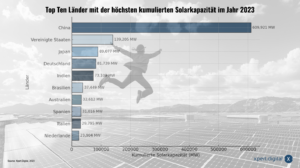
Since the nuclear disaster in Japan in March 2011, the country's solar energy sector has developed rapidly. Today, solar power generation contributes almost 10 percent to total energy production, compared to just 1.9 percent in 2014. The current energy plan aims to increase this share to between 36 and 38 percent by 2030, with power supply chain (PSC) technology playing a key role in exceeding these figures by 2040.
Related to this:
Diversification of renewable energies in Japan
While perovskite solar cells are a focus of Japan's energy strategy, the country is also investing in other renewable energy sources to diversify its energy mix and increase energy security. Japan aims to become a hydrogen society and has pursued a hydrogen strategy since 2017, which also supports its decarbonization goal by 2050. The Japanese government plans to invest around 15 trillion yen (approximately US$107 billion) in the hydrogen value chain over a 15-year period.
Furthermore, Environment Minister Shinjiro Koizumi announced that the ministry will take the lead in accelerating the development of geothermal energy. Minister of Administrative Reform Taro Kono announced the goal of doubling Japan's geothermal power plants by 2030. Favorable feed-in tariffs and the promotion of renewable energy are expected to lead to an increasing number of geothermal projects.
In addition, Japan is exploring fusion energy as a long-term energy source. The country is cooperating with the EU and the US to accelerate the development of fusion energy, with private investment and collaboration playing a key role. At the end of March 2024, 21 companies founded the Japan Fusion Energy Council – J-Fusion for short – with the aim of jointly advancing the technology and standards.
Implications for the global energy transition
Japan's massive investment in perovskite solar cells could have far-reaching implications for the global energy landscape. If the technology is successfully deployed on an industrial scale, it could serve as a model for other countries, particularly densely populated nations with limited space for traditional solar farms.
The Japanese government is confident that its investments in perovskite solar cells will be successful. After supplying its own domestic market, Japan plans to export this innovative technology to other countries, which could contribute to the global energy transition and strengthen Japan's position as a technology leader.
The development of perovskite solar cells is also part of a broader Japanese strategy to regain its technological leadership in various sectors. In addition to renewable energies, Japan is also investing heavily in other future technologies such as software-defined vehicles (SDVs), with the goal of achieving a 30 percent share of the global market by 2030.
A solar advancement for Japan's energy future
Japan's investment in perovskite solar cells marks a crucial step in the transformation of its energy landscape. The ambitious plans to install a capacity equivalent to 20 nuclear reactors by 2040 demonstrate the country's confidence in this innovative technology and its contribution to the energy transition.
Perovskite technology offers unique advantages due to its flexibility, lightness, and efficiency, especially for a densely populated country like Japan. Although challenges regarding durability and cost remain, continuous progress in research and development demonstrates that these hurdles are surmountable. The phased implementation strategy, aiming for gigawatt production by 2030, lays the foundation for ambitious long-term goals.
The widespread adoption of perovskite solar cells could not only help Japan achieve its climate goals and reduce its reliance on fossil fuels and nuclear power, but also restore its position as a leading provider of solar technology. The strategic use of domestic iodine production and substantial government investment underscore Japan's determination to succeed in this forward-looking technology.
With this comprehensive approach, encompassing both technological innovation and economic strategy, Japan is positioning itself as a pioneer in the global energy transition and demonstrating a promising path to sustainable energy production for the future. The success of this plan could be of great significance not only for Japan but for the global effort to achieve a sustainable energy future.
Related to this:
Your global marketing and business development partner
☑️ Our business language is English or German
☑️ NEW: Correspondence in your native language!

Konrad Wolfenstein
I and my team are happy to be available to you as your personal advisor.
You can contact me by filling out the contact form here wolfenstein@xpert.digital:or simply call me at +49 7348 4088 965. My email address is
I'm looking forward to our joint project.