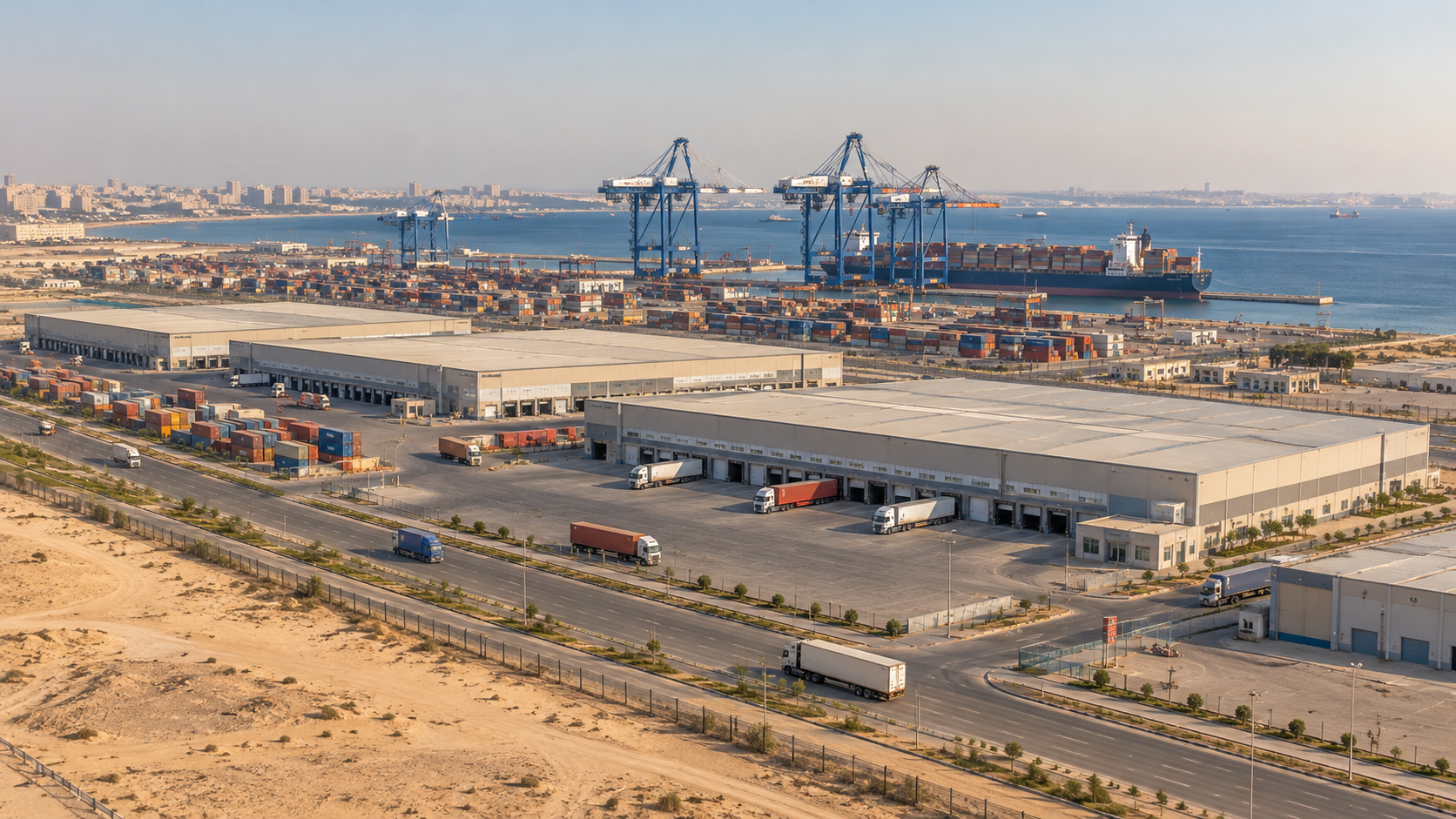
New logistics center near Alexandria: Can Dekheila make Egypt's supply chains more efficient? – Creative image on the topic, with AI: Xpert.Digital
273,000 square meters is not yet an economic miracle – what matters is what happens between the ship, customs and the factory
From port to value creation: This is why the logistics project in Dekheila is important
Port, customs, factory: Why Dekheila could offer more than just warehouse space
Egypt is planning a logistics center of approximately 273,000 square meters at the port of Dekheila near Alexandria. The project could consolidate warehousing, cargo handling, customs clearance, and light industrial services at a single location – thus helping companies move goods more quickly between the port, factory, and market. However, the available space alone does not guarantee economic success: reliable permits, functioning transport connections, and a sufficient number of customers willing to pay are crucial. The project is still in the evaluation and development phase; the investment amount, timeline, and specific capacities are not yet determined. A closer look at the planned center reveals why Dekheila is nevertheless strategically interesting, what opportunities and risks the project entails, and how its success would later be measured.
Dekheila as a litmus test: How Egypt could keep more added value in the country with a new logistics center
Egypt's economic future doesn't hinge solely on new factories, additional power plants, or larger port facilities. Equally crucial is the reliable interconnection of these locations. An industry can only be internationally competitive if raw materials arrive on time, intermediate products are predictably available, and finished goods reach their customers without unnecessary delays. The planned development of a logistics center at the port of Dekheila, west of Alexandria, addresses precisely this critical juncture.
A feasibility study will be conducted on an area of approximately 273,000 square meters to determine the potential for an integrated site for regional and international distribution, warehousing, transit, re-export, and additional logistics services. Light industrial activities are also included in the proposed range of uses. Hassan Allam Utilities, the Alexandria Port Authority, and Al Tarek Capital Real Estate Asset Management are involved in the project. The site is located in the western hinterland of the port. The aim is to incorporate the site into the port's customs territory and to obtain free zone status or a comparable legal and operational framework. However, these conditions, as well as further implementation, are subject to approval.
The economic significance therefore lies not merely in additional storage space. Rather, the interesting aspect is the opportunity to spatially and organizationally combine previously separate functions: the seaport as access to international trade flows, logistics as the link between transport and production, and industrial services as a source of additional added value. Whether this results in a viable business model, however, depends on far more than the size of the property.
Between strategic intention and sound investment
First, a clear assessment of the project's current status is required. The feasibility of constructing, developing, and operating a logistics center is being examined. This assessment does not yet provide evidence that the project has been fully evaluated economically, is fully financed, or is ready for construction. Implementation requires further agreements, the fulfillment of certain conditions, and the necessary permits. A reliable investment figure, a binding completion date, and a final capacity plan are not yet available.
This distinction is economically crucial. A number of complex decisions separate an attractive location idea from a profitable logistics operation. These include demand analysis, technical development, financing, legal usability, and acquiring solvent customers. A property can be ideally located yet remain unprofitable if its development costs are too high or the expected flow of goods fails to materialize.
Especially with large infrastructure projects, it's easy to oversimplify things: A planned area is equated with future growth. In reality, the land is initially just a prerequisite for production. Value only arises when companies use it productively and pay prices that adequately cover construction, operation, financing, and risks.
The evaluation phase should therefore not be seen as a mere delay. It should clarify which functions are actually needed at the location, which customer groups can be reached, and in what order individual sub-areas can be developed. A smaller, early-utilized first expansion phase can be more economically sensible than a fully constructed complex with persistently high vacancy rates.
Why Dekheila offers more than just its proximity to the Mediterranean
Dekheila is a natural extension of the Port of Alexandria. Located west of the older port area, the site boasts connections to the national road network and the railway. Furthermore, its proximity to industrial facilities, a free trade zone, and energy infrastructure makes it an ideal location for a logistics hub close to production.
The decisive advantage lies in the combination of different demand drivers. A port not only serves international transit traffic. It also serves companies that import raw materials, distribute intermediate goods, or export their own products. The more diverse this demand, the less dependent a logistics center is on a single group of goods or a single trade route.
Dekheila's main advantage, therefore, lies in its potential integration with the economic hinterland. A warehouse directly at the port can receive imported goods before they are distributed to various recipients. Conversely, export shipments from multiple manufacturers can be consolidated, monitored, and prepared for shipping. This allows companies to outsource certain logistical tasks from their own factory premises.
The existing rail connection is a structural advantage, but not yet proof of efficient combined transport. Reliable timetables, suitable transshipment facilities, available wagons, and coordinated processes would be necessary for that. A rail connection creates an option; only its economical operation transforms it into a competitive advantage.
What 273,000 square meters actually mean
The planned area covers 27.3 hectares, or 0.273 square kilometers. This is a considerable size for an integrated logistics site. It generally allows for the combination of multiple uses, such as warehouses, transshipment areas, traffic routes, technical facilities, and complementary industrial services.
However, the size of the plot does not allow for any conclusions to be drawn about the future warehouse area or the annual throughput. Part of the site is needed for access roads, maneuvering areas, safety distances, drainage, utilities, and possibly container storage. The area that can ultimately be leased or operated productively depends on the development plan and the usage concept.
The difference between area and throughput is even greater. A warehouse for slow-moving spare parts, of the same size, can handle significantly fewer tons per year than a transshipment center where goods remain for only a few hours. Conversely, high-value, lightweight goods can have a low tonnage and still generate high revenues.
For an economic evaluation, several key figures are therefore required together: the usable warehouse space, the number of storage spaces, the handling capacity, the average dwell time, the utilization rate, and the revenue per unit of service. A single area figure is helpful for determining the site's dimensions, but insufficient for a profitability calculation.
The term "capacity" also needs clarification. Technically achievable peak performance differs from sustainably attainable operational performance. Maintenance, shift changes, customs inspections, and fluctuating deliveries mean that calculated maximum values are not readily applicable in everyday practice.
The real productivity lever lies between the modes of transport
Logistics costs are not only incurred during the movement of goods. They often rise precisely where goods are waiting, need to be re-tracked, reloaded, or undergo organizational changes. Every additional interface can cause errors, delays, and coordination efforts.
An integrated center could address this by more closely linking port handling, interim storage, customs procedures, and onward transport. The benefit would then lie not only in shorter routes but also in fewer process interruptions. Companies would no longer necessarily have to transport their goods to distant warehouses to have services performed there that could also be carried out directly at the port.
Economically, this means reducing transaction and coordination costs. These include, for example, finding suitable service providers, coordinating different transport segments, and monitoring delivery dates. If these tasks are organized more reliably, a company can operate with lower safety stock and stabilize its production planning.
The entire transport chain is crucial. A modern warehouse is of little use if trucks regularly wait at the port gate or if documents have to be processed manually multiple times. Similarly, rapid transshipment at the port can be rendered ineffective by a lack of transport capacity in the hinterland. The productivity of the overall system depends on its bottlenecks, not on the most modern individual piece of equipment.
Which goods flows could support the business model?
The planned range of uses combines regional and international distribution with transit, transshipment, storage, re-export, and complementary services. These activities differ significantly in their requirements and revenue profiles. They should therefore not be considered a single market.
For national distribution, the focus is on supplying Egyptian customers. Goods are imported, temporarily stored if necessary, and then distributed domestically. Reliable customs clearance, good road connections, and the ability to handle varying shipment sizes economically are crucial.
Re-export involves the re-shipment of imported goods abroad after temporary storage or permissible processing. Efficient customs procedures and favorable international connections are therefore crucial. The location must offer a demonstrable advantage over alternatives, such as faster availability, lower overall costs, or additional services.
Transit traffic, in turn, only provides lasting benefits if it is integrated into competitive corridors. Geographical location alone is not enough. Border clearance, transport reliability, and connecting services must also be adequate.
A viable business model is therefore more likely to emerge from a suitable mix than from concentrating on a single type of transport. A combination of recurring regional demand and complementary international business would be particularly robust.
From warehouse to extended workbench
The most economically attractive activities often begin where mere storage ends. These include, for example, labeling, packaging, quality control, order picking, simple assembly, and the preparation of spare parts shipments. Such services do not necessarily alter the core product, but they do increase its usability in the respective market.
The planned integration of light industrial activities therefore opens up an additional perspective. A logistics center could become a place where goods are adapted for specific customers, sales markets, or production processes. However, which activities are actually permissible and economically viable would need to be specified more precisely in the further development of the concept.
From a manufacturer's perspective, this can relieve the burden on their own production. If packaging, shipping preparation, or spare parts handling are reliably outsourced, the factory can focus more on its core processes. At the same time, shared services can generate economies of scale for multiple companies.
For the site itself, this means potentially higher added value per processed shipment. However, this also increases the demands. Simple warehousing requires different skills than quality-assured assembly preparation or industry-specific documentation. Additional services are therefore not automatically more profitable. They only become so when their compensation exceeds the higher personnel, technical, and liability costs.
Customs and free zone rules can be more important than concrete
The intended inclusion of the area in the port customs territory, as well as a possible free zone status or a comparable framework, are among the central prerequisites of the project. This design is not yet considered finalized.
Their significance extends far beyond a formal location classification. Customs law influences when goods must be cleared, what documentation is required, and under what conditions storage, processing, or re-export is possible. Depending on the specific regulations, this can result in advantages for liquidity and process design.
It would be an oversimplification to equate a free zone with tax exemption or unrestricted use. The decisive factor is the actual regulations in force. These include permitted activities, the movement of goods between the zone and the mainland, control obligations, and the handling of processed products.
For investors, it is particularly important that these rules are not only attractively formulated but also reliably applicable in everyday practice. Unclear responsibilities can quickly negate any theoretical advantage. If companies need to make new individual decisions for every deviation from the standard procedure, their planning costs increase.
The location would therefore benefit most from consistent cooperation between customs authorities, port operators, and private service providers. Regulatory quality is not measured by the number of special rules, but by how predictably a lawful flow of goods can be organized.
Time savings are primarily a financing effect
When goods move more quickly through a supply chain, not only does the organizational effort decrease, but less capital is tied up in transit. This connection is particularly important for evaluating a logistics center because it reveals an economic benefit that is often missing in simple transport price comparisons.
A simplified calculation illustrates the scale of the effect. A company moves goods worth €100 million annually. If the average capital commitment is reduced by five days, assuming a constant flow of goods, approximately €1.37 million less working capital is required. Assuming annual financing costs of ten percent, this would correspond to a financing effect of roughly €137,000 per year.
These figures are solely a model calculation and not a forecast for Dekheila. However, they illustrate why even a few days can be economically significant. Additional benefits could arise if spoilage, damage, or production interruptions are reduced.
However, a distinction must be made between average speed and reliability. A supply chain that usually functions quickly but occasionally experiences significant disruptions may require high safety stock levels. A somewhat slower but stable process can be more cost-effective. For Dekheila, therefore, not only the average processing time would be crucial, but also its variability.
Your intralogistics experts

Consulting, planning and implementation of complete solutions for high-bay warehouses and automated storage systems - Image: Xpert.Digital
More information here:
Your container high-bay warehouse and container terminal experts


Container terminal systems for road, rail and sea transport in the dual-use logistics concept of heavy-lift logistics - Creative image: Xpert.Digital
In a world marked by geopolitical upheavals, fragile supply chains, and a new awareness of the vulnerability of critical infrastructure, the concept of national security is undergoing a fundamental reassessment. A state's ability to guarantee its economic prosperity, the provision of essential goods and services to its population, and its military capability increasingly depends on the resilience of its logistical networks. In this context, the concept of "dual-use" is evolving from a niche category of export control to a broader strategic doctrine. This shift is not merely a technical adjustment but a necessary response to the "paradigm shift" that demands a profound integration of civilian and military capabilities.
Related to this:
Egypt's logistics progress needs more than just new facilities
Egypt's logistics progress needs more than just new facilities
In the 2023 Logistics Performance Index, Egypt achieved a total score of 3.1 points, ranking 57th. The index assesses several dimensions, including customs clearance, infrastructure, international shipping options, service quality, shipment tracking, and on-time delivery. It thus describes a broader performance picture than simply the availability of ports or warehouse space.
This leads to an important conclusion for the project in Dekheila: Additional infrastructure can eliminate individual bottlenecks, but it cannot replace functioning processes. A country only sustainably improves its logistical competitiveness when physical investments and organizational capacity are aligned.
Furthermore, the index is not a current performance indicator for an individual port project. It is based on a national perspective and the assessments of internationally active logistics players. Therefore, neither the specific handling time in Dekheila nor the profitability of the planned center can be derived from the ranking.
Nevertheless, it serves as a useful guide. It makes clear that logistics quality consists of several interacting components. For investors, it would therefore be advisable not only to monitor construction progress, but also the development of process quality, service availability, and predictability with authorities.
The crisis in trade routes creates both opportunities and risks
The economic assessment must take into account the changed environment of maritime shipping. Disruptions in the Red Sea have led shipping companies to take longer routes around the Cape of Good Hope. At the beginning of May 2025, the tonnage transported through the Suez Canal was still around 70 percent below the 2023 average. This historical figure illustrates the vulnerability of established transport corridors, but does not automatically predict the traffic situation in November 2026.
This presents a mixed picture for Egypt as a logistics hub. On the one hand, longer and less reliable transport routes can increase the need for buffer storage and regional warehousing. Companies then try to protect themselves against delayed deliveries. On the other hand, altered shipping networks can weaken individual ports if direct calls are eliminated or connecting services become less favorable.
Dekheila should therefore not rely solely on the normalization of specific transit flows. A robust model must also function even if international routes undergo permanent changes. Supplying Egyptian industry and regional markets can have a more stabilizing effect than a strong dependence on transshipment traffic that is attractive in the short term.
The central strategic question is therefore not whether uncertainty generates more or less logistics. The crucial question is what kind of logistics is needed where, and who is willing to bear its costs.
Why more maritime traffic doesn't automatically mean more business
The global maritime economy is not growing uniformly, and transport performance can be measured in different ways. For 2024, a 2.2 percent increase in the volume of goods transported by sea was reported. Transport performance in ton-miles increased more sharply because detours lengthened average distances. Such a development can tie up shipping capacity without a corresponding increase in the volume of goods handled at a particular port.
For Dekheila, this distinction is important. Increased global transportation costs do not automatically create additional local demand. If the same quantity of goods travels longer distances, costs and transit times may increase, while the actual trade volume hardly grows.
A logistics center must therefore be geared towards specific goods flows and customer relationships. Global growth figures can provide context for the market, but they do not replace a reliable demand analysis. This analysis would need to examine, for example, which goods are generated in the catchment area, where storage currently takes place, and which services companies actually need.
The competitive landscape is also crucial. A new location can attract existing businesses without increasing overall regional demand. This might be attractive for the operator, but from an economic perspective, it's partly a relocation and not entirely additional value creation.
A viable revenue model requires more than just high capacity utilization
The revenue of an integrated logistics center can come from various sources. These include rent, storage fees, handling charges, transport coordination, and additional processing services. The exact mix of revenue streams is not yet clear.
Profitability depends on the risks the developer bears. A largely leased real estate model differs significantly from an operational logistics business. In the former, lease agreements and property costs are paramount. In the latter, employee productivity, order structure, liability, and daily operations have a greater impact on the result.
Even high occupancy rates don't guarantee a good return on investment. If rents are too low, operating costs too high, or investments too expensive, a fully occupied location can be economically disappointing. Conversely, selective occupancy with discerning, high-paying customers can generate higher returns.
Without information on investment volume, financing, prices, and the operating model, a reliable return on investment cannot be calculated. A sound valuation would need to differentiate at least between construction costs, development costs, technical equipment, operating costs, and the capital required during the start-up phase. Reserves for delays and unexpected adjustments would also need to be factored in.
Why phased expansion can be economically sensible
An area of this size does not necessarily have to be fully developed in a single phase. A modular approach could make it possible to initially provide those services for which there is demonstrable demand. Further construction phases would only follow once additional customers and goods flows have been secured.
This approach initially limits the risk of unused capacity. At the same time, ongoing operations provide information about which types of halls, technical facilities, and services are actually needed. These insights can be incorporated into later development phases.
However, there are potential disadvantages. Multiple construction phases can create additional site logistics, and some development work needs to be adequately sized from the outset. Furthermore, overly fragmented development can deter customers who require a larger, contiguous area immediately.
Therefore, a careful distinction between infrastructure that must be maintained long-term and capacities that can be supplemented as needed would be crucial. Binding commitments from larger customers could help to secure the economic viability of the first construction phase without fully committing to later developments.
Financing and currency risks should be at the heart of the planning
For a project in Egypt, financing must take into account the potential difference between local revenues and internationally driven costs. Technical installations, certain building materials, or specialized equipment may be paid for in foreign currency, while a portion of the revenue is generated in Egyptian pounds.
This can create a currency risk. If the exchange rate changes unfavorably, the costs for foreign currency debt or imported spare parts, measured in local currency, increase. A nominally attractive rent may then contribute significantly less to covering costs in real terms.
The extent of this risk depends on the specific financing and contractual model. Revenue from international business could offer some natural protection. Price adjustment clauses or suitable financing structures could also help, but these are not free and not practical for every customer group.
Equally important is the interest rate risk. Long construction and start-up phases mean that capital is already tied up before stable revenues are generated. Delays therefore not only worsen the schedule but can also directly impact profitability. Consequently, a convincing project structure requires sufficient liquidity reserves and realistic assumptions regarding the ramp-up phase.
Hinterland traffic determines the value of proximity to ports
Proximity to a port is only an advantage if the connection between the terminal, logistics center, and customer location functions reliably. Short geographical distances can be economically negated by traffic jams, access restrictions, or a lack of coordination.
Therefore, well-designed access routes, sufficient waiting and maneuvering areas, and effective time slot management are particularly important. When vehicles are processed in a predictable manner, their daily productivity increases. For transport companies, this can be just as relevant as a low price per kilometer.
Dekheila's existing road and rail connections offer several transport options in principle. However, their actual capacity must be assessed for the planned freight flows. Bulk goods, containers, and time-critical general cargo shipments each have different requirements.
An integrated concept should also take empty runs into account. Where import and export traffic can be sensibly combined, vehicles and containers can be better utilized. However, such effects do not arise automatically through geographical proximity. They require information, coordination, and appropriate timing.
Digitalization must reduce waiting times, not just collect data
A modern logistics hub requires a shared information base. This includes the identification of goods, the allocation of storage locations, order management, and the transparent documentation of handovers. Without this foundation, complex flows of goods can hardly be reliably organized.
The economic benefits of digital systems lie primarily in improved decision-making. If an incoming container is known in a timely manner, storage space, personnel, and onward transport can be prepared. If inventory is reliably tracked, shortages and duplicate safety stocks can be avoided.
Extensive automation, on the other hand, would not be sensible in every area. It is particularly worthwhile with sufficiently stable volumes and standardized processes. In an early operational phase with a changing customer base, flexible processes can be economically superior.
For Dekheila, a phased technological approach would therefore be plausible: first, robust data quality and interfaces, followed by targeted automation where its benefits can be demonstrated. Equally important would be data protection, reliability, and clear responsibilities. A digitized supply chain does not become more resilient if a single system failure brings all processes to a standstill.
Employment is primarily created by the quality of services
A logistics center can directly create jobs in warehousing, handling, administration, technology, and security. Potential employment effects also exist at transport companies, maintenance firms, and other service providers. However, the exact number of jobs that would be created cannot be reliably quantified without an operational and automation plan.
The quality of jobs depends significantly on the services offered. Simple space rental creates a different employment structure than a center with quality control, digital inventory management, or additional industrial services. The more demanding the tasks, the more important training and in-house qualification become.
For the regional economy, it is also relevant whether local companies gain access to the new opportunities. If maintenance, transport, packaging, or certain services are procured locally, a broader economic environment can develop.
Direct and indirect effects should not be uncritically lumped together. Some activities may simply be relocated from other locations. A genuine additional benefit arises primarily when productivity increases, new business opportunities arise, or previously imported services can be provided competitively within the country.
Environmental quality and land efficiency are economic factors
An integrated logistics center can avoid unnecessary journeys by eliminating the need to move goods between multiple, geographically separate facilities. However, a large center also generates additional traffic and energy consumption. Therefore, the environmental impact depends on the specific operations and not solely on the label of a modern logistics property.
Key planning issues concern energy supply, refrigeration of suitable goods, drainage, and the load-bearing capacity of traffic areas. The efficient use of buildings and technical facilities also influences long-term operating costs.
Photovoltaics on suitable roof surfaces or electric in-house vehicles could, in principle, be components of an economically viable energy concept. However, their suitability would need to be assessed based on load profiles, investment costs, grid conditions, and operational requirements. For this specific project, such features are not yet considered finalized.
In the long term, the most important factor is whether the buildings allow for different uses. Flexible halls and adaptable technical systems can reduce the risk of facilities becoming economically obsolete when demand changes. Space efficiency, therefore, does not mean maximizing the building footprint on every square meter, but rather being able to use it productively throughout its entire life cycle.
Three development paths reveal the true range
A favorable development path would involve a location that acquires reliable customers early on, expands gradually, and combines port processes with regional distribution. Additional processing services would increase the revenue per shipment. The economic benefit would then consist not only of more storage space, but also of a measurable improvement in regional supply chains.
A moderate outcome would result in a functioning site primarily focused on storage and distribution. It could be economically viable without triggering a fundamental change in the regional economic structure. This, too, would be a sensible result, provided costs and demand are aligned.
An unfavorable outcome would occur if development costs rise, permits are delayed, or expected customers fail to materialize. This could result in modern buildings operating at low occupancy rates. Additional price pressure could arise if multiple locations compete simultaneously for the same limited flow of goods.
These scenarios are not forecasts. They illustrate which factors are crucial: actual demand, investment discipline, operational quality, and regulatory predictability. Precisely because the scale of the project attracts attention, its evaluation should be based on these factors and not on the impact of the announcement.
What would later be required to measure success?
A sound performance review should extend well beyond the completion of buildings. Relevant factors would initially include the occupied floor space, the stability of customer contracts, and the development of operating results. In addition, process metrics such as turnaround times, adherence to deadlines, loss rates, and inventory accuracy would be considered.
From a customer's perspective, the crucial factor is whether overall logistics costs decrease. A low storage price alone is insufficient if additional transport, delays, or high safety stock levels negate the benefit. Therefore, the evaluation must include the entire journey from international transport to the actual recipient.
From an economic perspective, further questions need to be asked. Will additional export opportunities arise? Can smaller companies access services that were previously only available to large corporations? Will regional suppliers be involved? Will the availability of important intermediate products improve?
Public costs must also be considered. Should additional roads, utilities, or other development measures become necessary, they must be weighed against the expected benefits. A successful private business model and a positive overall economic effect can coincide, but they are not identical.
The crucial step would be from transshipment to economic interdependence
The planned logistics center in Dekheila has a clear strategic rationale. It combines an established port location with the prospect of integrated warehousing, distribution, and processing services. Its proximity to transport infrastructure and industrial sites creates fundamentally favorable conditions. However, the project is still in a review and development phase, meaning that neither its realization nor its economic success can be guaranteed.
The sound economic perspective is therefore this: The project can become valuable if it eliminates concrete bottlenecks and is geared towards demonstrable demand. A model that connects Egyptian manufacturing companies more reliably with international procurement and sales markets would be particularly compelling. A strategy that relies primarily on land size, anticipated transit flows, or an attractive special status would be less robust.
Egypt's greater opportunity lies in providing a higher proportion of the services related to trade within the country. This includes not only transport and storage, but also organization, quality control, processing, and customer service. The better these functions work together, the more likely Egypt is to leverage its proximity to a port for long-term competitive advantage.
Dekheila would then be more than just an additional storage facility. The site could become a link between international trade and local production. Whether this succeeds, however, depends not on 273,000 square meters on paper, but on the ability to transform it into a predictable, productive, and financially viable system.
Consulting - Planning - Implementation

Konrad Wolfenstein
I would be happy to serve as your personal advisor.
You can contact me at wolfenstein∂xpert.digital or
Just call me on +49 7348 4088 965 .
Your container high-bay warehouse and container terminal experts

Container high-bay warehouses and container terminals: The logistical interplay – expert advice and solutions - Creative image: Xpert.Digital
This innovative technology promises to fundamentally change container logistics. Instead of stacking containers horizontally as before, they will be stored vertically in multi-story steel racking structures. This not only allows for a drastic increase in storage capacity within the same area, but also revolutionizes all processes at the container terminal.
More information here: