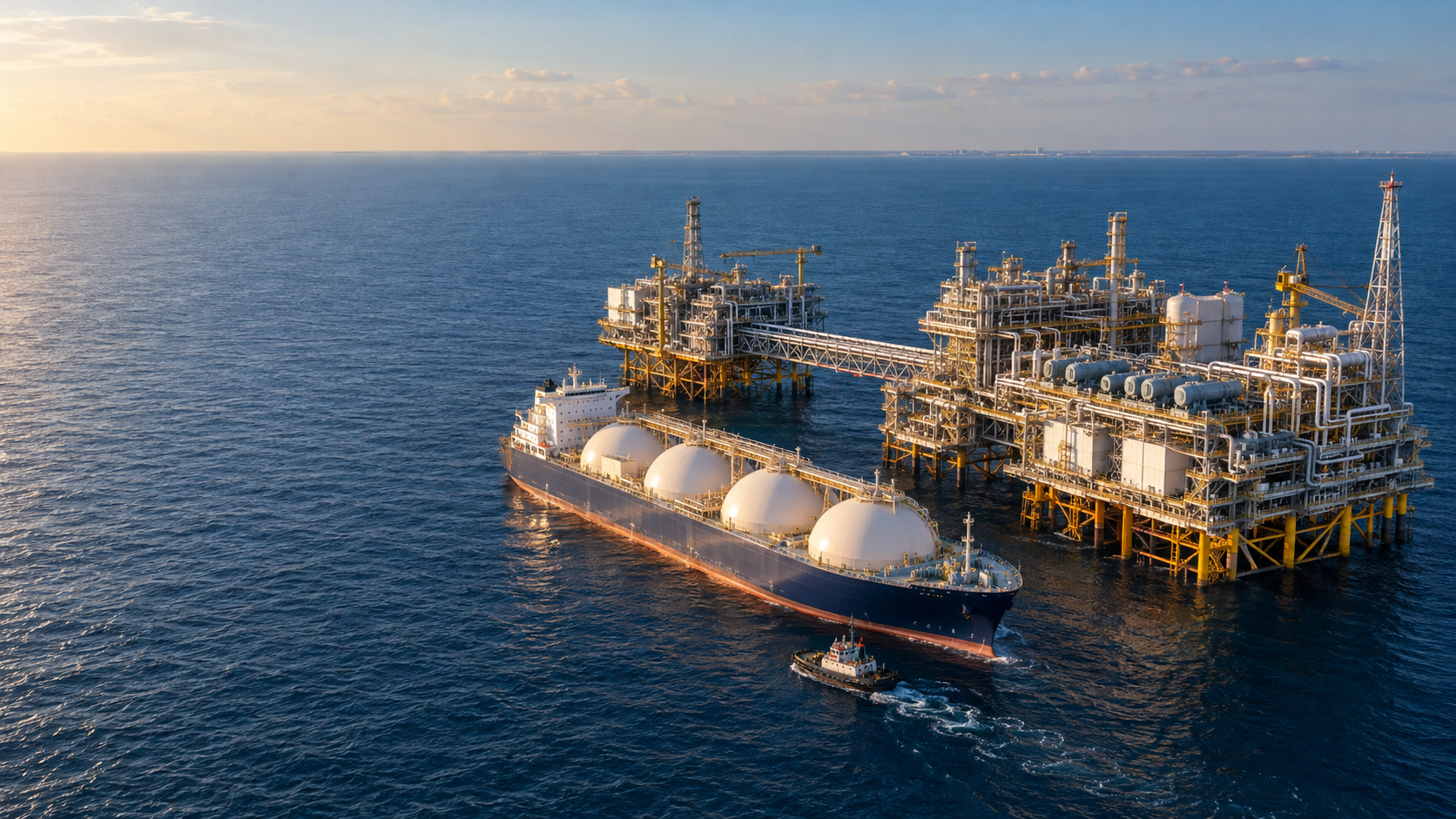
US gas offensive: New LNG port off the coast of Texas – What the multi-billion dollar project means for Europe's gas supply – Creative image on the topic, created with AI: Xpert.Digital
More LNG from the USA: How Europe's supply could become more secure – and what risks remain
Could a new port off the coast of Texas transform Europe's energy market? 8.4 million tons of LNG per year: What's behind the new US export project?
New gas source or new dependency? Europe's dilemma with American LNG – LNG project off the coast of Texas:
A multi-billion-dollar deep-sea LNG terminal is planned off the Texas coast, which could transform the international gas market. The ST LNG project is expected to export up to 8.4 million tons of liquefied natural gas annually. The US Maritime Administration for Development and Export Control (MARAD) approved the application for a deep-sea terminal license at the end of October 2026. Construction is scheduled to begin in 2027, with initial commissioning planned for 2029. However, significant steps remain between approval and reliable deliveries: the final investment decision is still pending, further requirements must be met, and customer contracts are not yet fully secured.
For Europe, the plant could create an additional source of supply and intensify competition for LNG. Increased supply generally strengthens importers' options – but it doesn't guarantee permanently low prices or an uninterrupted supply. Crucial factors also include the costs of liquefaction and transport, plant capacity utilization, long-term offtake agreements, and potential delays. Furthermore, a fundamental question arises for Germany: How can supply be diversified without simply shifting dependence to another supplier country? A closer look at the project reveals the opportunities ST LNG offers, the risks involved, and why Europe's energy security ultimately doesn't depend solely on a new port in Texas.
America's LNG offensive: How a new port off the coast of Texas could change Europe's energy market
More freedom at sea, new dependency on land
Off the coast of Texas, an energy project is planned that could have far-reaching implications beyond its immediate location. The proposed ST LNG deep-sea terminal represents the United States' continued rise to become a central supplier in the global liquefied natural gas market. This development opens up additional procurement opportunities for Europe. At the same time, it intensifies a fundamental question: How can security of supply be achieved without simply shifting economic dependencies from one supplier country to another?
In late October 2026, the US Maritime Administration of Development and Export Control (MARAD) approved the application for a deep-sea port license for the project. Four liquefaction plants with a total annual capacity of 8.4 million tons of LNG are planned approximately 16.7 kilometers off the coast of Matagorda, Texas. The estimated investment is $8.2 billion. The target dates are a construction start in 2027 and initial commissioning in 2029. However, these dates represent a project plan, not a guaranteed start of production.
The economic core lies not solely in additional export volumes. The project combines American gas production, maritime infrastructure, international financing, and long-term energy demand. It thus exemplifies how energy security is changing: dependencies are no longer determined solely by the location of storage facilities and pipelines, but also by the availability of liquefaction capacity, ships, import terminals, and reliable supply contracts.
This results in a nuanced perspective for Germany. More American LNG can broaden the supply and strengthen the negotiating power of importers. However, it does not replace well-thought-out diversification or investments in energy efficiency and alternative supply technologies. A new export port improves the range of options. Whether this will lead to permanently lower costs and greater security will only be determined by the interplay of market forces, infrastructure, and energy policy.
A billion-dollar project caught between approval and actual delivery capability
The regulatory decision is a significant step forward for ST LNG, but it does not yet equate to a fully financed and construction-ready project. Based on the project status announced at the end of October, the company is aiming for a final investment decision by mid- to late 2027. Furthermore, additional federal and state requirements must be met before the final license can be granted.
This distinction is economically crucial. An approved project represents a potential future source of supply. A plant with binding financing has a significantly higher probability of being realized. Only a completed, tested, and reliably operated plant actually delivers gas.
Significant risks can lie between these development stages. Construction costs can rise, financing costs can change, technical equipment can arrive late, and potential customers can postpone contractual decisions. Therefore, announced, approved, financed, and already operating capacities cannot simply be added together to assess the global market supply.
The timeline deserves particular attention. If the investment decision isn't made until later in 2027, initial commissioning in 2029 would be challenging. A staggered production start, with individual plant components starting up earlier than others, would be conceivable. However, the published key data does not indicate that the entire planned annual capacity would be available as early as 2029.
In addition, there is the need for commercial security. The company has stipulated minimum customer commitments totaling two million tons annually as a prerequisite for project approval. This corresponds to just under a quarter of the planned total capacity. Such commitments are an important starting point, but they do not yet answer all questions regarding financing, contract quality, and future capacity utilization.
For buyers, this means that ST LNG is a potential additional source of supply towards the end of the decade, but not an already available security reserve. Those planning their supply must distinguish between a strategic option and a guaranteed delivery obligation.
Why 8.4 million tons is more than just a technical figure
The planned capacity is distributed across four liquefaction plants, each with a capacity of 2.1 million tons per year. Compared to an American LNG capacity of more than 100 million tons annually, this would represent a significant increase. At the time of the announcement, the project's scale was described as approximately eight percent of existing US capacity. However, this figure is merely a snapshot: If the rest of the American supply continues to grow, the relative share of ST LNG will be lower at the time of its commissioning.
Dividing the plant into four units is economically advantageous because it allows for a degree of modularity. Construction, commissioning, and maintenance can essentially be distributed across multiple units. The failure of a single unit then doesn't necessarily have to shut down the entire production. At the same time, shared dependencies arise, for example, regarding gas supply, energy supply, control systems, and ship handling.
The difference between capacity and production is also important. Annual capacity describes the intended technical output. Actual export volumes depend on factors such as maintenance times, technical malfunctions, weather conditions, raw gas availability, and demand.
Assuming a purely hypothetical capacity utilization of 90 percent, an annual capacity of 8.4 million tons would translate to approximately 7.56 million tons of actual annual production. This calculation is not a forecast for ST LNG. Rather, it illustrates why nominal capacities should not be equated with guaranteed delivery volumes.
A facility of this size can be relevant to the market even if it doesn't directly supply German customers. Additional cargoes can displace or redirect other supply flows. For example, if an Asian customer is supplied from Texas, quantities from another producer can become available for Europe. LNG therefore operates through an international network of trade decisions, not just through direct supply relationships between two countries.
What the investment amount reveals about profitability
The estimated US$8.2 billion equates to approximately US$976 per ton of annual production capacity. This figure is calculated by dividing the total investment by the planned annual capacity. It is a measure of capital intensity, but not a selling price per ton of LNG.
This distinction prevents a common misinterpretation. Ideally, a plant produces for many years. The investment costs are spread across the quantities actually sold during its lifetime. In addition, ongoing expenses, financing, maintenance, and the return requirements of investors must be covered.
A simplified model calculation illustrates the scale of the project. If the $8.2 billion were spread evenly over 20 years without interest, it would result in an annual return of $410 million. At full capacity, this would equate to almost $49 per ton produced. At 90 percent capacity, this figure would rise to just over $54.
These figures are explicitly not an estimate of the actual production costs. They disregard interest on debt, return on equity, taxes, construction time, operating expenses, and other costs. Their analytical value lies in demonstrating the influence of capacity utilization: the less LNG a capital-intensive plant produces, the higher the capital required per ton sold.
Therefore, economic viability depends not only on the amount of construction costs. Equally crucial are reliable operating years, high technical availability, and a contract structure that stabilizes revenues even during weaker market phases.
Cost overruns cannot automatically be passed on to customers in full. Whether this is possible depends on the contracts and the competitive landscape. In a market with abundant supply, a more expensive project may come under pressure, while systems with more favorable cost structures remain profitable for longer.
The offshore location shifts the risks instead of making them disappear
The planned port is not located directly on the coast, but at sea. The published project description includes, among other things, 20 platforms, four floating LNG storage units, four mooring systems, and additional pipeline infrastructure. This makes it a complex production and logistics system, and not simply a new docking point.
One potential advantage lies in the shift of shipping traffic away from more heavily trafficked coastal areas. If large LNG tankers have to use certain narrow or busy channels less frequently, conflicts with other shipping traffic can decrease. However, this does not lead to a general conclusion that offshore installations are safer or more cost-effective overall.
The risks are changing in nature. At sea, waves, wind, corrosion, and the accessibility of technical facilities become more significant. Maintenance and repairs can become more complex if personnel, materials, and specialized equipment first have to be transported to the site. The connection between floating storage facilities, liquefaction technology, and export tankers must also function reliably under varying conditions.
For an economic evaluation, the entire supply chain is therefore crucial. A location may offer advantages in port operations while simultaneously imposing higher demands on maintenance and weather preparedness. The decisive factor is whether this reduces the cost per unit actually delivered and improves reliability.
The offshore approach is therefore neither inherently superior nor inherently problematic. Its quality is demonstrated by the technical design, the operational reserves, and how frequently the plant achieves its planned output under real-world conditions.
American expansion is changing the scale of the world market
ST LNG is part of a much larger development. The U.S. Energy Information Administration (EIA) outlines an expansion pathway that could add an estimated 13.9 billion cubic feet of additional U.S. liquefaction capacity per day between 2025 and 2029. It cites the current capacity as 15.4 billion cubic feet per day. This represents an expansion that would almost double the existing capacity, provided the planned projects are realized.
It is essential to clearly distinguish between reference years and geographical boundaries. A doubling compared to a previous baseline is different from a doubling compared to the level at the end of 2026. Similarly, American and North American capacities are not identical. In this context, North America also includes Canada and Mexico.
The EIA therefore also presents a North American expansion pathway: from 11.4 billion cubic feet per day at the beginning of 2024 to potentially 28.7 billion cubic feet in 2029. This is also contingent on the facilities currently under construction going into operation as planned.
The economic significance of this development extends beyond individual quantities. When a major supplier significantly expands its export capabilities, the availability of additional cargo changes. Buyers gain more options, traders can reroute shipments more flexibly, and producers must compete more intensely for long-term customers.
At the same time, a significant portion of the new American infrastructure is concentrated in Texas and Louisiana. This regional concentration facilitates the use of existing networks and industrial structures. However, it also creates shared risks if multiple facilities are affected by the same weather event or by disruptions to interconnected infrastructure.
More supply strengthens buyers, but does not guarantee permanently low prices
The international expansion of LNG generally suggests an easing of supply pressures. In its medium-term analysis, the International Energy Agency projects additional global export capacity of approximately 300 billion cubic meters annually by 2030. The US and Qatar together account for around 70 percent of this expected capacity increase.
For buyers, this is initially good news. A wider supply can reduce the likelihood that even small increases in demand will trigger extreme price movements. It can also improve their negotiating position with suppliers.
However, additional capacity is not the same as additional net supply. Existing plants may produce less, technical failures can occur, and project launches can be delayed. The IEA therefore distinguishes between the increase in capacity and a potential net increase in LNG supply of approximately 250 billion cubic meters annually by 2030.
The demand side is also reacting. Falling prices can attract additional buyers or make previously postponed gas demand economically viable. Particularly price-sensitive markets could absorb more LNG once it becomes more affordable. Some of the new supply would then be absorbed by additional demand.
This does not create an unalterable entitlement for Europe to cheap freight. European importers remain part of international competition. What matters are the prices other buyers are willing to pay, the transport costs incurred, and the obligations arising from existing contracts.
The objectively justified expectation, therefore, is not that LNG will necessarily become cheap. It is more plausible that successful capacity expansion will increase the range of options and limit peak shortages. This would already be a significant economic advantage, even if the price level does not return to previous lows.
Our US expertise in business development, sales and marketing


Our US expertise in business development, sales and marketing - Image: Xpert.Digital
Industry focus areas: B2B, digitalization (from AI to XR), mechanical engineering, logistics, renewable energies and industry
More information here:
A thematic hub offering insights and expertise:
- Knowledge platform covering global and regional economies, innovation and industry-specific trends
- A collection of analyses, insights, and background information from our key areas of focus
- A place for expertise and information on current developments in business and technology
- A hub for companies seeking information on markets, digitalization, and industry innovations
The role of LNG in the European energy market
Between cheap raw gas and expensive delivery lies an entire industry
For a German consumer, the American gas price is not the only factor. What matters is the price of usable gas at the European point of consumption.
Several economic stages lie between production and consumption: processing, pipeline transport, liquefaction, storage, maritime transport, regasification, and distribution in the gas network. Financing, hedging, and potential losses along the chain also need to be considered. The IEA's LNG emissions analysis explicitly considers these stages separately because each has its own technical and energy requirements.
Therefore, a large price difference can exist between American and European trading venues without this difference necessarily accruing entirely as profit to any single market participant. Part of it covers real supply chain costs. Another part may reflect risk premiums and capacity constraints.
The structure of these costs is crucial for competitiveness. If gas prices in the US are low, high liquefaction or transportation costs can partially negate the advantage. Conversely, an efficient supply chain can remain competitive even with rising raw gas prices.
For companies, an analytical approach is recommended to separate raw material prices, infrastructure charges, transport costs, and risk premiums. Only in this way can it be determined whether a favorable contract actually offers a sustainable cost advantage or merely makes a single price component appear attractive.
ST LNG would therefore not only be a producer of a tradable quantity of energy. The project would have to prove itself as part of an international cost chain whose individual components fluctuate differently and are, in some cases, only partially controllable.
Germany's dependence on the US must be measured by the correct denominator
Two figures are mentioned for Germany that can easily be confused: LNG accounts for approximately ten percent of gas imports, and more than 95 percent of this LNG comes from the United States. The second figure therefore refers to the LNG segment and not to all German gas imports.
Under these assumptions, directly sourced American LNG theoretically corresponds to approximately 9.5 percent of total gas imports. This is significant, but fundamentally different from an American dominance of 95 percent over the entire German gas supply.
Furthermore, such proportions are time-dependent. In 2024, 69 terawatt-hours of natural gas were imported via German LNG terminals. With total gas imports of 865 terawatt-hours, this represented approximately eight percent. These annual figures illustrate why percentages should always be considered in the context of the time period and definition.
However, direct terminal statistics do not describe every economic connection. Germany is integrated into the European gas market. Gas can enter the German network via other countries and their infrastructure. Therefore, the country of origin of a molecule, the immediate trading partner, and the country of border crossing are not necessarily the same.
Risk assessment also requires multiple layers. What is the share of a particular supplier country? How easily can other suppliers step in? How much spare import capacity exists? How flexible are the contracts? And how sensitive is the overall supply chain to a disruption?
The correct conclusion is neither that a high American share in the LNG segment is insignificant, nor that it proves comprehensive national dependence. The crucial factor is the combination of concentration, substitutability, and speed of adaptation.
Why past dependence on Russia is not a simple benchmark for comparison
The concern about a new dependency is understandable. However, it becomes analytically imprecise when different care systems are equated.
A pipeline creates a fixed connection between the production region and the sales market. Its economic importance stems from high investment costs and a limited range of alternative uses. LNG also requires capital-intensive infrastructure, but fundamentally enables transport between various export and import locations.
This difference can increase substitutability. However, it does not eliminate all dependencies. If many suppliers are subject to the same legal jurisdiction, political or regulatory decisions can affect several companies simultaneously. Similarly, several formally independent producers may depend on the same regional infrastructure.
The assessment presented in the initial case, namely that companies and existing market mechanisms limit the risks, therefore has a plausible core. Private actors react to prices, conclude contracts, and seek sales opportunities. This distinguishes a broad-based trading relationship from a completely centrally controlled supply structure.
This information alone is not enough to allay any concerns. Company diversity and country diversity are different categories. Ten suppliers from one country can offer more competition than a single supplier. However, they offer only limited protection against a joint political intervention or a major regional disruption.
A sound assessment should therefore not ask whether American LNG is fundamentally safe or unsafe. It should examine which risks are reduced by American deliveries and what new concentrations arise as a result.
Long-term contracts buy security and sell flexibility
For a multi-billion-euro project like ST LNG, long-term customer commitments are an essential component of financial security. They can stabilize expected revenues and thus facilitate financing. The aforementioned minimum threshold of two million tons of annual customer commitments demonstrates how closely project development and marketing are linked.
Such contracts also offer advantages for buyers. They can secure access to certain quantities and make procurement decisions more predictable over longer periods. This reliability has intrinsic economic value, especially when energy is essential for industrial processes.
The price for this is reduced adaptability. If a company's own gas demand falls more sharply than expected, long-term purchase commitments can become a burden. Whether this actually happens depends on how flexibly quantities can be adjusted, resold, or diverted to other customers.
The pricing formula is also crucial. A long-term contract does not automatically protect against high costs. It can secure delivery volumes, while the price remains linked to fluctuating market conditions.
For German companies, therefore, the contract duration alone is not the deciding factor, but rather the interplay of price fixing, quantity obligations, delivery location, resale rights, and default clauses. A seemingly favorable contract can be economically unattractive if it offers little flexibility. Conversely, a higher price can be sensible if it limits significant risks.
The challenge lies in not equating security of supply with maximum long-term commitment. A balanced procurement portfolio can combine different contract durations and sources of supply, instead of basing all expectations on a single market condition.
For industry, the final price matters more than political origin
German industry benefits from additional LNG primarily when it reduces actual supply costs and the risk of disruption. The mere availability of another source of supply is not enough to offset international competitive disadvantages.
Gas is particularly relevant where it is needed as process energy or a raw material. In such applications, price differences can directly impact production costs and investment decisions. At the same time, industries and companies differ considerably in how quickly they can adapt their energy consumption.
A company with few short-term alternatives assesses security of supply differently than a company that can choose between several energy sources. Similarly, a company with long-term guaranteed sales has different options for covering multi-year energy costs than a manufacturer with highly fluctuating demand.
Increased LNG supply can improve procurement. However, it does not automatically solve all location-related problems. The final price is also influenced by network costs, levies, infrastructure, and operational efficiency.
Furthermore, there is a conflict of objectives: persistently high gas prices can crowd out industrial demand. Lower prices can stabilize existing production, but at the same time make investments in alternative processes seem less urgent. Economic policy must therefore combine security of supply and competitiveness with credible long-term investment signals.
The central industrial-economic question is therefore not whether Germany needs more LNG. The crucial question is what quantity of gas remains economically viable for which applications and how this quantity can be reliably procured under varying market conditions.
The energy transition is changing the sales risk for new LNG plants
An export plant that doesn't start operating until the end of the decade at the earliest will not recoup its investment costs in the first few years of operation alone. Its profitability depends on a significantly longer usage period.
This creates a conflict of objectives. LNG can replace shortfalls and close supply gaps in the short term. Financing new plants, however, often requires long-term projections. The faster key sales markets reduce their gas consumption, the more producers will have to shift to other regions or applications.
The IEA expects that additional LNG supply can improve affordability, particularly in price-sensitive import markets. This opens up growth opportunities for exporters outside Europe. At the same time, it means that long-term demand should not be derived solely from current European security needs.
For ST LNG, the geographical composition of its customer portfolio is therefore important. A plant with diverse sales markets can partially offset different fluctuations in demand. However, it remains subject to global developments.
European buyers face the opposite problem. Those securing long-term volumes must align these commitments with their anticipated gas consumption. A contract that offers security today may incur adjustment costs later.
A balanced perspective therefore avoids two extremes. New LNG infrastructure is neither automatically superfluous nor permanently economically viable solely due to short-term security needs. Its quality depends on whether demand, costs, and contract durations remain aligned even under changing conditions.
Climate costs begin long before the German Brenner Pass
A complete economic analysis cannot ignore the emissions of the supply chain. With LNG, these emissions occur not only during subsequent combustion, but also during extraction, processing, transport, liquefaction, shipping, and re-evaporation. Potential methane releases must also be considered. The IEA explicitly examines these stages as an interconnected system.
Therefore, it is not sufficient to evaluate natural gas solely based on its use in power plants or industrial boilers. Two supply chains can provide the same fuel and yet cause different upstream emissions.
The IEA identifies several technical options for reducing this burden: limiting methane losses, more efficient processes, the use of low-emission electricity, reducing routine flaring, and capturing and storing certain CO₂ streams. These measures can improve parts of the supply chain, but they do not automatically eliminate all emissions.
For investors and customers, such differences are economically significant. Emission requirements can influence access to certain markets. Measurably and verifiably low emissions can represent a competitive advantage. Conversely, insufficient data or high methane losses can create additional risks.
A definitive climate assessment for ST LNG cannot be made without reliable, project-specific operating data. Neither the offshore location nor the novelty of the technology alone imply particularly good or particularly poor environmental performance.
A reliable assessment would have to take into account actual energy consumption, the origin of the energy used, methane losses, and transport routes. Only then can it be determined how the plant positions itself within the LNG market.
Despite many providers, regional concentration can become a weakness
Texas and Louisiana are gaining further importance due to the expansion of LNG infrastructure. From a business perspective, this concentration is understandable: existing infrastructure, industrial experience, and proximity to gas supply and export logistics can create locational advantages.
However, from a security of supply perspective, a different picture emerges. Several plants in a region are not completely independent sources of supply. Shared weather conditions, grid connections, or service providers can lead to disruptions affecting multiple locations simultaneously.
This is a general principle of risk assessment: diversification is only fully effective if the individual risks are not too closely interrelated. A large number of contracts can create a false sense of security if all deliveries are dependent on the same regional bottlenecks.
For European importers, this means that the number of suppliers alone is not a sufficient criterion. Geographical distribution, technological independence, and alternative transport routes must also be considered in the evaluation.
The offshore nature of ST LNG does not automatically solve this problem. While the facility can bypass certain coastal bottlenecks, it remains dependent on regional gas supplies, weather conditions, and maritime services.
Security of supply is therefore not achieved by having as many names as possible in the procurement portfolio, but by genuinely different failure profiles. This distinction is particularly important when new capacities are primarily being developed in a few export regions.
Three market developments determine success
For the economic classification of ST LNG, several future scenarios are more useful than a single, seemingly precise forecast.
In the first scenario, LNG supply grows faster than demand. New plants are largely coming onto the market as planned, while energy savings and alternative energy technologies limit consumption in key sales regions. Buyers gain bargaining power. For ST LNG, the key factors would then be whether construction costs, financing, and ongoing operation can remain competitive.
In the second scenario, demand largely absorbs the additional supply. Cheaper and more readily available LNG attracts new customers, while existing markets require significant quantities. For producers, this would be a comparatively favorable environment, provided their facilities deliver reliably. The possibility of additional demand in price-sensitive markets, as described by the IEA, fits this development path.
In the third scenario, recurring disruptions remain a defining characteristic. Delayed project launches, outages, or other interruptions prevent the announced capacity from being consistently available as a reliable supply. In such cases, despite an overall larger infrastructure, significant price fluctuations could still occur.
None of these future scenarios can be definitively selected based solely on the project data. However, they illustrate which characteristics are economically valuable: low costs, high availability, flexible marketing, and reliable financing.
The same logic applies to buyers in Germany. Procurement that relies solely on permanently low prices is just as vulnerable as a strategy that assumes unlimited high prices due to scarcity.
The strongest energy policy preserves choices
ST LNG represents a real expansion of the potential energy supply. If the project is financed, built, and reliably operated, it could provide significant additional quantities of LNG annually. Its market value lies not only in production but also in increasing the choice for buyers.
The reasoned perspective on the project is therefore neither unqualified approval nor blanket rejection. Increased export capacity can improve security of supply and limit market power. At the same time, it can create new long-term commitments, regional concentrations, and investment risks.
For Germany, the ability to switch between energy sources and solutions is crucial. This includes diverse supplier countries, robust infrastructure, adequate reserves, and contracts that can be adapted to changing gas demand. Equally important is reducing demand that can be replaced in a technically and economically viable way.
The greatest danger would not be the use of American LNG per se. The problem lies in a strategy that confuses short-term relief with permanent invulnerability. No supplier country, no contract, and no technology can eliminate all risks.
The new port off the coast of Texas could expand Europe's room for maneuver. Whether Europe utilizes this room for maneuver, however, will not be decided by Matagorda, but rather by its own procurement, industrial, and energy policies. Lasting security arises where additional supply leads not to increased convenience, but to greater economic choice.
🎯🎯🎯 Data-driven B2B industry hub as a quasi-in-house solution


The quasi-in-house solution: How Xpert.Digital closes operational gaps in B2B marketing and sales – Smart Content-Driven Business - Image: Xpert.Digital
Xpert.Digital is a data-driven B2B industry hub led by Konrad Wolfenstein . The company acts as an external, quasi-in-house solution for industrial partners, closing operational gaps in marketing, content, and sales – without requiring additional resources on the client side.
More information here:
Your global marketing and business development partner
☑️ Our business language is English or German
☑️ NEW: Correspondence in your native language!

Konrad Wolfenstein
I and my team are happy to be available to you as your personal advisor.
You can contact me by filling out the contact form here wolfenstein@xpert.digital:or simply call me at +49 7348 4088 965. My email address is
I'm looking forward to our joint project.