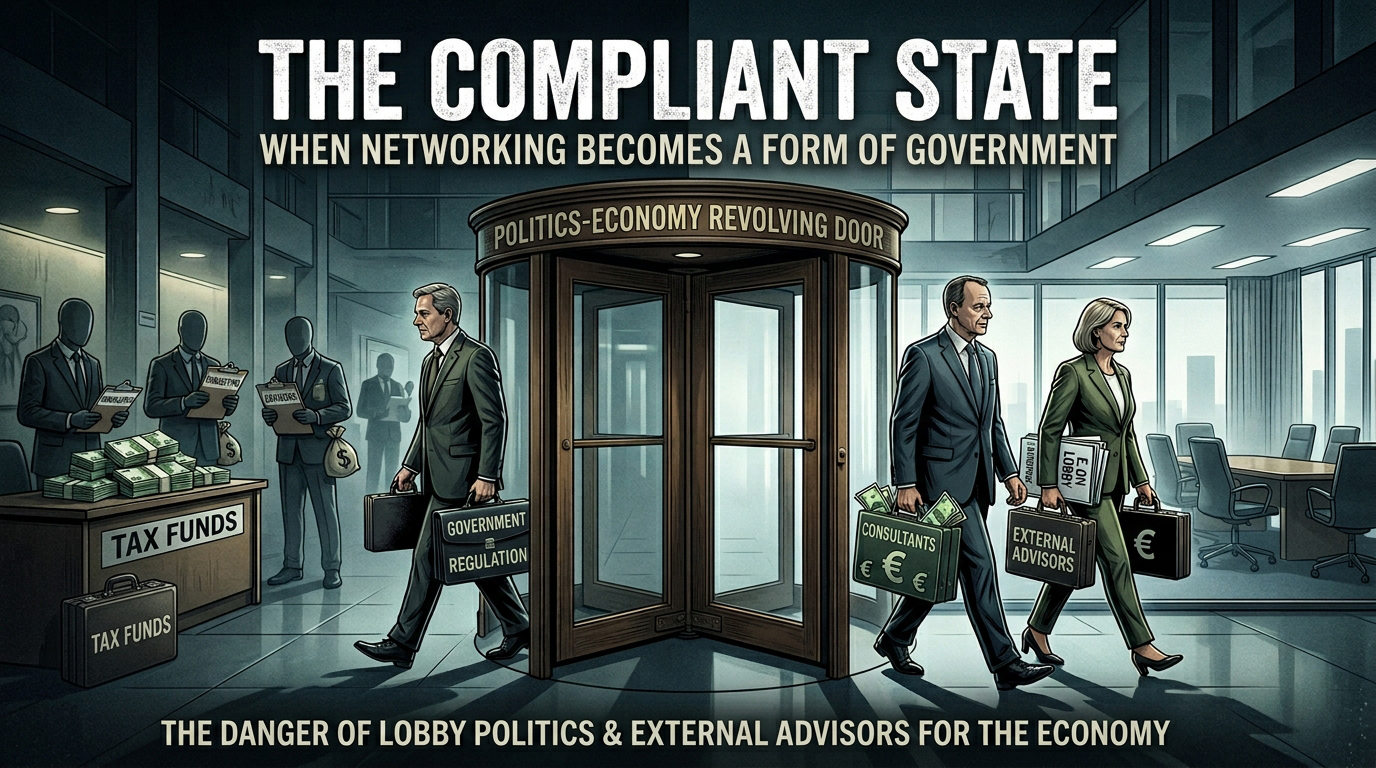
When networking becomes a form of government – and external consultants foot the bill at the taxpayers' expense – Image: Xpert.Digital
The obliging state: Why lobby politicians like Merz and the wealthy endanger the economy
The fundamental problem: competence as a miscategory
In the Federal Republic of Germany, two parallel career paths have emerged in recent decades, which in theory should run separately, but in practice are increasingly merging: the political path and the entrepreneurial-industrial path. The result of this merging are politicians like Friedrich Merz and Katherina Reiche, who did not reach the top of state institutions through exceptional policy expertise, but through something more subtle and effective: decades of systematically cultivating networks that make the transition between politics and the private sector a smooth, mutually beneficial, and continuous flow.
From 2016 to 2020, Friedrich Merz was chairman of the supervisory board of the German subsidiary of BlackRock, the world's largest asset manager, with assets under management exceeding the economic output of most countries. As BlackRock itself explained, Merz's role there was not operational or entrepreneurial, but decidedly political: "to cultivate relationships with key clients, regulators, and regulatory authorities in Germany for BlackRock." He wasn't an entrepreneur. He was a facilitator. Simultaneously, he sat on the supervisory boards of Deutsche Börse, Commerzbank, Axa Insurance, and the real estate company IVG, and represented the interests of the metal and electrical engineering lobby in the supporting association of the Initiative for a New Social Market Economy (INSM). When he returned to active politics in 2021 and ultimately became Chancellor, he carried all these ties into office like an invisible burden.
Katherina Reiche's career path follows a structurally identical pattern. After 17 years in the Bundestag, she moved to the executive management of the Association of Municipal Enterprises (VKU), the lobby group for 1,500 municipal energy and water suppliers, and subsequently became CEO of Westenergie AG, an E.ON subsidiary with 10,000 employees and one of Germany's largest gas networks. She, too, was not an entrepreneur in the creative sense. Her value to the corporations lay in her access to political decision-makers and her familiarity with regulatory structures. She returned to office as Federal Minister for Economic Affairs and Energy with this experience.
The institutional logic of incompetence
Anyone who wants to understand why such a career pattern is structurally dangerous not only for the individuals involved but for the entire economy must understand the institutional logic it generates. The Federal Ministry for Economic Affairs and Energy is one of the most complex ministries in the German government. It regulates energy markets with an annual turnover of several hundred billion euros, shapes industrial policy for sectors that support millions of jobs, negotiates international trade and commodity agreements, and formulates climate protection policies that will have an impact for decades. The depth of expertise required for these tasks exceeds what a politician with a degree in the natural sciences and a career as a lobbyist and networker can readily possess.
The state, however, has an answer to precisely this problem: highly qualified ministerial officials. The Federal Ministry for Economic Affairs and Energy (BMWi) employs several hundred experts—economists, lawyers, engineers, and industry specialists—who are trained and paid to conduct precisely the analyses a minister needs for decision-making. These officials are bound by instructions, but not obliging. They deliver what the law requires: an analysis to the best of their knowledge and conscience, even if the result is politically inconvenient. This is precisely their problem from the perspective of a minister whose political priorities are defined more by industrial networks than by economic expertise.
The solution the system offers is outsourcing to external consultants. External consulting firms are not subject to the reporting requirements of ministerial officials. They cannot be held accountable before parliamentary committees like state secretaries. They leave only those traces in public documentation that the client permits. And they know who commissions them and what is expected of them. The result is a systematic circumvention of the institutional knowledge that the state itself has built up, in favor of externally purchased opinions that structurally align with the ideas of the political leadership.
The billion-dollar boondoggle: What external consultants cost the state
The financial dimensions of this practice are alarming in themselves. In a 2025 audit report, the Federal Court of Auditors found that the German government spent more than €1.6 billion on external consulting services in the ten years between 2015 and 2025. From 2020 to 2023 alone, expenditures rose by 39 percent to almost €240 million annually. The Budget Committee of the Bundestag had already called for a substantial reduction in the use of external consultants in 2020. According to the Federal Court of Auditors, this demand was ignored. Most ministries had not even formulated concrete reduction targets. The Court of Auditors sees the "integrity of the administration" at risk.
The direct costs are the least of the problems. The real potential for economic damage lies in the decisions made based on these expert opinions and consultations. Perhaps the most spectacular example is the car toll under Federal Transport Minister Andreas Scheuer. In 2018 alone, the Ministry of Transport paid almost €12 million to external consultants for planning the toll, even though the legal risk of an EU lawsuit had been pointed out early on, both internally and externally. Scheuer nevertheless allowed the operating contract to be signed before the European Court of Justice (ECJ) had issued its ruling. The ECJ declared the toll illegal under EU law. The subsequent claims for damages by the operating consortia amounted to €560 million. The external consultants who had overseen the project bore no financial responsibility whatsoever. They had pocketed the money and shielded themselves from liability.
The consulting scandal at the Federal Ministry of Defense under Ursula von der Leyen reveals a structurally identical pattern. According to Der Spiegel, the then State Secretary Katrin Suder, herself a McKinsey director for many years, brought "numerous former colleagues from her McKinsey days into the ministry" and awarded multi-million-euro contracts to her former firm. The Federal Court of Auditors determined that the ministry "was consistently supported by certain consulting firms and individuals" and "frequently explicitly insisted on specific consultants." According to calculations, the Ministry of Defense spent €154.9 million on external consultants in 2020 alone, placing it at the top of all federal ministries in this regard. Parliament was not fully aware of this because the ministry systematically concealed contracts awarded to subcontractors when answering parliamentary inquiries.
The structural perversity of favorable expert opinions
The most economically dangerous aspect of the consultant model is not the financial dimension, but the epistemic one: Externally commissioned reports are systematically designed to confirm, rather than challenge, the political convictions of their clients. This is not speculation, but a documented finding.
In the case of the Ministry of Economic Affairs under Reiche, research by the environmental organization Greenpeace revealed that at least 28 substantive changes were made between the original version of the EWI Energy Transition Monitoring report from August 2025 and the published version from September 2025. Critical passages concerning the risks of new gas-fired power plants were toned down, the costs of the energy transition were deemed unacceptably inflated by experts, and recommendations for action that the institute considered necessary appeared as optional in the ministerial version. The institute that prepared the report, the EWI at the University of Cologne, was commissioned by a consortium led by BET Consulting GmbH – both institutions with proven ties to the fossil fuel companies E.ON and RWE. The result: The minister, who comes from the E.ON corporate milieu, commissioned experts from the same corporate milieu to produce an analysis that confirms her own policies. At the taxpayers' expense.
In a landmark report from 2023, the Federal Court of Auditors precisely described the systemic logic of this problem: “When the Federal Government uses external consultants, the public interest and corporate profit orientation clash in core areas of public administration. This practice poses particular risks to the federal budget and administrative integrity.” The consulting firm optimizes its own continued existence as a contractor. It does so not through quality in the scientific sense, but through client satisfaction. The more favorable its results, the greater the likelihood of a follow-up contract. This incentive structure is the enemy of independent policy advice.
Politicians, for their part, also benefit from this arrangement. Der Spiegel aptly described it back in 2019: Politicians can justify their decisions by citing "external and supposedly independent expertise." This creates a rhetorical safety net: If a measure fails, the consultants bear the intellectual responsibility, not the minister. If the measure succeeds, the minister reaps the political rewards. The risk is externalized, the gain internalized. For the commissioning politician, this is a rationally superior arrangement – for the economy, it is a disaster.
Our EU and German expertise in business development, sales and marketing


Our EU and German expertise in business development, sales and marketing - Image: Xpert.Digital
Industry focus areas: B2B, digitalization (from AI to XR), mechanical engineering, logistics, renewable energies and industry
More information here:
A thematic hub offering insights and expertise:
- Knowledge platform covering global and regional economies, innovation and industry-specific trends
- A collection of analyses, insights, and background information from our key areas of focus
- A place for expertise and information on current developments in business and technology
- A hub for companies seeking information on markets, digitalization, and industry innovations
Billions in risk from bad advice: Why external expert opinions make business more expensive
Why this is specifically dangerous for the economy
The economic damage caused by this situation is not abstract. It manifests itself in three different but interconnected channels.
The first channel is the direct misallocation channel
Energy policy decisions based on favorable expert opinions steer investments in the wrong direction. If external consultants from the gas industry help Germany secure long-term gas supply contracts until 2036 instead of accelerating the expansion of renewables, these contracts will tie up capital and infrastructure for at least a decade in a technology that is more expensive internationally than domestically produced green electricity. The Energy Watch Group calculated that delaying the expansion of renewables until 2045, compared to an accelerated scenario to 2035, will generate additional costs of €320 billion. This €320 billion is not an abstract figure – it represents energy costs for companies that will lose their international competitiveness and for households that will have less purchasing power.
The second channel is the regulatory channel
An economics minister with ties to fossil fuel companies, and whose key external advisors come from the same background, produces regulations that favor these corporations' interests. This is not a conspiracy theory, but an institutionally predictable consequence. If feed-in tariffs for small photovoltaic systems are abolished, small and medium-sized enterprises (SMEs) and private households will lose a means of self-sufficiency, while large energy suppliers will secure their customer base. If priority rules for wind and solar power are lifted in certain regions, the profitability of projects in which SMEs have invested will decline. Regulation systematically shifts market power from decentralized, small-scale players to established corporations. This is the antithesis of a free market.
The third channel is the competence erosion channel
When ministries systematically neglect their own resources in favor of external consultants, they gradually lose the ability to independently assess complex issues. The Federal Court of Auditors explicitly warned that government dependence on external consultants, particularly in strategically critical areas such as IT, but also in energy and industrial policy, leads to a situation where the public sector is no longer able to evaluate the quality of the expert opinions it receives. A ministry that can no longer determine the quality of an expert opinion has lost control over its own policies. Decisions are then no longer made by the democratically elected legislature, but by the consulting firm that received the commission.
The revolving door principle as a systemic risk
The revolving door phenomenon between politics and business predates the current government. But the cabinet composition under Friedrich Merz has given it a new dimension. According to research by abgeordnetenwatch.de from 2025, numerous ministers in Merz's cabinet can be identified who worked as lobbyists, management consultants, or corporate executives immediately before their appointment. This creates a government structurally composed of representatives of precisely those interests it is supposed to regulate.
The fundamental problem lies in what economists call "regulatory capture": the gradual takeover of a regulatory authority by the industry it is meant to regulate. Regulatory capture doesn't arise from overt corruption, but from more subtle mechanisms: shared worldviews, personal connections, and the unspoken conviction that what's good for industry is also good for the country. When the Chancellor comes from the circle of the world's largest asset manager and the Minister of Economic Affairs from the circle of the largest regional energy supplier, then regulatory capture is not a theoretical risk, but a structural reality.
LobbyControl documented in its lobbying file on the Merz government how former clients of current government members can directly profit from legislative processes. For example, the coalition agreement explicitly omits a ban on the "perpetual chemicals" PFAS, which directly benefits the chemical industry, with which close network ties exist. A coincidence? Perhaps. A pattern? Definitely.
The contradiction that sums it all up
Herein lies the fundamental contradiction that defines the entire system: Merz and Reiche publicly position themselves as advocates for business. Reiche speaks of security of supply, affordability, and industrial competitiveness. Merz emphasizes the need to strengthen Germany as a business location. Both see themselves as pragmatic realists who, after the ideological years of the traffic light coalition, are finally listening to the needs of businesses again.
But what does this mean in practice? Security of supply through gas contracts until 2036, which will once again drive Germany into geopolitical dependency and increase energy costs in the long term. Affordability through the reduction of feed-in tariffs, which have driven investments in decentralized renewables and would have reduced dependence on expensive large corporations. Industrial competitiveness through an industrial electricity price so low that experts describe it as "homeopathic." And an external consulting practice that pumps millions of taxpayer dollars into consulting firms that are not held accountable for their recommendations, yet whose recommendations shape investment decisions worth billions.
The contradiction is not that Merz and Reiche want to harm the economy. The contradiction is that they benefit a specific segment of the economy—the one they come from and are connected to—while simultaneously claiming to act for the entire economy. The economy they represent is that of large corporations, financial investors, and fossil fuel infrastructure operators. The economy excluded is that of small and medium-sized enterprises (SMEs), citizen energy cooperatives, solar pioneers, energy storage startups, and the millions of households that, as prosumers, could contribute to the success of the energy transition if given the necessary regulatory framework.
Irresponsibility as a business model
A particularly destructive aspect of the consultant-politician complex is the complete erosion of accountability. In a functioning democratic system, the minister bears political responsibility for their decisions. They can be questioned by parliament, removed from office through votes of no confidence, and judged by the public. External consultants are not subject to any of these controls.
The Federal Court of Auditors explicitly identified this as a problem in its 2023 report: Parliamentary oversight of consulting services is not guaranteed because many contracts fall outside the reporting requirements or are recorded opaquely. In a previous report, the Court of Auditors spoke of a "shocking picture of procurement practices." One ministry paid €17,200 for an external consultant to take minutes of a committee meeting—a task any staff member could have performed. Another paid €5,900 for answering a single parliamentary inquiry. These are not isolated cases, but rather symptoms of a systemic practice.
What are the implications? The model of the network-politics manager, who runs a complex department without in-depth expertise and compensates for this lack of competence with external consultants from their own network, is not only problematic from a democratic theory perspective. It is also economically damaging because it leads to systematic misjudgments that, in total, cost billions, and because it undermines the state's capacity to act in the long term. A state that no longer knows what it knows itself and that has delegated its core tasks to private companies loses the ability to govern independently over decades.
Political scientist and lobbying expert Gerhard Schick of the citizens' movement Finanzwende put it this way upon Merz's return to politics: The crucial question is what kind of economic activity he stands for – for providing services in the public interest or for one in which "trickery and backroom deals are made." This question is not personal. It is structural. And the structure of the current government provides a clear answer.
Which would require a real solution
The counter-movement to this system is not difficult to describe, but it is politically inconvenient. Firstly, it would require a strict cooling-off period of at least five years, during which politicians, after leaving office, would be prohibited from taking up any activities in sectors they have regulated. Germany has formally had such a cooling-off period since 2015, but it is too short, its enforcement too hesitant, and its impact correspondingly limited. Secondly, it would require a substantial development of in-house government expertise, instead of commissioning external consultants. The Federal Court of Auditors has been calling for this for years. Thirdly, it would require a comprehensive lobby register with full transparency requirements, encompassing not only formal registrations but also documenting all substantive influence on laws and regulations.
Politicians like Merz and Reiche will not seriously pursue such measures because they would damage the system from which their own power derives. This is not a criticism of their morals. It is a structural description of their institutional situation. Systems perpetuate themselves. And the system of the network-political manager with an external consulting arm has so far proven more resilient than all parliamentary demands for change.