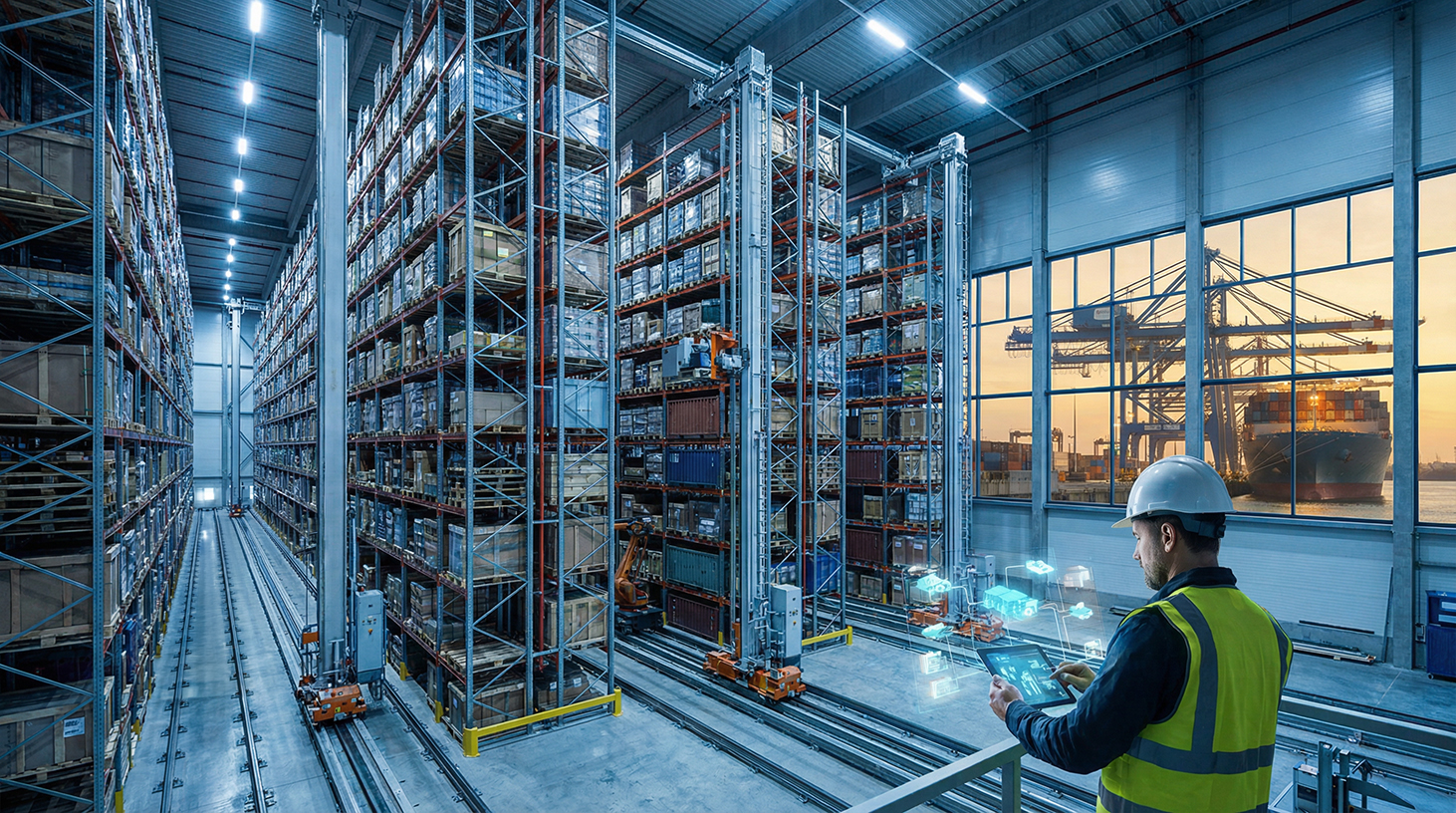
The end of cold calling? Why multi-million dollar deals in mechanical engineering never come about through advertising – Image: Xpert.Digital
Push vs. Pull: The 17-billion-dollar high-bay warehouse market: How the giants of heavy-lift logistics are really bought
No more impulse buys for 40 tons: This is how radically B2B purchasing is changing in logistics
From Dubai to China: The billion-dollar secret behind sales and AI plays a decisive role: Why capital goods in logistics have to sell themselves
You might spontaneously grab a chocolate bar at the checkout, or download a new app after clicking on a colorful advertisement. But how do you sell a fully automated high-bay warehouse for 15,000 Euro pallets? Or a fleet of heavy transport vehicles worth several million euros? The answer to this question forces B2B providers to radically rethink their approach. In the world of industrial heavy-load and container logistics, the classic "push strategy"—actively pushing advertising messages—simply doesn't work. Here, multi-million-euro investments, long buying cycles, complex committee decisions ("buying centers"), and the relentless dictate of ROI dominate. Anyone who wants to succeed in this growing multi-billion-euro market must master the mechanisms of the "pull strategy": Potential buyers actively seek solutions when facing operational bottlenecks and inform themselves through in-depth research, expert content, and—increasingly—artificial intelligence. This comprehensive analysis sheds light on why technical content is more important today than cold calling and how system integrators, port operators and vehicle manufacturers can reach their target groups exactly where the purchase decision is actually made.
Related to this:


Why the logistics giants can't be sold – but are in demand
Nobody buys a high-bay warehouse because they saw a commercial
There are products you buy because you happen to see them: a chocolate bar at the supermarket checkout, a perfume with attractive packaging, an impulse app with a tempting ad on your smartphone. And then there are products you buy after months of research, comparing specifications, requesting quotes, and discussing them with half a dozen internal experts. A fully automated high-bay warehouse for 15,000 Euro pallets clearly belongs in the second category – and with it, the entire world of heavy-load logistics and container infrastructure.
The question of whether these topics are push or pull phenomena is not an academic exercise. It determines how manufacturers, system integrators, port operators, and freight forwarders structure their marketing and sales, which channels they utilize, what content they produce, and how they plan their sales cycles. And the answer in this case is clear – even if it has nuances worth examining more closely.
The basic coordinates: What is push, what is pull?
Before understanding why heavy-duty logistics and high-bay warehouses are predominantly pull-oriented, a distinction must be clarified. The push strategy refers to the approach where a manufacturer actively pushes its products into the market – through retailers, advertising, direct contact, or promotions. The advertising message is forced into the market, often without the recipient having previously signaled a specific need. The classic instrument is the advertisement, which interrupts the consumer and draws their attention to a product they weren't actively looking for.
The pull strategy pursues the exact opposite: it creates or leverages existing demand, attracts prospects through relevant content, and is actively sought out rather than being pushy. Typical pull tools include content marketing, search engine optimization, specialist publications, white papers, and webinars – in short, anything that reaches someone who already has a question and is looking for an answer. The push strategy is the domain of sales, which actively approaches potential customers. The pull strategy is the domain of marketing, which builds trust and visibility so that prospects come organically.
This dichotomy is not a question of the medium, but of the purchasing motivation. And with capital goods such as high-bay warehouses, heavy transport vehicles, or automated container terminals, the purchasing motivation is invariably active: A company recognizes a problem, formulates a need, and seeks solutions. It is never the other way around.
The proof lies in purchasing behavior: This is how B2B buyers in logistics make their decisions
In a B2B context, purchasing a high-bay warehouse isn't a spontaneous decision. It's made because an existing warehouse has become overcrowded, a port is reaching its capacity limits, a new factory is being built, or existing manual logistics are driving up production costs. This process always begins with an internal realization – and then triggers a systematic research phase that often takes months.
Studies show that B2B buyers have already completed up to 57 percent of their decision-making process before they even contact a sales representative. They conduct their own research, compare suppliers online, read technical reports and case studies, seek recommendations from industry networks – and then end up on the websites, in the catalogs, or in the trade publications of those suppliers who provide the right content at the right time. This is pull marketing in its purest form. A logistics manager evaluating a high-bay warehouse actively searches for benchmarks, ROI calculators, technical white papers, and reference projects. They won't be surprised by a banner ad.
To make matters worse, the purchasing decision for complex logistics investments is not made by a single person. The so-called buying center – a cross-industry reality in B2B – comprises up to ten people for investments of this magnitude, each with different roles: initiator, decision-maker, buyer, user, advisor, and gatekeeper. Each of these roles has different information needs. The CFO wants to see the total cost of ownership, the operations manager is interested in the technical specifications, the buyer negotiates terms, and the IT manager checks the system integration. Pull marketing addresses all these information needs with targeted content – push marketing fails structurally in this regard.
High-bay warehouses: A technology that explains itself with market data
The figures are impressive. The global market for automated storage and retrieval systems (AS/RS) was valued at $9.58 billion in 2025 and is projected to grow to $17.4 billion by 2034, representing an annual growth rate of 7 percent. The broader field of warehouse automation, which includes high-bay warehouses, was valued at $26.5 billion in 2024 and is growing at a remarkable annual rate of 19.9 percent. This investment momentum is no accident—it reflects a systematic demand driven by operational necessities.
The reason lies in a fundamental physical reality: In the metropolitan areas of Europe, Asia, and North America, industrial space is becoming scarcer and more expensive. A modern high-bay warehouse promises not only more capacity on the same footprint but also a drastic reduction in space requirements. Container high-bay warehouses, such as the Boxbay system developed by SMS Group and DP World in the Port of Dubai, offer a threefold increase in capacity on the same footprint and reduce space consumption by up to 70 percent. An offering of this magnitude speaks for itself – it doesn't need to be advertised with hype, but rather explained by experts.
This also illustrates why companies like Hamburger Hafen und Logistik AG (HHLA) have invested over one billion euros in European port logistics in the last five years. HHLA operates 22 electrified warehouse blocks, offering a storage capacity of 45,000 TEU. Investments of this magnitude are not generated through push advertising. They result from systematic market monitoring, internal needs analysis, and intensive supplier research – in other words, from the pull mechanism in its purest form.
Container logistics: A global race that creates pull demand
Around 90 percent of global freight traffic continues to be handled via the world's oceans. However, the traditional container terminals in major port cities are reaching their physical and operational limits. This structural tension creates a constant, active demand for innovative solutions – and this is precisely the fertile ground in which pull marketing thrives.
China is pursuing a particularly aggressive automation approach and, by the end of 2024, was already operating 52 automated terminals – more than any other nation worldwide. The Chinese market for automated container handling facilities was estimated at 15.37 billion yuan in 2025 and is projected to grow by 7.24 percent annually. JD Logistics has launched a 5G-automated warehouse with over 100 autonomous vehicles and reports a 200 percent increase in efficiency compared to conventional systems. These figures are not marketing hype – they are facts actively sought by potential investors worldwide.
The market for container high-bay warehouses is projected to reach a volume of over US$20 billion by 2034. To succeed as a supplier in this market, you need to be visible where decision-makers research: in specialist publications, at industry conferences, on Google with high-level technical content, in LinkedIn groups for logistics professionals, and in academic studies. This is the logic of pull marketing.
Heavy haul logistics: No impulse purchases for loads over 40 tons
The global market for heavy-duty trucks had a volume of over US$233.28 billion in 2025 and is projected to exceed US$365.76 billion by 2035, representing an annual growth rate of 4.6 percent. These figures suggest a mass market – and in some respects, it is. However, the way purchasing decisions are made in this market is fundamentally different from that in the consumer goods sector.
A freight forwarder acquiring a fleet of heavy haulage vehicles goes through a structured tendering process. They define requirements, compare offers from manufacturers such as Volvo, MAN, Mercedes-Benz, or Scania, conduct test drives, and negotiate framework agreements. This process begins with independent information research – and it is driven by high-quality content, technical documentation, and reference projects, not by television advertising. Current investment priorities – such as the question of alternative drive systems for heavy haulage – are being actively analyzed by a growing number of logistics companies: While there is a clear high level of interest in zero-emission vehicles, high acquisition costs and limited infrastructure remain the key challenges. Here, too, the principle applies: complexity creates a need for research, and the need for research creates pull.
Global road freight volume reached approximately US$2.2 trillion in 2024 and is projected to grow to US$3.4 trillion by 2030. Air freight achieved record growth of 11.3 percent in 2024. This growth dynamic necessitates continuous capacity investment by logistics companies. These investment decisions are driven by operational constraints and strategic growth plans – not by external advertising pressure.
🎯🎯🎯 Data-driven B2B industry hub as a quasi-in-house solution

The quasi-in-house solution: How Xpert.Digital closes operational gaps in B2B marketing and sales – Smart Content-Driven Business - Image: Xpert.Digital
Xpert.Digital is a data-driven B2B industry hub led by Konrad Wolfenstein . The company acts as an external, quasi-in-house solution for industrial partners, closing operational gaps in marketing, content, and sales – without requiring additional resources on the client side.
More information here:
The silent transformation in B2B: Why customers find you long before your sales team does
Why pull dominates: Six structural reasons
The dominance of pull systems in heavy-duty logistics and high-bay warehouses is no accident. It results from six structural characteristics of these markets that reinforce each other.
The first factor is the investment amount. An automated high-bay warehouse costs between several million and several hundred million euros, depending on its size. With sums like these, impulsive purchasing behavior is structurally impossible. Every expenditure must be justified by business plans, profitability analyses, and strategic considerations. This necessitates intensive pre-information gathering – in other words, a pull strategy.
Secondly, there's the complexity and need for explanation. A high-bay warehouse isn't a standardized product you can just pick off the shelf. It's a customized system solution that needs to be integrated into existing production logistics. The buyer needs to understand how the system works, what interfaces it requires, how much maintenance is needed, and what the implementation process entails. This understanding isn't achieved through advertising, but through in-depth technical information.
The third factor is the length of the buying cycle. In industrial logistics, six to 24 months often pass between the initial recognition of a need and the final investment decision. During this time, potential customers are constantly engaged in research – and thus permanently in pull mode. They consume specialist articles, attend trade fairs, hold discussions with vendors, and compare offers.
Fourth, the narrowness of the target group. In B2C marketing, millions of potential buyers are addressed, justifying mass advertising formats. In the heavy-lift logistics sector, however, the relevant target group is small and highly specialized: port operators, large freight forwarders, car manufacturers with their own factory logistics, and retailers with complex distribution centers. Reaching this target group through mass advertising would be inefficient and costly. Pull marketing, which provides the right content for the right search queries, is the clearly superior strategy.
The fifth factor is the tendering process as standard practice. Large logistics projects in Europe are typically awarded through formal tenders. This process presupposes that the buyer is already at an advanced stage of their decision-making process – they have defined their needs, conducted market research, and formulated criteria. The tender itself is therefore already the product of a lengthy pull process.
Sixth and final factor: the digital transformation of the B2B buying process. In an influential analysis, Roland Berger succinctly summarized the transformation of B2B sales: it's about moving from a push-driven sales approach to a pull-driven approach driven by the customer. This shift is being accelerated by increasing digitalization. Currently, 89 percent of B2B searchers and technical buyers use AI models as their primary source of information in the buying process. Any supplier that doesn't appear in these AI-generated responses is, in effect, invisible to these buyers.
The role of trade fairs: Push islands in a pull ocean
Completeness requires acknowledging a crucial push element in this otherwise pull-dominated world: the trade fair. Events like LogiMAT in Stuttgart, transport logistic in Munich, or TOC Container Supply Chain in Rotterdam operate according to a push logic – suppliers actively present themselves, establish a physical presence, and directly engage potential customers. Typical push activities in B2B include trade fair appearances, cold calls, and sales visits to purchasing decision-makers.
But here, too, the following applies: those who book a booth at a logistics trade fair are not addressing an unprepared, random mass of visitors. They are addressing highly qualified professionals who arrive with a specific agenda – seeking solutions to defined problems. Even the trade fair, in this context, functions more as an enhanced pull point than a true push channel. Visitors have already done their research, carry notebooks with questions, and are actively seeking out specific exhibitors. Attending the trade fair is the culmination of a pull journey, not its starting point.
Furthermore, cold calling plays a significant role for freight forwarders, port operators, and automotive manufacturers – particularly during the market launches of new systems, such as the innovative Boxbay high-bay container warehouse. Here, it was initially necessary to generate awareness for a technological innovation that was not yet known to potential customers. This is push marketing in an early market phase, which transitions into pull marketing in the long term once awareness of the technology has been established.
The productivity paradox: When pull doesn't automatically lead to purchase
A fascinating phenomenon in the world of logistics capital goods is the so-called productivity paradox: Despite obvious technical and economic advantages, many decision-makers hesitate to invest in new high-bay warehouse systems or automated container terminals. While the market for container high-bay warehouses is growing, it is doing so more slowly than the technological possibilities would suggest. Why?
The answer lies in the complexity of the pull process itself. Pull marketing generates interest and research – but it cannot overcome structural barriers that lie beyond the information level. In the case of logistics automation, these are primarily the high initial investment, risk aversion with unproven systems, and institutional inertia in large organizations. Here, content marketing alone is insufficient – it requires complementary push elements such as personalized customer support, executive sponsorship, and tailored ROI demonstrations to bridge the final gap from interest to decision.
This hybrid strategy – pull for awareness and research, push for final decision-making – is the model that has proven successful in industrial B2B logistics. The mistake many providers make is switching to push too early, thereby scaring off prospects who are still in the research phase, or switching to push too late, thus failing to guide potential customers across the finish line.
Digital pull infrastructure as a competitive advantage
The modern logistics industry has recognized that content quality has become a competitive factor. Whoever appears first with a well-founded, data-rich article in response to the search query "automated high-bay warehouse cost comparison" has a tremendous advantage – not because they offer the lowest price, but because they gain the researcher's trust before they even begin sales pitches.
B2B SEO differs fundamentally from B2C SEO. Relevant B2B keywords often have a very low search volume of 10 to 20 searches per month. In the B2C sector, such keywords would be worthless – in B2B, they can facilitate multi-million-dollar deals because behind every single search query is a highly qualified decision-maker with a specific need. A high cost-per-click for B2B keywords signals that the searchers are already close to making a purchase decision. This is pull marketing at its finest.
The increasing importance of generative AI in search processes further reinforces this trend. Google reported as early as May 2024 that users are submitting more frequent and longer search queries – often more complex and encompassing multiple aspects. For providers in the logistics industry, this means that the quality of the content they provide determines whether it appears as a relevant source in AI-generated answers – or remains invisible. The conclusion for every market participant in heavy-lift logistics, the container industry, or the high-bay warehouse industry is clear: investments in pull marketing – that is, in high-quality content, technical expertise, SEO, and a visible presence in trade publications – are not marketing costs, but strategic infrastructure.
Heavy-duty logistics as a prime example of pull in B2B
Heavy-duty logistics, container logistics, and high-bay warehouses are prime examples of pull-oriented topics in the B2B context in several respects. The structural characteristics of these markets—high investment sums, technical complexity, long purchasing cycles, narrow target groups, and formalized tendering procedures—force an active information-gathering process on the part of the buyer, which fundamentally limits the effectiveness of push-based marketing approaches.
The global warehouse automation market is growing by almost 20 percent annually, the heavy-duty truck market is projected to exceed $365 billion by 2035, and high-bay container warehouses are transforming global port logistics with a market potential in the region of $20 billion. These enormous market volumes are not generated by advertising pressure, but by real operational needs – and they are unlocked through active search, expert research, and informed purchasing decisions.
The strategic consequence for suppliers is clear: Those who want to grow in these markets must primarily build a superior pull ecosystem – consisting of technically excellent content, a strong presence in trade publications and industry networks, high organic visibility in relevant search queries, and the ability to serve the buying center with tailored content for every role. Sales as a push tool remains necessary – but it is the final step on a long pull journey, not its beginning.
Your global marketing and business development partner
☑️ Our business language is English or German
☑️ NEW: Correspondence in your native language!

Konrad Wolfenstein
I and my team are happy to be available to you as your personal advisor.
You can contact me by filling out the contact form here wolfenstein@xpert.digital:or simply call me at +49 7348 4088 965. My email address is
I'm looking forward to our joint project.