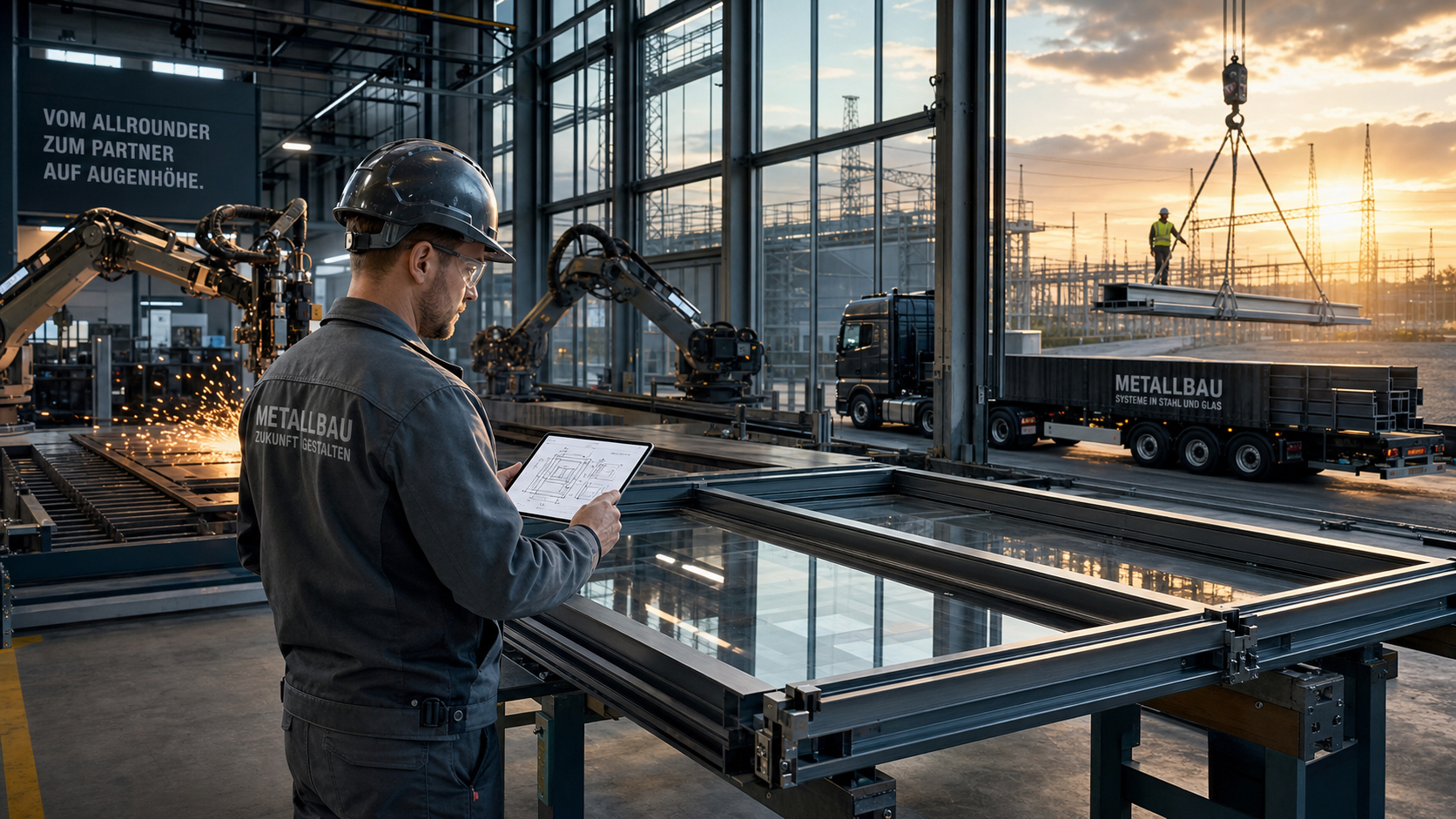
The end of the all-rounder? How the metalworking trade now has to reinvent itself – a creative image on the topic, created with AI: Xpert.Digital
Staff shortage in metal construction: Why outsourcing is often the better (and only) solution
Digitalization & contract manufacturing: How small metal construction companies tackle huge projects
Skilled worker shortage forces a rethink: Why the classic metal workshop is obsolete
The metal construction industry is facing a structural transformation. For years, the industry operated under the principle of the proud all-rounder: everything from a single source, from the initial sketch and measurements to the very last weld. But exploding costs, an unprecedented shortage of skilled workers, and increasingly complex construction requirements are pushing this traditional business model to its limits. To remain competitive today and in the future, companies must ruthlessly examine their own value chain. For many, the solution lies in a radical repositioning: away from being a pure manufacturer that handles every preliminary stage itself, and towards becoming a strategic project partner and system integrator. Those who enter into smart collaborations with specialized contract manufacturers and rely on end-to-end digital processes not only secure their survival but also open up entirely new growth opportunities despite the labor shortage. Why outsourcing services is often smarter than doing it all in-house – and what the metal construction company of the future will look like.
From all-rounder to strategic project partner: How the role of the metalworker is changing
A craft under pressure – when all-round competence reaches its limits
Metal construction companies are traditionally all-rounders: they plan, manufacture, assemble, advise, and fulfill individual customer requirements, all within a single company. However, the increasing complexity of construction projects, growing cost pressures, and ever-shorter required response times are making it increasingly difficult to cover every single stage of the value chain in-house. The German metal construction industry is thus at a crossroads: the classic concept of a company that handles everything from consultation to the final weld in-house is facing structural pressure, while at the same time, new cooperation models with specialized suppliers offer a way out of this overload.
The current economic situation makes this change particularly urgent. In the first quarter of 2026, order intake in the metalworking industry was nominally only 0.2 percent below the previous year's figure, following a decline of 2.7 percent in 2025, indicating a degree of stabilization after several weak years. At the same time, in the second quarter of 2026, only 19 percent of companies rated their business situation as good, while 35 percent rated it as poor, resulting in a net loss of 16 percentage points. The order backlog of three months or more for metal construction companies in North Rhine-Westphalia fell from 35.3 percent at the turn of the year 2024/2025 to just 20 percent at the end of March 2026, demonstrating the increasing loss of medium-term planning certainty. In this volatile environment, every hour that is not spent on core competencies such as consulting, assembly and customer retention, but on complex manufacturing processes, becomes a strategic risk.
The figures behind the staff shortage in the metalworking industry
The shortage of skilled workers is the key structural driver forcing metal construction companies to rethink their value chain. According to recent surveys, 68 percent of metal construction companies report vacancies they cannot fill, with southern Germany, particularly Bavaria and Baden-Württemberg, being especially hard hit, while eastern German states are experiencing fewer shortages. The Federal Employment Agency estimates the gap in qualified workers in the metal and steel construction sector at 18,400 unfilled positions, and around 45 percent of open positions for qualified metalworkers remain vacant for more than 200 days. The Competence Center for Securing Skilled Workers identified a skills gap of approximately 6,000 positions in metal construction alone for the period from July 2021 to June 2022, with a so-called vacancy surplus rate of 60.6 percent, meaning that for more than six out of ten open positions, no suitably qualified applicant was available.
The situation is exacerbated by a shortage of young talent. In the major metalworking trades, around 25,780 apprenticeship contracts were signed in 2025, compared to 28,350 the previous year – a decrease of 9.1 percent. Before the COVID-19 pandemic, 32,940 contracts were signed, representing a decline of 21.7 percent since then. At the same time, the number of apprenticeships offered in core industrial occupations also decreased by 8.6 percent in 2025, meaning that the long-term security of skilled workers will continue to deteriorate rather than recover. A study by the German Economic Institute (IW) predicts a nationwide shortage of 768,000 skilled workers by 2028, with employment in the metalworking trades themselves expected to fall by 14 percent, or around 161,000 positions, due to the retirement of qualified older workers and a lack of new recruits. Significantly, despite this decline in employment, a structural skills gap of 7,400 positions in metal construction trades persists because, even with decreasing personnel demand, there are simply too few qualified applicants. These figures illustrate why the classic full-range supplier model is reaching its limits: When skilled workers in design, cutting, welding, and surface treatment are lacking, every additional internal production step becomes a bottleneck that delays projects and erodes margins.
Why buying is often smarter than making it yourself
The business logic behind outsourcing production steps is not new, but it is gaining renewed relevance given the circumstances described. Particularly with custom-made products that exceed in-house capacity, it is often not worthwhile to invest in machinery and personnel whose utilization remains uncertain, as the high fixed costs of underutilized equipment can quickly erode a company's profits. Furthermore, many companies simply lack the specific expertise for custom or one-off production, for example in surface technology, complex sheet metal fabrication, or niche processes, which a specialized supplier can deliver more efficiently and with consistently high quality. At the same time, the risk profile of outsourcing has changed significantly: Since modern suppliers can no longer afford serious quality defects, scrap, or persistent delivery delays without jeopardizing their market position, the risk of outsourcing is considerably lower today than it was a few years ago.
This assessment is also reflected in the practices of the metalworking industry. A survey of approximately 100 specialists and managers revealed that 45 percent of managers in this sector expect the outsourcing of material storage and processing to continue to increase in the future, while another 50 percent anticipate it will remain at a consistently high level, and only three percent expect a decline. Outsourcing is already particularly widespread in raw material storage, which 60 percent of companies with outsourcing experience utilize, as well as in sawing and cutting, which 53 percent outsource, while 40 percent already use just-in-time delivery. Of the companies without prior outsourcing experience, 17 percent plan to implement such projects in the short term and 67 percent in the medium term, demonstrating that outsourcing is evolving from the exception to the rule across the industry. New digital platforms for contract manufacturing are further reinforcing this trend by giving craft businesses EU-wide access to vetted manufacturing partners and, conversely, enabling industry to benefit from the strength of craftsmanship in small series production.
Our EU and German expertise in business development, sales and marketing

Our EU and German expertise in business development, sales and marketing - Image: Xpert.Digital
Industry focus areas: B2B, digitalization (from AI to XR), mechanical engineering, logistics, renewable energies and industry
More information here:
A thematic hub offering insights and expertise:
- Knowledge platform covering global and regional economies, innovation and industry-specific trends
- A collection of analyses, insights, and background information from our key areas of focus
- A place for expertise and information on current developments in business and technology
- A hub for companies seeking information on markets, digitalization, and industry innovations
From craftsman to project partner: How the role of the tradesman in metal construction is changing
The metalworker as an interface between customer and factory
When manufacturing is outsourced to a specialized partner, the role of the metal construction company changes fundamentally, without losing any of its value. The company remains the competent local contact, providing the actual consulting services, conducting on-site measurements, maintaining direct communication with the customer, and ultimately being responsible for professional installation. These activities are difficult to standardize or outsource because they rely on local presence, trust, and a technical understanding of the specific construction situation. Manufacturing steps, on the other hand, especially complex cuts, bends, and serial parts, can be produced more cost-effectively and with greater precision by specialized sheet metal fabricators or certified contract manufacturers because they have access to specialized machinery and the necessary production volumes.
This division of labor is not a devaluation of the profession, but rather a strategic repositioning. Metalworkers are shifting their focus from pure production to project management, technical consulting, and customer retention – precisely those areas where personal experience, trust, and local market knowledge provide the decisive competitive advantage. Selecting reliable partners is crucial: auditors recommend that craft businesses test suppliers with smaller orders before outsourcing larger volumes, and rely on a few dependable, long-term suppliers rather than many changing service providers, as this reduces administrative overhead and ensures quality. Calculating a break-even point, at which the company's own investment in tools and machinery would become profitable again, is also one of the decision criteria that businesses should use to rationally weigh the pros and cons of in-house production versus outsourcing.
Digital interfaces as a prerequisite for cooperation
For the division of labor between consulting, assembly, and manufacturing to function smoothly, end-to-end digital processes are needed along the entire value chain. Leading system providers in facade and window technology now offer digital solutions that cover everything from design and cost calculation to quotation preparation and material procurement, all the way to manufacturing in the workshop and installation on the construction site. This enables increased productivity and reduced production times. A survey conducted by the industry association VDMA among 248 member companies shows that digitalization is now firmly anchored strategically within these companies, with applications related to artificial intelligence, digital twins, and low-code and no-code platforms developing particularly dynamically. Over 80 percent of the surveyed mechanical engineering companies already attribute greater importance to artificial intelligence, while about a third are already using corresponding solutions productively, meaning that the phase of purely pilot projects is considered largely complete in the industry.
For the metal construction industry, a supplier sector with many small and medium-sized enterprises, it is noteworthy that digitalization projects have so far often focused solely on production, while development, procurement, and sales are even less frequently the focus, even though these are precisely the areas where the greatest efficiency gains from collaboration with external manufacturing partners would lie. At the governmental level, the Manufacturing-X initiative supports the development of cross-industry data ecosystems to digitize the value chains of German industry and thus make them more competitive, resilient, and sustainable. In the long term, this should also facilitate access to digitally networked supply structures for smaller metal construction companies. Without such digital interfaces, for example, for the transmission of design data, measurements, and production orders, the division between on-site expertise and external manufacturing would remain prone to errors and would negate the anticipated efficiency gains.
Logistics, industry and critical infrastructures as growth areas
The need for specialized manufacturing models is particularly evident in market segments where metal construction services are required on a large scale and under tight deadlines. Order intake in the manufacturing sector showed a noticeable upturn in March 2026, rising by 5.0 percent compared to the previous month. Nearly all major industrial sectors recorded growth, including mechanical engineering (6.9 percent), metal production (3.4 percent), and the manufacture of metal products (3.7 percent). While these figures are subject to considerable monthly fluctuations, as demonstrated by the 11.1 percent decline in order intake in January 2026 compared to December 2025, which was characterized by large orders, the fundamental need for investment in logistics properties, industrial production facilities, and critical infrastructure such as data centers, energy supply systems, and transportation routes remains high.
Particularly in these sectors, metal construction services such as steel structures, facade systems, gates and fences, and security technology are in high demand. These services often need to be delivered in large quantities and under tight deadlines, pushing traditional, small-scale craft businesses to their capacity limits. The construction of data centers, for example, regularly requires highly specialized steel components for server racks, security fences, and air conditioning support structures, which must be produced in rapid succession while simultaneously adhering to stringent quality and certification requirements, such as those stipulated by the European standard for load-bearing steel components. Utilizing specialized contract manufacturers, often already certified to this standard, allows metal construction companies to take on large-scale projects in the logistics and infrastructure sectors without permanently overstretching their own capacity or investing in upfront costs that do not pay off when order volumes fluctuate.
Between opportunity and risk: A sober assessment
Despite the opportunities it presents, outsourcing manufacturing steps should not be viewed uncritically. Transferring manufacturing processes to external partners inevitably means relinquishing some control over the quality of the final product. This poses a serious risk, particularly for safety-critical components such as load-bearing steel structures or fire doors, if robust quality assurance processes are not in place. Furthermore, there is a risk of gradual deprofessionalization if companies lose relevant manufacturing know-how over time and become dependent on individual suppliers, which can weaken their negotiating position in the long run. Outsourcing is therefore only economically viable when faced with time constraints and overstretched internal capacities, machine breakdowns, supplementary manufacturing technology that is rarely needed in-house, or when the purchase of a specialized machine simply isn't cost-effective due to insufficient utilization.
At the same time, the overall economic situation shows that the industry cannot expect a significant upswing in the medium term. For the third quarter of 2026, only 19 percent of metal construction companies anticipate an increase in orders, while 32 percent expect a further decline. This results in a net negative outlook of 13 percentage points, making a gradual normalization rather than a dynamic recovery more likely than by 2028. In such an environment of intensified competition for orders and skilled workers, a strategic focus on core competencies, combined with reliable external manufacturing partnerships, will be not only a sound business strategy for many companies, but a vital option for their survival in order to remain competitive despite limited staffing levels.
A new self-image for a traditional craft
The shift from being a generalist to a strategic project partner ultimately marks a maturation process within the industry, which should be understood not as a loss, but as a necessary adaptation to structurally changed conditions. Companies that consistently focus their core competencies on consulting, technical planning, customer relations, and expert assembly, and utilize reliable, digitally connected manufacturing partners, are positioning themselves for a market environment in which skilled workers remain scarce, requirements complex, and timeframes short. The metal fabricator of the future is thus less a producer in the traditional sense and more a system integrator and trusted local partner, whose value is increasingly defined by process expertise rather than mere manufacturing capacity. While this realignment requires investments in digital interfaces and a rethinking of operational organization, it simultaneously offers the opportunity to handle significantly larger project volumes with limited personnel resources than would ever have been possible in the traditional full-range supplier model.
📈🚀 From visibility to trust 👀🤝 Your scalable path with Xpert.Digital

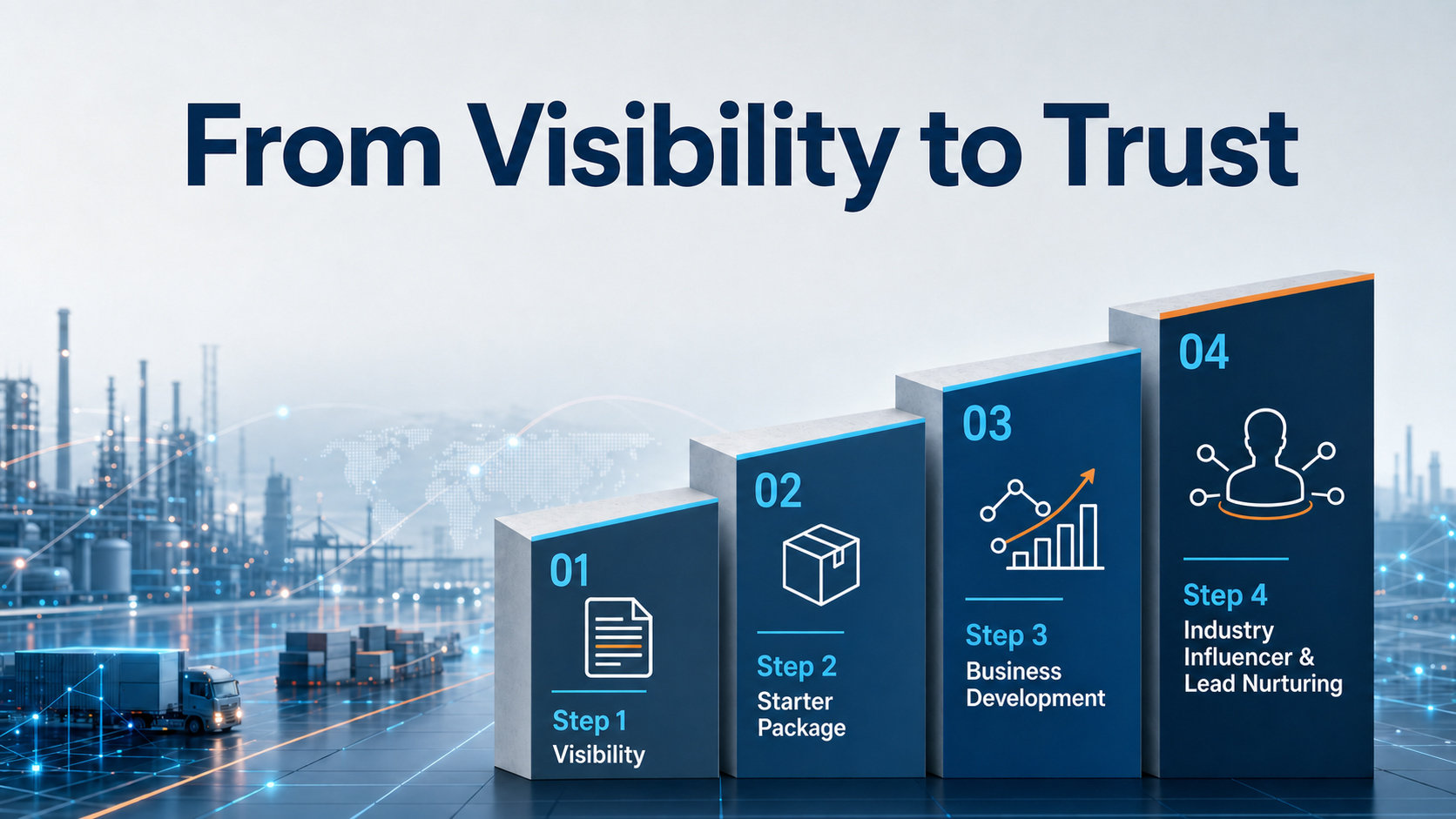
From visibility to trust: Your scalable path with Xpert.Digital - Image: Xpert.Digital
In industrial B2B, sustainable business relationships rarely emerge overnight. They develop step by step – through visibility, professional relevance, recurring touchpoints, and growing trust. Xpert.Digital's 4-stage model addresses precisely this: It offers a structured path that begins with a manageable entry point and can evolve into deeper collaboration in business development if needed.
Instead of relying on loud marketing promises, this model puts the relationship at the forefront. Companies start with clearly defined, easily calculable measures and then decide, based on their own experience, how far they want to expand the collaboration. A key factor for this undisturbed trust-building process: The platform completely avoids annoying advertising ads, so the editorial focus remains solely on the companies' expertise.
More information here:
Your global marketing and business development partner
☑️ Our business language is English or German
☑️ NEW: Correspondence in your native language!

Konrad Wolfenstein
I and my team are happy to be available to you as your personal advisor.
You can contact me by filling out the contact form here wolfenstein@xpert.digital:or simply call me at +49 7348 4088 965. My email address is
I'm looking forward to our joint project.