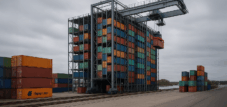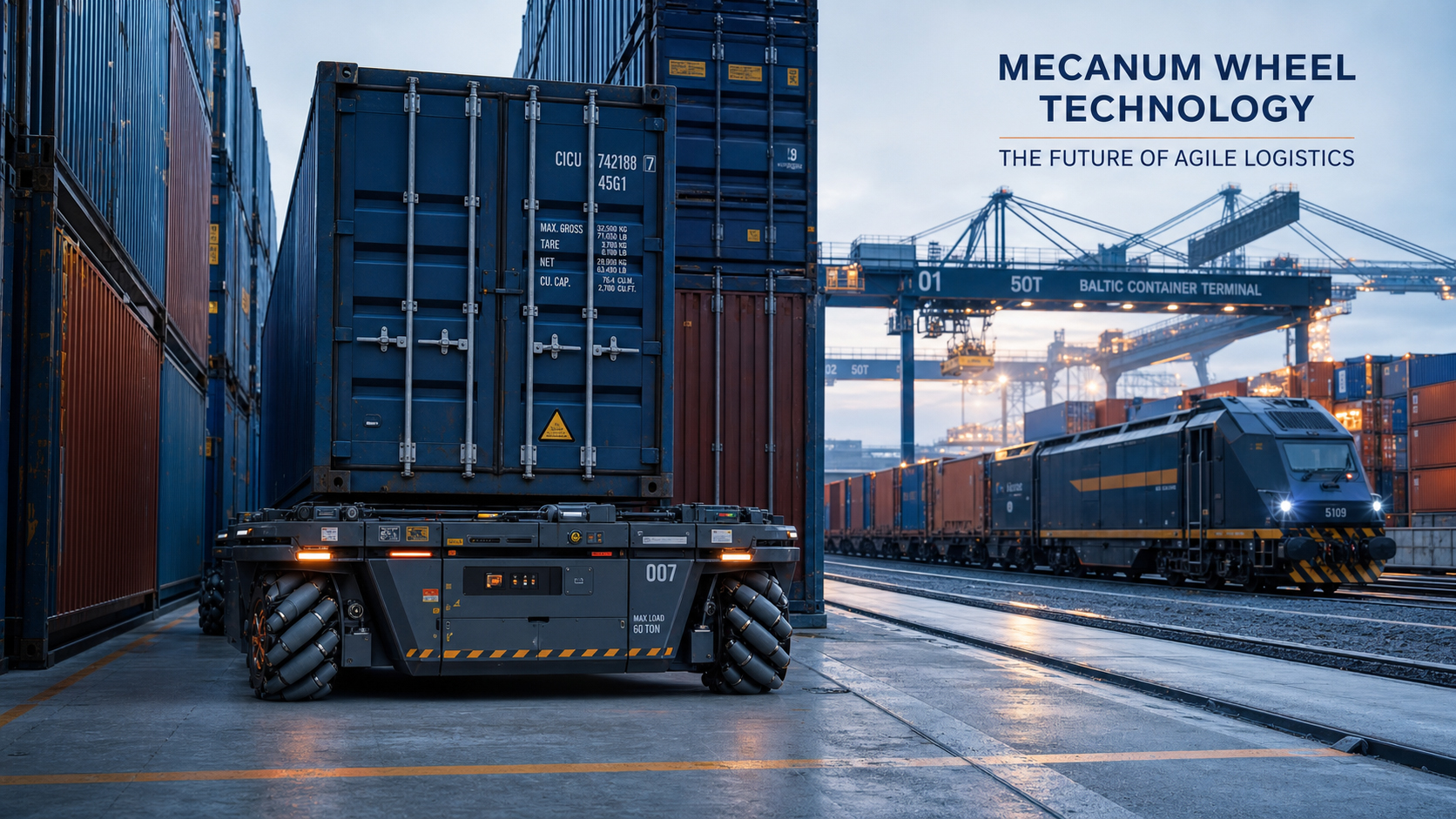
Space-saving wonders for terminals: When wheels think around corners – How Mecanum technology is reinventing container logistics – Image: Xpert.Digital
How the Mecanum wheel is changing logistics: No more maneuvering – Why heavy haul logistics now moves sideways
An invention from 1973 makes a comeback: The future of automated terminals – How omnidirectional drives save millions
High-bay warehouses of the future: Why rigid wheels for containers are obsolete
Global supply chains are reaching their limits – not just in terms of time, but above all in terms of space. In seaports, high-bay warehouses, and intermodal hubs, where every square meter counts, conventional vehicle concepts, with their enormous space requirements for maneuvering, become a costly obstacle. The solution to this bottleneck could lie in a seemingly inconspicuous invention from the 1970s, which is now being further developed for heavy-load logistics: the Mecanum wheel. Its unique design allows vehicles weighing many tons to move from a standstill in any direction – even sideways. Whether for the millimeter-precise positioning of containers, in fully automated high-bay warehouses, or at the complex interfaces of multimodal transport: this omnidirectional technology promises unprecedented space efficiency. But where exactly do the economic potentials lie, for whom does it all make financial sense, and what technical hurdles still need to be overcome for widespread deployment? A deep dive into a technology that literally thinks outside the box.
Why rigid wheels are no longer sufficient for the logistics of tomorrow
Container terminals, high-bay warehouses, and intermodal hubs are under pressure that has fundamentally changed in recent years. Global supply chains today must operate not only quickly, but above all in a space-efficient, energy-saving, and robust manner against disruptions. Classic vehicle concepts with kingpin steering or differential drive reach their physical limits when dealing with narrow aisles, heavy loads, and frequent changes of direction. It is precisely at this point that a technology gains importance that, at first glance, appears unspectacular, but whose impact on material flow and space utilization is considerable: the Mecanum wheel.
The principle was invented in 1973 by the Swedish engineer Bengt Ilon, who worked for the company Mecanum AB. The basic idea is as simple as it is effective: Several barrel-shaped, freely rotating rollers are mounted on the rim of each wheel, arranged at a 45-degree angle to the wheel axis. Each wheel is driven independently by its own motor, so that by precisely combining the direction and speed of rotation of all the wheels, virtually any desired direction of movement can be generated without the need for mechanical steering. A vehicle with this drive concept can move sideways, turn on the spot, maneuver diagonally, or accelerate from a standstill in any desired direction, comparable to the maneuverability of a hovercraft, but with significantly higher precision and complete road contact. What has been established in robotics and intralogistics for years is now increasingly being further developed for the significantly more demanding application scenarios of heavy-load logistics: for the handling of entire containers, for automated high-bay warehouses and for the seamless integration of different modes of transport in multimodal transport.
The technical basis of unusual mobility
To understand the economic potential of this technology, it's worth taking a closer look at how it works. A Mecanum wheel consists of a hub and a series of free-running, convex rollers evenly distributed around the wheel's circumference. These rollers have no drive mechanism of their own; they rotate passively around their own axis, which is inclined at 45 degrees. Instead, the drive is provided by the wheel as a whole, which is moved by an individual motor via an axial thrust bearing. Due to the inclined arrangement of the rollers, each drive movement generates two force components: one in the direction of travel and one perpendicular to it. When several such wheels, typically four, are driven in different combinations of direction and speed, certain force components cancel each other out, while others add up to a resulting overall movement. In this way, theoretically, ten basic movement patterns are created, including straight-line travel forwards and backwards, lateral movement to the left and right, diagonal movement in all four directions, and rotation on the spot clockwise and counterclockwise.
This characteristic fundamentally distinguishes Mecanum vehicles from conventional steering systems. A conventional vehicle requires a turning circle or at least a multi-movement shunting maneuver to change direction. In contrast, a Mecanum vehicle can enter a side corridor from a main corridor at a right angle without any turning maneuvers. For logistics planning, this represents a paradigm shift: travel paths no longer need to be dimensioned for turning circles, but can be reduced to the actual vehicle width plus a few millimeters of safety clearance. The practical consequence is a noticeably higher packing density in warehouses and transshipment areas, as narrower aisles are sufficient to access the same number of storage spaces or rack bays.
However, this concept also has physical limitations that are of considerable importance for use with heavy container loads. The relatively small effective contact area of the individual wheels results in high surface pressure on the ground, which places high demands on the condition of the road surface and does not function equally well on every type of surface. Furthermore, the discrete wheel transitions cause slight vibrations during rolling, which can be noticeable depending on the chassis design. Current research on the analysis and optimization of chassis with Mecanum wheels shows, however, that these vibrations can be reduced to such an extent through suitable suspension and damping within the chassis that no significant effects on sensitive cargo are detectable. For the robust container, which is designed for transport under harsh conditions anyway, this aspect naturally plays a subordinate role, while it remains quite relevant for more delicate goods in related logistics areas.
Container terminals: When agility becomes a competitive advantage
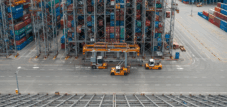
Container handling at seaports and rail terminals is among the most capital-intensive and highly automated sectors of global logistics. Leading European terminal operators are already relying on autonomous vehicle concepts to make horizontal container transport between quays, storage areas, and rail connections more efficient. A recent example is terminal operator Eurogate, which, together with its technology partner Embotech, has launched a second pilot project with autonomous terminal tractors at the Hamburg container terminal, following the successful completion of an initial technical pilot project in Wilhelmshaven. These autonomous tractors handle container transport between the rail terminal and the container terminal via the transshipment zones of conventional straddle carriers and are being tested in mixed traffic with manually driven vehicles. In North America, major rail companies are also investing heavily in autonomous vehicle fleets for their intermodal terminals. One provider has already covered over 500,000 miles and moved more than 300,000 containers without a driver, with the stated goal of expanding the fleet to several hundred vehicles in the coming years.
In this context, the question arises as to what additional benefits Mecanum propulsion systems could offer compared to today's dominant autonomous tractors and straddle carriers. The crucial difference lies in the ability to position themselves laterally without shunting. Conventional terminal vehicles, even when autonomous, still adhere to the geometric constraints of conventional steering axles and require corresponding maneuvering space for changes of direction. A Mecanum-based carrier vehicle, on the other hand, could maneuver a container laterally from a fixed position precisely under a crane or directly next to a railcar without obstructing surrounding traffic with shunting movements. For terminal areas whose expansion is hardly possible anymore due to limited urban port space, this kind of space saving becomes a strategic factor. Even small improvements in the space utilization of a terminal can have a significant economic impact given the enormous land prices in port locations.
At the same time, one must remain realistic: Containers weighing up to thirty tons when loaded pose a considerable technical challenge for Mecanum wheel systems. Currently available heavy-duty Mecanum wheel modules achieve load capacities of just a few tons per wheel, while specialized suppliers have already developed omnidirectional heavy-duty vehicles for transport between factory halls with load capacities of fifteen to thirty tons. Therefore, the technology is not yet fully mature enough to completely replace conventional straddle carriers in the daily high-performance operation of a large terminal, but economically viable applications are already emerging for defined niche applications, such as the precise transfer between railcars and intermediate storage areas in confined spaces.
Container high-bay warehouse: Density instead of distance
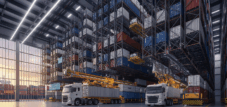
While traditional container handling takes place outdoors, a second application area is gaining importance in parallel, one that structurally resembles classic intralogistics: automated high-bay warehouses for containers or standardized load carriers such as swap bodies and bins. This is where the true strength of Mecanum technology becomes particularly evident. In a high-bay warehouse with narrow aisles, the ability to turn at right angles without a radius is immediately invaluable, as it drastically reduces aisle width and, conversely, significantly increases rack density.
A fundamental example from established intralogistics illustrates the principle: Driverless transport systems with omnidirectional 360-degree sensors and Mecanum chassis can already autonomously move loads of up to seven tons through warehouses without being bound to fixed tracks, and can change their direction of travel or rotate on their own axis at any time. This principle can be further developed for container high-bay warehouses, where load carriers are no longer organized on pallets but as swap bodies, standard containers, or special storage cassettes. Vehicles that park laterally into a rack compartment to place their load directly there do not require an additional turning area in front of the rack, thus significantly increasing the usable storage area within an existing hall without the need for new construction or structural expansion. This effect is of considerable economic importance, especially for existing buildings whose floor plans are determined by existing load-bearing structures and column grids, because retrofitting automation can be implemented without costly building modifications.
Another, often underestimated advantage concerns fine positioning. Automated high-bay warehouses require millimeter-precise positioning of load carriers to ensure the smooth operation of stacker cranes, crane systems, and transfer stations. Mecanum chassis have already demonstrated their precision capabilities in this area, for example, in tool change trolleys in the manufacturing industry, as the individual control of each wheel allows for minute corrective movements in any direction. For a container high-bay warehouse, this means that transfer positions at the front of the racks can be approached with an accuracy that conventional differential steering systems can only achieve with considerable control engineering effort. In combination with modern sensor technology, such as lidar or camera systems for environmental perception, this results in fully driverless stacker crane systems that remain flexible even with varying container sizes because the chassis itself has no geometric limitations regarding the approach direction.
On the cost side, however, it must be considered that Mecanum wheels are significantly more expensive to purchase and maintain than conventional drive axles, as each wheel requires its own motor, gearbox, and sensors for precise speed control. Furthermore, the numerous roller bearings of the individual wheels wear more under continuous load than a conventional running surface, which can lead to higher maintenance costs in a high-bay warehouse with 24/7 shift operation. A sound economic analysis must therefore always weigh the space savings from narrower aisles against the higher total cost of ownership of the drive system. In many cases, especially with very expensive inner-city or port-adjacent sites, this calculation is likely to favor the Mecanum solution, while for less expensive sites in rural areas, conventional storage and retrieval machines often remain the more economical choice.
🎯🎯🎯 Data-driven B2B industry hub as a quasi-in-house solution


The quasi-in-house solution: How Xpert.Digital closes operational gaps in B2B marketing and sales – Smart Content-Driven Business - Image: Xpert.Digital
Xpert.Digital is a data-driven B2B industry hub led by Konrad Wolfenstein . The company acts as an external, quasi-in-house solution for industrial partners, closing operational gaps in marketing, content, and sales – without requiring additional resources on the client side.
More information here:
Why omnidirectional transport systems could solve the space problem in terminals
Intermodal and multimodal transport: The interface as a bottleneck
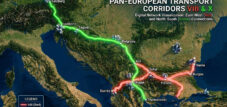
The third, and perhaps most strategically important, area of application concerns the interfaces between the modes of transport themselves. Intermodal or multimodal transport, i.e., the combination of ship, rail, and road within a continuous transport chain, has been considered for years a key hope of European transport policy for shifting goods from road to more climate-friendly modes of transport. However, a special report by European auditors on intermodal freight transport makes it clear that the effectiveness of previous support measures has remained limited, partly because the digitalization and automation of terminal infrastructure has still not been sufficiently advanced at many locations.
It is precisely at this interface, the so-called transshipment point between modes of transport, that Mecanum technology unfolds perhaps its greatest potential. Current research on sea-rail intermodal automated container terminals is intensively focused on how the transfer process between automated vehicles in the terminal and the connected railway station can be coordinated more efficiently, given that multidirectional container flows, different types of equipment, and complex loading processes converge here. A Mecanum-based shuttle system could be implemented at precisely this interface by moving containers directly and in any direction between the intermediate storage area, railcar, and truck transfer point, without the need for a transfer crane. Since such vehicles are not dependent on fixed lanes or turning maneuvers, the transshipment process could be implemented in smaller, more densely packed terminal areas, which is particularly relevant for combined inland transport terminals with limited space.
Another aspect concerns flexibility in changing operating scenarios. Multimodal terminals often have to handle standard containers as well as swap bodies, semi-trailers, and other loading units of varying dimensions. A rigid rail system or a classic gantry crane system is optimized for a specific range of load carriers and can only be converted with considerable effort. In contrast, a floor-mounted vehicle with omnidirectional drive can react relatively easily to new load carrier formats by adapting the control software, without requiring any structural changes to the infrastructure. In an era where the flow of goods is changing ever more rapidly due to geopolitical shifts, altered trade routes, and increasing demands for nearshoring, this kind of structural flexibility is a strategic advantage that should not be underestimated.
Nevertheless, the intermodal context remains the most demanding test case for the technology, because it combines outdoor operation, weather conditions, different floor surfaces, and very high load weights. Rain, snow, and dirty roadways put more strain on the freely rotating rollers of a Mecanum wheel than on a closed rubber tread, and the surface pressure, crucial for power transmission, becomes a real technical risk under wet or slippery conditions. Therefore, before Mecanum vehicles can be deployed on a large scale in the outdoor areas of rail terminals, further development steps are necessary regarding the choice of roller materials, the chassis suspension, and sensor fusion for varying weather conditions.
Economic evaluation: Between the promise of efficiency and investment risk
From an economic perspective, Mecanum technology in container logistics is best described as a niche technology with high strategic leverage, not as a universal replacement for existing systems. Its key economic value driver is space efficiency, meaning the ability to achieve greater handling or storage capacity with the same land area. In regions with scarce and expensive port or industrial space, as is typical for many European metropolitan areas, this effect can more than offset the higher acquisition and maintenance costs of the technology. In regions with abundant, affordable land, however, the investment is less likely to pay off, because simply expanding existing facilities often remains the more cost-effective alternative.
A second economic factor concerns investment security in light of competing automation approaches. As current pilot projects at Eurogate and the fleet expansions of North American providers demonstrate, the industry is currently investing primarily in autonomous tractors and straddle carriers based on conventional steering geometries because these systems have already reached a high level of maturity and can be integrated into existing terminal operations. Mecanum-based systems would have to compete directly with these established and capital-intensively developed solutions, which represents a significant barrier to entry for new market entrants. A more realistic approach, therefore, seems to be a gradual entry via specialized niche applications, such as in smaller transshipment terminals, in internal transport routes between warehouses and loading docks, or in newly planned facilities designed from the ground up for automation, where the track widths can be designed from the outset to accommodate the reduced space requirements of omnidirectional vehicles.
In the long term, however, the decisive growth driver for Mecanum applications in logistics is likely to be less the vehicle technology itself than the accompanying software and sensor development. Only the combination of a precise omnidirectional chassis, high-performance environmental sensors, and intelligent fleet management unlocks the full economic potential, because only in this way can the theoretically possible increase in space density be implemented reliably and without disruption. Companies that invest early in this system integration could gain a sustainable competitive advantage, particularly in space-constrained European port locations, while those that lag behind risk having to retrofit their existing infrastructure later at significantly higher costs. Overall, this paints a realistic but nuanced picture: Mecanum technology will not revolutionize container logistics, but it will increasingly become the economically viable standard in the coming years precisely where space is expensive and maneuverability is crucial.
📈🚀 From visibility to trust 👀🤝 Your scalable path with Xpert.Digital
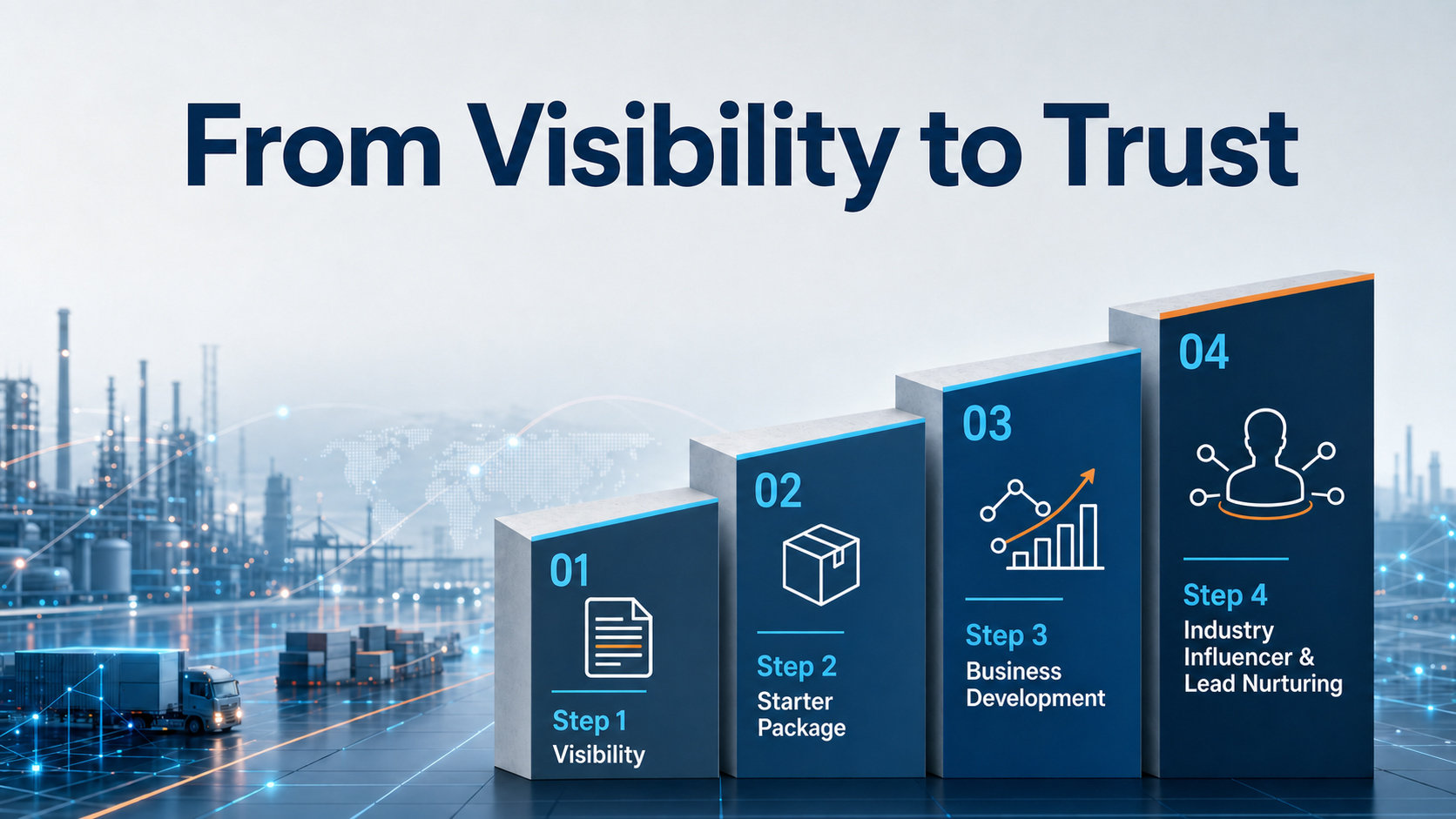
From visibility to trust: Your scalable path with Xpert.Digital - Image: Xpert.Digital
In industrial B2B, sustainable business relationships rarely emerge overnight. They develop step by step – through visibility, professional relevance, recurring touchpoints, and growing trust. Xpert.Digital's 4-stage model addresses precisely this: It offers a structured path that begins with a manageable entry point and can evolve into deeper collaboration in business development if needed.
Instead of relying on loud marketing promises, this model puts the relationship at the forefront. Companies start with clearly defined, easily calculable measures and then decide, based on their own experience, how far they want to expand the collaboration. A key factor for this undisturbed trust-building process: The platform completely avoids annoying advertising ads, so the editorial focus remains solely on the companies' expertise.
More information here:
Consulting - Planning - Implementation

Konrad Wolfenstein
I would be happy to serve as your personal advisor.
You can contact me at wolfenstein∂xpert.digital or
Just call me on +49 7348 4088 965 .
Your container high-bay warehouse and container terminal experts

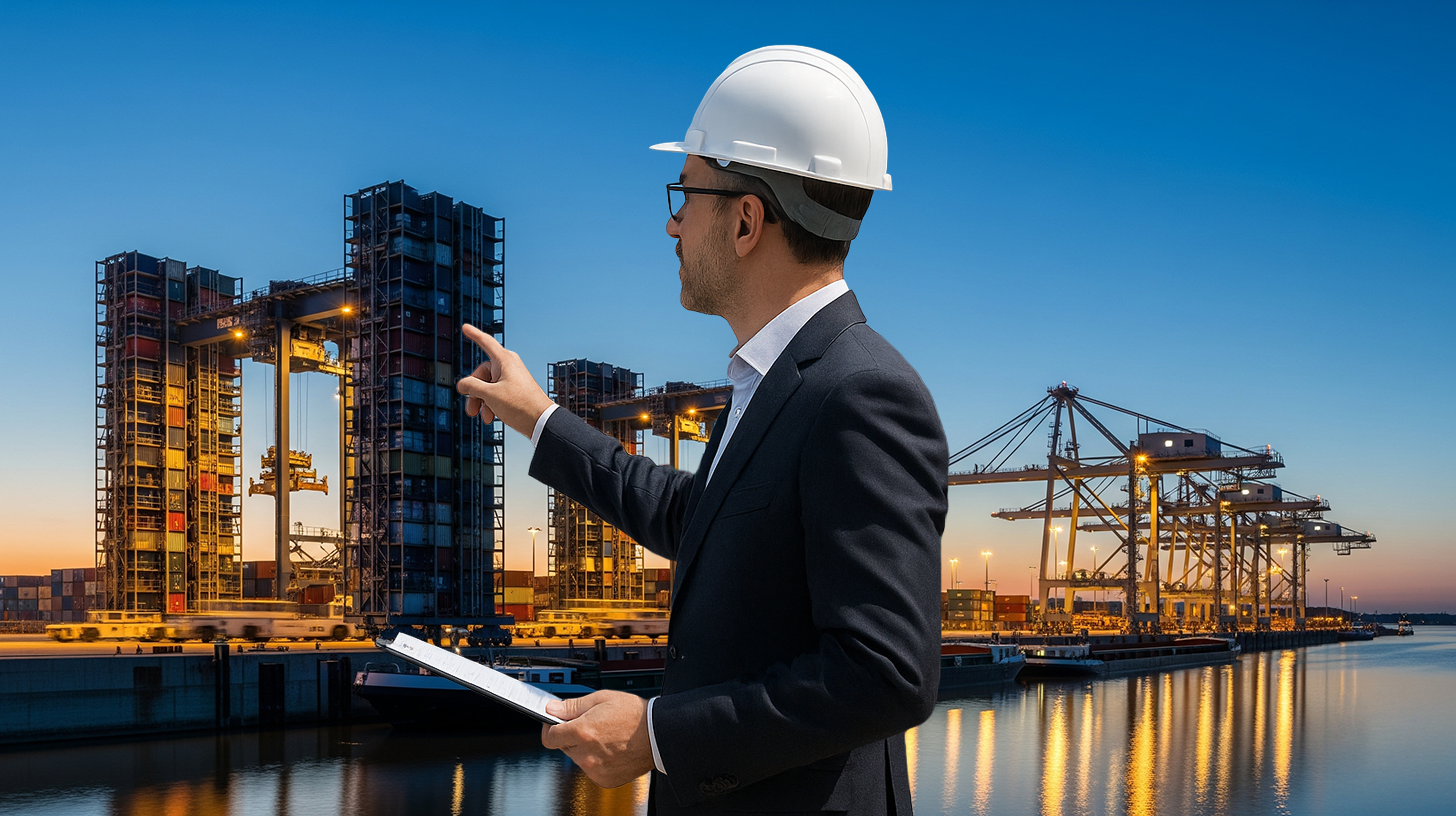
Container terminal systems for road, rail and sea transport in the dual-use logistics concept of heavy-lift logistics - Creative image: Xpert.Digital
In a world marked by geopolitical upheavals, fragile supply chains, and a new awareness of the vulnerability of critical infrastructure, the concept of national security is undergoing a fundamental reassessment. A state's ability to guarantee its economic prosperity, the provision of essential goods and services to its population, and its military capability increasingly depends on the resilience of its logistical networks. In this context, the concept of "dual-use" is evolving from a niche category of export control to a broader strategic doctrine. This shift is not merely a technical adjustment but a necessary response to the "paradigm shift" that demands a profound integration of civilian and military capabilities.
Related to this: