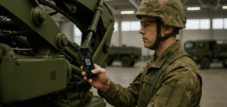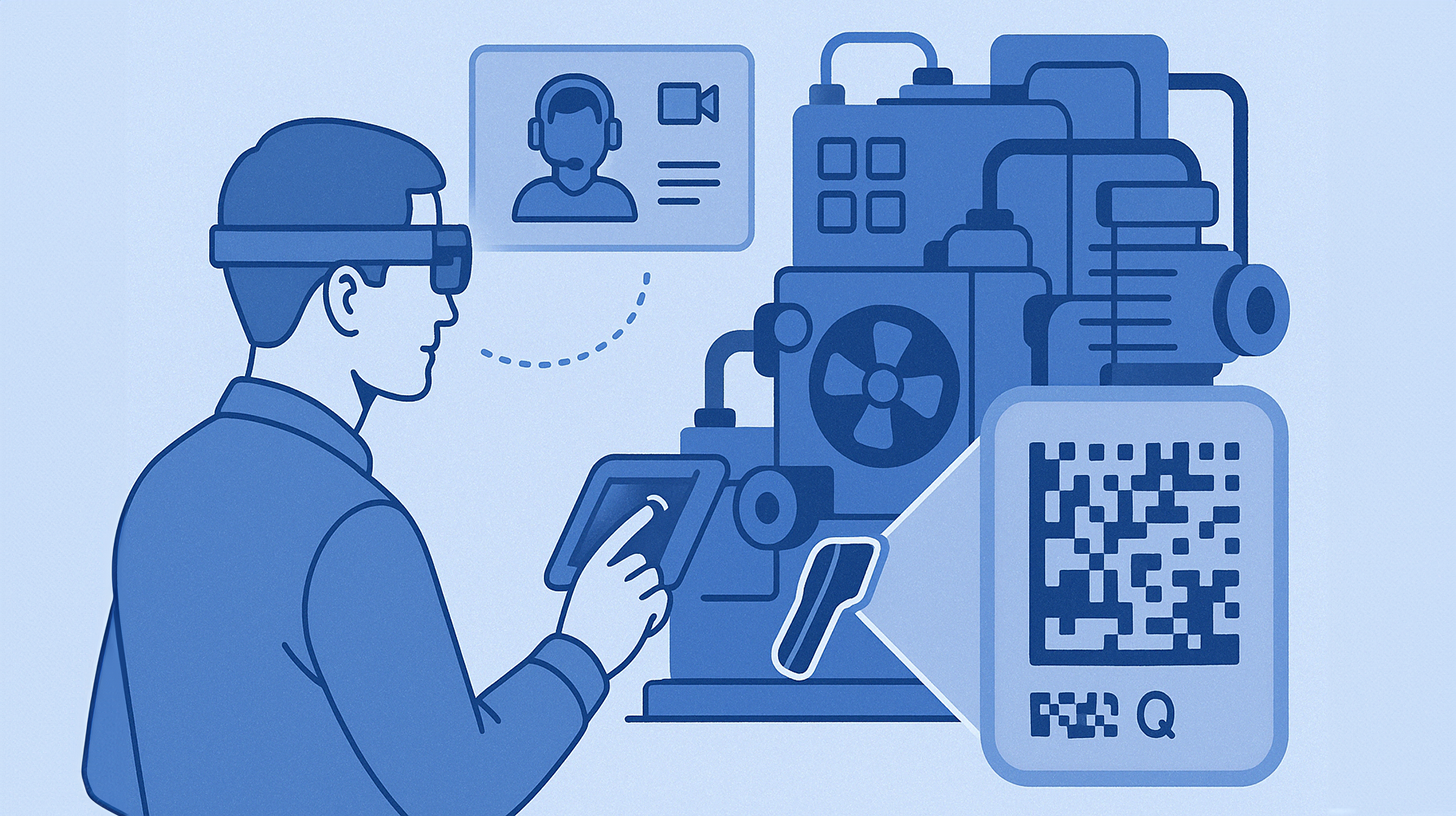
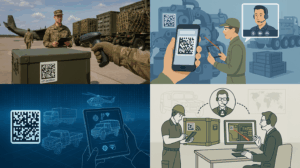
Future of maintenance logistics: Synergies between telemaintenance and GS1 DataMatrix – Image: Xpert.Digital
Digital transformation in logistics: Efficiency through modern maintenance strategies
Minimize downtime: The perfect maintenance technology for industry
Modern maintenance logistics is undergoing fundamental changes due to digital transformation. In particular, the combination of telemaintenance and the standardized GS1 DataMatrix creates new opportunities to make maintenance processes more efficient, faster, and more flexible. These technologies complement each other perfectly: While telemaintenance bridges the geographical distance between experts and the object being maintained, the GS1 DataMatrix ensures precise, machine-readable identification of components and links physical objects with their digital data. Together, they form a powerful combination that not only minimizes downtime and reduces costs but also lays the foundation for predictive maintenance concepts and the intelligent maintenance of the future.
Related to this:

Current challenges in maintenance logistics
The growing pressure for digitalization and efficiency improvements
The manufacturing industry worldwide is under enormous pressure to increase its efficiency and secure competitive advantages. New business models, in which performance rather than products is sold, are fundamentally changing the market. At the same time, increasingly complex machines and systems need to be maintained in geographically distributed, sometimes difficult-to-access environments. Traditional maintenance methods are reaching their limits here: they are often reactive or based on rigid maintenance intervals, which can lead to unnecessary costs or unexpected breakdowns.
The limits of traditional maintenance
Currently, two types of maintenance dominate: corrective maintenance, which only begins after damage has occurred, and preventive maintenance with fixed maintenance intervals. Both approaches have significant drawbacks. Corrective maintenance results in unplanned downtime, while preventive maintenance often involves replacing still-functional components. These inefficiencies lead to higher costs and reduced plant availability—a critical factor, especially in highly complex environments such as defense logistics.
The transition to intelligent maintenance
The answer to these challenges lies in the development of intelligent maintenance systems. "Only when maintenance itself evolves into smart maintenance can the future vision of the smart factory become a reality." However, this requires more than just the digitization of individual processes – it's about a holistic transformation encompassing the use of technology, efficient processes, and the integration of people.
Telemaintenance: Fundamentals and operating principles
Definition and areas of application
Telemaintenance, also known as remote maintenance, enables maintenance tasks to be performed remotely using telecommunications and digital technologies. At its core, it is a communication tool that facilitates the exchange of information, visual data, and troubleshooting techniques between experts and on-site technicians. Applications range from simple telephone consultations to complex, data-intensive remote diagnostics with real-time system data and video transmissions.
Technological requirements
Several technological components are required for the successful implementation of telemaintenance:
- High-speed telecommunications networks for real-time transmission of data, voice and video
- Secure data transmission protocols to protect sensitive technical information
- Video conferencing systems for visual inspection and direct communication
- Remote diagnostic tools for analyzing system parameters and error codes
- Digital maintenance tools for on-site staff and remote experts
Integrating these systems into existing maintenance information systems is crucial for efficient documentation and process control.
Strategic importance for defense logistics
In modern defense logistics, telemaintenance has established itself as a "combat multiplier," improving support for proactively deployed units and increasing operational readiness. The ability to quickly and reliably maintain and repair equipment, often under challenging conditions, represents a strategic advantage. Telemaintenance supports the efficient use of resources and the maintenance of operational capability for military systems.
GS1 DataMatrix: A powerful standard for identification
Technical fundamentals of GS1 DataMatrix
The GS1 DataMatrix is a two-dimensional barcode with high data capacity and error tolerance. It belongs to the Automatic Identification Technology (AIT) family and enables the fast and error-free capture of data about objects in the logistics process. Its robustness, compactness, and high data density have led to its adoption in demanding sectors such as defense, aerospace, and healthcare.
Advantages over conventional identification methods
The GS1 DataMatrix offers significant advantages over traditional identification methods:
- Automated, fast and unambiguous identification through the GS1 standard
- High accuracy through integrated error correction and avoidance of manual input
- Large data depth with the ability to store extensive information in a single code
- Immediate data access to relevant information
These features make the GS1 DataMatrix an ideal tool for modern maintenance logistics, where precision and speed are crucial.
Applications in mechanical engineering and the defense industry
GS1 standards enable the unambiguous identification of machines, components, and tools, and the exchange of related information such as manufacturing date and batch number. This allows for the tracking of the entire product lifecycle, from manufacturing through the supply chain and operation to dismantling and recycling. In the defense sector, the GS1 DataMatrix has already established itself as a reliable method for the unambiguous identification of complex weapon systems and their components.
Related to this:
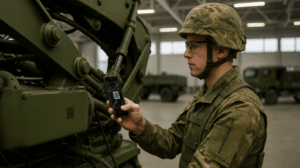
Synergies between Telemaintenance and GS1 DataMatrix
Integration of GS1 DataMatrix into telemaintenance processes
The integration of GS1 DataMatrix into telemaintenance processes follows a structured procedure:
- Identification: A technician scans the GS1 DataMatrix code on a defective component using a suitable scanner.
- Data transmission: The structured data read from the code is transmitted to the central telemaintenance platform via a secure network.
- Information retrieval: The system uses the unique identifier to automatically retrieve all relevant information from connected databases.
- Remote diagnosis: The remote expert receives the collected information clearly presented and, supplemented by live video transmission, can analyze the cause of the error.
- Guided action: The expert guides the technician on site through the necessary testing and repair measures.
- Documentation: All actions performed are documented in the central maintenance system in an audit-proof manner.
This process integration makes the GS1 DataMatrix an active key that triggers an automated and rich flow of information, thus significantly increasing the efficiency of telemaintenance.
Improvement and acceleration of maintenance processes
The combination of Telemaintenance and GS1 DataMatrix leads to significant improvements in maintenance logistics:
- Improved data quality through unambiguous identification and structured information transmission
- Accelerated diagnostic and repair processes through immediate access to relevant technical data
- Increased operational flexibility through the decoupling of expert location and maintenance location
- Reduced cognitive load for technicians and experts through standardization and automation
MBDA Germany, for example, has created an innovative telemaintenance service using the GS1 DataMatrix, which is used worldwide for the maintenance and repair of complex systems.
Success story: MBDA Germany
MBDA Germany provides a concrete example of the synergy between telemaintenance and GS1 DataMatrix. The company uses GS1 DataMatrix to serialize assemblies in machine-readable form and marks components during production. In the event of maintenance, this enables precise identification by reading the data carrier with a scanner.
The success of this integration is evident in several aspects:
- Targeted access to maintenance history or construction plans of the individual part
- Experts can provide support from Germany – without having to inspect the plant or component on site
- This innovative solution is also suitable for use in other maintenance-intensive areas
Expert partner in warehouse planning and construction

New business models through smart maintenance: How data is changing service
On the road to predictive maintenance
From reactive to predictive maintenance
Maintenance is evolving from reactive and preventive approaches to predictive maintenance. This advanced method is based on the real-time analysis of process and machine data. Analyzing this data enables forecasts that form the basis for needs-based maintenance and consequently reduce downtime.
Technological enablers for predictive maintenance
Predictive maintenance is made possible by various technologies:
- Data analysis, artificial intelligence and the Internet of Things (IoT) for predicting maintenance needs
- Sensors and monitoring systems for capturing machine data in real time
- Advanced algorithms and AI models for detecting patterns and deviations from normal operating behavior
- High-speed data processing for real-time analysis of large data sets
The combination of GS1 DataMatrix and Telemaintenance forms a solid basis for the implementation of Predictive Maintenance, as it enables the unique identification of components and access to their history and condition data.
Economic advantages and increased efficiency
The implementation of predictive maintenance in combination with telemaintenance and GS1 DataMatrix offers significant economic advantages:
- Cost reduction through targeted planning of maintenance work only when it is truly necessary
- Minimizing downtime through proactive prevention of disruptions
- Maximizing productivity and uptime of the plants
- Optimizing resource utilization through precise planning of personnel, materials, and tools
These advantages make predictive maintenance a central element of Industry 4.0 and an important competitive factor for companies in various sectors.
Related to this:
Smart Maintenance: The holistic transformation of maintenance
Definition and concept of Smart Maintenance
Smart Maintenance goes beyond individual technological solutions and describes a holistic transformation of maintenance. It encompasses the use of technology, efficient processes, and the integration of people. Through digitalization and the resulting networking of process management and plant operation, the maintenance technician becomes the backbone of Industry 4.0.
The role of maintenance in the smart factory
The role of maintenance in modern production environments is fundamentally changing:
"The maintenance of the future ensures maximum production efficiency, reduces TCO, guarantees optimal availability and flexibility – and thus increases profit."
In this context, maintenance is transforming from a mere cost factor into a value-creating factor that significantly contributes to the efficiency and productivity of the entire company. The integration of telemaintenance and GS1 DataMatrix supports this transformation by creating the foundation for data-driven decisions and automated processes.
Challenges in implementation
The implementation of smart maintenance and the underlying technologies is associated with various challenges:
- Data security and protection of sensitive technical information, especially in defense logistics
- Interoperability between different systems and standards
- Skills shortage and increasing complexity of processes
- Investment costs for new technologies and their integration into existing systems
Overcoming these challenges requires a strategic approach and collaboration between various disciplines, from IT to plant management.
Related to this:
Future prospects and trends
Further development of telemaintenance technologies
Telemaintenance technologies are constantly evolving. Future trends include:
- Integration of Augmented Reality (AR) to provide visual support for on-site technicians
- Use of remotely controlled robots for inspections or manipulations in hazardous areas
- Further development of communication technologies for even more reliable and secure data transmission
- Improved human-machine interfaces for more intuitive interaction between technicians and systems
These developments will further increase the efficiency and application possibilities of telemaintenance and open up new application scenarios.
Further development of GS1 standards for maintenance
The GS1 standards are also continuously being developed to meet the requirements of modern maintenance logistics:
- Increased data density and improved fault tolerance for use in challenging conditions
- Enhanced options for integrating sensor data and IoT connectivity
- Standardized interfaces for seamless integration into various maintenance systems
- Enhanced security features to protect against unauthorized access and tampering
These developments strengthen the position of GS1 DataMatrix as a key technology for the digital transformation of maintenance logistics.
New business models through digital maintenance
The digitalization of maintenance opens up opportunities for innovative business models:
- Service offerings where the service itself, rather than the product, is sold
- Data-driven services for optimizing plant efficiency and availability
- Remote support services with guaranteed response times and predefined service levels
- Pay-per-use models for maintenance services based on actual usage and wear and tear
These new business models are changing the relationships between manufacturers, operators and service providers, and creating new value chains in maintenance logistics.
From reaction to prevention: The path to smart maintenance
The combination of Telemaintenance and GS1 DataMatrix represents a significant advancement in the evolution of maintenance logistics. The synergy of these technologies makes maintenance processes more efficient, faster, and more flexible, resulting in higher plant availability, lower costs, and improved resource utilization. The full potential of this combination is particularly evident in sectors with complex systems and hard-to-reach locations, such as defense logistics or mechanical engineering.
The integration of Telemaintenance and GS1 DataMatrix also forms the basis for more advanced concepts such as predictive maintenance and smart maintenance, which are based on data analysis, artificial intelligence, and networked systems. This development marks the transition from reactive to proactive, data-driven maintenance, which not only prevents failures but also optimizes the lifespan of equipment.
For companies and organizations, this means a fundamental transformation of their maintenance strategies and processes. Implementing these technologies requires investment in infrastructure, expertise, and organizational changes, but promises significant long-term economic and competitive advantages.
The future of maintenance logistics lies in the complete integration of digital technologies and the development of intelligent, self-learning systems that not only react but also anticipate and optimize. The combination of Telemaintenance and GS1 DataMatrix represents an important step in this direction.

Xpert.Plus Warehouse Optimization - High-bay warehouses and pallet warehouses: Consulting and planning
Consulting - Planning - Implementation

Markus Becker
I would be happy to serve as your personal advisor.
Head of Business Development
Chairman SME Connect Defense Working Group
We are here for you - Consulting - Planning - Implementation - Project Management
☑️ SME support in strategy, consulting, planning and implementation
☑️ Creation or realignment of the digital strategy and digitization
☑️ Expansion and optimization of international sales processes
☑️ Global & Digital B2B trading platforms
☑️ Pioneer Business Development
Konrad Wolfenstein
I would be happy to serve as your personal advisor.
You can contact me by filling out the contact form below or simply call me on +49 7348 4088 965 .
I'm looking forward to our joint project.
Write to me


Xpert.Digital - Konrad Wolfenstein
Xpert.Digital is a hub for industry focusing on digitalization, mechanical engineering, logistics/intralogistics and photovoltaics.
With our 360° Business Development solution, we support renowned companies from new business to after-sales.
Market intelligence, smarketing, marketing automation, content development, PR, mail campaigns, personalized social media and lead nurturing are part of our digital tools.
You can find more information at: www.xpert.digital - www.xpert.solar - www.xpert.plus
Keep in touch