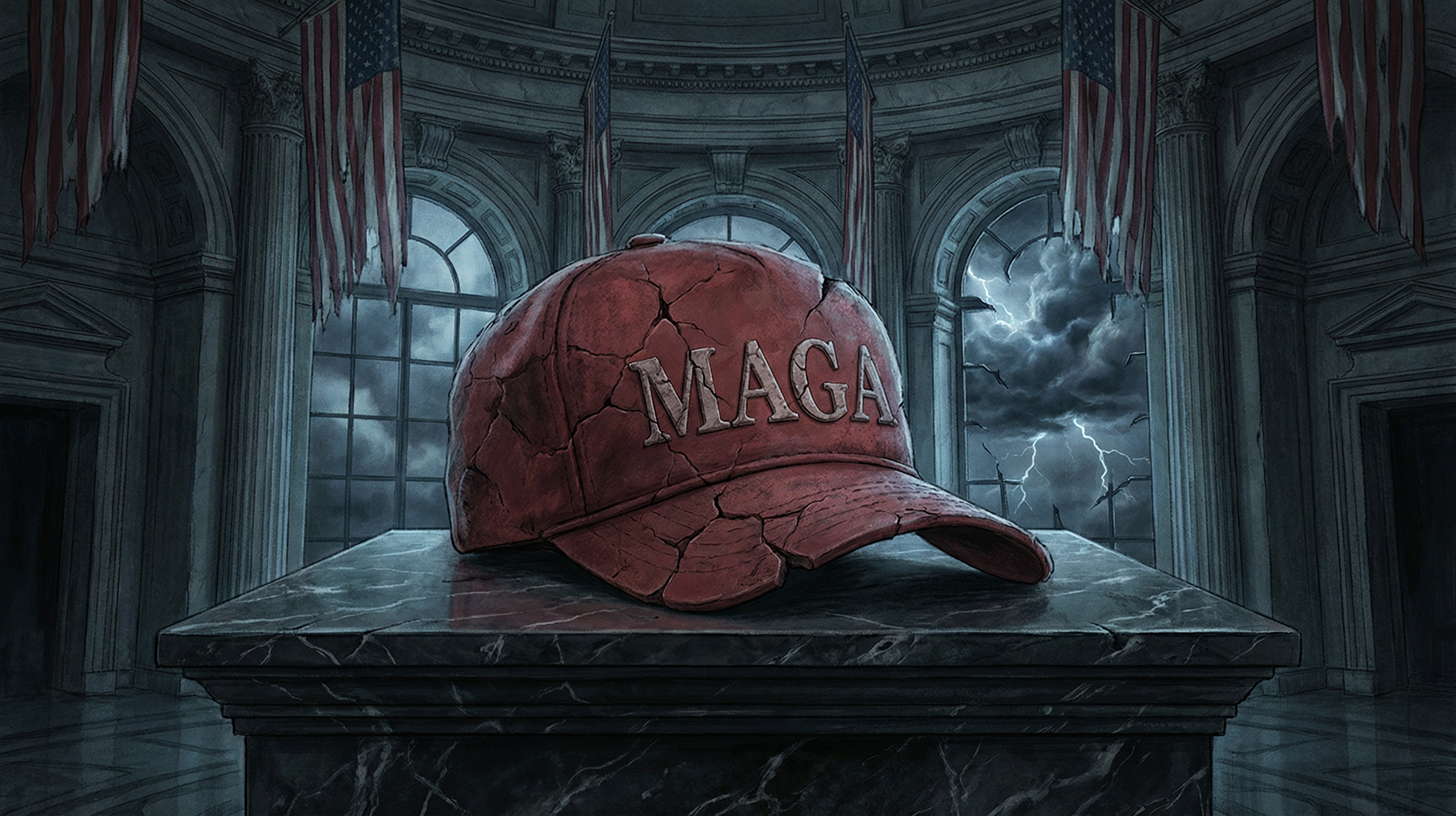
The MAGA movement at a crossroads: Between war with Iran, debt shock and the collapse of TruthSocialism: Donald Trump's house of cards is beginning to wobble – Image: Xpert.Digital
Internal revolt against Trump: Why Tucker Carlson & Co. are suddenly raging against the US president
Elon Musk's cost-cutting flop and expensive tariffs: The bitter truth about Trump's supposed economic miracle
Just over a year after his triumphant return to the White House, Donald Trump faces the ruins of many of his key campaign promises. What was touted as an economic and political revival program for the US is increasingly revealing itself as a toxic mix of stagnation, record debt, and geopolitical escalation. While the much-vaunted US economy groans under the weight of massive tariffs and the lack of cost-cutting measures from the "DOGE" initiative, his flagship project, TruthSocial, is crashing on the stock market. But the biggest bombshell lurks within his own ranks: A war against Iran, initiated without congressional approval, is driving a deep wedge into the "Make America Great Again" movement and drawing prominent critics like Tucker Carlson into the fray. Given disastrous poll numbers ahead of the pivotal midterm elections, a pressing question arises: Is America witnessing the beginning of the end of the Trump political project?
When the paint is peeling: How Donald Trump is trying to mend the cracks in his own camp with distraction tactics
In the spring of 2026, the political landscape of the United States is in a remarkable state of instability. Donald Trump, who began his second term in January 2025, finds himself, just over a year after his triumphant return to the White House, confronted with a confluence of problems that are shaking the foundations of his "Make America Great Again" movement. The US economy is growing significantly slower than promised, his social media platform Truth Social is sinking into economic and digital irrelevance, and the military strike against Iran, launched without congressional approval, is dividing his own supporters like no other event of his second presidency. This analysis illuminates the economic, media, and geopolitical dimensions of a crisis that is far more than a political skirmish.
The illusion of growth: Why the US economy is crumbling beneath the surface
Donald Trump seizes every opportunity to extol the strength of the American economy. In his State of the Union address on February 24, 2026, he described the United States as the hottest country in the world and highlighted supposed successes in reducing the cost of living. Reality tells a different story. The US gross domestic product (GDP) grew by an annualized rate of only 1.4 percent in the fourth quarter of 2025, after an impressive 4.4 percent increase in the third quarter. Expectations had been for 3.0 percent, but the actual result marked the weakest quarter since the beginning of 2025 and fell drastically short of forecasts. For the full year 2025, this translates to growth of 2.2 percent, a significant decline compared to the previous year's 2.8 percent.
The forecasts for 2026 are anything but encouraging. According to the Federal Reserve Bank of Philadelphia, GDP is expected to grow by only 1.8 percent in 2026. Allianz Trade even predicts a mere 1.6 percent, classifying this as one of the lowest growth rates since the beginning of the century. This puts the American economy significantly below its potential. The reasons for this are manifold, but one key factor stands out: the Trump administration's tariff policy.
Mark Zandi, chief economist at Moody's Analytics and one of the most renowned economic observers in the US, has been warning for months about the hidden weaknesses of the economy. In his outlook for 2026, he describes growth as fragile and points out that the positive GDP headlines mask deeper problems. His central argument revolves around the weakness in the labor market, which is obscured by the high-profile GDP figure. In fact, the US unemployment rate rose noticeably during 2025, reaching 4.6 percent in November 2025 and still standing at 4.3 percent in January 2026. The number of long-term unemployed—those who have been out of work for more than 27 weeks—rose by 397,000 year-on-year to 1.9 million. Even more alarming is the increase in involuntarily part-time workers by 980,000 to 5.3 million.
Customs policy as an economic boomerang: When protectionism backfires
The sweeping tariffs imposed by Trump in April 2025 against nearly all trading partners form the core of the economic malaise. According to calculations by Yale University, the average tariff rate for all imported goods rose to 18.2 percent, compared to just 2.4 percent before Trump took office. This massive increase has consequences that extend far beyond the mere impact on trade.
The Austrian National Bank calculated that tariffs reduced US economic growth by almost 2 percentage points in 2025, with retaliatory measures by trading partners having longer-lasting effects and likely to further reduce growth by an additional 0.6 percentage points in 2026. The Institute for Macroeconomics and Business Cycle Research at the Hans Böckler Foundation forecasts a growth loss of 0.7 percentage points for 2026, primarily caused by higher inflation, which puts pressure on real disposable incomes in the US. The mechanism is remarkably simple: higher tariffs make imports more expensive, companies pass these costs on to consumers, the purchasing power of private households decreases, and the US Federal Reserve is forced to adopt a more restrictive monetary policy than the economic situation would actually require.
While inflation itself is in a more moderate range than at the height of the tariff shocks, at 2.4 percent in January 2026 it remains above the Federal Reserve's target of 2.0 percent. LBBW forecasts an inflation rate of 3.5 percent for the full year 2026, while the Peterson Institute for International Economics even warns that inflation could exceed 4 percent by the end of 2026. The drivers are the delayed effects of the tariffs, an expanded fiscal deficit, a tighter labor market due to restrictive immigration policies, and a monetary policy that is looser than commonly perceived.
The fiscal time bomb: Debt explosion and record interest burden
While Trump throws around superlatives, the fiscal situation of the United States is deteriorating dramatically. The budget deficit reached $1.775 trillion in fiscal year 2025. Total national debt hit a staggering $38.5 trillion in January 2026. Interest payments alone on this debt amounted to a record $1.3 trillion in 2025, exceeding the entire US military budget. Within just four years, the US government's interest costs have nearly doubled.
This dynamic severely restricts the government's strategic room for maneuver and also explains Trump's ongoing attacks against the US Federal Reserve. His goal is to lower interest rates through political pressure and thus reduce the enormous interest costs. The Fed chairmanship is up for election in May 2026 – an opportunity Trump is likely to use to bring the central bank under his control. ZDF's fact check of the State of the Union address soberly concluded that Trump's promises to close the deficit through DOGE savings and tariff revenue are unrealistic.
The Department of Government Efficiency (DOGE) under Elon Musk, launched with great fanfare as a cost-cutting agency, proved to be a complete flop. Musk himself admitted in a podcast that DOGE had only been "somewhat" successful. The estimated savings of $160 billion fell far short of the promised $2 trillion. Most of the savings came from blunt cuts such as mass layoffs and the cancellation of government contracts, resulting in the elimination of more than 280,000 public sector jobs and, indirectly, the loss of contracts. Musk resigned from his post in May 2025, stating in retrospect that he would have been better off investing his time in his own companies. Experts fear that many of the savings will be negated by lost productivity, increased employee turnover, and lost tax revenue.
Consumer sentiment barometer: Pessimism despite presidential success stories
The discrepancy between Trump's rhetoric and public perception is nowhere more evident than in consumer confidence. The Michigan Consumer Sentiment Index stood at 56.6 points in February 2026, 21 percent below the previous year's level. While the Conference Board Consumer Confidence Index recovered slightly to 91.2 points in February 2026, it remained significantly below the four-year high of 112.8 points reached in November 2024.
The development of the expectations component is particularly telling. The Conference Board's Expectations Index has remained below the 80-point threshold – the level at which the indicator signals an impending recession – for ten consecutive months. Conference Board Chief Economist Dana Peterson noted that consumers have become significantly more pessimistic, especially regarding business prospects for the next six months, while expectations for the labor market remain decidedly negative and income expectations have shrunk dramatically.
The longest government shutdown in US history, lasting 43 days, further eroded confidence. Retail sales stagnated in December 2025, showing no change compared to the previous month. Job growth in December 2025 was a mere 50,000, with previous months' figures subsequently revised significantly downwards. All of this data paints a picture of an economy that is far from thriving, but rather groaning under the weight of misguided economic policies.
Truth Social: The expensive illusion of a digital power center
Beyond its economic woes, Trump's own social media platform, Truth Social, reveals a failure symptomatic of the lack of substance in many MAGA projects. The Trump Media and Technology Group (TMTG), Truth Social's parent company, reported a total loss of $400.9 million for fiscal year 2024 on revenue of just $3.6 million, a 12 percent decline over the previous year. These figures illustrate an almost grotesque discrepancy between the company's market valuation and its operational reality.
The user numbers tell a story of chronic weakness. In January 2025, Truth Social recorded an estimated 6.3 million active users. The average for 2024 was 5.9 million monthly active users, with enormous fluctuations: In March 2024, the platform reached its peak of 13.8 million users, only to plummet to a mere 2.1 million in June of the same year. More recent analyses by Search Logistics put the actual number of active users at only around 2 million. By comparison, Trump has over 100 million followers on X, the former Twitter, while Truth Social has only 8.93 million.
The platform never managed to transcend its status as an echo chamber for staunch Trump supporters. As SRF digital editor Jürg Tschirren aptly analyzed, Trump fans can provoke their political opponents with their content on X, Facebook, or other platforms, whereas on Truth Social they are more among themselves and can sow less discord – which simply makes the network less compelling. Only three percent of social media users in the US reported using Truth Social in 2024, while 25 percent were familiar with the platform. There is no question of a mass movement in the digital sphere.
TMTG on the stock exchange: From meme stock to loss-making business
The disaster was reflected on the stock market. TMTG shares (ticker symbol: DJT) were trading at around $10.65 at the end of February 2026, having lost approximately 55 percent of their value within a year. The market capitalization of Trump Media and Technology Group was just under $3 billion – a fraction of the nearly $11 billion it had been valued at on its first day of trading in March 2024. The monthly performance in February 2026 alone was a decline of 20.57 percent, while the stock was trading 64 percent below its 52-week high.
As early as April 2025, Trump himself had initiated plans to sell all 114 million of his TMTG shares through a series of public sales, according to documents filed with the U.S. Securities and Exchange Commission (SEC). The company's stock price had already fallen by 63 percent in the previous twelve months, as investors reacted to weak financial results and a collapse in user numbers by selling off shares. Adding to the pressure was a Delaware court ruling that found Trump Media had violated an agreement with major investor ARC Global, creating further massive selling pressure.
The latest development reveals the desperation of the company's management. In late February 2026, it was announced that Trump Media was in talks to spin off Truth Social into a separate, publicly traded company. This was to occur after the completion of a planned $6 billion merger with the fusion energy company TAE Technologies. The spin-off aims to separate the loss-making social media business from the speculative bet on commercial nuclear fusion, as the company seeks to capitalize on the massive energy demands of the AI boom. This strategic shift from social networking to nuclear fusion appears to be a clear admission that Truth Social has failed as a standalone business model.
Our US expertise in business development, sales and marketing

Our US expertise in business development, sales and marketing - Image: Xpert.Digital
Industry focus areas: B2B, digitalization (from AI to XR), mechanical engineering, logistics, renewable energies and industry
More information here:
A thematic hub offering insights and expertise:
- Knowledge platform covering global and regional economies, innovation and industry-specific trends
- A collection of analyses, insights, and background information from our key areas of focus
- A place for expertise and information on current developments in business and technology
- A hub for companies seeking information on markets, digitalization, and industry innovations
Economic turning point: While India is booming, Russia is threatened with stagnation

How the Iran war is tearing the MAGA coalition apart – Image: Xpert.Digital
The anatomy of a split: How the Iran war is tearing the MAGA coalition apart
On February 28, 2026, Donald Trump ordered "Operation Epic Fury"—a massive military strike against Iran, jointly with Israel and without the approval of the US Congress. In an eight-minute video message on Truth Social, he announced the start of "major combat operations," described the operation as "massive and ongoing," and called on the Iranian people to "take over their government." All five branches of the US armed forces participated in the operation. Iran responded with retaliatory strikes against US bases in five countries, including Bahrain, the United Arab Emirates, and Qatar.
The reaction within the MAGA movement was unprecedented in its intensity. Tucker Carlson, who had visited the White House just a week earlier, called the decision "absolutely disgusting and evil." Republican hardliner Representative Marjorie Taylor Greene wrote on X that the Trump administration had actually asked in a poll how many casualties voters would accept in a war with Iran, and called those responsible "sick fucking liars." "We voted for America First and ZERO wars," she wrote, adding that this was not what MAGA should be.
Republican Senator Rand Paul rejected the presidential war, citing the Constitution and pointing out that the power to declare war was deliberately given to Congress to make wars less likely. Republican Representative Thomas Massie announced his intention to force a congressional vote on war with Iran, together with a Democratic representative. Conspiracy theorist Alex Jones warned that Iran would activate terrorist sleeper cells within the United States in the coming days and weeks and described Trump's actions as a huge gamble that is rapidly pushing the world toward nuclear world war.
The ideological breaking point: America First versus neoconservative interventionism
The split within the MAGA movement over the Iran issue is far more than a current dispute. It exposes a fundamental contradiction that was inherent in the coalition from the outset. One faction, represented by Carlson, Bannon, and large segments of the populist base, defines "America First" as strictly anti-interventionist. For them, ending the US's "perpetual wars" is non-negotiable. The other faction, led by neoconservative senators like Ted Cruz and Lindsey Graham, understands "America First" as the robust enforcement of American interests, if necessary, even through massive military force.
As early as the summer of 2025, when Israel launched its first attacks on Iran, the MAGA world was in turmoil. Tucker Carlson, in his podcast, confronted Texas Senator Ted Cruz with probing questions, ruthlessly revealing that Cruz apparently knew very little about the country he intended to wage war against. Steve Bannon, the chief ideologue of the MAGA movement, had mused about the impending collapse of the American empire should Trump attack Iran.
While polls from June 2025 showed that 65 percent of MAGA supporters favored airstrikes on Iranian military installations, this support explicitly referred to *limited* military strikes, not a full-scale war. As US journalist Jude Russo of *American Conservative* analyzed, the MAGA movement is a coalition of heterogeneous ideological groups with significant internal disagreements on many issues. If the dropping of bombs were to serve as the prelude to a US invasion, the movement would split. This is precisely the scenario that has now unfolded with "Operation Epic Fury.".
The free fall in poll numbers: Trump is losing the center and his own base
Donald Trump's approval ratings are in freefall, having reached historic lows by early 2026. According to a CNN/SSRS poll from February 2026, approval of the president's performance stood at just 36 percent, while 63 percent disapproved. This was the lowest rating of his second term and a dramatic drop from the 47 percent approval rating in February 2025. An NPR/PBS poll in conjunction with the Marist Institute confirmed the trend, with 39 percent approval—the lowest rating since the storming of the Capitol on January 6, 2021.
The loss is particularly severe among politically independent voters, who traditionally play a decisive role in US elections. According to CNN data, Trump's approval rating among independents has fallen to 26 percent, a drop of 15 percentage points in a year. He saw a 19-point decline among Latino Americans and an 18-point drop among voters under 45. Even within his own party, support is crumbling: For the first time in his second term, his strong approval rating among Republicans fell below 50 percent (to 49 percent). Nearly 30 percent of Republicans believe Trump has not focused enough on the nation's most pressing problems.
Nate Silver's poll tracker placed Trump's net approval rating at minus 13.4 percentage points at the end of February 2026, with even more dramatic figures on specific issues. His net approval rating on economic policy was minus 18.6, on trade policy minus 22.4, and on inflation minus 32.3. Democrats lead 50 to 42 percent on the generic congressional ballot, an eight-point lead that could have serious consequences for the midterm elections in November 2026.
Distraction tactic or change of strategy: The logic behind the escalation
Considering all the data, the question arises whether the military escalation against Iran is not also driven by a significant domestic political calculation. Historical experience shows that American presidents, in times of domestic weakness, often resort to foreign policy actions to unite the nation. This phenomenon, known as "rallying 'round the flag," has its limits, however—especially when the president's own base perceives the war as a betrayal of their original political mandate.
Trump's situation is uniquely complex in this respect. The economy offers him no success story he can credibly sell. GDP growth is slowing, tariff policy is backfiring, labor market data is deteriorating rapidly beneath the surface, and consumer confidence is far below the levels promised upon his inauguration. His personal media platform, TruthSocial, is an economic disaster and digitally marginal. The DOGE initiative under Elon Musk has produced chaos rather than efficiency. And now, a war—one that the majority of his most loyal supporters did not want—is splitting the very coalition that brought him back into office.
The *New York Times* described Trump's actions as "reckless." The *Berliner Zeitung* analyzed that "Operation Epic Fury" already surpasses the twelve-day war of June 2025 and could escalate into a regional conflagration. According to polls, 61 percent of Americans believe that Trump's course is harming the country more than it is helping it. The question is no longer whether the MAGA movement is in crisis, but how deep this crisis runs and whether it will prove to be an existential threat to Trump's political project.
The structural weaknesses behind the facade: debt, interest rates, and demographic change
The economic fundamentals reveal a number of structural problems that go far beyond cyclical fluctuations. The construction sector is already in recession, with a real decline in construction output of around 5 percent in the first eight months of 2025. The automotive sector is also weakening: New car registrations shrank by 8 percent in the first eleven months of 2025 compared to the previous year. According to the JOLTS report, job vacancies fell to 7.14 million, significantly below the projected 7.6 million.
The interest payments on the national debt are developing into a structural threat of the highest order. At $1.3 trillion in 2025, they not only exceed the entire military budget but are already the second-largest item in the US federal budget after social security expenditures. The fundamentals remain "extremely concerning," as Maya MacGuineas, chair of the House Responsible Budget Committee, warned. Trump's tax policies, in the form of the "Big Beautiful Bill," threaten to widen the funding gap even further instead of closing it.
Consumers are feeling the effects of these disruptions in their daily lives. Although nominal consumer spending is still rising, persistent inflation is eroding purchasing power significantly. Consumers expect prices to rise by 4 percent next year, which is severely undermining confidence in the economic future. Long-term inflation expectations have risen slightly from 3.2 to 3.3 percent – a trend that is plunging the Federal Reserve into a drastic monetary policy dilemma: If it lowers interest rates, it risks another surge in inflation; if it keeps interest rates high, it risks stifling an already weakening economy.
The midterm question: Are Republicans facing a political earthquake in November?
The confluence of economic weakness, internal strife, and declining poll numbers casts a long shadow over the midterm elections in November 2026. Historically, the incumbent president's party regularly loses seats in midterm elections, but the starting position for Republicans is particularly unfavorable this time. The Democrats' eight-point lead on the generic congressional ballot (50 to 42 percent) signals a potential mood for change that goes significantly beyond the usual level.
The cost of living dominates voters' concerns ahead of the midterm elections as by far the most important issue. Trump's net approval rating of minus 32.3 on inflation shows that he is perceived as part of the problem, not the solution. Among the key independent voters, whom Trump narrowly won over in 2024, his approval rating is at a historically low 26 percent. Independents now favor the Democratic candidate 50 percent to 37 percent on the generic ballot.
The killing of intensive care nurse Alex Pretti on January 24 by ICE agents has further damaged Trump's standing with the general public and, according to Nate Silver, is likely to push his poll numbers even lower, as the full political impact of this event is not yet fully reflected in the national figures. It's a toxic mix of economic discontent, massive social polarization, and the feeling that the president is setting completely the wrong priorities. Sixty-eight percent of Americans now believe Trump has not focused on the right priorities—the lowest figure since he took office.
The paradox of the MAGA movement: Between loyalty and disillusionment
The MAGA movement is in a state that could be described as cognitive dissonance on a political scale. Its followers were won over with the promise of making America great again, ending the endless wars, making the economy flourish for the working class, and draining the proverbial swamp in Washington. A little over a year into his second term, little remains of those promises. The economy is growing at a below-average rate, inflation is eroding purchasing power, a new war has been launched without congressional approval, and DOGE has produced far more chaos than efficiency.
The reaction from the party base is more nuanced than the loud pronouncements of Carlson and Greene might suggest. Some MAGA supporters are employing the classic mechanism of identity politics, closing ranks behind the president at any cost. Others, however, are beginning to no longer ignore the drastic discrepancy between promises and reality. The sharp decline in support among younger Republicans under 45, of whom only 20 percent unconditionally support Trump's actions in Iran, points to a deep generational divide.
The movement's digital infrastructure, embodied by Truth Social, is proving to be a bottomless financial pit and a platform irrelevant beyond its core following. A $400 million loss on only $3.6 million in revenue is not a minor setback, but rather proof of a business model that simply never worked. The planned spin-off and the desperate shift towards nuclear fusion technology are an open admission of digital defeat.
The economic data, political polls, and internal conflicts all point in the same direction: the MAGA movement is facing its most serious crisis since its inception. Whether Trump can still turn the tide through further diversionary tactics—be it through additional military escalation or an aggressive rhetorical offensive—will be the central question of American politics in 2026. Currently, however, the signs are clearly not in his favor.
Your global marketing and business development partner
☑️ Our business language is English or German
☑️ NEW: Correspondence in your native language!

Konrad Wolfenstein
I and my team are happy to be available to you as your personal advisor.
You can contact me by filling out the contact form here wolfenstein@xpert.digital:or simply call me at +49 7348 4088 965. My email address is
I'm looking forward to our joint project.