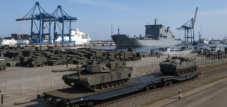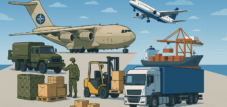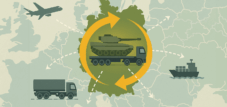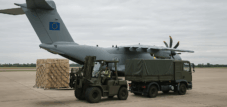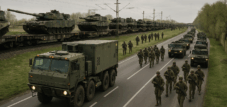
Why logistics experts must address the vulnerabilities of German defense logistics – Image: Xpert.Digital
Overhead power line damaged, defenses compromised: The Rendsburg incident as a warning signal
Structural vulnerability: Why a military train crippled German infrastructure
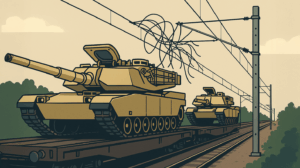
The Rendsburg incident on July 6, 2025, reveals a fundamental problem in German defense logistics: A single American military train with its tank hatch open damaged the 15,000-volt overhead power line, paralyzing the entire rail network in Schleswig-Holstein for hours. This seemingly trivial incident illustrates the structural vulnerability of German transport infrastructure, which has become a critical weak point in NATO logistics.
The Rendsburg incident as a symptom of a larger problem
On Sunday morning at 8:00 a.m., an overhead power line was damaged in Owschlag near Rendsburg by the open hatch of an American tank. The consequences were devastating: the RE7 regional express train between Flensburg and Neumünster, as well as the connections between Kiel and Husum, were completely suspended. Service was only able to resume on a single track at 10:00 a.m., and full repairs were not completed until 5:30 p.m.
An eyewitness documented the incident and observed the tank hatch coming dangerously close to the 15,000-volt overhead power line. The Federal Police later confirmed that the open hatch had struck the power line, causing a voltage drop. For security reasons, Deutsche Bahn declined to comment on details of the military transport.
Related to this:

Structural deficiencies of the German railway infrastructure
Capacity bottlenecks in military transport
The reality of Germany's military transport capabilities is alarming: According to former US General Ben Hodges, Germany only has the capacity to transport one and a half tank brigades, while NATO plans require the simultaneous transport of eight to ten tank brigades. This drastic discrepancy between need and availability makes Germany a logistical bottleneck in NATO strategy.
The current framework freight contract between the German Armed Forces and DB Cargo provides for the provision of 343 flatcars and 300 railcars with locomotives for more than 1,300 military transports per year. With a contract volume of approximately €200 million for two years (2018-2025), the financial dimensions that military rail logistics have reached become clear.
Dilapidated infrastructure as a security risk
Germany's rail infrastructure is in a deplorable state. Only 61 percent of the German rail network is electrified, while dilapidated tracks, outdated switches, and crumbling bridges are a common sight. DB Cargo, the freight subsidiary of Deutsche Bahn, is posting heavy losses: a loss of €350 million is expected for 2024, and 5,000 jobs are to be cut by 2029.
The lead time for military transports is particularly problematic: While NATO's Very High Readiness Joint Task Force (VJTF) is supposed to be ready for deployment within three to four days, Deutsche Bahn typically requires 36 days' lead time for military transports. This discrepancy between military requirements and civilian capacities highlights the structural inadequacy of the system.
Dual-use logistics as a strategic solution approach
Definition and basic principles
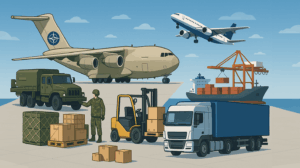
Dual-use logistics refers to the strategic use of infrastructure, systems, and capacities for both civilian and military purposes. Unlike traditional dual-use goods, which relate to individual products, dual-use logistics encompasses entire supply systems and transportation networks. This dual use makes it possible to create synergies between civilian economic interests and military defense requirements.
Related to this:

Modular system architecture
Effective dual-use logistics is based on modular, standardized systems that can be flexibly deployed for various purposes. The successful demonstration of such capabilities in multinational exercises like "Steadfast Defender 24" or "Quadriga" shows the practical potential of these approaches.
Advantages over traditional approaches
Dual-use logistics offers several crucial advantages:
- Economic efficiency: By sharing infrastructure, costs can be reduced and resources optimized. Instead of maintaining separate military and civilian logistics systems, synergies are created.
- Increased resilience: Networking civilian and military capabilities creates redundancies and increases resistance to failures. If one system fails, other components can take over its function.
- Technological innovation: The integration of civilian innovations into military systems accelerates technological progress. Modern Logistics 4.0 concepts such as the Internet of Things (IoT), artificial intelligence, and big data analytics can revolutionize military supply chains.
Why logistics experts are needed, not bureaucrats
Complexity of modern military logistics
Military Logistics 4.0 requires a fundamental shift from reactive to proactive, data-driven approaches. This transformation can only be accomplished by experts who understand both the technical requirements and the operational challenges.
- Networking and automation: Modern military operations require seamless connectivity and supply chain visibility. Dual-use logistics experts can meet these requirements using civilian technologies and standards.
- Multimodal transport concepts: The integration of different modes of transport (rail, road, waterway, air) requires specific expertise regarding interfaces and optimization possibilities.
Overcoming bureaucratic obstacles
The current approval procedures are a prime example of counterproductive bureaucracy: Transporting heavy military equipment from northern to southern Germany is already considered fast if it is carried out within 30 days, since each affected federal state must approve the transport. These regulations date back to a time when military mobility was not time-critical.
- Harmonization of procedures: The new agreement between the German Armed Forces and Autobahn GmbH from June 2025 establishes uniform framework conditions for military transport for the first time. Similar approaches are needed for rail transport.
- Prioritization in emergencies: The framework freight contract with DB Cargo includes an "express surcharge" of €5.9 million, which generally gives the German Armed Forces priority over civilian traffic. This prioritization must be systematically expanded.
International perspective and NATO requirements
Germany as a logistics hub
Due to its central geographical location, Germany occupies a key position in NATO logistics. As a hub for military transports from the west coast to the eastern flank of the alliance, Germany bears a special responsibility for the defense of the alliance.
- Multinational Railway Transport Services (MRTS): The MRTS project group develops cross-border rail transport concepts for military purposes. The model corridor between Germany, the Netherlands, and Poland demonstrates how international cooperation can work.
- Standardization and interoperability: NATO logistics requires uniform standards and procedures. Dual-use experts can harmonize these requirements with civilian industry standards.
Hub for Security and Defense - Advice and Information


Hub for Security and Defense - Image: Xpert.Digital
The Security and Defence Hub offers expert advice and up-to-date information to effectively support companies and organizations in strengthening their role in European security and defence policy. Working closely with the SME Connect Defence Working Group, it particularly promotes small and medium-sized enterprises (SMEs) that wish to further develop their innovative capacity and competitiveness in the defence sector. As a central point of contact, the Hub thus creates a crucial bridge between SMEs and European defence strategy.
Related to this:
Germany needs resilient dual-use logistics after the Rendsburg incident
Lessons from current conflicts
The war in Ukraine has dramatically highlighted the importance of robust logistics infrastructure. Modern reconnaissance and weapons systems enable attacks on high-value logistical targets from long distances. The resilience of this infrastructure is therefore a crucial factor.
Technological solutions
Digitalisation of transport chains
The integration of Industry 4.0 concepts into military logistics enables entirely new approaches:
- Predictive maintenance: Continuous monitoring can prevent failures like the one in Rendsburg. Sensors on critical components warn of impending problems.
- Real-time optimization: Artificial intelligence can dynamically adjust transport routes and automatically activate alternative routes in case of disruptions.
- Blockchain-based documentation: Immutable log chains increase the transparency and security of military transports.
Modular infrastructure concepts
Instead of rigid, specialized systems, Germany needs flexible, adaptable infrastructures:
- Standardized interfaces: Uniform loading equipment enables quick switching between different transport modes.
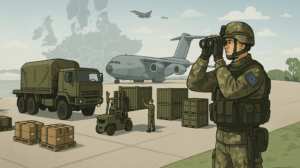
- Mobile logistics centers: Relocatable depots can be quickly set up and used at different locations as needed.
- Redundant capacities: Intelligent networking allows failures of individual components to be compensated for.
Related to this:
Financing models for dual-use infrastructure
Special fund for military mobility
The German Council on Foreign Relations (DGAP) is calling for a special fund of 30 billion euros for the targeted modernization of military corridors. This investment would pay for itself through their dual use for civilian purposes.
- Priority routes: Main corridors between German ports and the eastern border must be upgraded for heavy military transport.
- Bridge modernization: Many bridges are not designed for modern military vehicles and need to be reinforced or renewed.
Public-private partnership models
Dual-use infrastructure can be financed through innovative partnerships between the public sector and private companies:
- Risk distribution: Private investors take over construction and operation, while the public sector guarantees long-term purchase agreements.
- Technology transfer: Private companies contribute innovative solutions that can be used for both military and civilian purposes.
Resilience and vulnerability of critical infrastructures
Threat analysis
The vulnerability of Germany's transport infrastructure goes far beyond technical defects:
- Cybersecurity risks: Digitized systems are vulnerable to hacker attacks. The sabotage of fiber optic cables in Herne and Berlin-Karow in 2022 demonstrated how easily critical infrastructure can be crippled.
- Climate change: Extreme weather events are increasingly affecting transport infrastructure. Heavy rainfall affects between 5 and 30 percent of federal highways annually.
- Terrorist threats: Critical infrastructures are attractive targets for attacks.
Preventive measures
- Redundant systems: Dual-use infrastructures create natural redundancies. If military systems fail, civilian alternatives can be used.
- Monitoring and early warning: Continuous monitoring enables rapid responses to threats.
- Adaptive capacities: Flexible systems can be quickly reconfigured as needed.
International Best Practices
Swiss model
Switzerland has set international standards with the electrification of almost 100 percent of its rail network and a systematic dual-use orientation of its infrastructure.
French approaches
France also uses its TGV network for military purposes and recognized early on that high-speed trains offer strategic advantages.
American experiences
Although the USA lags behind in railway electrification, it has extensive experience in military rail transport.
Implementation strategies
Short-term measures (0-2 years)
- Optimization of existing contracts: The expiring framework freight contract with DB Cargo must be renegotiated and expanded.
- Standardization of procedures: Uniform approval procedures for all federal states are essential.
- Building expert teams: Dual-use logistics specialists need to be recruited and trained.
Medium-term goals (2-5 years)
- Infrastructure modernization: Critical sections of the route must be upgraded to meet military requirements.
- Digital transformation: Intelligent transport management systems must be implemented.
- International networking: Cooperation with European partners must be intensified.
Long-term vision (5-10 years)
- Full dual-use integration: Civilian and military logistics systems merge into a unified, efficient network.
- Technological leadership: Germany is becoming a European role model for dual-use logistics.
- Strategic autonomy: Reducing dependence on individual suppliers and systems.
Related to this:
The path to resilient defense logistics
The Rendsburg incident of July 6, 2025, was more than just a technical defect – it was a wake-up call for German security policy. The structural vulnerability of Germany's rail infrastructure not only jeopardizes national defense capabilities but also NATO solidarity.
- A paradigm shift is needed: Germany must move away from its current culture of waste to a strategically sound, modular approach. Dual-use logistics offers the key to this transformation.
- Expertise instead of bureaucracy: Only specialists with a deep understanding of civil and military logistics can solve the complex challenges. Bureaucratic obstacles must be systematically dismantled.
- Investing in the future: The requested 30 billion euros for infrastructure modernization are not an expenditure, but an investment in the security and future viability of Germany.
The time for half-measures is over. Germany needs a new generation of dual-use logistics experts who understand that modern defense cannot be tackled with 20th-century thinking. Only through the intelligent integration of civilian and military capabilities can Germany fulfill its role as NATO's logistics hub while simultaneously increasing its economic performance.
The Rendsburg incident has demonstrated the fragility of our infrastructure. Now it is up to us to learn the right lessons and set the course for a resilient future. Dual-use logistics is not just an option – it is a necessity for the security of Germany and Europe.
Consulting - Planning - Implementation

Markus Becker
I would be happy to serve as your personal advisor.
Head of Business Development
Chairman SME Connect Defense Working Group
Consulting - Planning - Implementation
Konrad Wolfenstein
I would be happy to serve as your personal advisor.
You can contact me at wolfenstein∂xpert.digital or
Just call me on +49 7348 4088 965 .