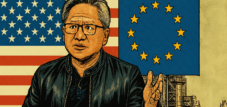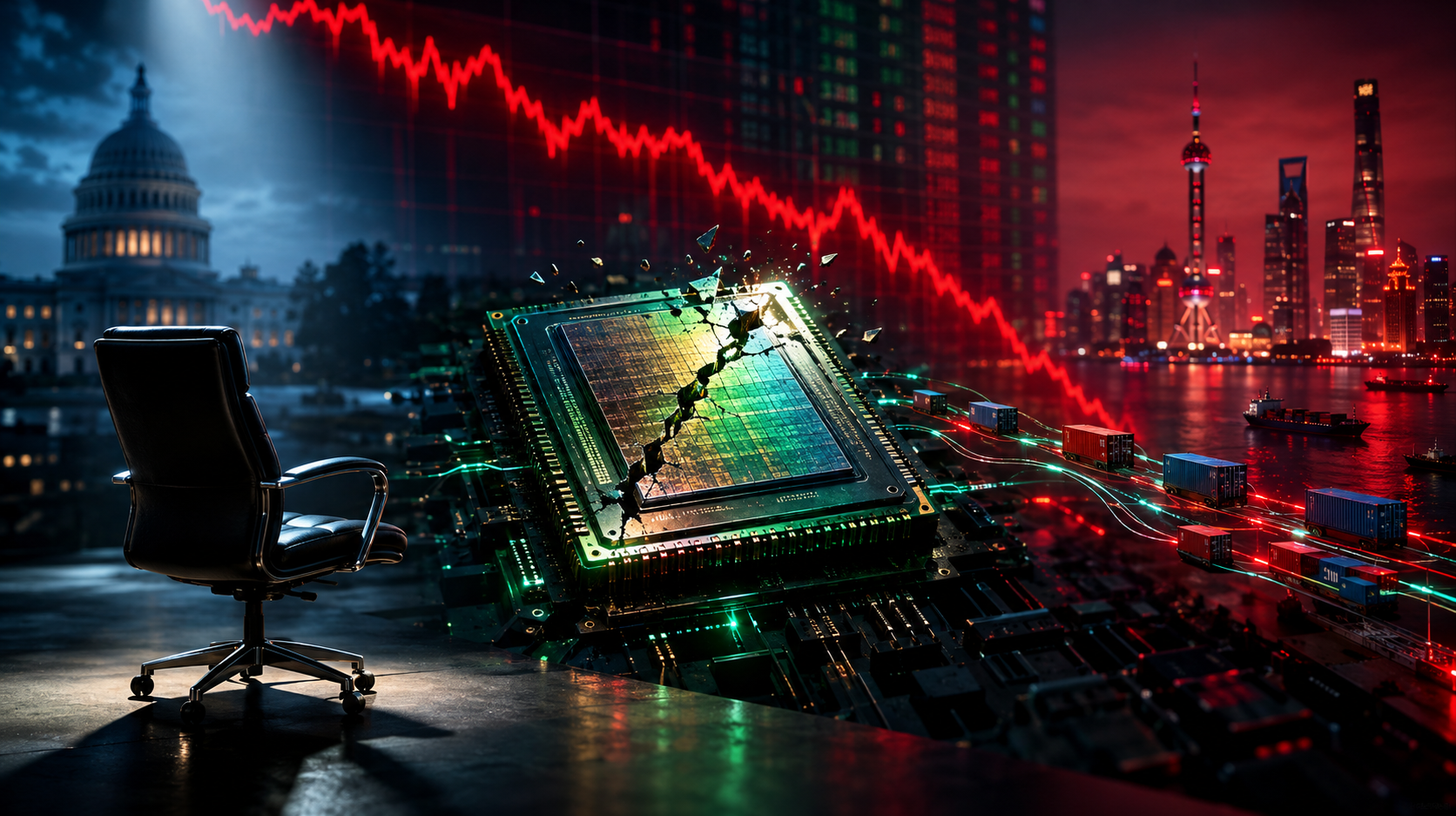
Nvidia after Jensen Huang's resignation: Why the company is losing billions in market capitalization – Creative image on the topic, with AI: Xpert.Digital
Lessons for companies and investors from the Nvidia crisis
More than just a stock market shock: Why the Nvidia case is shaking the AI industry
After the fall of the Nvidia icon: These three risks are weighing on the chipmaker
Nvidia was long considered an almost unstoppable winner of the AI boom. But within a few days, the world's most valuable chipmaker was plunged into a crisis that goes far beyond a personal scandal: allegations surrounding possible chip diversion to China, political tensions, and an abrupt leadership crisis shattered investor confidence. With the resignation of founder Jensen Huang, an era comes to an end – and a fundamental question arises on the stock market: How much of Nvidia's success was based on its business model, and how much on the person who shaped the company for almost three decades? The affair also reveals how vulnerable a company becomes when its leadership, its political connections, and its vision for the future are so heavily reliant on a single founder
The trillion-dollar affair: How Nvidia is paying the price for export leaks, founder cult, and political closeness
The world's most valuable chip company was not dethroned by its competitors, but by its own founder
In the capital markets, there are events that move prices, and there are events that shatter certainties. What transpired at Nvidia in the second week of November 2026 clearly belongs to the latter category. Within a few days, a private affair escalated into a national security crisis. This then became a leadership crisis and ultimately a stock market earthquake that cost the company several hundred billion dollars in market value. On Thursday, it culminated in the resignation of Jensen Huang, who had led Nvidia since its founding in 1993.
The magnitude of the loss in value is exceptional, even for a corporation of this caliber. In the first two trading days alone, following Huang's admission, the company's market capitalization shrank by approximately $430 to $470 billion. After a brief recovery on Wednesday to $173.73 per share, the stock plunged by almost eight percent in after-hours trading. This was triggered by reports that the board of directors was preparing to replace the CEO. After the official announcement of his resignation, the stock fell by more than ten percent in pre-market trading to around $156. This brings the total loss since the close of trading last week to more than $700 billion.
The picture is even more drastic when looking at a longer period. At the beginning of October, the stock was trading at a record high of just over $240, with a market capitalization of just under $6 trillion. In May 2026, Nvidia became the first company ever to surpass the $5.5 trillion mark. Since its October peak, the company has now lost more than a third of its value, or around $2 trillion. This is roughly equivalent to the combined market capitalization of all DAX-listed companies. At one point, Nvidia slipped behind Apple and Microsoft to third place among the world's most valuable companies.
The central economic question of this article is: What exactly has the market priced in here? The loss of a person, the damage to a business model, or the collapse of a political arrangement from which Nvidia had profited for years? My thesis: It is primarily the third. At the same time, the episode ruthlessly demonstrates how vulnerable a company becomes when its strategy, organization, and political relationships are tailored to a single individual.
From admission to resignation in five days
The sequence of events explains why the market reacted so strongly. On Sunday, November 8, Jensen Huang admitted in a memo to employees that he had been unfaithful to his wife. He took full responsibility but did not provide any details. This followed reports that American intelligence agencies had concluded that the Chinese businesswoman Alice Huang had passed information to Beijing. Despite sharing the same last name, she is not related to the Nvidia CEO.
That same weekend, the board of directors launched an independent investigation. A committee of independent directors hired external lawyers, led by Joon Kim, a partner at the law firm Wachtell Lipton and former acting federal prosecutor for the Southern District of New York. Initially, the committee explicitly backed Huang, stating that it had no reason to believe that national security or company secrets had been compromised.
On Monday, the stock fell sharply. That same evening, President Trump said the FBI was investigating the case. At the same time, a shareholder lawsuit was announced in California, intended as a class-action suit for all purchasers of the stock between October 9 and November 8. The allegations are that Nvidia and Huang concealed the affair and made false statements about their business dealings with Megaspeed, Alice Huang's company.
On Tuesday, the situation escalated further. Reports surfaced that the relationship had facilitated shipments of Nvidia chips worth at least $7.5 billion to China. Simultaneously, it emerged that the president had allegedly been briefed on the intelligence information as early as May aboard Air Force One. On Wednesday, a report emerged of a second extramarital affair, this time with Kimberly Powell, the vice president in charge of healthcare. She reportedly reported directly to Huang. This made the situation untenable for the board of directors.
According to Nvidia's bylaws, the CEO can be removed by a simple majority vote of the directors, with or without cause. Huang holds approximately 3.6 percent of the shares and therefore does not have a majority of votes. He was thus not protected by multiple voting rights like some founders. Following an all-night meeting, the board of directors announced his resignation on Thursday. Huang stepped down from his positions as president, CEO, and board member with immediate effect. Colette Kress, CFO since 2013, will assume interim leadership while remaining CFO. Harvey C. Jones, former head of the chip design software company Synopsys, will become the first independent chairman of the board. The search for a permanent successor will include both internal and external candidates.
What's remarkable is the speed of this change in sentiment. Full confidence on Sunday, resignation on Thursday. On the forecasting platform Polymarket, the probability of Huang leaving by the end of the year had already risen to 88 percent on Wednesday. This shows that the markets recognized the development earlier and more clearly than the supervisory board itself.
A network from Shanghai, Singapore and Kuala Lumpur
To understand the economic implications of these allegations, one must examine the network of companies that Alice Huang is alleged to have built together with her husband Kang Wei and her sister Huang Yu. This structure is typical of how export controls come under pressure in a globalized semiconductor industry.
Alice Huang, also known as Huang Le, comes from the Chinese financial sector. She previously worked for HSBC's private banking division in Hong Kong and for CITIC Securities. Later, she was deputy managing director and a member of the investment committee at Shanghai Hexi, an investment company her husband founded in 2010. Kang Wei was once considered a star fund manager in China. According to people close to the couple, he had met Jensen Huang a decade earlier and later introduced him to his wife. In 2018, the Chinese securities regulator fined Kang and Shanghai Hexi, among other things for undisclosed holdings during a takeover battle.
In March 2023, the Singaporean subsidiary of a video game company in which the couple had previously held a stake was renamed Megaspeed International. Alice Huang was listed as a director and served as CEO until November 2023. She is also believed to have been the majority shareholder from March 2023, before the shares were transferred to a Singaporean company called SwiftData at the end of 2023. It is unclear who ultimately controls SwiftData. However, in subsequent public appearances, Alice Huang continued to be presented as the chairwoman of Megaspeed. Around the same time, in June 2023, Century Litong was founded in Shanghai. This company operates data centers and leases computing capacity, including Nvidia graphics processors. Its founding shareholder can be traced, via an intermediate holding company, to an investment firm in which Alice Huang previously held 99 percent and which she transferred to her sister in 2017. Another subsidiary, Speedmatrix, was added in Malaysia.
The decisive factor was its partner status with Nvidia. In the fall of 2023, Megaspeed was granted preferred cloud partner status. This afforded it priority access to chips at a time when graphics processors were in short supply worldwide and delivery times were crucial to the success of entire AI projects. Megaspeed had listed the Chinese technology company Alibaba as its anchor customer to Nvidia. CenturyLitong also received this status only about four months after its founding, roughly two weeks after Washington tightened export restrictions on chips specifically designed for China in October 2023. This close timing is striking, but in itself, it does not prove any violation of the rules.
The quantities are considerable. According to research based on information from two people close to Alice Huang, the network is said to have handled imports worth more than $7.5 billion. Around 240,000 export-restricted Nvidia chips are believed to have entered China in this way, primarily H100 and H200 processors, as well as some A100 chips. Megaspeed alone is said to have imported Nvidia chips worth approximately $4.6 billion between 2023 and 2025. Its Malaysian subsidiary, Speedmatrix, received more than 200 shipments worth around $2 billion between June 2024 and June 2025. A short seller had already pointed out in May that Megaspeed's balance sheet total had increased from $33 million in 2023 to $3 billion in 2024. For a young company, that's almost a hundredfold increase.
Calculating the aforementioned figures yields an average value of roughly $31,000 per chip. This is within the range of market prices for H100 systems during the years of greatest scarcity. The order of magnitude is therefore plausible. However, a crucial distinction, often overlooked in the debate, is that operating data centers in Southeast Asia and leasing computing power to Chinese customers like Alibaba is legal under current law. It only becomes illegal when the hardware itself is physically transported to China. To date, no publicly established violation by Megaspeed has occurred. Megaspeed maintains that it is a compliant company and rejects the accusations. Nvidia had previously stated that it had investigated and refuted suspicions. Beijing calls the espionage allegations baseless and denies them as slander.
Authorities in several countries have nevertheless taken action. Taiwan has revoked Alice Huang's entry permit and is investigating whether her visits were for intelligence gathering purposes. Singapore detained her in the summer of 2025, imposed a travel ban which was later lifted, and continues its investigation into Megaspeed. Her husband was reportedly detained in Shanghai earlier this year. In the United States, the Department of Justice has taken over the investigation. Alice Huang is now believed to be in Beijing with the knowledge of security authorities.
Why export controls are economically leaky
The Megaspeed case is not an isolated incident, but a textbook example of the economics of export controls. When a state restricts a major market's access to a scarce and strategically important commodity, a price differential arises between the regular global market and the restricted market. The greater the demand in the restricted market and the higher the value per unit, the greater the incentive to circumvent the restrictions. AI accelerators are almost ideal for this: they are small, extremely valuable, and can be installed in servers that are virtually indistinguishable from ordinary data center equipment. A former Nvidia employee, quoted by a short seller, described the practice in Singapore as follows: take the graphics processors and declare them as smartphones.
Furthermore, there is a structural weakness in the distribution system. Nvidia only sells some of its high-performance chips directly to end customers. A significant portion is routed through server assembly plants, distributors, and cloud partners. When the United States banned the Chinese variants A800 and H800 in October 2023, distributors were still allowed to sell already shipped inventory. Century Litong is alleged to have purchased large quantities of precisely this stock. Each additional step in the supply chain reduces the manufacturer's visibility into the actual end-user. At the same time, it increases the possibility of circumventing regulatory barriers via third countries.
The scale is crucial for assessing this case. The allegedly diverted $7.5 billion is spread over roughly two to three years. In the second quarter of fiscal year 2027, which ended in July 2026, Nvidia alone generated $96.2 billion in revenue, $89 billion of which came from its data center business. Measured against this revenue, Alice Huang's network is therefore a mere footnote. The loss in market capitalization is many times this amount. It follows that the market is not penalizing the loss of revenue, but rather the risk of regulatory changes and the loss of credibility.
This credibility was already undermined. In May, a New York short seller claimed in a 40-page report that roughly 20 percent of computing power revenue actually originated in China, propped up by diversions through Southeast Asian intermediaries. Nvidia, on the other hand, stated that its market share in China had plummeted from approximately 95 percent to virtually zero. Its own forecast for the third quarter explicitly excludes revenue from data center chips in China. If it turns out that a significant portion of the growth was based on channels that are no longer politically acceptable, this would pose a problem for the quality of earnings, not just their size. It is precisely this uncertainty that is now being reflected in the discounted valuation.
The concentration risk for founders
The second major valuation factor is key person risk. Jensen Huang wasn't simply a CEO. He was the founder, architect of the product strategy, chief salesman, face of the AI revolution, and political negotiator all rolled into one. According to media reports, around 60 executives reported directly to him. That's an extremely flat organizational structure for a company of this size. Huang was more deeply involved in day-to-day operations than the CEOs of other major corporations. There was no publicly prepared succession plan.
Economically, this effect can be quantified with unusual precision because analysts have openly disclosed it. A prominent technology analyst estimated the fair value of the stock at $300 with Huang at the helm, and at $225 without him. This difference of a quarter is essentially the founder premium. It is based on the expectation that a visionary founder will recognize technology cycles earlier, deploy capital more boldly, and build stronger customer loyalty than an administrator. Several analysts anticipated a further price decline of up to 20 percent in the event of Huang's removal. One investment manager even described the stock as uninvestable given the lack of a succession plan.
However, there are also sober dissenting voices, and they carry weight. Customers aren't buying charisma from Nvidia, but rather an ecosystem of computing power, software, and networking technology. The CUDA programming platform, the combination of graphics processors, high-speed connections, and system software, as well as the developer communities that have grown over years, don't simply vanish with the departure of one man. No one can reliably quantify the specific revenue loss resulting from Huang's departure. Short-term demand for Nvidia chips is likely to remain robust because the major cloud providers have already finalized their investment budgets, and there are hardly any comparable alternatives in the short term.
The selection of Colette Kress as interim CEO sends a clear signal of continuity. She knows the capital markets, customer contracts, and the company's financial architecture like almost no one else. However, her appointment doesn't answer the fundamental question of who will set the technological direction in the future. Ian Buck, head of the data center business and considered one of the architects of CUDA, has been the primary candidate for the permanent position. External names are also circulating. Elon Musk publicly stated that it would be an honor to hire Huang. This statement also demonstrates the significant market value Huang possesses beyond Nvidia itself.
The governance move of separating the chairmanship of the board from operational leadership for the first time is noteworthy. Until now, Huang had effectively combined both roles. The appointment of Harvey C. Jones as the first independent chairman is a belated correction to a structure that, in good times, was seen as an expression of entrepreneurial resolve but appears as a control deficit in times of crisis. This is also an uncomfortable lesson for institutional investors, who have exerted little pressure in this direction in recent years.
🎯🎯🎯 Data-driven B2B industry hub as a quasi-in-house solution


The quasi-in-house solution: How Xpert.Digital closes operational gaps in B2B marketing and sales – Smart Content-Driven Business - Image: Xpert.Digital
Xpert.Digital is a data-driven B2B industry hub led by Konrad Wolfenstein . The company acts as an external, quasi-in-house solution for industrial partners, closing operational gaps in marketing, content, and sales – without requiring additional resources on the client side.
More information here:
Three scenarios for the period after Jensen Huang's resignation
Political proximity as a risk factor
The third, and perhaps most consequential, factor is the political dimension. Jensen Huang was considered one of the president's closest allies in Silicon Valley and an influential informal advisor on AI issues. As recently as October, Trump had awarded him the National Medal of Science. Huang had engaged in shuttle diplomacy between Washington and Beijing to secure an approved route back into the Chinese market. This access was a strategic asset for Nvidia. It has now turned into a liability.
According to multiple reports, the president was briefed on the intelligence findings at least twice within a seven-month period. Around a year ago, federal agents reportedly informed some members of Congress that Huang might be the target of a foreign intelligence operation. The FBI had noticed that Alice Huang possessed unusually high purchasing power for someone in her position. In the spring, Secretary of State Marco Rubio had a confidential memorandum drafted. It stated that she was a source for the Chinese Ministry of State Security and tasked with gathering information on Huang and potentially persuading Nvidia to push for the sale of its best chips to China. In May, Rubio reportedly briefed the president personally aboard Air Force One en route to China, before Huang joined the delegation during a stopover in Alaska. Commerce Secretary Howard Lutnick also reportedly received a top-secret memorandum regarding the relationship.
Trump refers to a conversation with Huang in which the latter asserted that he knew nothing about any espionage activity. The president says he believes him, called Huang an honorable man, and stated that he does not regret not having acted on the information. At the same time, he claimed to have been unaware of the allegations before his trip to China in May. He later conceded that the topic may have been mentioned, but apparently made little impression on him. The White House denies the reports about the briefing on the plane. Two former senior FBI officials raise an additional question: Why did Huang never receive a defensive briefing, that is, a warning that he might be a target of a foreign intelligence service?
Deep rifts are emerging within the government itself. Treasury Secretary Scott Bessent reportedly asked Lutnick in the White House briefing room why Megaspeed wasn't yet on the so-called Entity List, the list of companies to which American firms can only supply with special permission. Several agencies, including the State Department, had already advocated for its listing months ago. However, the Commerce Department, which makes the final decision, hesitated, citing ongoing reviews. It also denies that the confrontation took place. Since March 2025, when more than 80 companies and organizations were added to the list, not a single new entry has been made. This is the longest hiatus in 18 years. Nvidia continues to list Megaspeed in its directory of official cloud partners.
What's economically interesting is how much American export policy has recently become a tool for negotiation. At the end of 2025, Washington permitted the sale of the H200 to select Chinese customers, provided that 25 percent of the revenue went to the American government. According to a licensing framework from January, around ten approved Chinese companies are each allowed to purchase up to 75,000 units. In reality, hardly any have been delivered so far, partly because Beijing itself is restricting the purchase of American chips in favor of domestic alternatives. Huang's attempt to open even the most powerful chips to China failed due to resistance from Rubio and other government officials. Against the backdrop of the espionage allegations, this lobbying now appears in a different light, and therein lies the problem for Nvidia.
When export policy is treated as a bargaining chip, a company's market access depends on personal relationships. Such relationships are efficient as long as they last, and dangerous as soon as they break down. The opposition is demanding a comprehensive investigation and stricter export restrictions. Senate Majority Leader Chuck Schumer, a Democrat, accuses the president of failing to protect America, not China or its allies. Senators Elizabeth Warren and Chris Coons have called on the administration to secure all documents related to the chip exports and the affair. But pressure is also coming from within the Republican ranks. Senator Kevin Cramer, a member of the Banking Committee, called for Huang's resignation, citing the enormous potential for blackmail. Republican-led House committees, including the China Affairs Committee, have summoned Huang to a closed-door hearing on November 18 regarding Nvidia's security protocols. If he refuses to appear, he faces a subpoena and criminal penalties.
For the company's financial outlook, this means that the likelihood of Congress pushing through stricter and less negotiable export regulations with bipartisan support has increased significantly. The informal channel between Nvidia's leadership and the White House, which has repeatedly facilitated concessions in recent years, is closed for the foreseeable future. A new CEO will be careful not to advocate for easing export restrictions in China. China revenues, which had already been excluded from the forecast, are thus transformed from a potential source of future growth into a permanent non-revenue.
The contagion channels in the AI ecosystem
A company with a weighting of around 6 percent in the S&P 500 and about 10 percent in the Nasdaq-100 is no longer an individual stock, but a systemic factor. The crisis at Nvidia therefore has repercussions far beyond its own shareholders, affecting the market through multiple channels.
The first channel is the impact on individual investors and retirement savings. Around 70 percent of American 401(k) plans are invested in publicly traded stocks. The average American saver's reliance on Nvidia is estimated at 3 to 5 percent, depending on the investment portfolio. For public pension funds, the average allocation is around 2.5 percent of assets. Anyone fully invested in a Nasdaq-100 index fund has lost about one percentage point of their assets this week due to Nvidia alone. This isn't a collapse, but it's a noticeable blow to confidence that relies heavily on a handful of technology stocks.
The second channel is the financing entanglement in the AI sector. In recent years, Nvidia has increasingly taken stakes in customers who build data centers based on its chips. In doing so, the supplier partially finances its own demand. During a boom, this cycle amplifies growth. Conversely, if a slowdown occurs, it can also exacerbate the downward trend. The fact that the stock of data center operator CoreWeave fell by six percent in after-hours trading demonstrates how directly the market is pricing in this correlation. Memory chip manufacturer SK Hynix and the American memory specialist Micron also declined.
The third channel is the shift within the industry. AMD and Broadcom both saw gains of three to four percent during the same period. This shows that the market is not interpreting the crisis as the end of the AI investment wave, but rather as an opportunity for competitors to gain market share. Large cloud providers, who are already working on their own chips and want to reduce their dependence on a single supplier, have an additional argument. In the medium term, this could reduce Nvidia's previously exceptionally high pricing power, which is reflected in its gross margin of 75 percent.
The fourth channel extends all the way to Europe. In Frankfurt, the stock fell by around seven percent on Thursday morning, and European semiconductor stocks declined broadly. As recently as mid-October, Huang had appeared as a celebrated guest at the Invest in Germany summit in Berlin. For European companies planning AI factories, industrial cloud solutions, or research data centers based on Nvidia hardware, the technology itself remains unchanged for the time being. However, the assessment of supplier risk is shifting. A manufacturer whose export licenses, partner programs, and corporate governance are simultaneously under political scrutiny is a less predictable partner than just a few weeks ago.
Strong numbers, weak confidence
Perhaps the biggest discrepancy of this crisis lies between the operating figures and the valuation. In the second quarter of fiscal year 2027, Nvidia increased its revenue by 106 percent year-over-year to $96.2 billion. The data center business grew by 117 percent to $89 billion. The gross margin was 75 percent, and net income according to general accounting standards was $59.7 billion. For the third quarter, management projected revenue of $108 billion, explicitly excluding data center revenue from China. During the quarter, approximately $26 billion was returned to shareholders through share buybacks and dividends. For the following fiscal year, Huang had projected revenue growth of around 70 percent.
With a recent market capitalization of around $3.8 trillion and an annualized adjusted quarterly profit of approximately $54 billion, the price-to-earnings ratio is roughly 17 to 18. For a company that recently doubled its revenue within a year, this is remarkably low. It is below the level of many industrial conglomerates with a fraction of that growth. This figure is the best indicator of how much risk the market is now pricing in. It is no longer valuing growth itself, but rather the uncertainty surrounding its sustainability, future leadership, and the regulatory environment.
However, this calculation shouldn't be misinterpreted as a buy signal. It's based on the assumption that current margins and growth rates will hold. And that's precisely the open question. Even before the scandal, the stock had underperformed the overall market because many investors doubted whether their clients' enormous AI investments would generate sufficient returns. Since May, when the short seller published his report, the stock has lost around a quarter of its value. The scandal didn't create these doubts, but it gave them a face and a reason to dwell on them.
The quarterly figures on November 17 will therefore be the first real stress test of the post-Huang era. Investors will pay less attention to the revenue figures, which should be largely secured by existing orders. Three signals will be more important. First, whether customers confirm their orders or become more cautious. Second, how the company intends to control its partner programs and sales channels in the future. Third, whether the interim leadership can present a credible technological agenda that is not tied to a single individual.
Beijing's calculations and the race for computing power
From a Chinese perspective, the situation is ambivalent. Should it be confirmed that a network has been funneling tens of thousands of high-performance chips into China for years, this would have provided Chinese companies and research institutions with computing power at a crucial juncture, power they could not have obtained through regular channels. Approximately 240,000 graphics processors are equivalent to the equipment of several large AI training centers. Such an influx could have measurably narrowed the gap with the leading American players.
At the same time, Beijing has been pursuing a strategy of technological self-sufficiency for some time. The purchase of American chips is being curbed to strengthen domestic suppliers. This has resulted in a paradoxical situation. The United States wanted to keep Nvidia chips out of China, and China itself increasingly no longer wants them. And yet, they apparently still found their way into the country through indirect channels. This demonstrates that official policy on both sides and actual market flows can diverge significantly. The demand for computing power in China's technology companies is evidently greater than domestic production can currently meet.
This presents the United States with a difficult dilemma. Stricter controls increase the incentive to circumvent regulations and accelerate China's efforts to develop its own chips. Looser controls strengthen American manufacturers in the short term but give China access to strategically important technology. The Megaspeed case now provides proponents of a hard line with a strong political argument. It weakens the position of those like Huang who advocated keeping China dependent on American chips rather than forcing it to develop its own. This economically sound position is hardly politically defensible in the foreseeable future.
Lessons for businesses and investors
Several lessons can be learned from the crisis that extend beyond Nvidia.
The first concerns the control of distribution channels for security-relevant goods. Manufacturers of products subject to export restrictions cannot rely on formal declarations from distributors and partners. Verifying the end-use of the goods, analyzing unusual growth patterns, and critically evaluating partners with opaque ownership structures are core responsibilities of company management. A newly founded company that achieves preferred partner status within a few months and whose balance sheet increases almost a hundredfold within a year should have triggered alarms in any robust control system.
The second lesson concerns succession planning. A company with a market capitalization of several trillion dollars and no discernible successor for its founder represents a governance failure that has accumulated over years. In times of exceptional success, the concentration of power is celebrated as a strength. In times of crisis, it becomes clear that it poses an unsecured risk to shareholders. Boards of directors and institutional investors should conclude that succession plans are not a vote of no confidence in a founder, but rather insurance for the company.
The third lesson concerns political proximity. Good connections to the government can open market access, soften regulations, and expedite licensing. However, they also make a company vulnerable to political upheavals. When market access depends on personal relationships, every personal misstep becomes a business risk. The value of such relationships is asymmetrical: their benefits build slowly, while their harm can occur overnight.
The fourth lesson concerns the investors themselves. The heavy concentration of major stock indices on a few technology companies means that even passive investors bear significant individual stock risks without realizing it. Anyone who believes they are diversified with a broad index fund is, in reality, holding a substantial stake in a single company whose fate this week hinged on the privacy of its founder.
Three scenarios for the post-Huang era
What happens next? I consider three scenarios plausible.
In the baseline scenario, operations stabilize. Quarterly figures confirm strong demand, the board of directors finds a technically skilled successor within a few months, presumably from within the company, and the group visibly tightens its export controls. The share price recovers partially. However, a persistent discount due to the lost start-up bonus and the stricter political environment remains. The valuation approaches the rather conservative analyst estimates, which see a fair value excluding Huang significantly above the current share price but clearly below the October high.
In the worst-case scenario, the investigations will expand. Should it emerge that Nvidia employees were aware of the data diversions or ignored warning signs, substantial fines, restrictions, and further lawsuits are possible. Congress could pass significantly stricter export laws across party lines, which would also complicate shipments to Southeast Asia and international cloud partners. At the same time, customers could use the crisis to accelerate their dependence on Nvidia. In this case, this week's share price decline would be just the beginning of a longer-term reassessment.
In the best-case scenario, Huang's departure proves liberating. A more professional governance structure, a clearly separated chairmanship of the board, and management less focused on a single individual could even strengthen the confidence of institutional investors in the long run. The fundamental strength of the ecosystem would remain intact, and the currently unusually low valuation relative to earnings would offer scope for a strong recovery.
The end of inviolability
My assessment is that the market is overreacting in the short term to the operational damage, but is correct in its structural diagnosis. Nvidia's chips didn't get any worse on Thursday, the data centers of the major cloud providers aren't getting any less busy, and the technological gaps can't be closed in just a few months. Therefore, part of the share price decline reflects an emotional overreaction to the fall of an icon.
What has changed permanently, however, is the environment in which Nvidia operates. First, the founder's bonus has disappeared. It was real and measurable because Huang had repeatedly recognized technological turning points earlier than his competitors. Second, the company's special political status has ended. In Washington, Nvidia will no longer be perceived as a national champion with privileged access to the president, but as a security-relevant player under stricter scrutiny. Third, the market has learned that the narrative of the unstoppable AI champion is vulnerable. And not from technological competition, but from governance gaps, opaque sales structures, and an overly close relationship with politics.
This is a crucial lesson for the global economy. The AI investment boom rests on the assumption that a few select companies will reliably provide the necessary infrastructure. This week has demonstrated just how much of this hinges on trust and how quickly that trust can erode. The roughly $2 trillion loss in market value since its October peak is the price paid for a company shaping the future of computing power having tied its own future to a single individual for far too long.
📈🚀 From visibility to trust 👀🤝 Your scalable path with Xpert.Digital


From visibility to trust: Your scalable path with Xpert.Digital - Image: Xpert.Digital
In industrial B2B, sustainable business relationships rarely emerge overnight. They develop step by step – through visibility, professional relevance, recurring touchpoints, and growing trust. Xpert.Digital's 4-stage model addresses precisely this: It offers a structured path that begins with a manageable entry point and can evolve into deeper collaboration in business development if needed.
Instead of relying on loud marketing promises, this model puts the relationship at the forefront. Companies start with clearly defined, easily calculable measures and then decide, based on their own experience, how far they want to expand the collaboration. A key factor for this undisturbed trust-building process: The platform completely avoids annoying advertising ads, so the editorial focus remains solely on the companies' expertise.
More information here:
Your global marketing and business development partner
☑️ Our business language is English or German
☑️ NEW: Correspondence in your native language!

Konrad Wolfenstein
I and my team are happy to be available to you as your personal advisor.
You can contact me by filling out the contact form here wolfenstein@xpert.digital:or simply call me at +49 7348 4088 965. My email address is
I'm looking forward to our joint project.