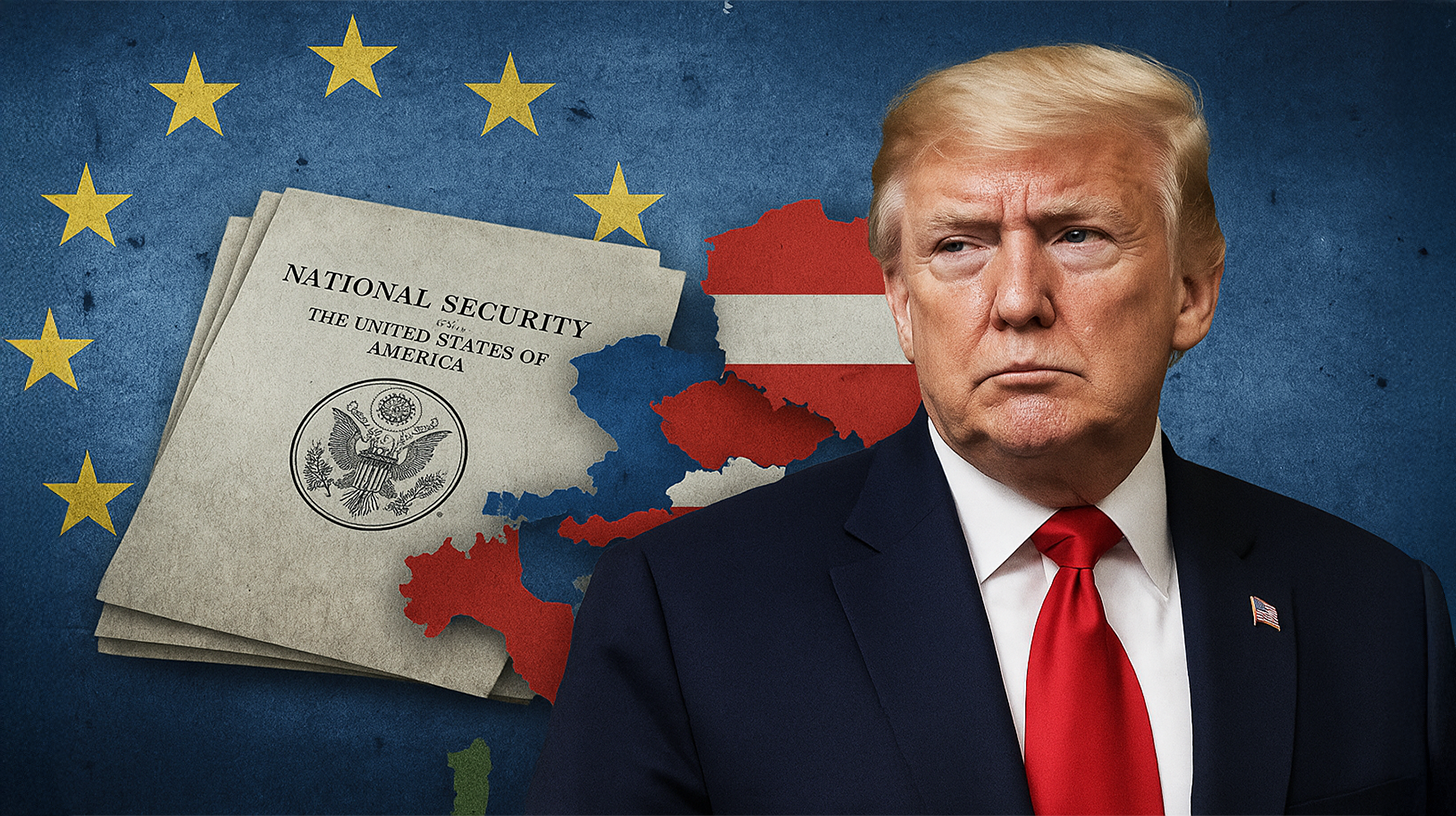
Leaked US strategy paper: Poland, Austria, Italy and Hungary want to deliberately break the US out of the EU – Creative image: Xpert.Digital
Donald Trump's plans regarding European unity: When geopolitical ambitions shake the foundations of the transatlantic order
A rift is running through the West: How a new US security doctrine threatens the existence of the European Union
For a long time, the transatlantic partnership was considered the unshakable foundation of the Western world order. But the unveiling of an expanded version of the US National Security Strategy by "Defense One" at the end of November marks a historic turning point. What at first glance appears to be a continuation of the familiar "America First" rhetoric, upon closer analysis reveals itself to be a meticulously crafted battle plan for the systematic weakening of the European Union.
The document leaves no room for doubt: Washington no longer views the EU primarily as an allied bloc, but increasingly as an economic competitor and regulatory obstacle. A "divide and rule" strategy is being employed to selectively remove four member states – Poland, Austria, Italy, and Hungary – from Brussels' sphere of influence and place them in bilateral dependencies with the US. The goal is to break the collective bargaining power of the single market and neutralize the global "Brussels Effect."
Coupled with immense demands for an increase in defense spending to up to 5 percent of gross domestic product and open ideological support for national-conservative forces, Europe faces perhaps its greatest test. The following analysis examines the economic background, the ideological dynamite, and the fatal financial consequences of a strategy that forces Europe to choose between sovereignty and disintegration.
Related to this:


A turning point in the transatlantic relationship: The USA downgrades Europe from partner to economic competitor.
The revelation of an expanded version of the US National Security Strategy has triggered a security policy shock, the consequences of which extend far beyond symbolic upheavals. What initially appeared to be a rhetorical affront, upon closer examination, reveals itself to be a methodical attempt to systematically weaken the European Union and divide it along ideological fault lines. The longer version of the strategy paper, which Defense One uncovered at the end of November, specifically names four member states that Washington aims to draw away from Brussels: Poland, Austria, Italy, and Hungary. This geopolitical offensive marks a turning point in transatlantic relations, threatening not only the European project but the entire Western security architecture at its core.
The economic and strategic implications of this development cannot be considered in isolation. They fit into a larger pattern of American foreign policy, which, under the doctrine of "America First," is systematically dismantling the liberal internationalism of the postwar order. In this new worldview, Europe is no longer seen as a partner, but as a competitor for resources, markets, and geopolitical influence. The question is no longer whether the United States will redefine its role as Europe's security guarantor, but how radical this redefinition will be and what costs it will entail for both sides of the Atlantic.
The economic anatomy of a geostrategic split
The intention, formulated in the security strategy, to systematically withdraw four European states from the EU orbit follows a calculated economic policy logic. The selection of the target countries is by no means random, but reflects a precise analysis of European vulnerabilities. Poland, Austria, Italy, and Hungary represent different facets of European fragility: economic dependence on non-European energy sources, domestic political polarization, fiscal burdens, and ideological distance from the Brussels mainstream.
The economic dimension of this strategy manifests itself on several levels. First, Washington aims to strengthen bilateral trade relationships that bypass or circumvent the common European market. This would substantially weaken the EU's negotiating power as a bloc. The European Union derives its economic strength not primarily from the sum of its national economies, but from the integration and coherence of its internal markets. A single market of over 450 million consumers enables Brussels to set regulatory standards that have a global impact, from data protection and product safety to competition rules. This power is exercised through the so-called Brussels Effect, whereby companies worldwide adopt European standards to gain access to the lucrative EU market.
The American strategy attacks precisely this mechanism. By attempting to extract individual member states through bilateral deals, Washington is fragmenting the single market and thereby undermining collective bargaining power. This is not a theoretical threat. The EU's Digital Markets Act and Digital Services Act, which force American technology companies to fundamentally change their business models, are only possible for Brussels because the Union acts as a closed bloc of 27 states. Should individual countries break ranks and conclude separate agreements with the US, the Commission's regulatory authority would erode.
Secondly, the strategy targets the defense industry. The US is by far the dominant arms exporter to Europe. Between 2020 and 2024, approximately 64 percent of arms imports by European NATO states were of American manufacture. This structural dependency gives Washington enormous leverage. The demand that European states spend 3.5 percent of their gross domestic product annually on nuclear defense and a further 1.5 percent on security-relevant infrastructure by 2035 represents a massive reallocation of public resources. For the European Union as a whole, this would mean an increase in annual defense spending from the current figure of around $360 billion to over $600 billion.
These funds have to come from somewhere. Either through cuts in other areas such as social spending, education, or infrastructure, which is highly contentious domestically, or through additional borrowing, which further strains the already tight EU fiscal rules. The countries Washington is specifically targeting are, in some cases, already in precarious budgetary situations. Italy's national debt exceeds 140 percent of its GDP, while Austria's is around 80 percent. Massive rearmament programs would either bring these countries into conflict with Brussels' fiscal rules or force them to become more reliant on American financing and procurement models, which in turn weakens their integration into European defense initiatives.
The ideological dimension of the fragmentation strategy
The support formulated in the expanded version of the security strategy for patriotic parties, movements, and intellectual figures who advocate sovereignty and the preservation or restoration of traditional European ways of life constitutes an unprecedented interference in the internal affairs of sovereign democracies. Washington explicitly states here that it is willing to support right-wing, national-conservative, and Eurosceptic forces as long as they are pro-American.
This strategy is based on a precise assessment of European democracies. In all four target countries, there are political movements that are disillusioned with European integration or reject it outright. In Italy, Giorgia Meloni's Fratelli d'Italia, a right-wing nationalist party, is already in power. While rhetorically critical of the EU, it remains dependent on access to EU funding. In Hungary, Viktor Orbán has established a system that observers describe as an illiberal democracy and maintains close ties with both Moscow and Washington. In Poland, traditionally one of the most pro-American EU states, a change of government away from the pro-European Tusk administration could alter the dynamics. Finally, Austria could see an FPÖ-led government after the next elections, which is also Eurosceptic and critical of migration.
The economic policy consequences of successfully implementing this strategy would be devastating. An EU in which several member states actively work against the Brussels institutions is not only politically paralyzed but also loses its economic coherence. Joint initiatives such as the European Green Deal, the digital strategy, or the industrial policy agenda would be blocked or watered down. The Union's ability to act as a single economic actor vis-à-vis the US, China, or other powers would be substantially weakened.
This is not a hypothetical scenario. The European Union has repeatedly experienced in recent years how individual governments can block key initiatives. The unanimity rule in many policy areas, particularly in foreign and security policy, effectively turns any recalcitrant member state into a veto power. Hungary has repeatedly demonstrated this, for example, by blocking sanctions packages against Russia or obstructing EU aid for Ukraine. Should several states unite in a coordinated obstructionist strategy, the EU could become paralyzed.
The reactions of European capitals reveal fundamental cracks.
The reactions to the unveiling of the American strategy reflect the fragmentation that Washington seeks to exploit. Public outrage is widespread in Berlin and Paris. German Chancellor Friedrich Merz described parts of the strategy as unacceptable from a European perspective and called for greater strategic autonomy. The French Foreign Minister spoke of a brutally clear stance taken by the US and warned that Europe would only be respected if it knew how to defend itself.
This rhetoric, however, stands in stark contrast to actual capacity for action. While Germany has taken historic steps with the €100 billion special fund and the suspension of the debt brake for defense spending, its strategic culture remains deeply ambivalent. Surveys show that while majorities support higher defense spending, roughly two-thirds of Germans reject their country's military leadership role. This strategic schizophrenia—wanting to spend more money but unwilling to assume genuine responsibility—undermines the credibility of German security policy.
France, under Emmanuel Macron, has made strategic autonomy its guiding principle, but is failing in its implementation. While the French defense industry is highly developed, it lacks the industrial depth and scalability necessary for lasting European independence. Moreover, security policy cultures within Europe diverge fundamentally. While France and Great Britain, as nuclear powers, have a different self-image, the Baltic states and Poland are existentially dependent on American security guarantees and view any debate on European autonomy as a potential betrayal of the transatlantic alliance.
The target countries of the American strategy reacted predictably differently. Viktor Orbán explicitly welcomed the American security strategy as the most important document of recent years and praised Washington for criticizing Europe in the same tone that Biden and Brussels had previously used to criticize Hungary. The Hungarian government sees the Trump doctrine as confirmation of its own line, which calls for reconciliation with Russia and portrays the EU as an overreaching bureaucratic apparatus. Germany's AfD, whose representatives are traveling to Washington to hold talks with the Trump administration, also welcomed the strategy as a wake-up call for Europe.
In Italy, Giorgia Meloni is skillfully navigating between opposing sides. She presents herself as a bridge-builder between Washington and Brussels, but at the same time tries to position Rome as a privileged partner of the US. This strategy carries considerable risks. Should Meloni shift too strongly towards Washington, she risks alienating her European partners, particularly Germany and France, whose support she needs for domestic and fiscal policy leeway. Should she cooperate too closely with Brussels, she risks losing credibility with her own right-wing nationalist base.
Poland, under Donald Tusk, reacted with sharp rejection. Tusk posted on X that Europe was America's closest ally, not its problem, and reminded everyone that both sides had common enemies. This stance reflects the deep unease in Warsaw. Poland is geographically and strategically exposed, bordering Belarus and the Russian exclave of Kaliningrad, and has experienced Russian aggression against Ukraine as an existential threat. Any weakening of NATO or US withdrawal from Europe is perceived in Warsaw as a potential death sentence for Polish security.
The fiscal consequences exacerbate existing tensions.
The demand to increase defense spending to 3.5 percent of GDP for nuclear defense plus 1.5 percent for security-relevant infrastructure by 2035 poses enormous budgetary challenges for European states. For most EU member states, this would mean an increase of an average of 1.3 percentage points of GDP. In absolute terms, European NATO members would have to increase their annual defense spending by approximately $250 billion.
These sums are not insignificant. Germany, whose defense spending in 2024 was around 1.2 percent of GDP, would have to reach 3.5 percent, which, with a GDP of approximately 4.5 trillion dollars, translates to roughly 160 billion dollars annually, compared to the current 55 billion. Even with the suspension of the debt brake for defense spending, it remains unclear how these funds can be mobilized sustainably without drastically cutting other areas of spending or significantly increasing the tax burden.
The European Commission has proposed exempting defense spending from fiscal rules, similar to what was done during the COVID-19 pandemic. This would allow member states to finance the spending through additional borrowing. However, financial experts warn that this could lead to a dangerous dynamic. Countries with already high levels of debt, such as Italy, France, and Belgium, could jeopardize their debt sustainability. Financial markets do not differentiate between debt for tanks and debt for social spending; they only ask whether that debt can be serviced.
For Germany, the planned increase in defense spending to 3.5 percent of GDP by 2030 would mean that the debt-to-GDP ratio would rise from the current 63 percent to over 70 percent. This would significantly restrict the fiscal leeway for other investments such as climate protection, digitalization, and infrastructure. Analysts estimate that Germany would have to invest roughly an additional percentage point of GDP in each of these areas in the coming years to achieve its strategic goals. This is hardly feasible from a fiscal policy perspective without either drastically increasing taxes or massively cutting other expenditures.
Fiscal tensions are exacerbating political fragmentation. Countries already suffering under Brussels' fiscal rules might be tempted to turn to bilateral deals with Washington to obtain military aid or favorable financing. However, this would promote precisely the fragmentation that Washington seeks.
Our US expertise in business development, sales and marketing

Our US expertise in business development, sales and marketing - Image: Xpert.Digital
Industry focus areas: B2B, digitalization (from AI to XR), mechanical engineering, logistics, renewable energies and industry
More information here:
A thematic hub offering insights and expertise:
- Knowledge platform covering global and regional economies, innovation and industry-specific trends
- A collection of analyses, insights, and background information from our key areas of focus
- A place for expertise and information on current developments in business and technology
- A hub for companies seeking information on markets, digitalization, and industry innovations
Strategic autonomy or junior partner? Europe's last chance for security policy independence
The European defense industry as a strategic bottleneck
Another critical element of American strategy is control over the European defense industry. Europe not only imports the majority of its weapons systems from the US, but is also highly dependent on it for key strategic technologies such as satellite communications, transport aircraft, and advanced weapons platforms. This gives Washington considerable leverage.
While the European defense industry is not insignificant—five of the world's twenty largest arms companies are European—it is fragmented and suffers from a lack of scale. While the American industry dominates globally through massive Pentagon contracts and exports, European manufacturers compete amongst themselves and struggle with national procurement regulations that hinder cross-border cooperation.
The EU has attempted to counteract this trend with initiatives such as the European Defence Fund and the European Defence Industrial Strategy. These programs aim to ensure that by 2030 at least 50 percent of procurement comes from European production and 40 percent is procured jointly. However, the reality is different. Many member states continue to preferentially purchase from American manufacturers, partly out of habit, partly for technological reasons, and partly for political reasons to appease Washington.
The planned increase in defense spending theoretically offers a historic opportunity to build a European arms industry capable of defending the continent independently. In practice, however, there is a risk that the additional hundreds of billions will once again primarily flow into American systems. Germany, for example, plans to procure additional F-35 fighter jets from Lockheed Martin, Tomahawk cruise missiles from RTX, and P-8 Poseidon reconnaissance aircraft. These purchases strengthen American industry and deepen technological dependence.
American arms manufacturers have recognized this and are strategically expanding their presence in Europe, partly through joint ventures, partly through acquisitions of European companies, and partly through co-production agreements. These strategies allow them to profit from European rearmament without achieving genuine independence. As long as European armed forces rely on American weapons systems, they will also remain politically dependent on Washington, since the US can exert pressure at any time through export controls and spare parts deliveries.
Related to this:

The Russian and Chinese dimension of the transatlantic crisis
American security strategy treats Russia with remarkable leniency. Moscow is not defined as an adversary, but rather as a power with which strategic stability can be restored. This formulation stands in stark contrast to the European perception. For the EU, and especially for its Eastern European member states, Russia is an immediate existential threat. The war in Ukraine has demonstrated that Moscow is prepared to use force to re-establish its sphere of influence.
The strategy criticizes European officials for their unrealistic expectations regarding the war in Ukraine and accuses them of adopting a blocking stance that prevents genuine peace. This interpretation remarkably aligns with Russian narratives. Moscow has explicitly welcomed the American security strategy, stating that it coincides with the Russian perspective on many points.
For Europe, this is a nightmare scenario. Should Washington and Moscow begin negotiating security architectures over the heads of Europeans, the continent would be reduced to a bargaining chip. This concern is not unfounded. The strategy explicitly states that the US is prepared to negotiate with Russia on strategic stability and to end the perception of NATO as an ever-expanding alliance. This effectively means that countries like Ukraine and Georgia have no prospect of NATO membership and are to remain within Russia's sphere of influence.
The economic implications are significant. A rapprochement between Washington and Moscow could lead to the lifting or easing of sanctions, which would put European companies adhering to the sanctions regimes at a disadvantage compared to their American competitors. At the same time, Russian control over parts of Ukraine or the neutralization of the country would jeopardize Europe's long-term energy security and return Russia as leverage, which Europe is currently struggling to dismantle by diversifying its gas imports.
China plays a central but peculiar role in American strategy. Beijing is primarily seen as an economic competitor, less so as a military threat. Washington aims for decoupling in strategic sectors, but not full-scale confrontation. This presents a dilemma for Europe. The EU is China's most important trading partner, and China is one of the most important export markets for European industrial goods, particularly those from Germany. An American policy that forces Europe to choose between Washington and Beijing would severely impact European companies.
The US is already exerting massive pressure on Europe to exclude Chinese technology companies like Huawei from critical infrastructure and to restrict investments in strategic sectors. At the same time, Washington is threatening tariffs on European imports containing too many Chinese components. This policy of secondary sanctions is forcing European companies to restructure their supply chains, which entails significant costs and inefficiencies.
The technological dimension of the transatlantic divide
Another point of contention is European regulations for digital markets. The Digital Markets Act and the Digital Services Act aim to limit the market power of American technology giants such as Apple, Google, Meta, and Amazon. The EU has already imposed hundreds of millions of euros in fines on these companies, and further proceedings are underway.
Washington views these regulations as protectionist measures that deliberately disadvantage American companies. The Trump administration has threatened to retaliate with tariffs. Secretary of State Marco Rubio described the penalty against X as an attack on all American technology platforms and the American people by foreign governments. This rhetoric signals that the US is prepared to escalate trade conflicts to protect its technology companies.
For Europe, a fundamental principle is at stake here. The ability to set market rules is a core component of European sovereignty. Should Brussels cave in to American pressure and suspend the enforcement of its laws, this would undermine the EU's credibility and create a precedent that extends far beyond the technology sector.
At the same time, Europe is economically and technologically dependent on American platforms and infrastructures. European companies make massive use of cloud services from Amazon, Microsoft, and Google. Financial infrastructure is deeply intertwined with American systems. Complete digital sovereignty for Europe would be a project that would take decades and cost trillions. In the meantime, Europe remains vulnerable to American pressure.
Europe's trading options in a fragmented world order
Europe faces the fundamental question of how to respond to the American strategy. Three scenarios are conceivable, each with significant risks and costs.
The first scenario is adaptation. Europe accepts the new American doctrine, massively increases its defense spending, primarily purchases American weapons systems, and attempts to avoid a transatlantic rift through appeasement. This would mean that Europe scales back its regulatory ambitions, gives in to the trade conflict, and adopts the American line in its dealings with Russia and China. The advantage would be the preservation of NATO and American security guarantees. The disadvantage would be a lasting strategic dependency and the abandonment of independent European interests. Economically, this would mean that Europe is relegated to the role of a junior partner, implementing American directives without possessing any independent power to shape policy.
The second scenario is confrontation. Europe decides to consistently pursue the path of strategic autonomy, builds up an independent defense capability, develops a European arms industry, establishes alternative financial systems, and openly confronts Washington. This would require a decade of massive investment, fiscal integration within the EU, political unity, and a willingness to accept significant economic disruptions. The advantage would be genuine sovereignty. The disadvantage would be a potential NATO split, the end of the US nuclear security guarantee, and the risk of being crushed between the rival blocs of the US and China.
The third scenario is fragmentation. Europe disintegrates along the fault lines that Washington seeks to exploit. Individual states seek salvation in bilateral deals with Washington, others in closer European integration, and still others in rapprochement with Russia or China. This would mean the end of the EU as a geopolitical actor. Economically, the single market would erode, tariffs and trade barriers would return, and European companies would lose their competitiveness against American and Chinese rivals. This is the worst-case scenario, but given the deep divisions within Europe, it is by no means implausible.
The long-term costs of strategic dependence
The central question for Europe is whether it is prepared to pay the price of true sovereignty. Strategic autonomy is not cheap. It requires not only money, but also political will, social consensus, and a willingness to take risks. The existing European security architecture was comfortable. It could rely on American nuclear deterrence, avoid making unpopular military decisions, and portray itself as a moral civilian power while leaving the dirty work of power projection to others.
This era is over. American security strategy makes it unequivocally clear that Washington is no longer willing to play this role, at least not without substantial concessions. For Europe, this represents a fundamental paradigm shift. The question is no longer whether Europe needs to spend more on defense, but how quickly, how much, and for what purpose.
Economic analyses show that Europe is fundamentally capable of financing its own defense. The EU's combined gross domestic product is approximately $17 trillion, significantly more than China's and comparable to the US. Its population of 450 million provides a sufficient demographic base. The technological and industrial capacity is also present. What is lacking is the political will to mobilize and coordinate these resources.
The biggest obstacles are political and institutional in nature. The EU is not a federal state, but a complex multi-level system in which sovereignty is shared. Defense is traditionally a national competence. A genuine European defense union would require significant transfers of sovereignty, common command structures, integrated armed forces, and a common strategic culture. This is highly controversial politically and is opposed by many member states.
At the same time, the reactions to the American strategy show a growing awareness of the need for change. Even traditionally transatlantic-oriented politicians like Friedrich Merz are now calling for strategic autonomy. France, which has been making this demand for years, is increasingly finding a receptive audience. The question is whether this rhetorical shift can be translated into concrete political steps before the transatlantic alliance is irreparably damaged.
The need for a European reality check
The unveiling of the expanded American security strategy is not the cause of the transatlantic crisis, but rather its symptom. The structural divergences between the US and Europe have been building for years. The US has become increasingly competitive with China and more inward-looking. Europe has failed to invest in its defense in a timely manner and to develop a coherent strategic vision. Dependence on Russian energy, the naive hope that trade would bring about change, and the neglect of its own defense industry—all these were political decisions that have made Europe vulnerable.
The new American doctrine forces Europe to confront this reality. The days of hiding behind moral rhetoric while others guaranteed security are over. Europe must decide what kind of actor it wants to be in world politics: a sovereign power capable of defending its own interests, or a pawn of rival powers, caught between American, Russian, and Chinese ambitions.
The economic costs of this decision are considerable, but the costs of inaction are higher. An EU that cannot guarantee its security will not be able to maintain its economic prosperity in the long run. Investors need stability, businesses need reliable framework conditions, and citizens need the assurance that their governments are capable of protecting them. None of this can be taken for granted in a world where the law of the jungle increasingly replaces the rule of law.
The coming years will show whether Europe is capable of meeting this challenge. The alternative is not a comfortable status quo, but the gradual decline in importance of a continent that was once the center of world politics and now risks becoming a footnote in history.
EU/DE Data Security | Integration of an independent and cross-data-source AI platform for all business needs

Independent AI platforms as a strategic alternative for European companies - Image: Xpert.Digital
AI Game Changer: The most flexible AI platform - Tailor-made solutions that reduce costs, improve your decisions and increase efficiency
Independent AI platform: Integrates all relevant company data sources
- Rapid AI integration: Tailor-made AI solutions for businesses in hours or days, instead of months
- Flexible infrastructure: Cloud-based or hosting in your own data center (Germany, Europe, free choice of location)
- Maximum data security: its use in law firms is irrefutable proof
- Deployment across a wide variety of enterprise data sources
- Choice of own or different AI models (DE, EU, USA, CN)
More information here:
Your global marketing and business development partner
☑️ Our business language is English or German
☑️ NEW: Correspondence in your native language!

Konrad Wolfenstein
I and my team are happy to be available to you as your personal advisor.
You can contact me by filling out the contact form here wolfenstein@xpert.digital:or simply call me at +49 7348 4088 965. My email address is
I'm looking forward to our joint project.