Fascination with virtual worlds – Digital Reality – Image: Xpert.Digital / Andrey Suslov|Shutterstock.com
Other realities have so far been sparsely populated
Meta will soon launch a new high-end VR headset called the Quest Pro. As the name suggests, the new hardware is aimed at professional users. Accordingly, at €1,800, the headset is a rather expensive purchase that will do little for the general population of virtual worlds. In any case, only a small portion of humanity will use virtual or augmented reality hardware in the near future. Currently, around 74 million people worldwide have access to VR headsets, while the number of AR devices is less than ten million. And the coming years will do little to change this exclusive access to digital realities. Analysts estimate the user base for VR and AR hardware at less than 250 million people by 2027.
Related to this:
But things are happening nonetheless – just not as quickly as Meta would like
By 2025, only 130 million people worldwide will own virtual or augmented reality glasses. This represents a mere 1.6 percent of the global population. The coming years will do little to change this exclusive access to digital realities. Most VR and AR devices will continue to be used in industrial and military sectors. Where highly sensitive data is involved, control over the hardware is paramount.
For the general public, these devices are still far too expensive, and their applications are too limited. Affordable devices for the mass market are not expected for several years. Until then, virtual reality will remain an exclusive technology, primarily adopted by industry.
Nevertheless, there are also positive developments that could lead to more people having access to VR headsets and AR devices in the future. For example, Microsoft is currently working on a new version of its HoloLens headset, which is intended to be even lighter and smaller than previous models. This should make the headset easier to wear for children and the elderly.
It's also positive that more and more companies are recognizing the advantages of virtual and augmented reality. As a result, an increasing number of firms are relying on these technologies to better understand products, define goals, and improve employee training. This also increases the demand for devices that enable companies to work more effectively.
Forecast for worldwide sales of virtual reality glasses until 2026
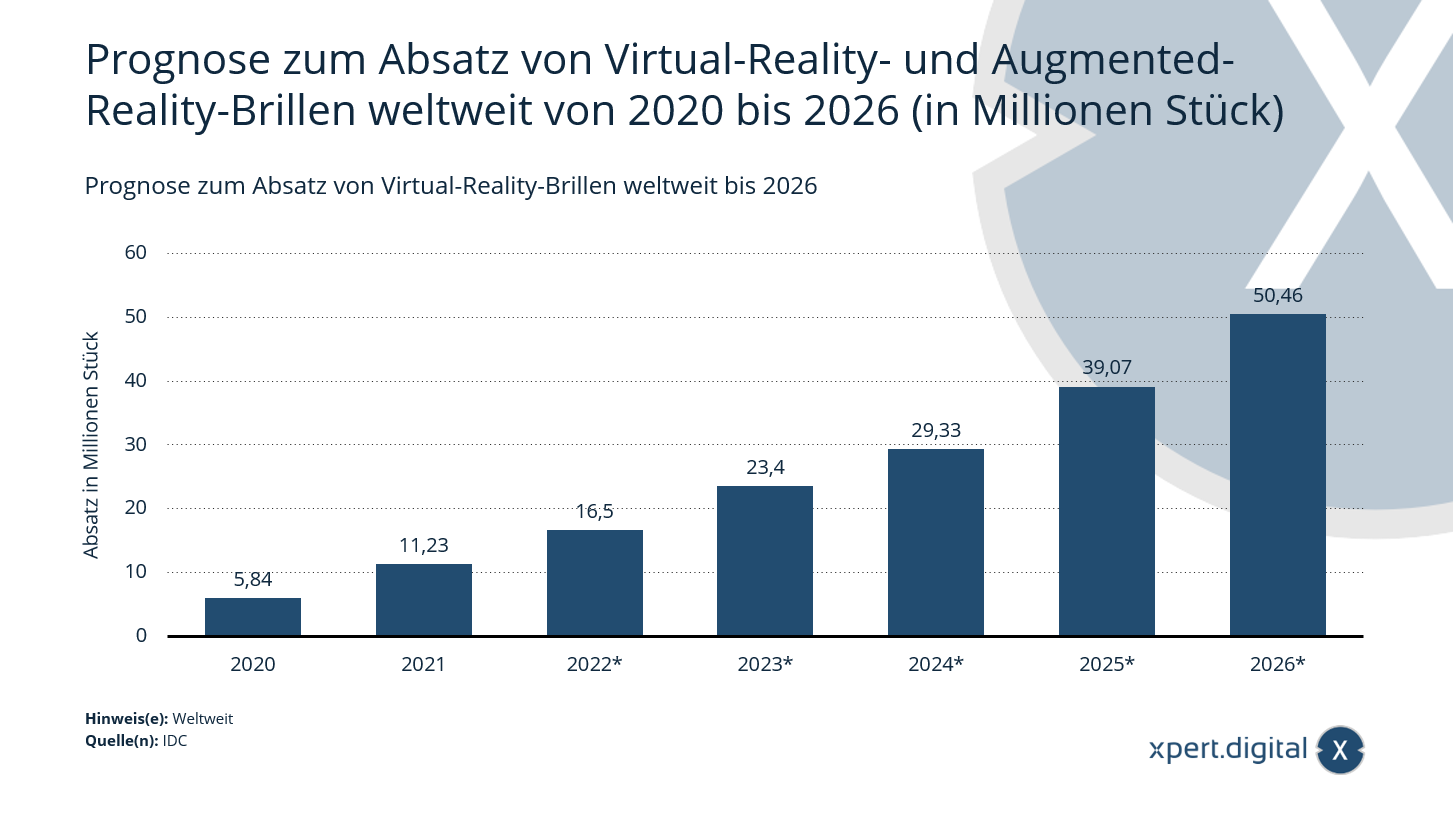
Forecast for worldwide sales of virtual reality glasses until 2026 – Image: Xpert.Digital
Forecast for worldwide sales of virtual reality and augmented reality glasses from 2020 to 2026 (in millions of units)
This statistic presents a forecast for global sales of augmented reality and virtual reality glasses up to the year 2026. According to the source, sales of VR/AR glasses are expected to reach more than 50 million units in 2026.
- 2020 – 5.84 million
- 2021 – 11.23 million
- 2022* – 16.50 million
- 2023* – 23.40 million
- 2024* – 29.33 million
- 2025* – 39.07 million
- 2026* – 50.46 million
* Forecast
Digi-Capital forecast
Digi-Capital predicts that by 2025, only 171 million people worldwide will be using AR/VR hardware. This represents just 2.3 percent of the global population. The picture isn't much better in terms of adoption: Currently, only about 16% of Germans own a VR headset. While this number is expected to increase in the coming years, usage will remain limited to a relatively small number of people.
Conclusion: Even in the future, virtual and augmented reality hardware will only be used by a minority of the population.
Related to this:
There is great interest in VR worlds ☝️
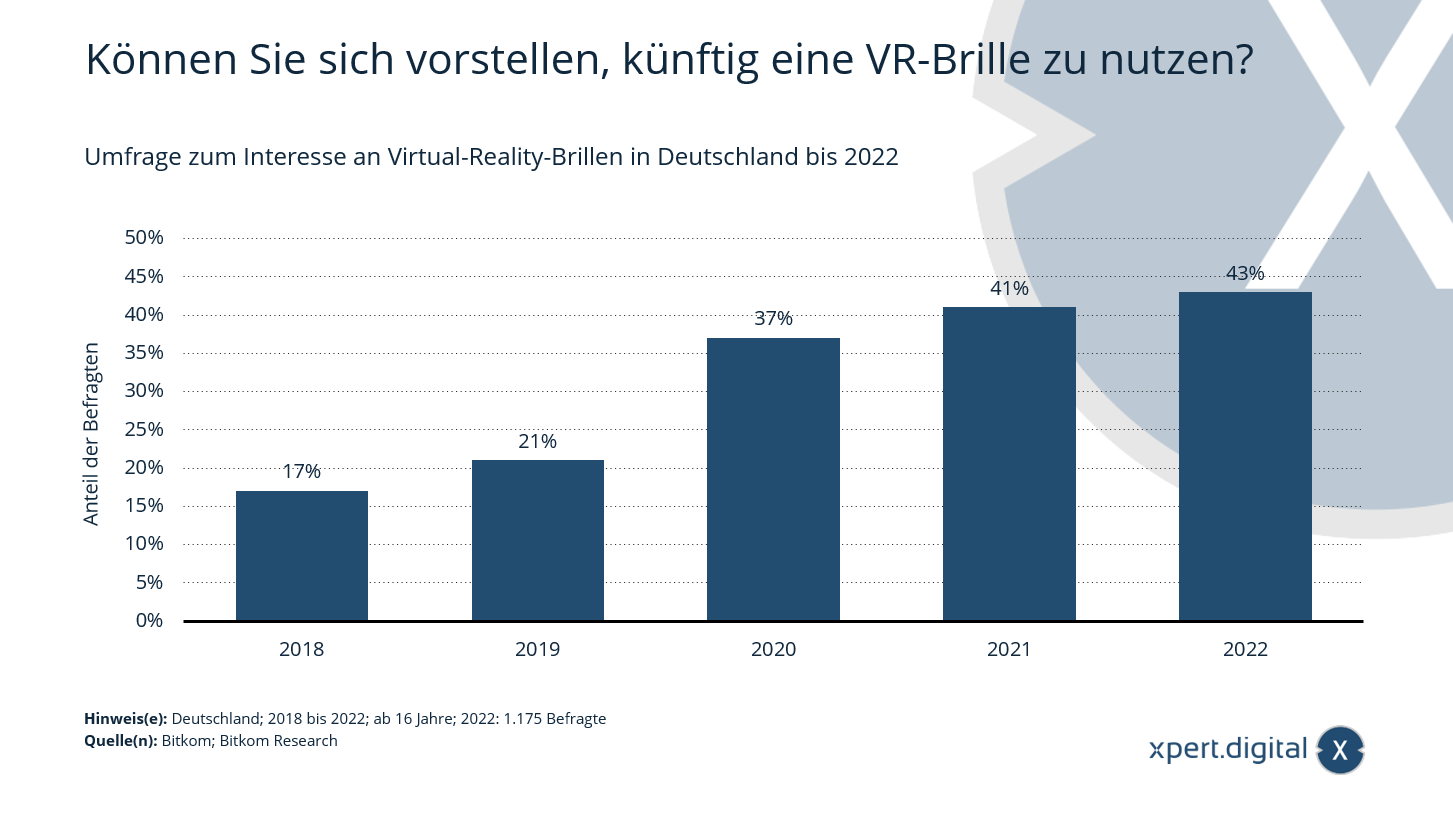
Survey on interest in virtual reality glasses in Germany until 2022 – Image: Xpert.Digital
Survey on interest in virtual reality glasses in Germany until 2022
The statistic shows the results of a survey in Germany regarding interest in virtual reality glasses. Around 43 percent of respondents in 2022 could imagine using VR glasses in the future.
Survey: Can you imagine using VR glasses in the future?
- 2018 – 17 in %
- 2019 – 21 in %
- 2020 – 37 in %
- 2021 – 41 in %
- 2022 – 43 in %
Other worlds are even more in demand elsewhere
Nevertheless, many people already live in alternative realities. They don't do this through virtual reality headsets or augmented reality devices, but by creating their own reality. However, most of these people are unable to create their own world because they are dependent on digital media. Instead, they live in social media and online worlds like Reddit or 4chan. In these worlds, everyone can create their "self" and interact with others without fear of their identity being discovered.
A division of humanity through virtual worlds?
Nevertheless, it is not necessarily the case that the coming years will mean a division of humanity into "those who are able to immerse themselves in other realities" and "those who cannot." This is because, so far, other worlds—whether virtual or real—are still very sparsely populated. This means that every person who gains access to digital realities also has the chance to become part of these worlds. Therefore, there is no reason to worry that the coming years will lead to a division of humanity.
Survey on popular use cases for virtual reality

Survey on popular use cases for virtual reality – Image: Xpert.Digital
In a survey conducted in Germany regarding the use of virtual reality content, approximately 79 percent of the VR users surveyed stated that they had played computer and video games using VR glasses.
For what content have you already used virtual reality?
- Computer and video games – 79%
- Movies – 67%
- Traveling to places – 63%
- Music concerts – 41%
- For sporting activities – 33 in %
- Sporting events – 20 in %
- Educational and learning projects – 20 in %
- Museums, exhibitions, trade fairs – 15 in %
- Visualization of apartment and house planning – 11 in %
- Shopping – 8 in %
- Virtual meeting – 7 in %
- For relaxation – 4 in %
Extended Reality: Brave new virtual world – What's currently happening (2018) in virtual reality


Brave new virtual world – Image: Damir Khabirov|Shutterstock.com
Extended Reality (XR) Library (PDF)

Extended Reality (XR) PDF Library – Useful Information – Image: Gorodenkoff|Shutterstock.com
Are you looking for technical and strategic advice for the 3D visualization of digital twins and augmented/extended reality solutions? Xpert.Digital can help!

Konrad Wolfenstein
I am happy to be available to you as a personal consultant for Augmented / Extended Reality solutions.
You can contact me by filling out the contact form below or simply call me on +49 7348 4088 965 .
I'm looking forward to our joint project.
Write to me


Xpert.Digital – Konrad Wolfenstein
Xpert.Digital is a hub for industry focusing on digitalization, mechanical engineering, logistics/intralogistics and photovoltaics.
With our 360° Business Development solution, we support renowned companies from new business to after-sales.
Market intelligence, smarketing, marketing automation, content development, PR, mail campaigns, personalized social media and lead nurturing are part of our digital tools.
You can find more information at: www.xpert.digital – www.xpert.solar – www.xpert.plus
Keep in touch