Why Brexit failed spectacularly – 10 years after the shock: Is Britain planning a secret return to the EU? – Image: Xpert.Digital
A historic U-turn? 58 percent of Britons demand an end to Brexit
“Catastrophic mistake”: This is how London plans its way back to Europe
The broken promise: How the British destroyed themselves with Brexit
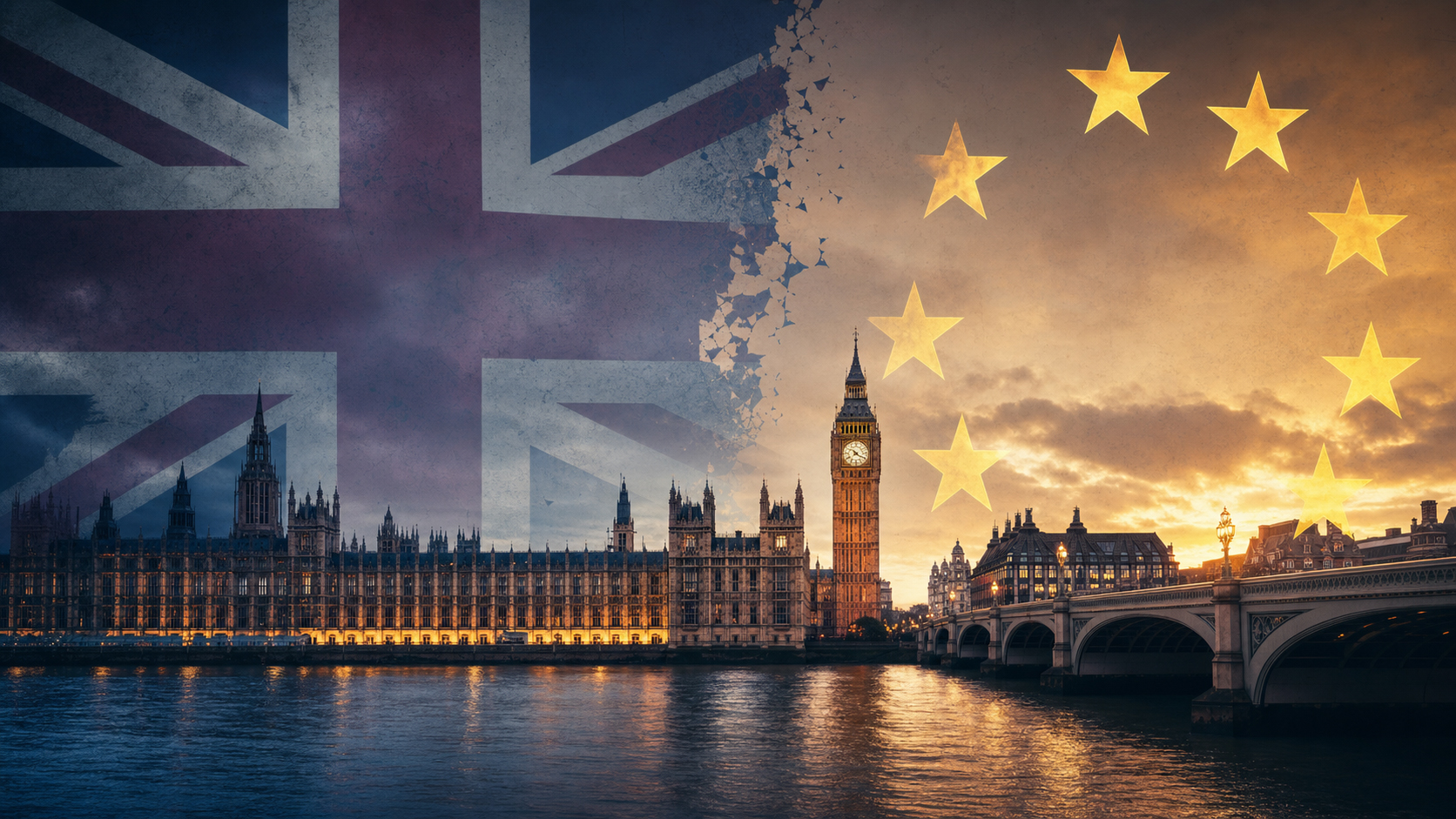
Ten years after the historic referendum of June 23, 2016, Great Britain faces a political and economic disaster. Brexit, once celebrated as a glorious act of liberation and a reclaiming of national sovereignty, has turned out to be an economic black hole and a social time bomb. Instead of the promised control over its borders, the United Kingdom experienced an unresolved migration crisis, coupled with chronic weak growth, plummeting investment, and massive new trade barriers. Now, a decade later, the mood on the island is shifting dramatically: A clear majority of Britons want to return to the European Union, and even high-ranking politicians are breaking the long-held Brexit taboo. But the road back to Europe is fraught with obstacles, geopolitical fronts are entrenched, and the conditions imposed by Brussels would be harsh. This is an assessment of a lost decade, the legacy of populism, and the question of whether the historic mistake of Brexit can truly be reversed.
Brexit regret: Back to Europe? Ten years of lost history or the dawn of a historic turnaround?
To understand the political epicenter of this populist upheaval, one must look to London – and to June 23, 2016. On that Thursday, 51.9 percent of British voters voted for their country to leave the European Union. It was the first time in the history of European integration that a member state had pulled the emergency brake. And, contrary to popular belief, it was no accident. It was the culmination of decades of pent-up anger directed at the winners of globalization, political elites, and a Brussels bureaucracy perceived as being controlled by remote forces.
The shock was profound – in Brussels as well as in the European capitals. Four months later, Americans elected Donald Trump as president, who had deliberately positioned himself as "Mr. Brexit" during the election campaign. What began in Great Britain became an export product: the political blueprint for a nationalist backlash that has since shaken Western democracies. Not only Trump adopted the Brexit rhetoric, but also politicians from Alice Weidel in Germany to Giorgia Meloni in Italy. "Take back control" – the promise of the Brexit campaign – became the global slogan of populists.
Ten years after the referendum, the question is more relevant than ever: Was Brexit a historic mistake? And if so, can it be reversed?
Fragile foundations: Why 52 percent was a weak mandate
The vote was incredibly close, with 52 percent in favor and 48 percent against. Not even Boris Johnson and Nigel Farage, who spearheaded the "Vote Leave" campaign, believed they could win the night before. Pollsters attribute the "Vote Leave" victory primarily to the fact that many older Britons voted for Brexit, while a significant portion of the younger generation simply stayed home.
This demographic imbalance had far-reaching consequences: as early as 2019, analysts calculated that a new referendum would lead to a different result solely due to demographic trends – the death of older Brexit voters on the one hand, and the rise of younger EU supporters on the other. The tipping point had long been passed before the first post-Brexit trade agreement came into effect. Today, demographic change is one of the decisive factors behind the growing majority in favor of rejoining the EU. Many older Brexit voters have died, and many younger Britons are pro-European.
And yet, it would be too simplistic to dismiss Brexit as a mere demographic misunderstanding. The deeper societal fault lines that made the vote possible in the first place have not been overcome to this day. Sara Hobolt, a political scientist at the London School of Economics, describes in her study "Tribal Politics: How Brexit Divided Britain" how many Britons still primarily define themselves as "Remainers" or as supporters of "Vote Leave." Brexit has become less a political decision than a collective identity.
The balance sheet of the lost decade: What leaving the EU really cost
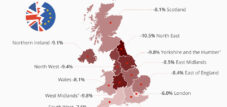
Ten years after the referendum, the economic impact of Brexit can be assessed with a starkness that was initially obscured by political smoke and mirrors. Economists at Stanford University, in a widely discussed analysis, calculated that the UK's gross domestic product would be six to eight percent higher had the United Kingdom remained in the EU. Investments have fallen by up to 18 percent as a result of Brexit, and employment and productivity by up to four percent. The Office for Budget Responsibility (OBR) projects long-term imports and exports to be 15 percent lower compared to a hypothetical continued EU membership.
According to the researchers, these significant negative impacts are due to a combination of increased uncertainty, declining demand, additional management time, and a greater misallocation of resources as a result of the protracted Brexit process. Between 2021 and 2023 alone, British goods exports to the EU fell by 27 percent, while imports from EU countries declined by 32 percent. The British Chambers of Commerce put the decline in service exports to EU markets at 15.8 percent.
Immediately after the referendum, Bloomberg estimated the accumulated costs of Brexit at £130 billion by the end of 2019 – with a projected increase to £200 billion by the end of 2020. These early estimates proved to be conservative. However, completely isolating the Brexit effect is methodologically complex: the Covid-19 pandemic in 2020, the energy price shock resulting from Russia's war of aggression from 2022 onward, and persistent inflation masked the effects of Brexit and made precise attribution difficult. Nevertheless, the bottom line is clear: by leaving the EU, the UK has forfeited enormous growth potential.
While the UK is projected to achieve economic growth of 1.4 percent in 2025 – the second strongest among the G7 countries after the US – this masks a chronic productivity weakness that pervades all sectors. The British Chambers of Commerce note that 54 percent of surveyed export-oriented companies say the Trade and Cooperation Agreement with the EU (TCA) has not helped them grow their business. Around two-thirds of these companies report increased administrative burdens due to certificates of origin, customs formalities, and differing regulatory requirements.
The broken promise: How the immigration issue flipped into its opposite
Perhaps the most emotionally charged promise of the Brexit campaign was to end uncontrolled immigration. This promise, at least in its original intent, has been spectacularly broken. Brexit has significantly reduced the employment of EU workers in the UK, while simultaneously significantly increasing the employment of workers from non-EU countries. The bottom line is that the total number of foreign workers living in the UK is now higher than it would have been without Brexit.
Only under sustained political pressure from Reform UK did the Labour government under Keir Starmer begin a significant tightening of migration rules from 2025 onwards. In 2025, net immigration to Great Britain fell to 171,000 – a record low since 2012. However, the damage to public perception is almost irreparable: many Britons still associate Brexit with an unfulfilled promise that restructured immigration but did not reduce it. Furthermore, Brexit has made it extremely difficult to return migrants who have crossed the English Channel illegally to EU countries, a situation that has considerable political implications.
The Federal Agency for Civic Education succinctly summarizes migration after Brexit: Brexit ended the free movement of EU citizens in the United Kingdom on December 31, 2020, but led to a changed – not reduced – composition of immigration. The paradoxical result: Those who wanted to "regain control" instead ended up with a more complicated migration regime that satisfied neither public opinion nor the country's economic needs.
The shift in opinion: When majorities admit mistakes
Public opinion in Great Britain has fundamentally changed in recent years. According to a YouGov poll from April 2026, 53 percent of British voters would vote for rejoining the EU. An Ipsos poll even puts the figure at 58 percent. On average, according to surveys from February 2026, around 56 percent of Britons support rejoining.
Nearly two-thirds of the British population want closer ties with the EU – a sentiment that is widespread across party lines and even enjoys 60 percent support among former Leave voters. However, the question of a concrete referendum remains sensitive: while many Britons see Brexit as a mistake, they are not convinced that a new referendum should take place in the near future.
It is also noteworthy where this shift in opinion becomes politically visible. As recently as 2022, according to a WELT analysis, 53 percent of Britons voted in favor of returning to the EU; among younger people under 35, the figure was even higher at 77 percent. The political identity as a "Remainer" or "Leaver" continues to override conventional party lines – which makes securing a parliamentary majority for a new referendum more difficult.
Our EU and German expertise in business development, sales and marketing

Our EU and German expertise in business development, sales and marketing - Image: Xpert.Digital
Industry focus areas: B2B, digitalization (from AI to XR), mechanical engineering, logistics, renewable energies and industry
More information here:
A thematic hub offering insights and expertise:
- Knowledge platform covering global and regional economies, innovation and industry-specific trends
- A collection of analyses, insights, and background information from our key areas of focus
- A place for expertise and information on current developments in business and technology
- A hub for companies seeking information on markets, digitalization, and industry innovations
Brexit consequences ten years later: Why the populist wounds are deeper than previously thought
Political vacuum: From Starmer to Burnham and the shadow of Farage
The domestic political situation in Great Britain is turbulent at the time of this analysis. Prime Minister Keir Starmer, who won the 2024 general election with a landslide victory for Labour, finds himself in a deep political crisis after only two years in office. The United Kingdom, suffering from chronic economic weakness, cannot be steered out of its ongoing crisis, and Starmer is being blamed for the failure.
His likely successor within the Labour Party, Manchester Mayor Andy Burnham, would be the seventh Prime Minister in ten years. Burnham has taken an unusually clear stance, stating that he hopes Britain will rejoin the EU during his lifetime – without, however, calling for an immediate second referendum. Health Secretary Wes Streeting, who resigned in protest against Starmer's hesitant approach to Europe, calls Brexit a "catastrophic mistake" that he would correct as Prime Minister.
These are unusually frank words in British politics. For a long time, it was a political taboo in London to reopen the old Brexit wounds – the memories of the bitterly fought campaign were too painful and traumatic. But on the tenth anniversary of Brexit, this taboo is being broken.
Lurking in the background is the right-wing populist Nigel Farage, whose Reform UK party has led British polls for months with around 30 percent. British Business Secretary Peter Kyle explicitly warned of the dangers that a right-wing populist takeover would pose for the country. The paradoxical result of the Brexit decade: the very man who campaigned for leaving the EU in 2016 is now profiting from the ongoing chaos of that exit – while avoiding the very issue that made him famous.
The cost of returning: What Brussels would demand of London
A British return to the EU would be anything but free or straightforward. The last British EU Commissioner, Julian King, made it clear that upon rejoining, Britain would have to forgo the budget rebate negotiated by Margaret Thatcher in 1984. This would mean additional annual payments of at least five billion euros. On top of that, there would be structural contributions as one of Europe's largest economies.
But that's only the financial dimension. Politically, rejoining the EU would mean that Britain would have to fully accept the four fundamental freedoms of the EU single market – the free movement of goods, services, capital, and people – including the free movement of people. This very freedom of movement was a key motivation for Leave voters in 2016. As recently as June 2026, a YouGov poll revealed that almost 60 percent of Britons would not be willing to accept less British control over laws and regulations as part of any future agreement to deepen economic integration with the EU.
Furthermore, in a formal accession process under Article 49 of the EU Treaty, the UK would be treated like any other candidate country – without the special arrangements (no Schengen membership, no euro) it enjoyed during its previous membership. Michael Heseltine, the conservative pro-European and long-serving British politician, predicted years ago that it would take a generation to heal the wounds of Brexit – on both sides of the English Channel. The road back is not a sprint, it is a marathon obstacle course.
Approach as a preliminary step: Reset instead of return
Instead of a formal application for readmission, a gradual, pragmatic reset of relations is emerging for the coming years. This course was initiated at the EU-UK summit in London on May 19, 2025, the first summit of its kind since Brexit. A security and defense pact, a declaration of solidarity, and agreements on trade, fisheries, and youth mobility were signed.
Britain has agreed to keep its waters open to European fishermen for another twelve years after the current fisheries agreement expires in 2026. In return, the EU is easing bureaucratic hurdles for British food imports indefinitely. In the area of defense and security – particularly in light of Russia's war of aggression against Ukraine – cooperation between the EU and Britain has already become significantly closer, albeit initially on an ad-hoc basis.
Oxford historian Timothy Garton Ash points to a structural weakness in the British debate: While London passionately discusses what would be best for Britain economically, Europe itself remains largely excluded. The thoughts and priorities of the rest of Europe are hardly considered. This is a fundamental problem: Re-entry requires the consent of all 27 EU member states – and their populations have invested significant trust lost through Brexit.
The populist origin: What Brexit really unleashed
Brexit was not an isolated event, but rather the first and, so far, most pronounced symptom of a deeper societal erosion. During the four months of the Brexit campaign, phenomena became visible and audible that have since shaped Western politics: the anger of the politically forgotten and economically marginalized towards globalization, doubts about the veracity of facts and the credibility of experts, fear of mass immigration, a nationalist "us first" mentality, and the widespread use of bots on social media to manipulate public opinion.
All of this first erupted in the Brexit vote and subsequently became the hallmark of an entire era. "Vote Leave" was the outlet for mass protest against political conditions against which many citizens rebelled because they felt they were losing control over their lives. The same feeling, the same vocabulary, and the same political dynamics can be observed today in Germany (AfD), France (Rassemblement National), Italy (Fratelli d'Italia), and the USA (Trump).
Crucially, the structural causes that led to the Brexit vote in 2016 have still not been eliminated. Neither the unequal regional economic development, nor the alienation of entire population groups from the political class, nor the feeling of cultural overload have been resolved by Brexit – quite the opposite. This finding has direct consequences for any discussion about re-entry: A return to the EU that is not accompanied by profound political renewal would be politically difficult to justify and would only further fuel populist forces.
The geopolitical dimension: Great Britain as an indispensable European anchor
Beyond the economic debate, there is a second, strategically equally important level: the geopolitical one. If one considers the developments of the next twenty years—a world of competing great powers with a militarily aggressive Russia, an economically aggressive China, and an America that will not fully maintain its post-1945 transatlantic commitment—it is obvious that the best option for a middle power like Great Britain is to be part of a larger alliance of countries that largely share the same interests and values.
The same applies in reverse: For the EU, it would be a significant strategic gain to reintegrate Great Britain, with its liberal democratic tradition, its innovative strength, its global financial center London, and above all its considerable military power, into the union. The country possesses nuclear weapons, a permanent seat on the UN Security Council, and one of the most powerful militaries in Europe – resources that are lacking in an expanded European security architecture.
Napoleon's credo that a country's geography determines its fate has lost none of its geopolitical validity. Brexit was an attempt to disregard this – and it has failed miserably after ten years. The rapprochement at the 2025 EU-UK summit was a first step towards at least partially correcting this historical mistake. Whether this will lead to a full re-entry depends on political decisions that will only be made in the 2030s.
Signaling effect for the world order: What a rejoining would mean
A British return to the EU would be more than a national political event – it would send a global signal. The old continent, long since relegated to the second tier by both the US and China, would make a powerful comeback on the world stage. An enlarged, strengthened, and more secure EU would be a different player in the competition between great powers than the fragmented union of recent years, teetering on the brink of internal populism.
It would also send a global signal against the specters of populist nationalism unleashed by Brexit in 2016. Autocrats like Donald Trump, Vladimir Putin, and Xi Jinping, who rely on the power-political strategy of "divide and rule," would face a fundamental challenge to their worldview: that cooperation is stronger than isolation, that multilateral commitments do not diminish sovereignty but rather make it effective.
But this historic moment has not yet arrived. The scars of Brexit are deep, and mistrust on both sides of the English Channel is considerable. Half of Britons polled favor a referendum after the next general election in 2029 – which could become the real showdown between pro-Europeans and isolationist forces. Until then, the question of whether the United Kingdom, after a decade gone astray, will find its way back to reason – and to Europe – remains arguably the most pressing geopolitical question of the coming decade on the European continent.
🎯🎯🎯 Data-driven B2B industry hub as a quasi-in-house solution


The quasi-in-house solution: How Xpert.Digital closes operational gaps in B2B marketing and sales – Smart Content-Driven Business - Image: Xpert.Digital
Xpert.Digital is a data-driven B2B industry hub led by Konrad Wolfenstein . The company acts as an external, quasi-in-house solution for industrial partners, closing operational gaps in marketing, content, and sales – without requiring additional resources on the client side.
More information here:
Your global marketing and business development partner
☑️ Our business language is English or German
☑️ NEW: Correspondence in your native language!

Konrad Wolfenstein
I and my team are happy to be available to you as your personal advisor.
You can contact me by filling out the contact form here wolfenstein@xpert.digital:or simply call me at +49 7348 4088 965. My email address is
I'm looking forward to our joint project.