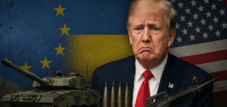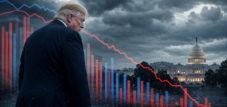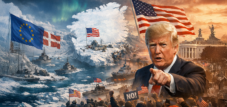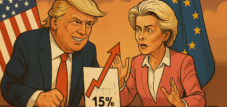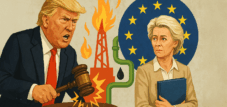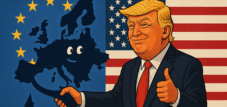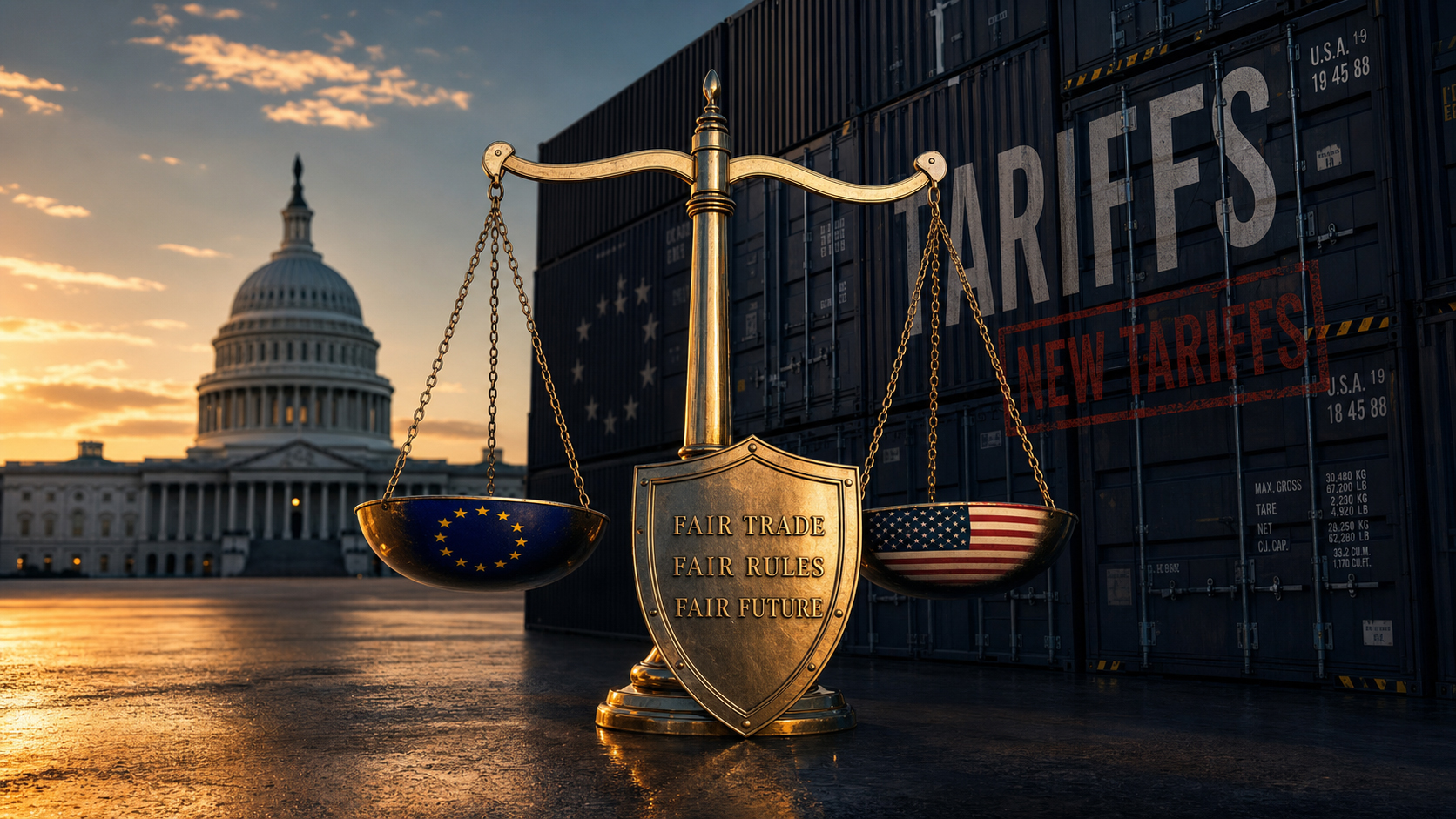
The domestic American opposition to the US's anti-European policies under Donald Trump – Image: Xpert.Digital
Judges, senators, business leaders: The massive internal US resistance to Trump's anti-European stance
Europe's "Quiet Quitting": How Trump's policies are driving away the closest allies of the USA
Trump's tariffs backfire: Why America's farmers and industry are now sounding the alarm – The US economy has had enough of Trump's trade war
The transatlantic divide is widening – but the resistance isn't just coming from Europe, but directly from the heart of the USA. While Donald Trump is putting pressure on America's trading partners with an aggressive anti-European policy and massive global tariffs, an unprecedented counterforce is forming at home. Whether it's the Supreme Court, the Republican wing of the Senate, influential governors, or powerful business associations: they are all warning of economic disaster and a historic loss of trust. But despite this bipartisan alliance at home, the hardline policies are already having fatal consequences abroad. Europe has recognized the gravity of the situation and is reacting with a quiet retreat – a "quiet quitting" that will ultimately hit hardest precisely those American companies, farmers, and workers who are currently desperately trying to correct Washington's economic course. An analysis of the internal American power dynamics and the looming geopolitical rift.
Europe's loss of trust in the US is real and measurable: According to an ECFR survey conducted in May 2026 in 15 European countries, only 11 percent of Europeans still consider the US an ally – compared to 22 percent in November 2024. This is no longer a gradual shift, but a structural break. Yet, within the US itself, resistance is growing against precisely the policies that are causing this break.
Federal level: Courts, Senate and Congress as brakes
The most effective counterweight to Trump's tariff policy to date came not from Congress, but from the judiciary. The Supreme Court declared Trump's original tariffs, imposed under the International Emergency Economic Powers Act, illegal in a 6-3 decision. Shortly thereafter, the US Court of International Trade followed suit with another ruling against the new, blanket 10 percent global tariffs that Trump had imposed after his defeat before the Supreme Court. Both decisions underscore that the US legal system represents an institutional counterweight to executive trade arbitrariness—even if Trump responds with new emergency decrees based on other legal grounds.
Meanwhile, a persistently active minority of Republicans has formed in the Senate, defying the party line. Rand Paul, Susan Collins, Lisa Murkowski, and former Majority Leader Mitch McConnell repeatedly voted with Democrats on resolutions to repeal European and global tariffs. McConnell summarized his position in a much-quoted sentence: Tariffs make it more expensive to build and manufacture in America, and the economic damage of trade wars is historically not the exception but the rule. Senator Thom Tillis explicitly called the tariffs against NATO partners a boon for Putin and Xi Jinping and extremely damaging to the US itself. The drastic historical crisis analogy that Senator Ben Sasse used for the European tariffs during Trump's first term—he spoke of "Make America 1929 Again"—reflects the deep-rooted commitment to economic order that many traditional conservatives associate with the concept of free trade.
A group of seven Republican senators, including Grassley, Moran, Young, Collins, Murkowski, McConnell, and Tillis, co-sponsored legislation that would automatically expire new tariffs after 60 days without congressional approval. While these bills are currently failing in the House of Representatives under Speaker Mike Johnson, they clearly demonstrate the broad and bipartisan opposition to tariff policy in the Senate.
States: 19 governors as a counterforce
At the state level, a coordinated front formed early on. Massachusetts Governor Maura Healey organized a coalition of 19 governors—including Democrats from Michigan, Wisconsin, Illinois, New York, and North Carolina—with a joint appeal to Congress to legislatively limit the president's tariff powers. Healey symbolically requested a reimbursement of $1,745 per Massachusetts household from the Treasury Department for the loss of purchasing power caused by the tariffs. Illinois Governor J.B. Pritzker led a second wave of coalition efforts, focusing on the economic damage to farmers, small businesses, and families.
It is noteworthy that economically strong export states like Oregon – whose economy is heavily dependent on global trade – Nevada, and New Mexico are prominently represented on this front. Oregon Governor Tina Kotek summed it up perfectly: tariffs directly impact tax revenues and employment in the states, and that is a matter of regional economic policy, not just national ideology.
Our US expertise in business development, sales and marketing

Our US expertise in business development, sales and marketing - Image: Xpert.Digital
Industry focus areas: B2B, digitalization (from AI to XR), mechanical engineering, logistics, renewable energies and industry
More information here:
A thematic hub offering insights and expertise:
- Knowledge platform covering global and regional economies, innovation and industry-specific trends
- A collection of analyses, insights, and background information from our key areas of focus
- A place for expertise and information on current developments in business and technology
- A hub for companies seeking information on markets, digitalization, and industry innovations
Who pays the price? How US tariffs are tearing agriculture and industry apart
Corporate level: Three camps against tariff policy
The US Chamber of Commerce and AmCham EU
The US Chamber of Commerce, traditionally the most powerful lobbying tool for American businesses in Washington, has taken a clear stance. On its website, the organization states that it opposes the use of broad tariffs because they provoke retaliatory measures and harm American workers. The American Chamber of Commerce to the EU (AmCham EU), which represents some 140 member companies with over three million jobs in Europe, put it particularly succinctly: The new steel and aluminum tariffs against the EU are harsher than those imposed in 2018, cover more products, and will damage jobs and prosperity on both sides of the Atlantic – both sides must de-escalate. AmCham EU also warned that tariffs lay the foundation for broader protectionist tendencies – including within the EU itself.
Agriculture: Structural dependency as an argument
The threat of European tariffs hitting the US agricultural sector is not abstract. US agricultural exports recently reached $191 billion annually, and a significant portion of that—soybeans, meat, nuts, and dairy products—depends on European markets. The American Farm Bureau Federation warned that farmers were reporting losses for the third consecutive year across nearly all major crops, and additional trade barriers could represent an economic burden that some farms would not survive. The National Farmers Union echoed this sentiment: American family farms would bear the brunt of the damage, and the consequences would extend to the entire food system and rural communities. The National Pork Producers Council, the USA Poultry & Egg Export Council, and the International Dairy Foods Association all sent similar messages to Washington: retaliatory tariffs from Europe would hit agriculture first.
Technology and mechanical engineering: Supply chains in focus
VDMA President Bertram Kawlath – although European – articulated a sentiment that resonates with many US industrial companies: They must not allow themselves to be blackmailed, because every concession only encourages further demands. On the US side, mechanical engineering associations like the Association of Equipment Manufacturers argue that tariffs destroy investment security. Factories would never be built if companies couldn't know whether raw materials and intermediate products would double in price tomorrow. This point is crucial: The real damage caused by tariffs lies not in the tariff rates themselves, but in the enormous unpredictability. Legal advisors from the renowned law firm King & Spalding put it succinctly: For companies, this is not the beginning of a stable period, but rather a new wave of uncertainty – anyone who believes the trade war is over is sorely mistaken.
The structural paradox: Why the opposing forces are still too weak
All these forces – courts, senators, governors, associations – have one thing in common: they act reactively, are fragmented, and have so far been unable to fundamentally halt tariff policy. Senate resolutions mostly die in the House of Representatives. Court rulings are circumvented by new emergency declarations based on other legal grounds. Furthermore, the export lobby has less media presence than the lobby of sectors threatened by import competition. And last but not least, the political cycle favors short-term protective narratives over long-term free trade arguments.
The deepest problem, however, is geopolitical: Europe recognizes this paradox – and is drawing its conclusions. The ECFR survey reveals not only a decline in trust, but also an active reorientation. Europe is increasing its military spending at its own expense (around €800 billion by 2030). It is diversifying its trading partners through agreements with Mercosur, Canada, and the UAE. It is developing its own raw materials strategies and is consciously purchasing more European rather than American arms. The Carnegie Endowment aptly termed this Europe's "quiet quitting" of the US.
This fundamental loss of trust ultimately also affects those American companies, farmers, and institutions that vehemently oppose anti-European policies. Because a Europe seeking strategic autonomy will, in the long run, buy less American LNG, less American arms, and fewer American agricultural products. The bill is therefore not paid by the tariff advocates, but by precisely those who warn most loudly of the consequences.
Your global marketing and business development partner
☑️ Our business language is English or German
☑️ NEW: Correspondence in your native language!

Konrad Wolfenstein
I and my team are happy to be available to you as your personal advisor.
You can contact me by filling out the contact form here wolfenstein@xpert.digital:or simply call me at +49 7348 4088 965. My email address is
I'm looking forward to our joint project.
☑️ SME support in strategy, consulting, planning and implementation
☑️ Creation or realignment of the digital strategy and digitization
☑️ Expansion and optimization of international sales processes
☑️ Global & Digital B2B trading platforms
☑️ Pioneer Business Development / Marketing / PR / Trade Fairs
🎯🎯🎯 Data-driven B2B industry hub as a quasi-in-house solution


The quasi-in-house solution: How Xpert.Digital closes operational gaps in B2B marketing and sales – Smart Content-Driven Business - Image: Xpert.Digital
Xpert.Digital is a data-driven B2B industry hub led by Konrad Wolfenstein . The company acts as an external, quasi-in-house solution for industrial partners, closing operational gaps in marketing, content, and sales – without requiring additional resources on the client side.
More information here: