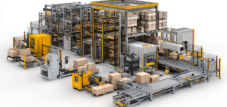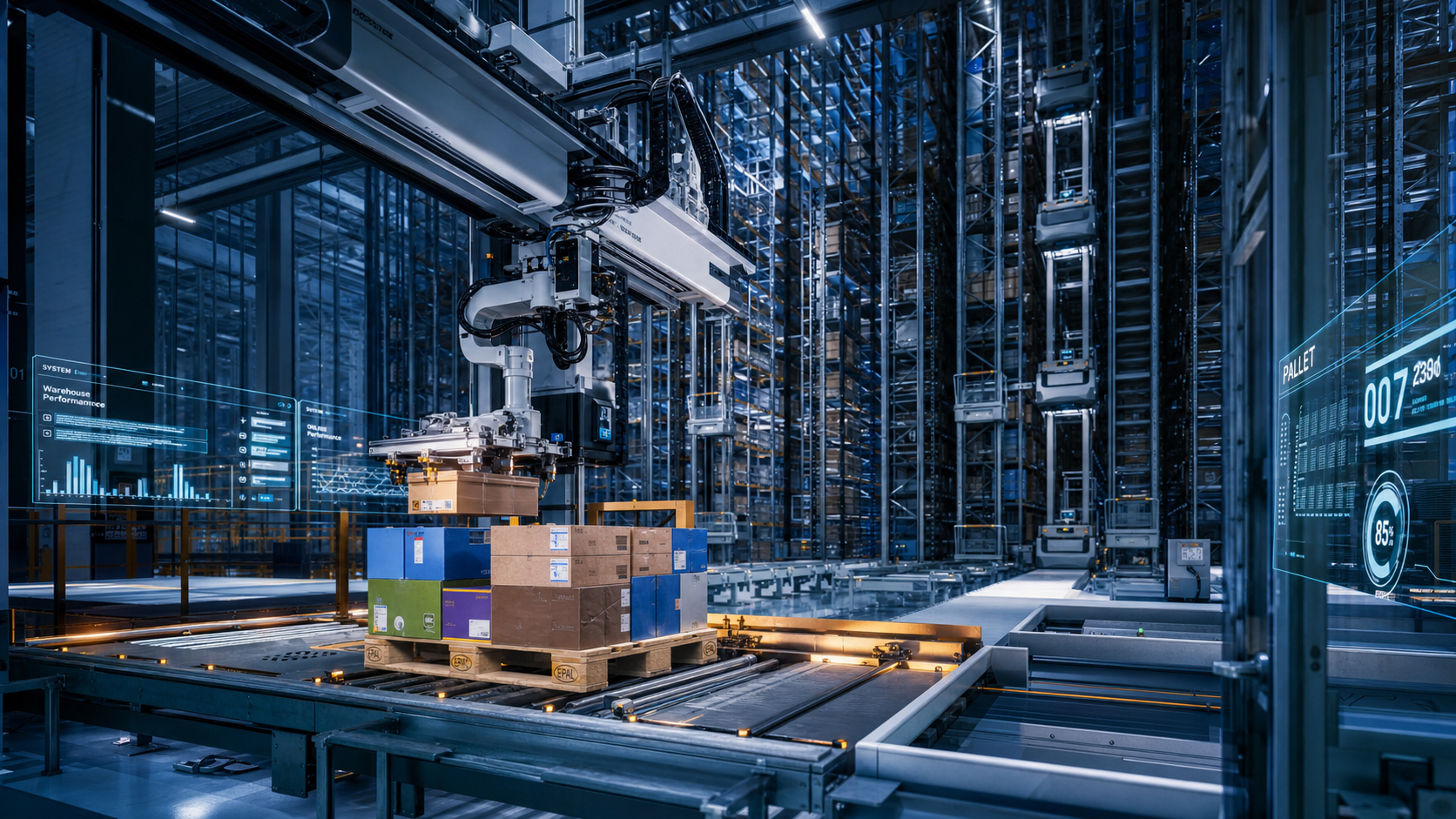
Mixed Case Palletizing: Intelligent B2B Fulfillment – How intelligent palletizing is changing global supply chains – Image: Xpert.Digital
The hidden billion-dollar problem in the supermarket: Why the mixed assortment determines victory or defeat
AI robots play Tetris: 32,000 items, 1 pallet – The most ingenious automation secret of modern logistics centers
The underestimated cost driver in the warehouse: Why you can no longer afford manual palletizing
Modern logistics faces a massive problem: Retailers no longer demand single-product truck deliveries, but rather mixed pallets tailored to each individual store – so-called mixed-case palletizing. While this means maximum efficiency and immediate shelf availability for supermarkets, it pushes distribution centers to their limits. Every day, thousands of different items in varying sizes, weights, and packaging must be stacked stably and efficiently under enormous time pressure.
At the same time, the drastic shortage of skilled workers is forcing the industry to rethink its approach: Manual palletizing is extremely physically demanding, prone to errors, and increasingly becoming an incalculable business risk. But the solution is already in place. Intelligent automation, AI-supported robots, and state-of-the-art automated storage and retrieval systems (AS/RS) are now taking over this Herculean logistical task. This article explains why the seemingly insignificant mixed pallet is becoming a crucial strategic competitive factor for the future – and how companies can use the right technology not only to drastically reduce their costs but also to significantly increase their sustainability and customer satisfaction.
When the product range becomes a strategic competitive factor — and those who haven't grasped this yet will lose out
Retail is moving at a pace that was almost unimaginable ten years ago. Shelves need to be restocked faster, orders assembled more precisely, and delivery schedules adapted to the real-time demands of modern inventory management systems. In this environment, the pallet—often considered a mere tool in industrial logistics—has become the true bottleneck of fulfillment. More precisely, the mixed pallet, or mixed-case pallet, on which goods of varying shapes, weights, and packaging sizes are transported together. What sounds simple is actually one of the most complex operational challenges in modern distribution centers—and simultaneously one of the most significant levers for cost efficiency, sustainability, and customer satisfaction. Mastering this complexity will master the fulfillment of the future.
The hidden complexity behind the supermarket shelf
The sheer number of different items a modern distribution center has to handle daily is staggering. An average US supermarket carries nearly 32,000 different items—known as Stock Keeping Units, or SKUs. Even British convenience stores, which tend to manage a more compact assortment, average around 4,600 SKUs, spread across food and beverages, personal care, household goods, and more. This sheer variety forces fulfillment centers to handle thousands of individual items daily, with varying compositions, formats, and weights—all within an increasingly tight timeframe.
The fundamental problem lies in the nature of commerce itself: While industry often works with uniform pallets—one product, one batch, one load—retail demands mixed deliveries precisely tailored to the needs of each individual store. No supermarket orders only ketchup or only laundry detergent. The reality is mixed deliveries that comply with the store's inventory management and must be assembled individually for each branch. This requirement transforms the distribution center from a simple transshipment point into a highly complex, time-critical production facility—with the goal of assembling each pallet in such a way that it is stable, space-saving, and ready for immediate shelf placement.
At the same time, a structural trend, already visible in some segments, is putting further pressure on assortment planning: Some retail groups are actively reducing their number of SKUs to focus on the most profitable and best-selling products. Dollar General, for example, has publicly stated that it has achieved significant operating gains through assortment streamlining. But even when a retailer reduces its assortment, thousands of SKUs remain—enough to keep the mixed-case problem structurally relevant and complex. The question, therefore, is not whether mixed pallets are needed, but how they can be assembled more efficiently, quickly, and without errors.
From manual challenge to business loss-maker
To understand why mixed-case palletizing has become a focus of automation investments in recent years, one must first understand the economic costs of the status quo. Manual palletizing of mixed loads is physically demanding, error-prone, and labor-intensive. Operators repetitively lift boxes that can weigh anywhere from a few hundred grams to several kilograms, mentally organize the stacking sequence, and are constantly exposed to the risk of strain injuries. US data from the Bureau of Labor Statistics consistently shows that overexertion and repetitive movements involved in lifting and placing materials lead to more injuries in production and warehousing than any other job category.
The consequences are high employee turnover, expensive replacement recruitment, and rising insurance costs. In palletizing positions, the annual turnover rate often exceeds 40 percent, and each new hire costs between $4,000 and $8,000 in recruitment, training, and lost productivity. For a distribution center with multiple palletizing stations, this quickly adds up to a significant annual cost factor—one that is often not fully captured in traditional full-cost accounting.
This situation is exacerbated by the persistent shortage of skilled workers, which represents a structural problem in the German and European warehousing sector. In the fourth quarter of 2024, around 45 percent of German warehousing companies reported that their business operations were hampered by a lack of skilled workers. According to a global study by Randstad, 76 percent of logistics companies worldwide are struggling with an acute staff shortage that extends far beyond seasonal peaks. In Germany, according to IAB statistics, over 60,000 warehouse logistics positions remained unfilled in 2025 alone—a significant increase compared to previous years. The Federal Employment Agency confirms this trend, and industry associations such as the DSLV speak of a structural, demographically driven problem that will worsen in the coming years.
In this context, the automation of mixed-case palletizing is not a technological gimmick, but an operational necessity. Systems that run around the clock, require no breaks, and exhibit no fluctuations in execution quality close a gap that can no longer be filled by human labor alone.
The market is growing — and for good reason
The willingness to invest in automated mixed-case palletizing systems directly reflects this pressure to act. The market for automated mixed-case palletizing was valued at approximately US$3.2 billion in 2025 and is projected to grow to US$6.8 billion by 2034—a compound annual growth rate (CAGR) of 9.4 percent. Robotic systems already dominate the market with a share of around 62.4 percent. The segment of intelligent, AI-powered palletizing robots is developing particularly dynamically, with some analysts even forecasting CAGRs of over 30 percent.
The overall market for palletizing machines rests on a broad foundation: It is estimated at around US$1.07 billion for 2024 and is projected to grow to over US$1.68 billion by 2033, with a CAGR of 5.2 percent. The qualitative shift is particularly interesting: While conventional systems continue to hold significant market share, growth is clearly moving towards robot-assisted, AI-integrated systems that can flexibly adapt to changing SKU portfolios.
Geographically, North America and Europe lead the market, followed by the emerging economies of the Asia-Pacific region. The driving sectors are food and beverages, pharmaceuticals, and e-commerce—three industries that together exhibit exceptionally high SKU pressure, tight delivery windows, and rigorous quality requirements. Particularly in food logistics, where temperature control, expiration dates, and fragile packaging place additional demands on palletizing logic, the full potential of intelligent automation solutions becomes apparent.
Why palletizing is more than stacking: The physics of stability
To understand why mixed case palletizing is technologically demanding, it's worth looking at the underlying physics. A mixed pallet is a three-dimensional optimization problem: heavy items belong at the bottom, fragile products on top, and wide-based cartons form a more stable layer than narrow ones. At the same time, the pallet must ensure sufficient stability for transport on unstable loading surfaces, must not exceed the permissible palletizing weight, and should achieve the highest possible space efficiency to minimize transport costs.
Modern palletizing robots solve this problem not by manually programming each configuration, but through intelligent stacking algorithms that calculate thousands of possible arrangement variations in milliseconds and select the optimal configuration. This is complemented by advanced gripping systems—from vacuum grippers for smooth surfaces to pneumatic grippers for irregular shapes and adaptive soft-gripper solutions for delicate items—as well as camera systems and 3D sensors that measure and classify each incoming box in real time.
The result is a pallet that is not only physically stable but also logistically optimized: In practice, this means improved utilization of cargo space in the truck, less damage from pallet collapse during transport, and a direct impact on shelf availability in the store. When fewer products arrive damaged, more items are available, which directly affects customer satisfaction and the retailer's sales. This causal chain—from palletizing quality to the product's marketability on the shelf—is often underrepresented in traditional logistics calculations, but in reality, it is of considerable economic importance.
Before the robot intervenes: Sequencing as a strategic advantage
One of the most important insights gained in mixed-case palletizing practice is that the real success factor is not solely the palletizing robot itself, but rather what happens before it. The sequencing of goods, i.e., the order in which items are delivered from the warehouse to the palletizing station, is the crucial preparatory step for a stable, efficient pallet. A robot that receives items in the wrong order—for example, light boxes first, then heavy ones—is structurally disadvantaged in its stacking logic and must either create cumbersome intermediate buffers or compromise on stability.
This realization fundamentally changes the requirements for the entire upstream storage system. Automated storage systems must not only store and retrieve information—they must be able to dynamically sort items and provide them in the optimal sequence for palletizing. This is a task that traditional static storage cannot fulfill, placing state-of-the-art AS/RS (Automated Storage and Retrieval Systems) technology at the heart of system design.
The sequencing principle also applies to manual palletizing operations: Even if an employee builds the pallet by hand, they benefit enormously from an upstream system that presents the items in the correct order and displays the stacking sequence on a screen. This makes even ergonomically designed, manual palletizing workstations significantly more efficient and less prone to errors. Automation, therefore, doesn't begin with the robot, but with the intelligence of the upstream system.
The backbone of the system: AS/RS technology in a performance comparison
Automated storage systems for small load carriers, so-called mini-load AS/RS, form the logistical core of high-performance mixed-case operations. Designed for handling small units—containers, cartons, trays—they provide the essential foundation for seamless mixed-case palletizing through their integrated storage, sorting, and sequencing functions. Two main competing technology principles have emerged in the market: crane-based systems and shuttle-based systems.
Crane-based mini-load systems utilize high-bay stackers that travel on rails within individual storage aisles, storing and retrieving load carriers. Their key strength lies in their vertical reach of up to 20 meters—nearly double that of typical autonomous mobile robots. This allows them to utilize the full storage capacity of modern high-bay warehouses, resulting in significant cost savings where floor space is limited. Throughput is typically 100 to 120 storage and retrieval cycles per hour per crane—sufficient for medium volumes but limited for high-frequency distribution operations.
Shuttle-based systems, such as the Daifuku Shuttle Rack M, operate on a fundamentally different principle: Each rack level has its own independent, lightweight vehicle capable of moving through the aisle at speeds exceeding 200 meters per minute. Since operations are performed simultaneously on each level, throughput scales linearly with the number of vehicles and levels used. This results in systems capable of up to 1,000 storage and retrieval cycles per hour per aisle—ten times faster than crane-based systems. Another economically significant aspect: According to the manufacturer, the Shuttle Rack M consumes approximately 60 percent less energy per cycle than conventional crane systems, a factor that is gaining importance in light of rising energy costs and ESG requirements.
In addition to throughput, flexibility with changing load formats is also relevant when selecting the appropriate system. Crane-based systems are considered more robust with heterogeneous product weights and shapes, while shuttle systems demonstrate their strength in high-volume operations with greater homogeneity of load carriers. A third technology principle, motorized conveyor systems (Motorized Conveyor AS/RS), offers the highest storage density of all available solutions, but is limited in its product size compatibility and more difficult to scale. Therefore, for mixed-case applications with high SKU diversity, crane- or shuttle-based systems are the dominant solutions in practice.

Expert partner in warehouse planning and construction

From Mini-Load to RaaS: How to keep your logistics future-proof and scalable
Robot versus human: The hybrid solution as the pragmatic best way forward
The question of whether a distribution center should be fully automated or hybrid is less a technological than a business decision. Fully automated robotic systems—both articulated robots and gantry robot systems—offer the capability to operate 24 hours a day, 7 days a week, without fatigue, without breaks, and with consistently high precision. Systems like the IK PAL, developed by the Spanish company ULMA Handling in partnership with Daifuku, achieve more than 600 cycles per hour, can handle products of varying shapes and weights, and simultaneously integrate the shrink wrapping process for pallet securing into a single workstation.
This performance, however, comes at a price. Fully automated mixed-case palletizing systems require significant initial investment, extensive integration with existing warehouse management systems (WMS), and specific IT expertise for operation and maintenance. For smaller distribution centers or operations with volatile, unpredictable product compositions, full automation may be economically suboptimal. In these cases, ergonomically designed, manually operated palletizing workstations with digital sequencing instructions offer a viable alternative—provided the upstream AS/RS delivers the goods in the correct sequence.
The payback period for automated palletizing systems is typically 10 to 18 months in practice. For a basic robotic palletizing system without complex vision integration, investments of $200,000 to $400,000 are realistic; for complex mixed-case systems with image processing, the investment is correspondingly higher. The economic justification arises from the combination of direct labor cost savings—typically replacing two to three employees per shift—with reduced recruitment costs, lower insurance expenses, and the avoidance of production downtime due to employee turnover. High-performance operations with two or more shifts, significant SKU numbers, and existing recruitment challenges generally exhibit the most attractive ROI profiles.
Sustainability through intelligence: The ecological added value of optimized pallets
Besides its economic advantages, mixed-case palletizing has an often underestimated environmental impact. A correctly stacked, volumetrically optimized mixed-case pallet makes better use of a truck's available loading space—less air volume, more payload, more efficient transport. In practice, better truck utilization simply means fewer trips for the same quantity of goods, and therefore directly fewer CO₂ emissions per unit transported.
The relevance of these efficiency gains can be illustrated by the example of packaging: When packages are stacked on pallets, they typically require stretch film for load securing—around 14 meters of film per pallet, which, with 26 pallets in an average truck, equates to approximately 364 meters of plastic film per vehicle. Optimizing palletizing to require fewer pallets for the same quantity of goods not only saves transport space but also significantly reduces packaging material. In a corporate landscape where ESG reporting and Scope 3 emissions are increasingly required by regulators and investors, this leverage should not be underestimated.
Furthermore, intelligent stacking logic minimizes product damage during transport. Damaged goods mean returns, destruction, and replacement deliveries—all environmentally damaging processes. A stable, algorithmically optimized pallet is therefore not only a logistical but also a resource-political argument for automation.
Error rates, shelf availability and customer satisfaction as an interconnected system
Fulfillment errors are costly—both directly and indirectly. If a distribution center delivers the wrong product mix to a store, it incurs further costs: The retailer has to reorder missing items, return or store excess stock, and the end consumer may not find the desired product on the shelf. Out-of-stock situations are considered direct sales killers in retail research—a study by the ECR Community estimates that around 8 percent of items in the European grocery trade are regularly unavailable, leading to measurable shopping cart abandonment and customer churn.
Automated mixed-case palletizing structurally minimizes these sources of error. Robots pick up precisely the predefined items, in exactly the right quantity and in exactly the right sequence—without the risk of mix-ups that arise in manual processes despite all due care. In conjunction with an integrated warehouse management system that tracks each individual item via barcode or RFID, a seamless digital quality chain is created from goods receipt to loading.
The result is improved shelf availability as a systemic effect—not as an isolated measure. The connection is logically compelling: A more precisely palletized, correctly assembled shipment arrives with less damage, contains the right items in the right quantities, and can be stocked directly by the store with minimal rework. In times when click-and-collect and BOPIS (Buy Online, Pick up In Store) further raise expectations for shelf availability, this precision becomes a direct competitive advantage.
System integration as a complexity challenge: What companies underestimate
Choosing an automated mixed-case palletizing system is just the beginning of a profound technological transformation. The real challenge lies in the seamless integration of AS/RS, conveyor technology, robotics, and higher-level software layers—WMS (Warehouse Management System), WCS (Warehouse Control System), and increasingly, WES (Warehouse Execution System). These systems must communicate in real time, dynamically adjust priorities, and react to deviations in the flow of goods without bringing the entire system to a standstill.
Software integration is often underestimated by companies planning automation projects. High-bay warehouses and robotic systems from different manufacturers use proprietary communication protocols, the standardization of which is complex. A Daifuku Shuttle Rack M, for example, must communicate with the operator's WMS, which in turn receives order data from the ERP system and transmits sequencing commands to the AS/RS. This multi-layered system landscape requires competent IT resources for planning, implementation, and ongoing operation—a resource that is just as scarce on the German labor market as operational warehouse workers.
In addition, there are structural requirements: Shuttle-based and crane-based storage systems require specific floor loads, ceiling heights, and the availability of high-voltage power infrastructure. According to real estate consultant JLL, new high-bay warehouses are therefore increasingly designed with a smaller footprint but significantly higher – a trend that architecturally reinforces the importance of vertical space utilization through AS/RS systems and will make future location decisions less dependent on labor availability and more dependent on power capacity.
The AI dimension: Machine learning transforms palletizing logic
The next leap forward in mixed-case palletizing lies in the deep integration of artificial intelligence and machine learning. Current systems already use rule-based stacking algorithms capable of handling high levels of complexity. However, future-oriented approaches go further: learning algorithms analyze historical palletizing results, transport damage data, and feedback loops from the branch to continuously improve the stacking logic.
The use of next-generation computer vision systems is particularly promising: Instead of pre-programmed categories for known product types, modern 3D camera systems with neural networks can classify previously unknown carton shapes or new packaging designs in real time and incorporate them into the stack calculation. This makes systems like the IK PAL significantly more flexible in the face of assortment changes—a crucial advantage in a retail segment where new listings and product maintenance constantly alter the SKU portfolio.
At the market level, this technological dynamic corresponds to aggressive investment cycles: ABB, KUKA, and Yaskawa, as leading robotics manufacturers, are driving development, while the Robotics-as-a-Service (RaaS) model is gaining increasing importance. RaaS enables even small and medium-sized distribution centers to access state-of-the-art palletizing robotics without having to shoulder the high initial investments—a paradigm shift that significantly lowers the automation threshold and is likely to further accelerate the market for autonomous palletizing systems.
The Daifuku ecosystem: From individual systems to a holistic automation strategy
A key trend emerging from technological developments in recent years is the shift from standalone solutions to integrated automation ecosystems. Companies like Daifuku pursue an end-to-end optimization strategy—from goods receipt through storage, sorting, order picking, and palletizing to loading in a fully automated material flow.
This is not an academic vision, but rather the lived reality in modern distribution centers. Daifuku's F-Line project is a practical example of how the combination of mini-load AS/RS and automated mixed-case palletizing robots can transform the entire operational performance of a distribution center. System integrators play a crucial role in this: ULMA Handling, Daifuku's Spanish partner for the European market, brings in-depth domain knowledge in gripper system design, conveyor technology, and plant engineering, thus complementing the AS/RS expertise of its Japanese parent company.
This partnership strategy is symptomatic of the overall market dynamics: No single company dominates the entire technology chain, from shuttle technology and vision systems to plant control software. The most competitive offerings emerge from strategic alliances that combine technological expertise from various domains—a pattern that companies should consider more carefully than mere price comparisons when selecting automation partners.
Strategic implications: What decision-makers should do now
For companies that take mixed-case palletizing seriously as a strategic area of focus, the analyses above reveal a clear course of action. First, the inventory of current error rates, palletizing quality, and transport damage rates should be comprehensive—including the resulting costs in the branch, which are often not attributed to the fulfillment department. Second, technology selection should not be understood as an isolated purchase decision, but rather as a system architecture: AS/RS, robotics, conveyor technology, and software integration form a complete system whose interactions must be optimized.
Third, amortization calculations must be realistic and comprehensive: Direct savings in labor costs, avoided recruitment costs, reduced insurance expenses, lower transportation costs through better truck utilization, and reduced branch-related costs due to fewer fulfillment errors together form a robust economic basis for investment decisions. Typical amortization periods of 10 to 18 months, with full cost consideration, are generally acceptable to institutional investors and equity providers.
Fourth and finally, the automation strategy should be understood as a dynamic, iterative process: Starting with a mini-load AS/RS with manual, but sequence-based, palletizing workstations can be a sensible first step before integrating robotic palletizing in a second step. This phased approach reduces risk, enables operational learning, and creates a scalable foundation for further automation steps—a principle unanimously recommended by leading automation experts.
The mixed pallet as a litmus test for the logistics strategy
Mixed-case palletizing is more than just an operational efficiency issue. It's a litmus test for the maturity of a company's entire logistics strategy. Those who try to manage the complexity of mixed pallets with outdated manual processes are fighting against demographic, economic, and technological trends—and will lose in the long run. Conversely, those who invest in intelligent AS/RS technology, precise sequencing systems, and flexible robotic palletizing gain advantages that have a profound impact on the entire value chain: from lower operating costs and reduced transport damage to improved shelf availability and measurable customer satisfaction.
The technological building blocks are in place, the economic situation is sound, and demographic pressures are increasingly making automation not just a competitive advantage, but a necessity for survival. Distribution centers that lay the groundwork today—AS/RS, intelligent sequencing, hybrid or fully automated palletizing—are not only securing operational stability for the coming years, but also the flexibility to manage SKU growth, e-commerce demands, and ESG obligations for the next decade. The question is no longer if, but when and how.
Your intralogistics experts

Consulting, planning and implementation of complete solutions for high-bay warehouses and automated storage systems - Image: Xpert.Digital
More information here:
Your global marketing and business development partner
☑️ Our business language is English or German
☑️ NEW: Correspondence in your native language!

Konrad Wolfenstein
I and my team are happy to be available to you as your personal advisor.
You can contact me by filling out the contact form here wolfenstein@xpert.digital:or simply call me at +49 7348 4088 965. My email address is
I'm looking forward to our joint project.
☑️ SME support in strategy, consulting, planning and implementation
☑️ Creation or realignment of the digital strategy and digitization
☑️ Expansion and optimization of international sales processes
☑️ Global & Digital B2B trading platforms
☑️ Pioneer Business Development / Marketing / PR / Trade Fairs
Our global industry and economic expertise in business development, sales and marketing


Our global industry and economic expertise in business development, sales and marketing - Image: Xpert.Digital
Industry focus areas: B2B, digitalization (from AI to XR), mechanical engineering, logistics, renewable energies and industry
More information here:
A thematic hub offering insights and expertise:
- Knowledge platform covering global and regional economies, innovation and industry-specific trends
- A collection of analyses, insights, and background information from our key areas of focus
- A place for expertise and information on current developments in business and technology
- A hub for companies seeking information on markets, digitalization, and industry innovations