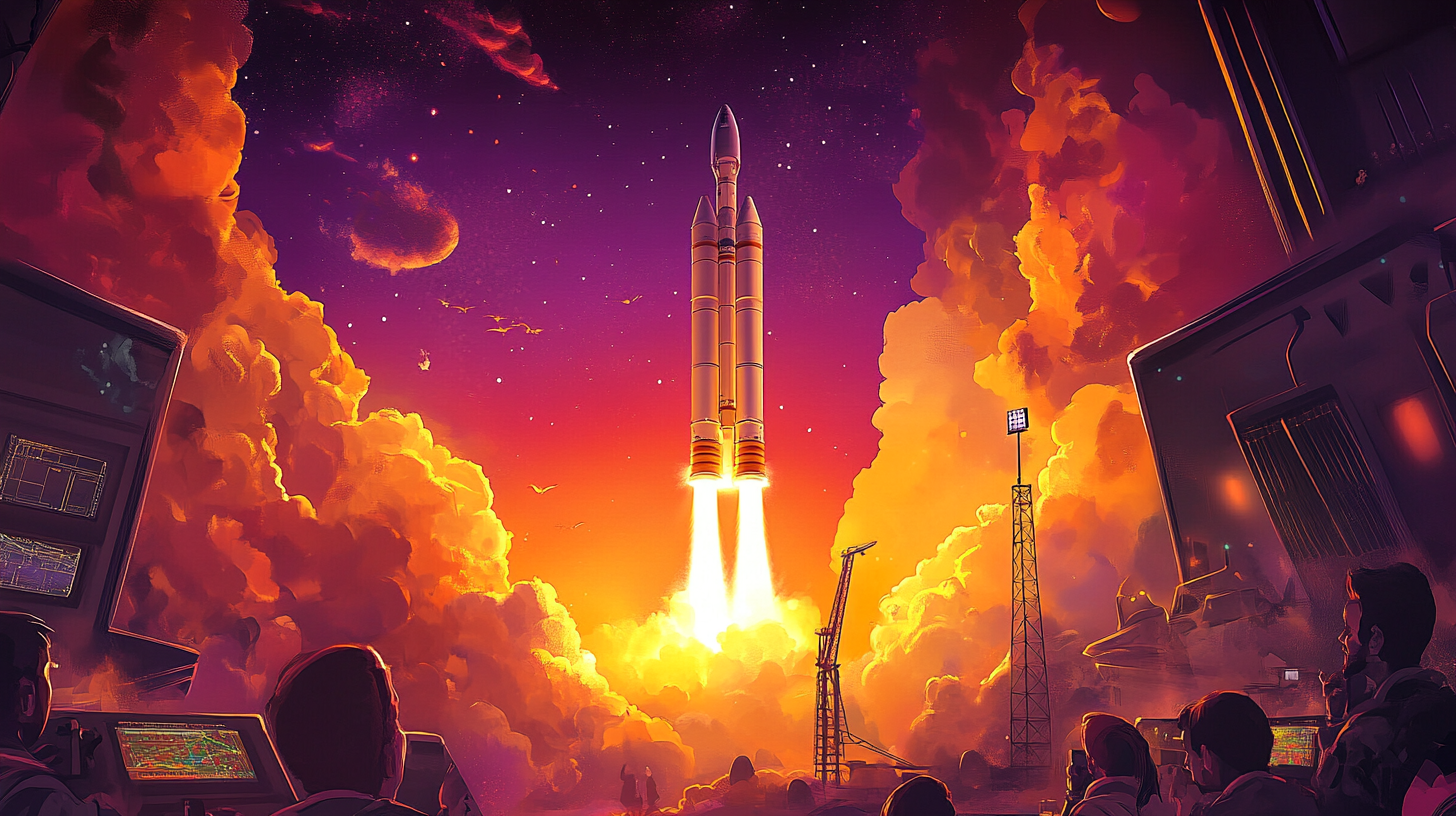
India conquers space: ISRO's ambitious plans – Where does India stand in international comparison to SpaceX, China and Russia? – Image: Xpert.Digital
India's space program: A rising power in space
India has established itself as a major force in space exploration in recent years. With a series of successful missions and ambitious plans for the future, the country is solidifying its position in the global space community. Join us on a journey through the fascinating world of Indian space exploration and discover its recent achievements, ambitious future plans, and the challenges India faces on its path to becoming a leading space nation.
The Indian Space Research Organisation (ISRO)
The Indian Space Research Organisation (ISRO) is India's national space agency. Its headquarters are located in Bengaluru. ISRO is responsible for the planning, execution, and monitoring of space missions, as well as the development of space technologies. It reports to the Department of Space (DoS), which is directly subordinate to the Indian Prime Minister. The Chairman of ISRO is also the Chief Executive of the DoS.
The history of ISRO dates back to 1962, when the Indian National Committee for Space Research (INCOSPAR) was founded. On August 15, 1969, INCOSPAR was replaced by ISRO, which was given a broader scope of responsibilities. In 1972, the Department of Space (DoS) was established, and ISRO was placed under its authority. This step institutionalized space research in India and laid the foundation for today's Indian space program.
Latest news from the Indian space program
India concluded 2024 with a series of remarkable space achievements. A highlight was the launch of the SpaDeX (Space Docking Experiment) mission on December 30th. With this mission, India took a significant step towards building its own space station and conducting more complex space missions. The SpaDeX satellites are the first to be built entirely by Indian industry under the leadership of ISRO. This underscores the growing contribution of the private sector to Indian space exploration.
Another milestone is the upcoming launch of ISRO's 100th rocket from the Satish Dhawan Space Centre in January 2025. This launch, using the Geosynchronous Satellite Launch Vehicle (GSLV), marks a significant achievement for the Indian space agency. Furthermore, ISRO conducted a total of 15 missions in 2024, strengthening private sector involvement.
Recent space missions and successes
India has conducted an impressive number of successful space missions in recent years. Among the most important are:
XPoSat
On January 1, 2024, ISRO launched the X-ray Polarimeter Satellite (XPoSat). This is India's first dedicated mission to study the X-ray polarization of celestial sources. With XPoSat, India positions itself as one of the few nations capable of conducting such advanced astronomical studies.
INSAT-3DS
In February 2024, the INSAT-3DS weather satellite was successfully launched on a GSLV-F14 rocket. INSAT-3DS enhances India's capabilities in environmental monitoring, ocean observation, and disaster relief. The satellite provides crucial data for weather forecasting, climate research, and disaster management.
Chandrayaan-3
On August 23, 2023, India successfully landed Chandrayaan-3 on the Moon. This mission was a historic moment for India and solidified its position as a leading spacefaring nation. Chandrayaan-3 provided valuable data on the composition of the lunar soil and the availability of water resources.
Aditya-L1
In September 2023, India launched its first solar mission, Aditya-L1. The probe reached the L1 Lagrange point on January 6, 2024, and has begun studying the solar atmosphere. Aditya-L1 will provide data on solar activity, the solar corona, and the solar wind, which are crucial for understanding space weather and its impact on Earth.
SpaDeX
The SpaDeX (Space Docking Experiment) mission, launched on December 30, 2024, is another important milestone for Indian space exploration. This mission deployed two small satellites into a circular orbit at an altitude of 475 km aboard a PSLV-C60 rocket. The mission's objective is to test autonomous docking technology in orbit. This technology is crucial for the construction of India's own space station and for conducting more complex space missions, such as returning lunar samples to Earth. The first docking attempt could take place as early as January 7, 2025.
Plans for future space missions
India has ambitious plans for future space missions. Key objectives include:
Gaganyaan
India's first manned space mission, Gaganyaan, is scheduled to launch in 2025. The goal is to send a three-person crew into a 400 km high orbit for three days. With Gaganyaan, India will join the exclusive group of nations capable of sending humans into space.
Chandrayaan-4
Another lunar mission, Chandrayaan-4, is planned for 2027-28. This mission will collect lunar samples and return them to Earth. Chandrayaan-4 will expand our knowledge of the Moon and its formation.
Venus Orbiter Mission
A mission to Venus is planned for March 2028. The probe will study Venus's atmosphere and provide new insights into this fascinating planet.
Lunar Polar Exploration Mission
In cooperation with the Japanese space agency JAXA, India is planning a mission to explore the Moon's south pole. This mission will advance the search for water ice and other resources in this region of the Moon.
Bharatiya Antariksha Station
India plans to build its own space station, which is scheduled for completion between 2028 and 2035. The space station will serve as a platform for scientific experiments and technological developments.
Roadmap for the future
Prime Minister Modi has instructed ISRO to develop a roadmap for building an Indian space station by 2035 and sending an Indian astronaut to the moon by 2040. These ambitious goals underscore India's long-term vision for space exploration.
Reusable Launch Vehicle Technology
India is working on developing reusable spacecraft. In April 2023, ISRO successfully tested a Reusable Launch Vehicle Autonomous Landing Mission (RLV LEX). This technology has the potential to reduce the cost of space launches and increase the frequency of missions.
Military Applications of Space Technology
India's Defence Space Agency (DSA) has submitted a request for a mobile launch system. This system should be capable of delivering payloads of approximately 0.71 tons into orbit. Mobile launch systems offer greater flexibility and resilience compared to stationary launch pads.
Space Biology Research
ISRO is collaborating with the Department of Biotechnology to explore biological applications in space. This collaboration aims to investigate the effects of the space environment on living organisms and to gain new insights for medicine and biotechnology.
Comparison with other spacefaring nations
Although India has made significant progress in space exploration in recent years, there are still differences compared to the US and China in terms of budget and experience. The US has a considerably larger budget and a longer history of space exploration. NASA has extensive experience in manned spaceflight missions and solar system exploration. India and the US cooperate in various areas, including planetary defense to protect Earth from asteroid impacts.
China has invested heavily in its space program in recent years and plans to expand and commercialize its space systems beyond its borders. India, on the other hand, is focusing on traditional space goals such as satellite launches and interplanetary missions. China plans to conduct around 100 space launches in 2025, while India plans 30 launches by March 2025. India is working on developing satellite internet, but there is no clear government plan yet to make it a critical infrastructure.
Russia has a long tradition in space exploration and was the first country to send a human into space. However, since the collapse of the Soviet Union, the Russian space program has faced financial and technical challenges.
India pursues a cost-effective approach to space exploration, focusing on developing technologies relevant to national development. The country has proven itself a reliable partner for international cooperation.
Economic and technological impacts
India's space program has had significant economic and technological impacts. Investments in space exploration have led to innovations in various fields, including telecommunications, weather forecasting, disaster management, and agriculture.
Over the past decade, India's space sector has contributed US$60 billion to GDP and created 4.7 million jobs. Every dollar invested in the space sector generates a multiplier effect of US$2.54 for the Indian economy. The space sector has contributed 20 trillion rupees to India's GDP over the same period and created 96,000 jobs in the public and private sectors. India is the world's eighth-largest space nation in terms of funding and is experiencing rapid growth in startups within the sector.
ISRO has also contributed to the development of indigenous technologies, such as the Indian Regional Navigation Satellite System (IRNSS) and the Polar Satellite Launch Vehicle (PSLV). These technologies strengthen India's independence and its position in international competition.
India's space program is in a dynamic phase of development
With a series of successful missions, ambitious plans for the future, and a focus on cost-effective solutions, India has established itself as a significant force in space exploration. ISRO plays a vital role in national development and contributes to technological advancements in various fields.
However, India also faces challenges. ISRO's budget is limited compared to the US and China. Cooperation with international partners and the private sector will be crucial to achieving India's ambitious goals. India must further develop its technological capabilities to remain competitive internationally.
Despite these challenges, the future prospects for India's space program are promising. The growing economy and the increasing importance of technology in India create a favorable environment for the further development of space exploration. India has the potential to play a leading role in the global space community and make a significant contribution to space exploration.
Our recommendation: 🌍 Limitless reach 🔗 Connected 🌐 Multilingual 💪 Sales power: 💡 Authentic with strategy 🚀 Innovation meets 🧠 Intuition


From local to global: SMEs conquer the world market with a clever strategy - Image: Xpert.Digital
In an era where a company's digital presence determines its success, the challenge lies in creating an authentic, personalized, and far-reaching presence. Xpert.Digital offers an innovative solution that positions itself as the intersection of an industry hub, a blog, and a brand ambassador. It combines the advantages of communication and sales channels in a single platform and enables publication in 18 different languages. Cooperation with partner portals and the ability to publish articles on Google News and a press distribution list with approximately 8,000 journalists and readers maximize the reach and visibility of the content. This represents a crucial factor in external sales and marketing (SMarketing).
More information here:
We are here for you - Consulting - Planning - Implementation - Project Management
☑️ SME support in strategy, consulting, planning and implementation
☑️ Creation or realignment of the digital strategy and digitization
☑️ Expansion and optimization of international sales processes
☑️ Global & Digital B2B trading platforms
☑️ Pioneer Business Development

Konrad Wolfenstein
I would be happy to serve as your personal advisor.
You can contact me by filling out the contact form below or simply call me on +49 7348 4088 965 .
I'm looking forward to our joint project.
Write to me


Xpert.Digital - Konrad Wolfenstein
Xpert.Digital is a hub for industry focusing on digitalization, mechanical engineering, logistics/intralogistics and photovoltaics.
With our 360° Business Development solution, we support renowned companies from new business to after-sales.
Market intelligence, smarketing, marketing automation, content development, PR, mail campaigns, personalized social media and lead nurturing are part of our digital tools.
You can find more information at: www.xpert.digital - www.xpert.solar - www.xpert.plus
Keep in touch