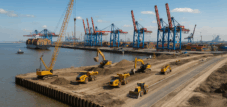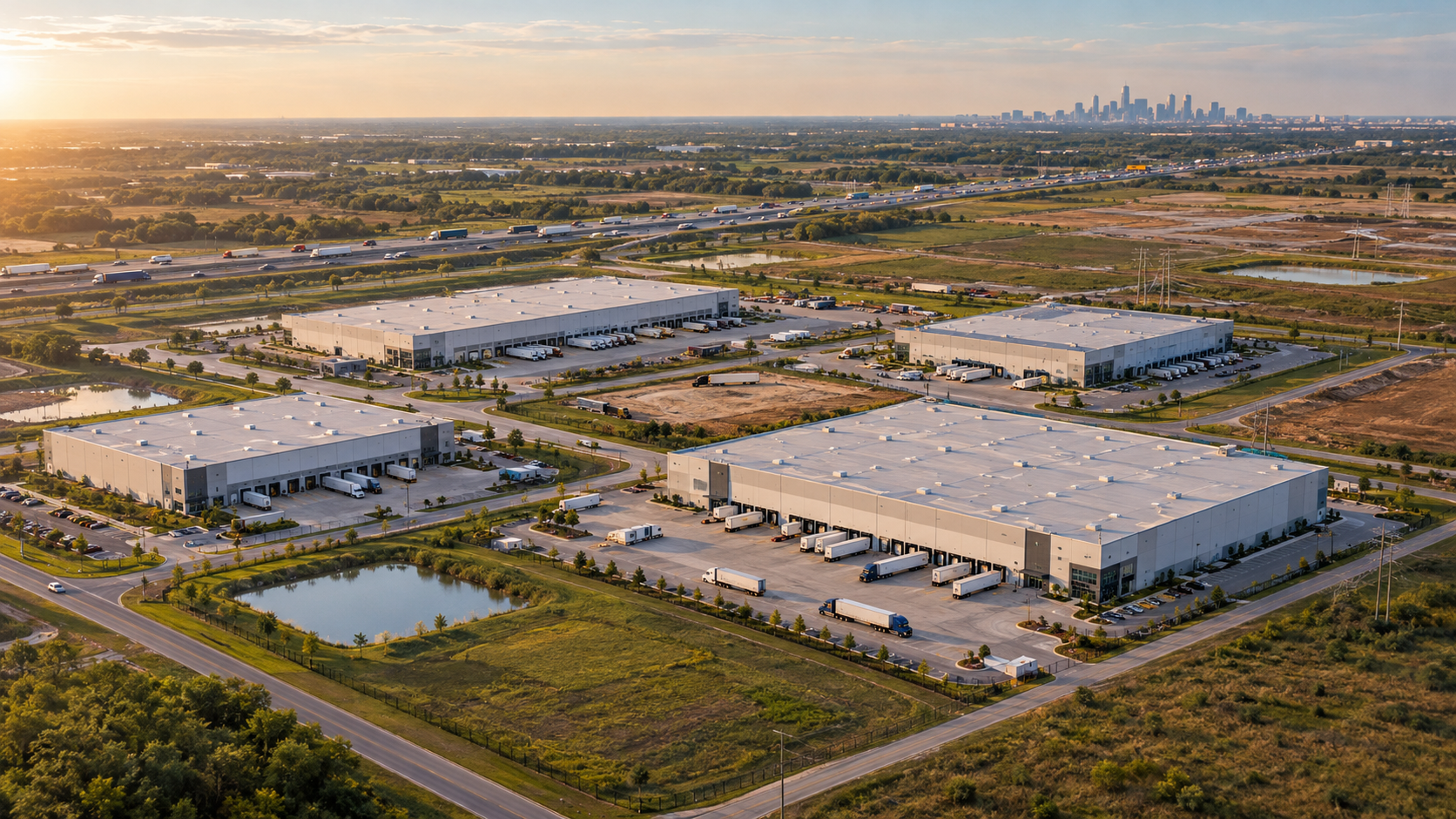
Brookshire, Texas: The economic impact of logistics projects – Waller County's new warehouse project – Creative image on the topic, with AI: Xpert.Digital
$63.6 million for logistics: A region on the path to industrial prosperity
Brookshire as a new logistics hub: Opportunities and challenges for Waller County
Investing in the future: How four warehouses can boost Waller County's economy
Waller County, west of Houston, is on the cusp of a significant economic transformation that could turn this predominantly rural area into an industrial hub. The planned investment in four warehouses with a total area of approximately 102,200 square meters and a total volume of $63.6 million underscores the potential of this development. However, behind these impressive figures lies far more than just a construction project. Economically, the project will impact the municipal tax base, the labor market, land use, transportation infrastructure, and Waller County's long-term competitiveness. The project also carries uncertainties, however, as neither specific construction timelines nor future tenants are known. The question of what actual economic benefits will result from this investment remains open. In this context, it becomes clear that large logistics properties should not simply be viewed as guaranteed sources of prosperity. Their success depends significantly on future tenants, their investments, and the resulting tax base. Waller County thus faces the challenge of actively shaping this structural transformation while simultaneously laying the foundation for sustainable economic development.
Waller County focuses on logistics: How four warehouses can change the regional economy
Waller County, west of Houston, exemplifies a development observed in many growth regions of the United States: Formerly rural areas are transforming within just a few years into industrial hubs, residential locations, and investment centers. A planned warehouse and logistics project near Brookshire illustrates the scale of this structural change. The plans call for four buildings with a combined usable area of approximately 1.1 million square feet (about 102,200 square meters). The total planned investment amounts to $63.6 million. This is not a single warehouse for an existing tenant, but rather a large real estate complex that could permanently establish the location on the industrial map of the greater Houston area.
Economically, this project is far more than just a construction project. It impacts the municipal tax base, the labor market, land use, transportation infrastructure, and Waller County's long-term competitiveness in attracting businesses. At the same time, the project involves considerable uncertainty. Neither a concrete start date for construction nor future tenants have been publicly named. Furthermore, the quality and number of jobs that will eventually be created cannot be reliably inferred from the sheer size of the building. This case therefore illustrates particularly clearly why large logistics properties should be viewed neither as an automatic engine of prosperity nor as a mere collection of warehouses. Their economic value depends on which tenants move in, the extent of their investments in machinery and equipment, the development of additional tax revenues, and the resulting public costs.
Four halls form a flexible industrial portfolio
The planned area is spread across buildings of very different sizes. A hall of 102,000 square feet, or approximately 9,500 square meters, is budgeted at $7.3 million. A second building, measuring 126,000 square feet, or about 11,700 square meters, is expected to cost around $8 million. The third building comprises 283,000 square feet, or roughly 26,300 square meters, and is estimated to cost $16.2 million. The largest building is planned to reach 589,000 square feet, or nearly 54,700 square meters, and will cost approximately $32.1 million. Together, these four buildings represent the announced investment of $63.6 million and a total area of approximately 102,200 square meters.
This staggered approach makes strategic sense. A unified complex comprising several size classes can appeal to different customer groups. The smaller halls are better suited for regional distributors, suppliers, light manufacturing, spare parts logistics, or specialized service providers. The medium-sized building is suitable for larger production and trading companies. The 589,000-square-foot hall, on the other hand, targets a national or international tenant with high throughput, extensive warehousing, or semi-automated processes. This mix allows a developer to reduce their dependence on a single tenant type. At the same time, the site can form a kind of internal ecosystem if several companies with complementary functions are located there.
The investment costs per square foot vary considerably. For the smallest building, $7.3 million equates to approximately $71.60 per square foot. For the second building, $8 million translates to about $63.50 per square foot. The third building costs around $57.20, and the largest approximately $54.50 per square foot. The overall project averages just under $57.80 per square foot. The decreasing unit costs with increasing building size illustrate typical economies of scale for large-scale logistics properties. Roof, building envelope, infrastructure, and standardized warehouse space can be distributed more efficiently in larger volumes. However, this does not automatically mean that the largest building is more economical. Higher space productivity requires sufficient occupancy; a large, empty building ties up significantly more capital than a smaller, more easily divisible warehouse.
Interstate 10 makes Brookshire the gateway to the interior
The decisive location advantage lies in its proximity to Interstate 10. This east-west axis connects the greater Houston area with key Texas markets and extends far beyond the state's borders. For logistics companies, it's not just the distance to the city center that matters, but above all, reliable access to highways, production facilities, sales markets, ports, and labor pools. Brookshire lies west of Houston and combines relatively available land with access to one of the largest economic and consumer regions in the United States. At the same time, other Texas centers can be served from there without every shipment having to first pass through the most densely populated parts of Houston.
This locational advantage explains why the area is increasingly transforming from a peripheral real estate market into an industrial corridor. Large logistics, consumer goods, energy, and industrial operations have already developed in Brookshire and the surrounding area. The region attracts both distribution centers and manufacturing companies. This is economically significant because modern industrial developments increasingly combine logistics and manufacturing. A building initially designed as a warehouse can later accommodate pre-assembly, packaging, quality control, repairs, spare parts supply, or light production. The prerequisites are sufficient power capacity, load-bearing floors, suitable building heights, fire protection, data connectivity, and operational processes that meet permit requirements.
Brookshire also benefits from the westward expansion of the Houston metropolitan area. Housing construction, population growth, and commercial development reinforce each other. New residents create demand for retail and services. Businesses find a growing pool of potential workers. Improved infrastructure, in turn, increases the attractiveness of other sites. This cycle can rapidly enhance a location's value. However, it also creates a significant need for coordination, as roads, drainage, public safety, schools, and utility systems do not automatically grow at the same pace as warehouse space and residential areas.
The Houston industrial market is providing both tailwinds and warning signals
The overall market offers generally favorable conditions. Houston boasts a very large and diversified stock of industrial real estate. Demand is driven not only by e-commerce, but also by energy, petrochemicals, mechanical engineering, consumer goods, food processing, construction, data centers, and technology-oriented manufacturing. This broader industrial base distinguishes Houston from markets more heavily reliant on a single industry or pure parcel delivery. Positive space absorption and large lease agreements demonstrate that companies continue to require significant capacity in the region.
At the same time, the project decision cannot be justified by a blanket reference to Houston's growth. The market has absorbed a large amount of new space in recent years, and the construction pipeline has remained high. Depending on the definition and data provider, vacancy rates have recently hovered roughly between six and seven percent, sometimes higher in the warehouse and distribution segment. Particularly in very large warehouses, the available space can be significantly above the market average. For a speculative building of several hundred thousand square feet, this means that leasing may take longer and tenants will have greater negotiating power.
Even seemingly contradictory market data is revealing. Some surveys show rising rents and robust demand, while others emphasize a normalization of absorption and increasing vacancy rates. Both can be true simultaneously. Nominal asking rents can rise as landlords offer concessions such as rent-free months, fit-out subsidies, or flexible lease terms. Likewise, the overall market can grow positively even though certain size classes or submarkets have an oversupply. Therefore, for the Waller County project, it is not crucial whether Houston is generally considered a strong industrial market. What matters is whether the specific location, warehouse configuration, and technical features offer a discernible advantage over competing new builds.
The tax base is the actual municipal business model
From the county's perspective, the most significant immediate benefit lies in expanding the business tax base. Waller County is growing rapidly. The population increased from just under 56,800 in 2020 to more than 65,000 in 2024 and was approaching 70,000 by 2025. This growth increases the demand for roads, police, emergency services, government, schools, and technical infrastructure. If a large portion of the new revenue continues to come from residential real estate, private owners will face greater pressure. Commercial and industrial investments can spread the burden more broadly.
The scale of the project illustrates both its potential and its limitations. The total market value of real estate in Waller County in 2025 was approximately $24.4 billion, with a net taxable value after exemptions and special provisions of about $13.85 billion. A construction volume of $63.6 million would therefore represent only about 0.26 percent of the total market value and about 0.46 percent of the net taxable value, assuming the entire investment were treated as additional taxable value. This is substantial for a single project, but not large enough to fundamentally alter the county's finances on its own.
More important is the cumulative effect. Several large industrial developments can create a new revenue stream for years to come. In 2025, single-family homes in the county had a market value of approximately $7.3 billion, while commercial properties were valued at about $2.45 billion and industrial properties at around $1.08 billion. The industrial sector thus still possesses considerable growth potential. Each new facility broadens the base on which the county generates its revenue. This can mitigate future residential property tax increases, but it doesn't guarantee lower tax bills. In a rapidly growing county, public spending can increase faster than the additional commercial revenue.
Tax breaks are an investment with a repayment risk
Temporary property tax breaks are a common location policy tool in Texas. These breaks do not necessarily exempt the entire property value from taxation. Often, the relief applies only to a portion of the newly created value, while land, existing assets, or certain movable property remain taxable. After the agreed-upon period expires, the full taxable value generally becomes relevant. The economic concept resembles a municipal investment: the municipality forgoes a portion of potential revenue in the first few years to attract investment that, without the incentive, might otherwise be made elsewhere.
Whether this logic holds water depends on the additionality. If the developer would have built in Brookshire even without the tax break, a windfall effect occurs. The council then forgoes revenue without having actually triggered any additional behavior. However, if several nearly equivalent locations are competing and the tax break tips the scales in favor of Waller County, the incentive can be economically justified. A sound assessment must therefore compare the present value of the forgone tax revenue with the present value of the future additional revenue and the resulting public costs.
Risk distribution is particularly important for speculative warehouse investments. A building initially creates real estate value, but not yet a full-fledged contribution to business value. Only the tenant brings employment, inventory, machinery, IT systems, and ongoing economic activity. If warehouses remain vacant for extended periods, the municipality may receive property taxes on the land and non-eligible parts of the building, but the anticipated employment and consumption effects are delayed. Therefore, performance-based conditions are advisable, such as minimum investment requirements, completion deadlines, reporting obligations, recovery mechanisms, and, where applicable, requirements for taxable inventory or employment. The central question is not whether tax breaks are inherently good or bad, but whether public concessions are measurably linked to private performance.
Your intralogistics experts

Consulting, planning and implementation of complete solutions for high-bay warehouses and automated storage systems - Image: Xpert.Digital
More information here:
Strategies for minimizing vacancy pressure
Machinery and inventory determine the fiscal added value
A frequently underestimated factor is the composition of the eventual tax value. The four buildings merely constitute the physical shell. Depending on the user, additional equipment such as conveyor systems, racking systems, refrigeration units, robotics, packaging lines, battery systems, charging infrastructure, servers, security technology, and other operating resources may be added. For a simple transshipment warehouse, this added value remains limited. However, for automated distribution or light manufacturing, it can represent a significant portion of the total investment. Therefore, for Waller County, a capital-intensive user is often more fiscally attractive than a company that merely occupies a large area.
Inventory can also be relevant for tax purposes, albeit with important limitations. Texas offers exemptions for certain goods that leave the state within a specified period. Such freeport regulations increase the competitiveness of distribution centers but may reduce the directly taxable value of inventory. The fiscal impact of a logistics center therefore depends on the flow of goods, ownership structures, the length of stay, and the decisions of the respective tax authorities. The expectation of high revenues from stored goods should not be automatically included in a profitability analysis.
This leads to a clear priority for location policy. Long-term returns are determined not by the maximum warehouse space, but by the quality of the user. A modern manufacturing plant with technical equipment, skilled jobs, and local supplier relationships can generate greater regional impact on a smaller footprint than a largely automated large warehouse. The planned portfolio with four building sizes offers the fundamental opportunity to attract diverse users. However, economic success will depend on whether this results in a productive mix of industries or merely additional storage capacity.
Jobs are not created proportionally to the hall area
Large warehouses are often equated with a high number of new jobs in public discourse. This conclusion is not reliable. The employment intensity of modern logistics varies considerably. A highly automated distribution center can handle enormous volumes of goods with relatively few employees. An e-commerce fulfillment center with order picking, returns processing, and multi-shift operation requires significantly more personnel. A production facility or food processing plant can create additional technical, commercial, and quality assurance functions. Therefore, without knowing the tenants, the employment impact cannot be reliably quantified.
The initial, temporary employment effects will be felt in construction, planning, transportation, installation, and skilled trades. A portion of the $63.6 million will flow into local or regional businesses, wages, and services. However, not the entire investment will remain within the county. Specialized materials, technical components, financing, and development services may originate from outside the county. Ultimately, the businesses that will operate in the area will be crucial for long-term value creation. They will pay wages, procure services, award maintenance contracts, and stimulate consumer spending.
The quality of jobs is just as important as their number. Waller County should pay particular attention to competitive wages, training opportunities, career advancement pathways, and job security. Entry-level jobs can be important for many households, but they are insufficient to offset rising housing, transportation, and living costs. Technical maintenance, automation control, inventory planning, data analysis, workplace safety, and production management offer higher productivity and often better incomes. A successful industrial policy therefore combines land development with continuing education, vocational schools, universities, and targeted skills training.
Growth incurs costs before it generates revenue
The fiscal analysis cannot end at the property line. Four large warehouses generate truck traffic, commuter movement, and additional demands on roads, intersections, drainage, fire departments, and emergency services. Heavy goods traffic, in particular, accelerates the wear and tear of local access roads. If these costs are borne primarily by the public sector, a nominally attractive increase in tax revenue can be partially offset. The economic balance is only positive if infrastructure costs, operational risks, and future revenues are considered together.
In a rapidly growing region, the problem of timing differences becomes more acute. Roads, water lines, or operational capacities often need to be expanded before a property is fully leased and can realize its maximum tax impact. The county therefore needs liquidity and planning certainty. Developer contributions, infrastructure agreements, or clearly allocated development costs can prevent existing residents from financing a disproportionately large share of the upfront costs. At the same time, requirements must not be so stringent that economically viable projects become unattractive compared to competing locations.
Environmental and land-use considerations also come into play. Large warehouses seal off significant areas and alter water runoff, the landscape, and local traffic patterns. In the Texas climate, heavy rainfall, heat, and high cooling requirements are relevant planning factors. Retention basins, robust drainage systems, heat-reducing roofs, solar energy, battery storage, and electric forklifts can mitigate environmental impacts and lower operating costs. Such measures are not merely about image; they increase a property's resilience and long-term leasability.
Speculative construction accelerates development but increases vacancy pressure
A project without pre-selected tenants follows the logic of speculative industrial construction. Companies that urgently need new capacity can rarely wait several years for planning, permits, and the construction of a custom-built building. Ready-to-occupy spaces are therefore a significant locational advantage. They shorten development times and allow a region to respond to specific demand. Especially for large corporate projects, the availability of a suitable building can be the deciding factor.
The downside is market risk. If several developers simultaneously target the same demand, an oversupply can occur. Particularly large buildings cannot be arbitrarily subdivided and require tenants with corresponding creditworthiness and a need for sufficient space. Rising financing costs further increase the pressure to lease quickly. Possible consequences include rent concessions, delayed construction phases, or the sale of the project. For the municipality, this means that announced investment sums do not automatically translate immediately and fully into productive economic activity.
The four-part structure somewhat mitigates this risk because not all spaces require the same type of tenant. Nevertheless, more than half of the total area and investment is concentrated in the largest building. This is precisely where the main leasing risk lies. Phased development could limit capital commitment but would diminish the advantage of an immediately available large-scale location. The optimal strategy depends on pre-leasing, financing, regional demand, and the building's technical adaptability.
The biggest opportunity lies between storage and production
The most economically attractive development path for Waller County is not to simply accumulate as many warehouses as possible. In the long term, the region should attract businesses that combine logistics with manufacturing, energy, maintenance, and technology. The area already has connections in battery and energy systems, consumer goods distribution, wind energy logistics, pump and water technology, and other industrial sectors. These connections can foster supplier relationships and specialized service clusters.
A cluster reduces costs because companies can access shared labor, service providers, transport companies, and technical expertise. Spare parts, packaging, maintenance, and industrial services no longer need to be sourced from distant regions. At the same time, location loyalty increases because a company utilizes not just a single warehouse, but a functioning network. These agglomeration effects are the real driving force behind successful industrial policy. A single warehouse can relocate; a company with skilled employees, suppliers, and integrated production processes is significantly more deeply rooted.
The project can serve as a platform for this development path. The smaller buildings could house suppliers or specialized businesses, while the large hall could accommodate an anchor tenant. However, such a constellation doesn't happen automatically. It requires proactive industry outreach, suitable infrastructure, and clear positioning. If every available space is allocated to the first available tenant without strategic selection, the location will remain an interchangeable real estate market. On the other hand, if tenants are evaluated based on investment quality, wage levels, technical expertise, and regional ties, the industrial park can evolve into a thriving industrial ecosystem.
The housing market only benefits from balanced growth
A broader business tax base can ease the pressure on homeowners, but the relationship is indirect. Increased business value initially raises the tax potential. Whether households actually benefit depends on tax rates, household spending, valuation changes, and the distribution of tax revenue across different jurisdictions. In a rapidly growing county, costs for schools, roads, and security often rise simultaneously. Furthermore, higher land values and demand for housing can drive up property prices.
New jobs in Brookshire can shorten commutes if employees live nearby. This reduces wasted time and increases local consumer spending. However, if predominantly low-paying jobs are created while housing costs rise, commuting from more distant communities will increase. This also generates infrastructure costs and weakens the local multiplier effect. Therefore, industrial and housing development must be considered together, both spatially and socially.
For municipal finance policy, it would be misleading to portray the project as a guarantee against future tax increases. A more cautious statement is realistic: Additional commercial value can curb the increase in the burden on residential properties, provided that the new revenues exceed the project-related costs and expenditures are managed responsibly. This condition is crucial. Growth creates fiscal leeway, but not automatic budget relief.
Transparency determines public acceptance
Large development projects are more readily accepted when their benefits, costs, and conditions are transparent. Tax breaks should clearly state which asset is being favored, the duration of the benefit, which investments are binding commitments, and the consequences of non-compliance. Equally important is regular reporting on completion, leasing, actual tax value, job creation, and infrastructure impact. Without such information, public perception remains shaped by expectations and vested interests.
A transparent analysis must also allow for uncertainty. As long as tenants, the start of construction, and operational equipment are not yet determined, statements regarding employment and tax revenue are scenarios, not facts. A conservative calculation should consider a longer lease term, potential tax exemptions on inventory, additional road costs, and different types of users. The value of such a calculation lies not in a seemingly precise forecast, but in making the most important conditions for success or failure visible.
The comparison with a situation without a project is particularly relevant. While undeveloped land generates less traffic, it also yields lower tax revenues and creates few jobs. A purely static analysis that focuses solely on lost tax revenue during a period of subsidies is therefore insufficient. Conversely, the alternative scenario should not be artificially portrayed as complete economic stagnation. If Brookshire is experiencing strong growth anyway, other projects could emerge. The council's negotiating power depends on the actual scarcity of suitable land, infrastructure, and permitting opportunities.
Success can be measured by a few hard metrics
In the first few years, economic success should be assessed using clear indicators. These include the completed building value, the leased area, the time to occupancy, additional investments by tenants, the taxable value of machinery and inventory, the number and quality of jobs, and the actual public infrastructure costs. Also relevant are truck traffic, accident rates, road maintenance, water and energy consumption, and the use of local suppliers.
A high occupancy rate alone is not enough. A fully occupied complex can be a fiscal disappointment if the tenants contribute little taxable capital, pay low wages, or incur high public costs. Conversely, phased leasing with capital-intensive and productive businesses can be more valuable in the long run. The assessment should therefore be based on net effects, not gross figures such as floor space or announced investment volume.
The time factor is also important. Construction investments have a short-term impact, while property taxes and employment have an effect over many years. A sound analysis considers a period of at least ten to twenty years and discounts future revenues and expenditures. Only then does it become clear whether an initial tax waiver will actually be recouped. A positive nominal balance in the distant future is insufficient if the municipality has to bear high, debt-financed infrastructure costs in the first few years.
Waller County needs growth with industrial depth
The planned $63.6 million project is fundamentally sound from an economic perspective. Its location on Interstate 10, strong population growth, and the industrial dynamism of the western Houston corridor create real demand advantages. The four buildings of varying sizes improve leasing prospects compared to a single, monolithic structure. At the same time, the investment can broaden the tax base, which is currently heavily reliant on residential real estate, and strengthen Waller County as a location for logistics, manufacturing, and energy-related industries.
However, the advantages are not guaranteed. Unknown tenants, a large speculative area, competing new buildings, and potential tax exemptions limit predictability. The number of jobs may be significantly lower than the impressive total area would suggest. Additional road, security, and drainage costs can eat up some of the tax gains. Tax breaks are therefore only convincing if they are time-limited, performance-based, transparent, and include clawback provisions.
The clear economic policy perspective is this: Waller County should not evaluate the project based on the amount of concrete used, but rather on the productive activity taking place within the facilities. Key factors are capital-intensive users, skilled employment, local integration, and a positive net fiscal contribution. If this approach is successful, the complex can become another building block in a high-performing industrial corridor and actually reduce pressure on the housing-related tax base. Conversely, if it remains a large-scale, low-value-added storage facility with significant infrastructure impacts, the project, while visible, would be less economically significant than its scale would suggest.
Brookshire and Waller County are thus faced with a typical decision for rapidly growing regions. They can either measure development purely quantitatively and approve as many square meters as possible, or they can leverage their increasing attractiveness to impose higher standards on investment quality, employment, and infrastructure contributions. The second path is more demanding but more sustainable in the long run. Not every warehouse represents progress, but a well-integrated industrial and logistics site can.
Your global marketing and business development partner
☑️ Our business language is English or German
☑️ NEW: Correspondence in your native language!

Konrad Wolfenstein
I and my team are happy to be available to you as your personal advisor.
You can contact me by filling out the contact form here wolfenstein@xpert.digital:or simply call me at +49 7348 4088 965. My email address is
I'm looking forward to our joint project.