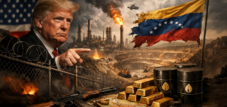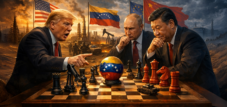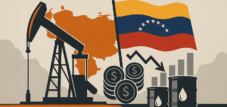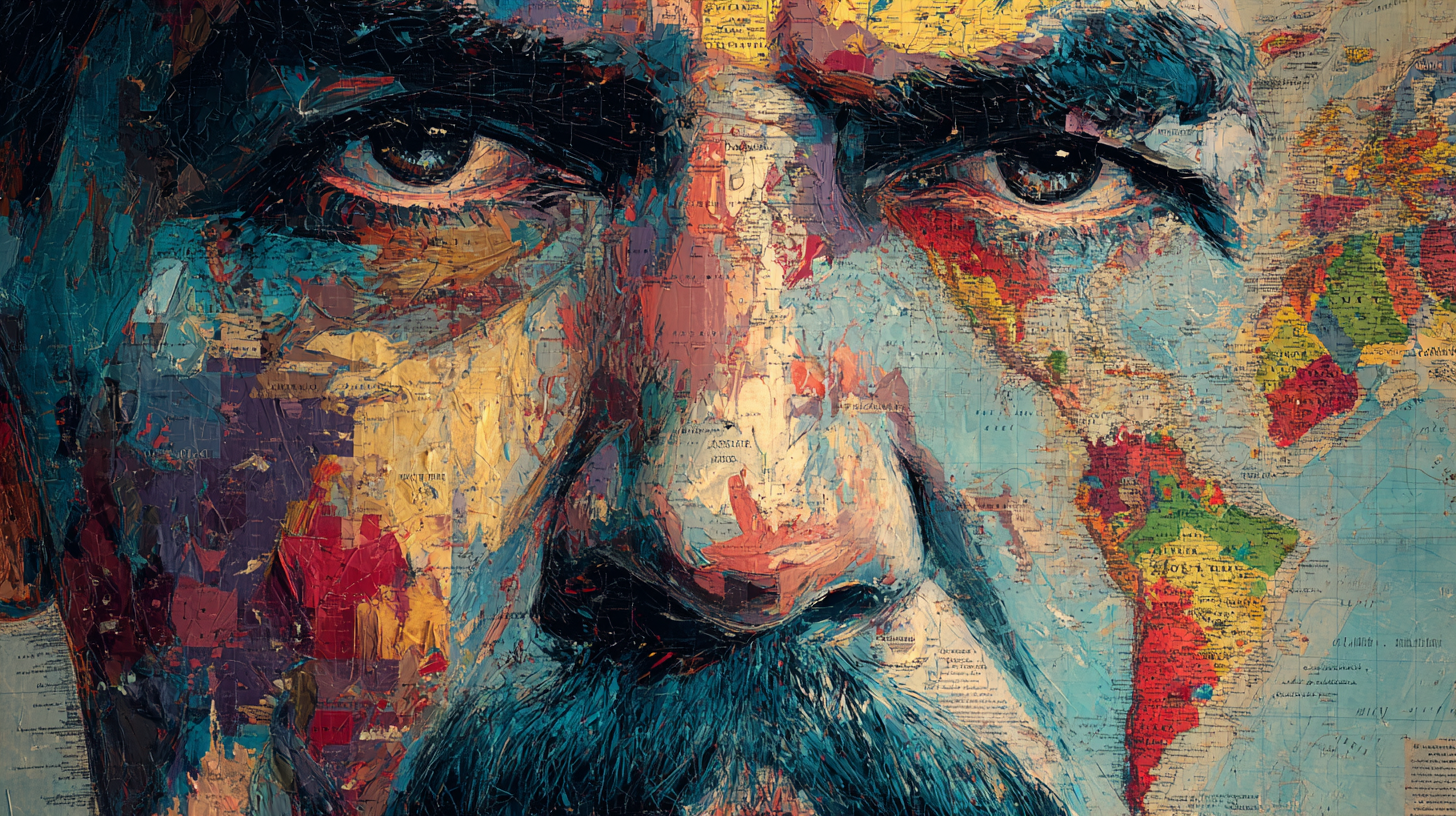
Power, oil, and the hypocrisy of the world order – Image: Xpert.Digital
How the ouster of Nicolás Maduro reveals the true driving forces of geopolitics
The collapse of a rentier economy
Those who think only in terms of good and evil do not understand world politics – those who only moralize replace thinking with attitude
Venezuela presents one of the most fascinating and tragic case studies of economic mismanagement in modern history. The country, considered the wealthiest in Latin America until the early 2010s, has slid into near-total economic collapse in less than a decade and a half. This development was not solely the result of external forces, but rather the product of a fundamental design flaw in the Venezuelan economic system under Hugo Chávez and his successor, Nicolás Maduro.
The Venezuelan economy had historically become entirely dependent on oil exports. With the collapse of the oil price from over $100 per barrel in 2011 to below $30 at times in the mid-2010s, the entire state's business model collapsed. GDP has since plummeted by over 70 percent. However, this was not simply a consequence of external shocks, but rather the result of systemic incompetence and mismanagement by a centrally planned economy.
The fundamental problem was that during the oil price boom years of the 2000s, the Chávez government failed to invest in infrastructure or economic diversification, instead squandering profits on short-term social promises and cronyism. The state-owned oil company PDVSA was not modernized, but politicized. Skilled workers were driven out, maintenance was neglected, and the production capacity of the oil fields steadily declined. While Venezuela once produced over three million barrels a day, today it barely produces one million.
At the same time, nationalizations were carried out without any economic plan. The government took over private companies, expropriated agricultural land, and centralized control over most means of production. This did not lead to a fairer distribution of wealth, but rather to corruption, inefficiency, and economic stagnation. The planned mismanagement, coupled with price fixing and artificial exchange rates, resulted in massive market distortions.
When oil revenues finally collapsed, the state lacked flexible institutions, reserves, and a productive base to manage the crisis. Inflation exploded. The inflation rate was around 800 percent in 2016, over 2,000 percent in 2017, and 80,000 percent in 2018. Estimates for 2019, according to official Venezuelan sources, ranged between 7,374 and 9,585 percent, while the International Monetary Fund put the figure at 200,000 percent. This is not just a statistical problem—it means concrete hell for the population.
With inflation like this, money loses its value daily. A minimum wage that buys something at the beginning of the month is practically worthless by the end. In November 2017, due to rising prices, food was being sold in tiny portions of less than 200 grams. Four tablespoons of sugar cost 4,000 bolivars, equivalent to two-thirds of the daily minimum wage. People started eating their pets, then animals from zoos. This is not a metaphor—this is the documented reality of people starving in one of the world's most resource-rich countries.
The healthcare system collapsed. Hospitals had no medicine, no equipment, no electricity. Doctors left the country in droves. Infant mortality rose dramatically. The education system broke down. Schools had no electricity or heating; teachers left the profession because their salaries weren't enough to buy food.
The poverty rate, which had fallen under Chávez in the 2000s thanks to oil financing alone, has skyrocketed again and now exceeds 80 percent of the population. Around 53 percent live in extreme poverty and cannot even afford a basic basket of goods. This is not economic regression – this is civilizational collapse.
A rentier economy is an economic system in which a significant portion of wealth is not generated through productive labor or value creation, but rather through the extraction of "rents"—that is, income derived from scarcity, monopolies, or external payments (e.g., commodity rents, transit fees, aid payments). Typically, actors (often the state) can generate high revenues without broadly developing their own economy, frequently leading to political stagnation, low innovation, and dependence on these rents.
Related to this:

The geopolitical dimension: raw materials, power, and strategic interests
It would be naive to believe that the US overthrew Maduro solely out of humanitarian concern. But it would be equally naive to claim that only economic interests were at play. The reality is more complex and less morally charged than both extreme positions suggest.
Venezuela possesses the world's largest known oil reserves—an estimated 303 billion barrels, more than Saudi Arabia, Iran, and Russia. In addition, it has massive gold deposits (estimated at around 8,000 tons in the Orinoco mining belt), diamonds, nickel, coltan, and other critical minerals. For a country that needs energy security and wants to reduce its technological dependencies, such resources are strategically valuable.
But the oil issue is often oversimplified. American oil companies like Chevron could easily source cheaper oil from the Gulf or even Guyana (which is also under US control). The real reason lies deeper: it's about controlling spheres of influence, about preventing another major power – especially China – from controlling the resources.
China had become the main buyer of Venezuelan oil. Approximately 70 percent of Venezuelan oil exports went to Beijing. Furthermore, China had made massive investments and extended loans totaling 60 to 70 billion dollars. This made Venezuela an implicit client of China—or at least a state with strong ties to a power that Washington considers an existential threat.
Russia played a supporting role. Moscow supplied weapons, equipment, and diplomatic cover. The coordination between Russia and Venezuela, which culminated in a strategic partnership in October 2025, signaled that Venezuela was not merely an oil-rich state, but part of a counter-alliance against Western dominance.
Trump has stated this more clearly and directly than his predecessors. He has not tried to hide it behind humanitarian rhetoric. His statements, such as "They took our oil and we want it back," were an explicit reference to Chávez's nationalization of ExxonMobil facilities in 2007. Trump speaks in terms of ownership and control—revitalizing the Monroe Doctrine, which 200 years ago declared the Western Hemisphere to be an American sphere of influence.
The Monroe Doctrine 2.0, as Trump's national security advisors called it, is an explicit return to a policy of spheres of influence. It means that the US considers Latin America its legitimate territory, where no other major powers are allowed to exert dominant influence. This is not new—it has been the foundation of US foreign policy for two centuries. But under Trump, it is being enforced more blatantly.
Related to this:

The grey area of international law and Western hypocrisy
This is where things get uncomfortable for the Western order. The US military intervention in Venezuela clearly violates fundamental norms of international law. The abduction of a foreign head of state without a UN mandate is a breach of the UN Charter. Article 2, paragraph 4 of the Charter prohibits the threat or use of force against the territorial integrity or political independence of another state.
There are only two legally recognized exceptions: authorization by the UN Security Council or a right to self-defense against an armed attack. Neither of these exceptions applies to Venezuela. There was no armed attack on the US by Venezuela, and China and Russia would have blocked such a resolution in the Security Council.
Numerous international lawyers and international organizations have deemed the deployment illegal. UN Secretary-General Guterres warned that a lasting political solution cannot be imposed from the outside. Germany, under its new Chancellor Merz, speaks of "concern" and calls for an "orderly transition in accordance with international law"—a diplomatic understatement for "This was a violation of international law, but we don't want to protest too loudly.".
And this is precisely the central problem with Western credibility. The West – particularly Germany, the EU, France, and Great Britain – has insisted for years on a “rules-based international order.” They have consistently used this term to criticize Russia’s invasion of Ukraine, China’s threats against Taiwan, and other violations. This is morally correct. Russia should not invade Ukraine.
But when the West remains silent or even tacitly signals support for an American military intervention against an undemocratic state that is not directly attacking the US, it reveals a blatant double standard. This hypocrisy is not only analytically untenable—it is also strategically foolish because it further alienates precisely those countries of the Global South that the Western order needs.
Brazilian scholar Giorgio Romano Schutte aptly summarized this: The Global South sees the same Western countries that bombed Belgrade, intervened in Libya without a UN mandate, destabilized Afghanistan for decades, and are now attacking Venezuela. And these same countries preach morality and adherence to international law to the Global South. It is no wonder that Brazil, Mexico, India, and other major states refuse to support US sanctions against Russia. They see this as a selective application of the rules in favor of the major powers that can afford to ignore them.
Germany and the EU can no longer be credible by only defending Ukraine and ignoring Venezuela. Either international law applies to everyone, or it is an instrument of power, not genuine law.
Our South America and Latin America expertise in business development, sales and marketing
Our Latin America expertise in business development, sales and marketing - Image: Xpert.Digital
Industry focus areas: B2B, digitalization (from AI to XR), mechanical engineering, logistics, renewable energies and industry
More information here:
A thematic hub offering insights and expertise:
- Knowledge platform covering global and regional economies, innovation and industry-specific trends
- A collection of analyses, insights, and background information from our key areas of focus
- A place for expertise and information on current developments in business and technology
- A hub for companies seeking information on markets, digitalization, and industry innovations
Maduro's downfall exposes Europe's double standards: The bitter truth behind the crisis
The reality of humanitarian necessity in a dirty world
But there is another, uncomfortable truth that many don't want to speak: Venezuela under Maduro was a humanitarian catastrophe. The facts are undisputed. Over seven million people – roughly 30 percent of the population – have left Venezuela. This is the world's second-largest external migration crisis after the exodus from Syria.
Approximately 2,000 people flee Venezuela every day because of unbearable hunger, because criminals, gangs, and the military control the cities, and because the infrastructure has collapsed. The United Nations calculated that by 2025, around 7.9 million Venezuelans will be in need of humanitarian aid – 4.2 million of them children. Fifteen percent of the total population urgently requires food assistance.
Maduro is responsible for tens of thousands of deaths – from hunger, lack of medicine, and violence perpetrated by state security forces and militias. Under his regime, there have been extrajudicial killings, systematic torture, suppression of opposition parties, election manipulation, media control, and systemic corruption. The 2024 election was rigged – this has been documented by independent election observers.
If ever there was a case where a regime completely forfeited its legitimacy, it is Venezuela under Maduro. The question is not whether Maduro should go – he should have gone years ago, through elections or a change of power. The question is: How and under what conditions?
A humanitarian intervention could have taken place under strict international legal standards – with a UN mandate, with international participation, with a follow-up strategy, and with clear commitments to the restoration of democratic institutions. This did not happen. Instead, it was a military operation by a superpower pursuing its own interests.
This doesn't necessarily mean the outcome will be bad for Venezuela. It's possible that, despite a process that violates international law, a better situation will emerge. History is full of such paradoxes. A forced regime change without a legal basis can still lead to better results for the population than the continuation of a barbaric regime.
Related to this:
Europe's paralysis and Germany's irrelevance
What is the European response? Unease. Caution. Concern. Calls for an "orderly transition" and respect for international law, while at the same time not daring to criticize the US directly.
France's Macron even tried to have the best of both worlds: He quietly criticizes the method but welcomes the result—that Maduro is gone—and speaks of the Venezuelan people being "liberated from dictatorship." This is morally and analytically weak. An intervention is either illegal, or it isn't. You can't say it's good just because you like the outcome.
Germany under Merz occupies the classic position of European weakness: it condemns the actions in general terms without specifying what concrete consequences this should have. It warns of "instability"—as if an oil-rich state, supported by China and Russia, which keeps 80 percent of its population in poverty, weren't already completely unstable. This is self-deception.
The German government likes to boast about its values and its support for a "rules-based order." But the rules-based order is written by the US, wherever the US has an interest: in Asia with China, in Europe with Russia, in Latin America with Venezuela. Germany cannot truly oppose this game—it is too dependent on the American security guarantee and the dollar system.
This does not mean that Germany is acting maliciously. It means that Germany is structurally weak. Europe as a whole is structurally weak. China and Russia can carry out such operations because they are states willing to accept economic costs for geopolitical goals. The West—including America—can carry them out because it has the power and can shift the consequences onto others. Europe cannot do that.
This doesn't hurt anyone – it's simply a realistic assessment. European foreign policy is trapped in a paralysis between moral aspirations and strategic impotence.
The new multipolar world order and the limits of power
What the Trump operation in Venezuela truly demonstrates is the realignment of global power. The era of unilateral action by the US is not over – but the costs have increased. The fact that Trump had to conduct a military operation with special forces to kidnap Maduro, rather than simply orchestrating a CIA-backed coup as in the Cold War era, shows that Venezuela's local power – supported by China and Russia – is greater than before.
China had provided Venezuela with massive financial and technological support. Russia supplied weapons and diplomatic assistance. This helped Maduro survive Trump sanctions for years. Maduro's calls to Chinese officials just hours before his arrest show that he tried to mobilize external support until the very end.
But China and Russia ultimately could not intervene without directly clashing with the US – a risk they were unwilling to take. Beijing and Moscow will offer Venezuela verbal support, but no military assistance. That's realpolitik: you support an ally as long as it doesn't pose an existential threat to yourself.
For China, this change of power represents a clear loss. The hope was that Venezuela could be a long-term supplier of raw materials and an ally in the fight against American dominance. That is now questionable. China will have less influence under a more US-friendly, or at least less dependent, government.
At the same time, there could be a lesson for China in this: financial and economic dependence alone does not protect you from a change of power if the major power that supports you is militarily weaker. This is a warning against overextension in regions where another major power has the military capacity to enforce its interests.
Related to this:
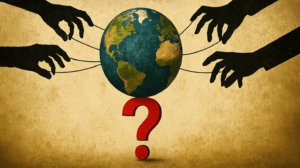
The broader context: European self-dissolution
But now to the part that really hurts – and that few want to talk about. While Europe feels morally superior to Trump and the US intervention in Venezuela, the real cultural and institutional disintegration of Europe is taking place right on its own doorstep.
Germany paid billions for a public broadcasting system that systematically erodes national culture, deconstructs national history, delegitimizes national interests, and pathologizes national identity. This is nothing like Trump—it's worse because it's subtle and shrouded in an aura of morality.
The rise of far-right parties across Europe—AfD in Germany, RN in France, FPÖ in Austria, Meloni in Italy—is a direct reaction to a perceived cultural elite takeover. The attempt to feel morally superior to Trump in America while simultaneously systematically undermining the legitimacy of one's own institutions at home is the height of hypocrisy.
This is not an argument against migration or multiculturalism. It is an argument that institutions that systematically delegitimize their own foundations lose control over their legitimacy. If public broadcasters, universities, and the media systematically give the impression that national culture, national history, and national interests are inherently evil, it is no wonder that the population yearns for leaders who do not say so.
This is a simple management problem, not a moral one. If you want to govern a community, you must credibly believe that the continued existence of that community is valuable. If, instead, you feel beholden to some external, global progressive agenda, you lose control of the domestic narrative.
Sobriety instead of holiness
Multiple truths can be valid simultaneously. Trump is acting out of geopolitical interests – controlling resources, containing Chinese influence, and enforcing the Monroe Doctrine. This isn't about piety; it's realpolitik. We shouldn't moralize about it.
Related to this:
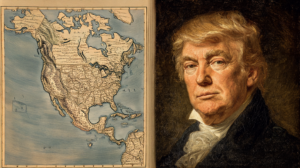
At the same time, Maduro was a dictator who led his country to economic and humanitarian collapse. Millions fled. People starved. The healthcare system collapsed. This is documented reality, not propaganda.
The US military intervention was illegal under international law – there was no UN mandate, no international coalition, no legitimate legal grounds. That is also true.
The Western reaction was hypocritical – criticizing Russia over Ukraine while remaining diplomatically cowardly regarding Venezuela. That's also true.
The central analytical problem of the West is that it tries to argue morally while acting in the name of power politics. This is impossible. One must choose: either international law, which applies to everyone, or power politics, in which the strong take what they need. One cannot claim that both are true at the same time.
For Germany and Europe, this means: stop lecturing states that pursue their own interests. Instead, Europe should define its own interests more clearly, restore its legitimacy internally, and then negotiate with other major powers on the basis of mutual respect. This is uncomfortable. This is not the narrative one hears. But it is the only basis for a credible foreign policy.
Your global marketing and business development partner
☑️ Our business language is English or German
☑️ NEW: Correspondence in your native language!

Konrad Wolfenstein
I and my team are happy to be available to you as your personal advisor.
You can contact me by filling out the contact form here wolfenstein@xpert.digital:or simply call me at +49 7348 4088 965. My email address is
I'm looking forward to our joint project.
☑️ SME support in strategy, consulting, planning and implementation
☑️ Creation or realignment of the digital strategy and digitization
☑️ Expansion and optimization of international sales processes
☑️ Global & Digital B2B trading platforms
☑️ Pioneer Business Development / Marketing / PR / Trade Fairs
🎯🎯🎯 Benefit from Xpert.Digital's extensive, five-fold expertise in one comprehensive service package | BD, R&D, XR, PR & Digital Visibility Optimization
Benefit from Xpert.Digital's extensive, five-fold expertise in a comprehensive service package | R&D, XR, PR & Digital Visibility Optimization - Image: Xpert.Digital
Xpert.Digital possesses in-depth knowledge across various industries. This allows us to develop tailored strategies precisely aligned with the requirements and challenges of your specific market segment. By continuously analyzing market trends and monitoring industry developments, we can act proactively and offer innovative solutions. The combination of experience and expertise generates added value and provides our clients with a decisive competitive advantage.
More information here: