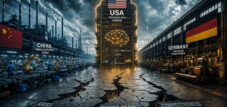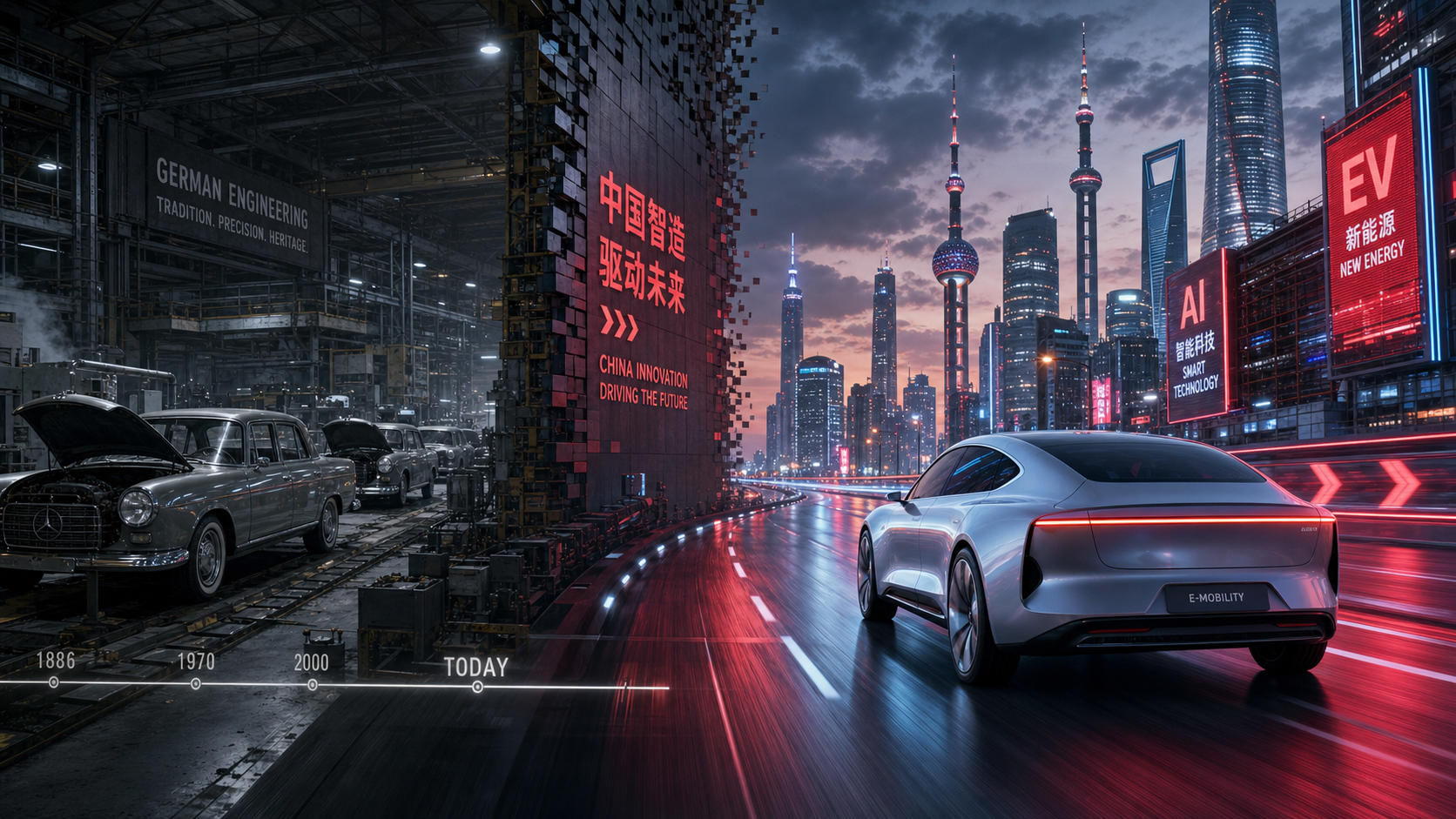
Former VW boss settles accounts: How Germany gave away the future of the car industry to China – “We made them smart” – Image: Xpert.Digital
The Apple Paradox: What fatal mistake do VW and the iPhone manufacturer have in common?
China's secret master plan: How 40 years of arrogance are destroying our key industry
"We made them smart": Why the decline of VW, BMW & Co. is self-inflicted
The German automotive industry is mired in the worst crisis of its post-war history – and it is entirely of its own making. Tens of thousands of jobs are disappearing, profits are plummeting, and former industry giants like Volkswagen, BMW, and Mercedes-Benz are battling a seemingly insurmountable opponent from the Far East. But how did it come to this? Jochen Sengpiehl, former head of VW marketing in China, delivers a stark diagnosis: Blinded by record profits and driven by corporate arrogance, Western corporations exported their most valuable knowledge to Asia for decades. The bill is now coming due in the form of highly sophisticated Chinese electric cars flooding the European market. The bitter truth: Not only German automakers have fallen into this trap, but also tech giants like Apple. This is an in-depth analysis of the end of German complacency, the fatal error of the joint venture system, and the pressing question of whether the industrial decline can still be averted.
Related to this:
From global market leadership to structural crisis: What the numbers reveal
There are moments when a single number says it all. At the end of the third quarter of 2025, the German automotive industry employed 721,400 people – a level last seen in the second quarter of 2011. Compared to the previous year, this represented a decline of 48,700 jobs, or 6.3 percent – the largest job loss in any German industrial sector with more than 200,000 employees. Looking at the period since the pre-pandemic year of 2019, the automotive industry has lost around 111,000 jobs – a decrease of 13 percent. The German Association of the Automotive Industry (VDA) estimates that a total of 225,000 jobs could disappear by 2035, around 35,000 more than predicted a few years ago.
These figures don't describe a cyclical dip, the kind industries regularly experience after recessions. They describe a structural upheaval, which Jochen Sengpiehl, former head of marketing at Volkswagen in China, precisely identified in an interview: "This isn't a temporary problem that can be fixed with a cost-cutting program." Sengpiehl, who worked for the VW Group for almost eight years, most recently until June 2025 as CMO and Head of Product Strategy in the most important single market in the company's history, describes a crisis that has been brewing for decades – and is now becoming fully apparent. His verdict is devastating and analytically precise: German manufacturers have brought this situation upon themselves.
The profit slumps at premium manufacturers confirm the depth of the crisis. BMW recorded a 37 percent drop in profits in the first half of 2025, while Mercedes-Benz saw a 48 percent decline. Porsche, normally the most profitable segment in the VW Group, issued several profit warnings and experienced a near 100 percent collapse in its operating margin in the second quarter of 2025. The consulting firm EY described the scenario as a "perfect storm" that calls into question the entire business model for many manufacturers.
Related to this:

China as a mirror: What Sengpiehl's return to Beijing revealed
The most striking image Sengpiehl paints isn't a data point—it's a street scene. When he drove through Beijing's streets again in 2022, after more than two years of pandemic-related absence, he couldn't believe his eyes. The cityscape had been transformed: electric vehicles, which looked like products from the future, dominated the scene. The isolation of the pandemic years hadn't paralyzed China, but rather spurred it on. While Europe was preoccupied with its own lockdowns, the Chinese automotive and technology industries had experienced a surge in development that exceeded all Western predictions.
This observation is not an isolated incident. It aligns with what the figures have since confirmed. In the first four months of 2026, EU registrations of BYD vehicles rose by 152.9 percent to more than 71,850 units. SAIC Motor, owner of the MG brand, increased its registrations by 10.4 percent to over 77,000. Chinese brands achieved a combined EU market share of around 6 percent – twice as high as in the same period of the previous year, when it was 3.2 percent. In the UK, their market share had already reached 11.8 percent in the third quarter of 2025. In Norway, Chinese brands led the way with 13.7 percent of new registrations.
What appears to Europeans as a gradual advance is, from a Chinese perspective, the result of a long, strategic effort. The difference lies in the time horizon: while quarterly reports dictate the pace in Wolfsburg, Munich, and Stuttgart, Beijing thinks in terms of decades. This difference in the strategic planning horizon is one of the key explanations for the current state of the German automotive industry.
Decades as a teacher: How the joint venture system exported knowledge
Sengpiehl's most pointed thesis is: "In fact, we have made the Chinese smarter over 40 years." This statement sounds like a confession – and it is one. It names a mechanism that was long suppressed in German industry: the structural gift of knowledge that Western car manufacturers made over decades within the framework of the Chinese joint venture obligation.
When VW established its first joint venture with the state-owned Shanghai automotive group SAIC in 1984 – following that legendary impromptu visit to Wolfsburg by Chinese delegates who had originally intended to meet with Daimler in Stuttgart – the logic on both sides seemed clear. China wanted Western capital and production know-how; VW wanted access to a multi-billion-dollar market. Over the decades, the joint venture evolved into a knowledge transfer channel of enormous proportions. The joint venture requirement, which mandated that foreign automakers have a Chinese partner with at least a 50 percent stake, not only opened up production facilities but also provided insights into design plans, development processes, supplier structures, and vehicle specifications.
That this knowledge transfer wasn't always voluntary is demonstrated by a case from 2012: VW learned that its joint venture partner FAW was systematically copying design plans for transmissions and engines and using them in its own vehicles, which were intended to compete directly with VW models in third-party markets. VW was in a bind: Anyone wanting to produce locally needed the partner – and was therefore dependent on their loyalty, which could prove to be limited. Nevertheless, the knowingly permitted transfer was no less crucial than the illegal outflow. For over four decades, engineering expertise, production processes, and market intelligence flowed into Chinese structures.
China strategically leveraged this input. The best graduates were trained at Western universities and returned home. What began as the adoption of foreign technologies evolved into independent development and ultimately led to dominance in certain segments, particularly in electromobility and vehicle-specific software. From the outset, China viewed the car as a moving machine, a software platform on wheels – a perspective that was slow and hesitant to gain traction in German engineering cultures.
The China Buffer Paradox: How Profits Masked Structural Weaknesses
Sengpiehl's second key diagnosis concerns the mechanism of delusion. In its peak year of 2020, Volkswagen sold around 3.85 million vehicles in China. Most recently, the figures have fallen to approximately 2.1 to 2.2 million, representing a decline of almost 10 percent in 2024 alone. According to Sengpiehl's calculations, the company is missing 1.2 million vehicles between its best years around 2018 and the latest results – that's billions in lost profits.
These profits from China served a systemic function: they compensated for structural inefficiencies in the core German business. The unions were satisfied, the supervisory board was satisfied, the dividends flowed – and no one had any serious reason to question the company's fundamental structure. This is the paradox of success: it prevents change. A company that achieves excellent returns for a decade feels no pressure to reform. Sengpiehl describes this phenomenon with startling directness: "These profits from China essentially leveled everything out." Now that this buffer is gone, the weaknesses are laid bare.
The figures illustrate the slump. VW delivered 9.027 million vehicles worldwide in 2024 – narrowly missing its self-imposed target of 9 million, and originally expecting an increase this year. Sales in China plummeted by almost 10 percent. At the same time, the cost base continues to rise: VW plans to cut around 35,000 jobs by 2030. BMW is facing restructuring costs in the billions. At Mercedes-Benz, around 5,500 employees have already voluntarily left the company by 2026 as part of a cost-cutting program; the restructuring costs for these job cuts have reached €1.6 billion.
The arrogance of the winners: Why Tesla was ridiculed and China underestimated
Sengpiehl identifies a mentality that was long dominant in German boardrooms: the self-assurance of the incumbent. He recalls situations in which leading managers laughed at Tesla and its losses at the time. The electric car pioneer from Palo Alto was considered a well-funded experiment lacking mass appeal. The laughter has died down: Tesla temporarily overtook the core VW brand as the best-selling single model in Europe, and the Wolfsburg-based company now has to reposition itself.
This attitude was no accident – it was systemic. Large corporations operated in departmental silos instead of cross-functional teams. Product cycles, which last seven to eight years in Germany, were compressed into two to three years in China. While European engineers honed the combustion engine to perfection, Chinese teams developed networked, software-controlled vehicles designed as service platforms. The car ceased to be a mechanical product and became a digital ecosystem – and this shift in categories was recognized too late in Stuttgart, Munich, and Wolfsburg.
Added to this is a pricing strategy that puts European manufacturers under pressure. Batteries are produced in China for up to 40 percent less than in Europe, and labor costs in the Chinese automotive industry are up to five times lower. BYD already offers electric cars in China for the equivalent of less than €10,000. In Europe, Chinese vehicles are often cheaper compared to their European counterparts: The MG4 costs around €7,000 less than the similarly sized Opel Astra; the Nio ET7 undercuts the Mercedes EQS by almost €20,000. This difference can be explained by structural cost advantages in battery technology, subsidized production conditions, and government support programs in China specifically geared towards affordable electric mobility.
Our global industry and economic expertise in business development, sales and marketing

Our global industry and economic expertise in business development, sales and marketing - Image: Xpert.Digital
Industry focus areas: B2B, digitalization (from AI to XR), mechanical engineering, logistics, renewable energies and industry
More information here:
A thematic hub offering insights and expertise:
- Knowledge platform covering global and regional economies, innovation and industry-specific trends
- A collection of analyses, insights, and background information from our key areas of focus
- A place for expertise and information on current developments in business and technology
- A hub for companies seeking information on markets, digitalization, and industry innovations
Two mistakes, one lesson: What Apple and Volkswagen teach us about global dependency
The Apple parallel: How the US made the same mistake on technological ground
The phenomenon Sengpiehl describes for the automotive industry is not an isolated case. The American technology company Apple provides a structurally identical example in the field of consumer technology – thus broadening the analytical scope from an industry crisis to a systemic question of the Western economic model.
Between 2016 and 2021, Apple invested approximately $275 billion in the People's Republic of China—nearly double the total amount mobilized by the Marshall Plan. Apple's then-CEO, Tim Cook, consistently optimized for operational excellence and scalability. The Foxconn factory in Zhengzhou, dubbed "iPhone City," employed up to 350,000 workers at its peak and produced up to 500,000 iPhones daily. Apple permanently seconded thousands of its own engineers to Chinese supplier factories, jointly developed new production processes, and thereby created the densest and most efficient manufacturing ecosystem in economic history.
The result was the world's largest unintentional knowledge transfer program in industry. Patrick McGee, former chief Apple correspondent for the Financial Times, reconstructed in his 2025 book, "Apple in China: The Capture of the World's Greatest Company," based on over 200 interviews, how Apple, with its engineers, machinery, and capital, not only made the iPhone a global brand but also significantly advanced China's state-run industrial strategy, "Made in China 2025." The suppliers whom Apple trained to world-class standards for years simultaneously supplied Huawei, Xiaomi, and Oppo. The diffusion of knowledge was systemic: skilled workers trained at Apple's suppliers became key personnel for the competition.
The parallel to the automotive industry is apt: Just as VW and its European competitors forced Chinese partners to share design secrets, Apple trained Chinese suppliers to a level that enabled them to innovate independently. McGee's central argument: "Apple gave birth to the Chinese smartphone industry"—not a comparison, but a historical diagnosis. Chinese smartphones held around 52 percent of the global foreign market in 2025, compared to 11 percent in 2013.
The dilemma Apple faces today foreshadows Sengpiehl's scenario on the technological front: Apple still produces around 90 percent of its iPhones in China. This dependence is so profound that, according to expert estimates, a complete withdrawal would require several decades and investments in the hundreds of billions. The Trump administration's tariffs cost Apple around $900 million in the second quarter of fiscal year 2025 alone. By February 2026, these tariff burdens had accumulated to approximately $3.3 billion. The strategy of controlled risk diversification—India, Vietnam, less China—is the same one German automakers are attempting today: diversification in stages, without being able to resolve the structural dependencies.
Related to this:

The price of reciprocity: Trade policy asymmetries and their consequences
Another finding formulated by Sengpiehl concerns the trade architecture. He argues that Chinese automakers should operate in Europe under the same conditions under which European manufacturers operated in China – that is, with mandatory joint ventures, technology transfer requirements, limited market shares, and state control. This demand is provocative because it takes the principle of reciprocity to its logical conclusion: those who have received access to Western markets with open arms for decades cannot expect to grant free access in return.
The trade deficit illustrates the imbalance. In 2025, the EU exported goods worth €199.6 billion to China, while imports reached €559.4 billion – a trade deficit of €359.8 billion. In the previous year, 2024, the EU's trade deficit with China was €304.5 billion. At a summit in July 2025, European Commission President Ursula von der Leyen pointed out that the deficit was trending upward and required a fundamental reorientation.
In 2024, the EU introduced additional tariffs on electric cars from China. The impact of this measure has been limited: it has slowed, but not stopped, the advance of Chinese brands in Europe. BYD more than doubled its registrations in the EU in the first four months of 2026. Chinese manufacturers are also responding with a second wave of expansion, this time focusing not on direct exports, but on local production and strategic alliances: Xpeng has been producing at Magna Steyr in Graz since September 2025, Stellantis distributes Leapmotor through its existing dealer network and has sold around 40,000 vehicles in Europe in twelve months. BYD is collaborating with Apple to build production capacity in Vietnam – a situation that illustrates how deeply Chinese players are already integrated into the global supply chain.
Structural failure and silo mentality: The organizational dimension of the crisis
Besides strategic complacency, Sengpiehl identifies an organizational defect that has plagued large German companies for decades: the vertical silo structure. Departments operate in isolation, development and sales communicate inadequately, and software development takes place in a separate world from vehicle design. In a world where the car is becoming a networked software platform, this organizational form is fatal. Chinese manufacturers like BYD or NIO, on the other hand, work in cross-functional teams, drastically shorten development cycles, and view software architecture as an integral part of the vehicle concept—not as an add-on.
Sengpiehl calls for speed as a measurable metric for executive boards and closer cooperation among German automakers in software development, instead of internal competition in an area where they are all already lagging behind their Chinese and American competitors. Artificial intelligence must become a top priority, not just a tool for cost optimization. AI integration as a strategic imperative, not merely an efficiency measure – this is a demand that extends beyond the automotive industry and addresses the entire German industrial model.
According to VDA President Hildegard Müller, a "serious and persistent location crisis" in Germany and Europe is also contributing to the negative trend: high taxes and levies, expensive energy, high labor costs, and excessive bureaucracy. These structural location factors exacerbate the competitive disadvantage compared to China, where government subsidies are strategically used to reduce production costs. It is therefore a crisis with several mutually reinforcing dimensions: corporate complacency, strategic miscalculations, government regulations, and a geopolitical shift that is calling the existing business model into question.
Two scenarios for Volkswagen – and Germany as an industrial location
Sengpiehl outlines two conceivable scenarios for Volkswagen. The pessimistic one: The company is broken up, leaving only the profitable brands – Porsche, possibly Audi, Skoda, and Cupra. The core VW brand, the heart of the group and once a symbol of the German economic miracle, would be the casualty. The optimistic scenario: Volkswagen succeeds in a genuine reinvention, as the company has already accomplished several times in its history. The prerequisite for this is not another "homeopathic cost-cutting program," but a fundamental cultural shift at all levels of the company.
Automotive expert Frank Schwope from the University of Applied Sciences for Small and Medium-Sized Enterprises puts it similarly bluntly: Not all of today's car manufacturers will survive the 2030s as independent companies. Ferdinand Dudenhöffer, director of the Center Automotive Research, predicts that employment in the German automotive industry could fall from its current level of around 720,000 to well below 700,000 and potentially to 650,000 by 2027. The forecast is even bleaker for suppliers: Their workforces were already projected to shrink by more than 11 percent in 2025 because they are facing a double burden – declining order volumes from manufacturers and technological change that is rendering traditional manufacturing jobs obsolete.
The VDA president nevertheless emphasizes: 100,000 jobs have already been lost between 2019 and 2025, and this process is unstoppable. The question is not whether change is taking place, but whether it is managed or uncontrolled. Managed change requires consistent investment in software expertise and artificial intelligence, close cooperation between competitors in cross-cutting technologies, an EU trade policy response that formulates reciprocity not only as a goal but as a condition, and a location policy that makes energy prices, bureaucratic burdens, and tax rates competitive.
What Apple and VW have in common: The structure of unintentional knowledge transfer
The persuasive power of this analysis lies in its structural universality. Both Apple and the German automakers represent a type of Western industrial company that, in a phase of success and arrogance, systematically underestimated the long-term consequences of its internationalization decisions. Both not only used China as a production location but also as a learning environment for Chinese companies. Both reaped maximum short-term profits and paid the long-term price in the form of competitors who now challenge them in key markets.
The structural mechanism is identical in both cases: Western companies send knowledge, capital, and skilled workers to China to optimize costs and access markets. China strategically absorbs this knowledge, subsidizes the relevant industries, trains a new generation of engineers, and makes the transition from imitation to innovation at a pace that Western players did not think possible. The result is Chinese competitors in smartphone, electric vehicle, and battery technology, who are now competing in European and American markets with their own independent products.
Sengpiehl sums it up perfectly: China trained its best young talent at Western universities, who then returned and not only adopted Western technologies but further developed them. The joint venture requirement was not merely a barrier to market entry, but a state-constructed knowledge transfer mechanism. Western companies had the choice between accessing the Chinese market and protecting their technologies – and they chose the market. Under the prevailing conditions at the time, this decision was rational. Its strategic consequences are only now becoming fully apparent.
Not an isolated case: The systemic dimension of the German crisis
The automotive industry is not alone. While it is the most visible indicator of Germany's industrial decline, the figures point to a broader trend. In 2025, German industry as a whole lost around 124,000 jobs – almost twice as many as in 2024. Since the pre-pandemic year of 2019, the number of industrial employees has fallen by around 266,000, or almost five percent. Industrial revenue declined by 1.1 percent in 2025 – the fourth quarter of 2025 marked the tenth consecutive quarter of revenue decline. The consulting firm EY speaks of a "deep crisis" that would require a genuine upswing to prevent further job losses.
Dudenhöffer's forecast for 2026 is sobering: Car manufacturers are increasingly expanding production, research, and development abroad – "at the expense of jobs in Germany." This means the crisis is transforming from a cyclical to a structural exodus of capital, know-how, and employment. Profits are increasingly being made elsewhere; structural costs remain in Germany. This is the real strategic nightmare for Germany as an industrial location.
Automotive analyst Jürgen Pieper, however, also sees the potential for a turning point in 2025: "2025 has the potential to be a turning point for the German automotive industry." The realization that the current model is unsustainable is now widely shared. The question is whether the necessary consequences will be drawn from this realization – or whether the industry will remain in a mode that tries to cure the problem with the next cost-cutting program instead of addressing the root causes.
Strategic conclusions: What would be needed now
Sengpiehl's analysis, supported by the example of Apple and macroeconomic data on the German industrial situation, shows that the crisis in the German automotive industry is not solely a technological problem. It is a failure of strategic vision, organizational and innovation culture, and trade policy frameworks all at once.
The conclusions drawn from this evidence can be summarized in four areas of action. First, technological repositioning: Understanding the car as a software platform is no longer optional, but a crucial prerequisite for survival. This means cross-functional development teams, shortened development cycles, and consistent AI integration as a strategic priority for management. Second, the industrial policy response: EU tariffs on Chinese electric cars are a first step, but not sufficient. A trade policy that stipulates reciprocity as a condition for market access would be more consistent – and would correspond to the principle that China itself has applied for decades. Third, the cooperation strategy: German manufacturers should cooperate in cross-cutting technologies such as software platforms and battery technology, rather than competing. The resources for this transformation are limited; fragmenting them into parallel projects is strategically negligent. Fourth, location policy: A German and European location policy that fails to make energy prices, bureaucracy, and the tax burden competitive jeopardizes not only the automotive industry, but Germany's industrial base as a whole.
Sengpiehl puts it succinctly: What's needed is a genuine shift in thinking at all levels, not another homeopathic cost-cutting program. This statement doesn't just apply to Volkswagen. It applies to Germany as an industrial location as a whole. It took China four decades to overtake the Western automotive industry. Germany doesn't have another four decades to respond. What remains is the question of whether the will to do so exists – among companies, politicians, and society.
Your global marketing and business development partner
☑️ Our business language is English or German
☑️ NEW: Correspondence in your native language!

Konrad Wolfenstein
I and my team are happy to be available to you as your personal advisor.
You can contact me by filling out the contact form here wolfenstein@xpert.digital:or simply call me at +49 7348 4088 965. My email address is
I'm looking forward to our joint project.
☑️ SME support in strategy, consulting, planning and implementation
☑️ Creation or realignment of the digital strategy and digitization
☑️ Expansion and optimization of international sales processes
☑️ Global & Digital B2B trading platforms
☑️ Pioneer Business Development / Marketing / PR / Trade Fairs
🎯🎯🎯 Data-driven B2B industry hub as a quasi-in-house solution


The quasi-in-house solution: How Xpert.Digital closes operational gaps in B2B marketing and sales – Smart Content-Driven Business - Image: Xpert.Digital
Xpert.Digital is a data-driven B2B industry hub led by Konrad Wolfenstein . The company acts as an external, quasi-in-house solution for industrial partners, closing operational gaps in marketing, content, and sales – without requiring additional resources on the client side.
More information here: