Norway's next productivity reserve: How autonomous robots are changing internal logistics – Creative image on the topic, with AI: Xpert.Digital
Robots in hospitals and factories: Why material flow determines economic success
Expensive labor costs, short distances: When autonomous transport robots really pay off
Automation without the promise of return on investment: How to calculate the benefits of mobile robots
High labor costs increase the pressure to organize recurring processes more efficiently. In Norway, where average annual labor costs per full-time equivalent were around 970,000 Norwegian kroner in 2024, this is bringing into focus activities that are easily overlooked in day-to-day operations: pushing material carts through buildings, distributing supplies, or retrieving equipment from storage. Such tasks are necessary, but often do not create any immediate added value for the actual work – yet they still tie up valuable working time.
Autonomous mobile robots can handle internal transport tasks. However, their economic benefit depends not only on a vehicle's driving performance. Crucially, robots, adapted storage units, transfer stations, software, and building infrastructure must work together reliably. Equally important is whether the freed-up working time can actually be used effectively. Because less transport effort does not automatically translate into lower personnel costs.
This article demonstrates how autonomous intralogistics can be economically evaluated, the role of standardized transport solutions, and why a thorough process analysis is essential before purchase. Using Norwegian labor cost data, a hospital project, and a clearly labeled model calculation, it illustrates what matters most when making an investment – and why the process, not just the robot, determines success.
It is not the robot that determines the profit – but the process it replaces
The next increase in productivity doesn't necessarily come from a new factory, a larger machine park, or additional employees. It can also begin where material carts are pushed through corridors, consumables are distributed between rooms, and tools are retrieved from a warehouse. These activities are necessary, but often don't create immediate added value for an organization's core performance. Nevertheless, they consume working time, tie up personnel, and affect whether other employees can complete their tasks without interruption.
Autonomous mobile robots, or AMRs for short, address this interface. They are designed to independently handle internal transport tasks, thereby organizing material movements more reliably. This approach becomes particularly interesting when the vehicles are connected to purpose-built cabinets, containers, and transfer stations. Then it's no longer just about moving a transport cart through a building. A cohesive system emerges, encompassing material provision, transport, access, and digital control.
Norway offers an economically insightful environment for this. In 2024, the average annual labor costs per full-time equivalent there amounted to 970,454 Norwegian kroner. Of this, 761,398 kroner were direct costs and 209,056 kroner were indirect costs. These averages are not specific cost rates for logistics personnel. However, they illustrate why labor-intensive routine tasks are subject to particularly close scrutiny from a business perspective.
The crucial economic relationship is simple: the more expensive scarce working time is, the more important its productive use becomes. However, this does not mean that every automated journey is profitable. A robot only creates tangible benefits when it actually reduces workload, makes better use of existing capacities, or demonstrably improves the quality of care.
The central perspective is therefore this: Autonomous intralogistics is less a vehicle issue than an investment in the organization of material flow. Its economic success depends on how consistently physical processes, software, buildings, and personnel are integrated.
Why Norway is an insightful application market
Norwegian labor cost data reveals not only a high absolute cost level, but also a significant trend. In the transport and warehousing sector, the labor cost index rose from 121.4 in the second quarter of 2025 to 126.1 in the second quarter of 2026. This represents an increase of almost 3.9 percent within a year. This indicator measures the change in labor costs per hour and should not be equated with a specific hourly wage.
This creates a continuous incentive for operators of buildings and internal supply systems to review recurring transport operations. When the same routes are traveled every day, their financial impact increases with rising personnel costs. At the same time, a transport process often remains organizationally invisible: it is distributed across numerous employees, different cost centers, and many short interruptions.
This very distribution complicates economic decision-making. An organization can employ relatively few explicitly designated transport personnel and still spend considerable working time on material movements. If qualified specialists regularly collect supplies themselves, this effort may not appear in the logistics budget, but rather in the working time of their respective department.
Automation can make this hidden effort visible. However, this requires first recording routes, transport reasons, and waiting times. The economic question is not just how much a current transport service costs. Equally important is which other activities are displaced by material searches and supply interruptions.
Therefore, no general guarantee of success can be derived from the Norwegian example. Rather, it provides a particularly plausible reason to examine the use of working time more closely. Whether this results in a viable investment will be decided at the level of the individual location.
A vehicle becomes a supply system
An autonomous mobile robot initially performs a transport function. It moves within a designated environment between defined points and reacts to the respective spatial conditions. However, its economic benefit does not arise solely from the movement itself. Crucially, it depends on how the transport is initiated, loaded, prioritized, and completed.
This can be illustrated by a simple example. A robot can reliably deliver a cabinet to a department. However, if no one there knows that the delivery has arrived, if the vehicle blocks an important traffic area, or if the cabinet doesn't fit the designated handover point, the entire process remains unreliable.
The actual service therefore consists of several interconnected steps: A need must be identified, the appropriate material provided, transport initiated, and the handover confirmed. Only when this chain functions smoothly does movement become a reliable supply.
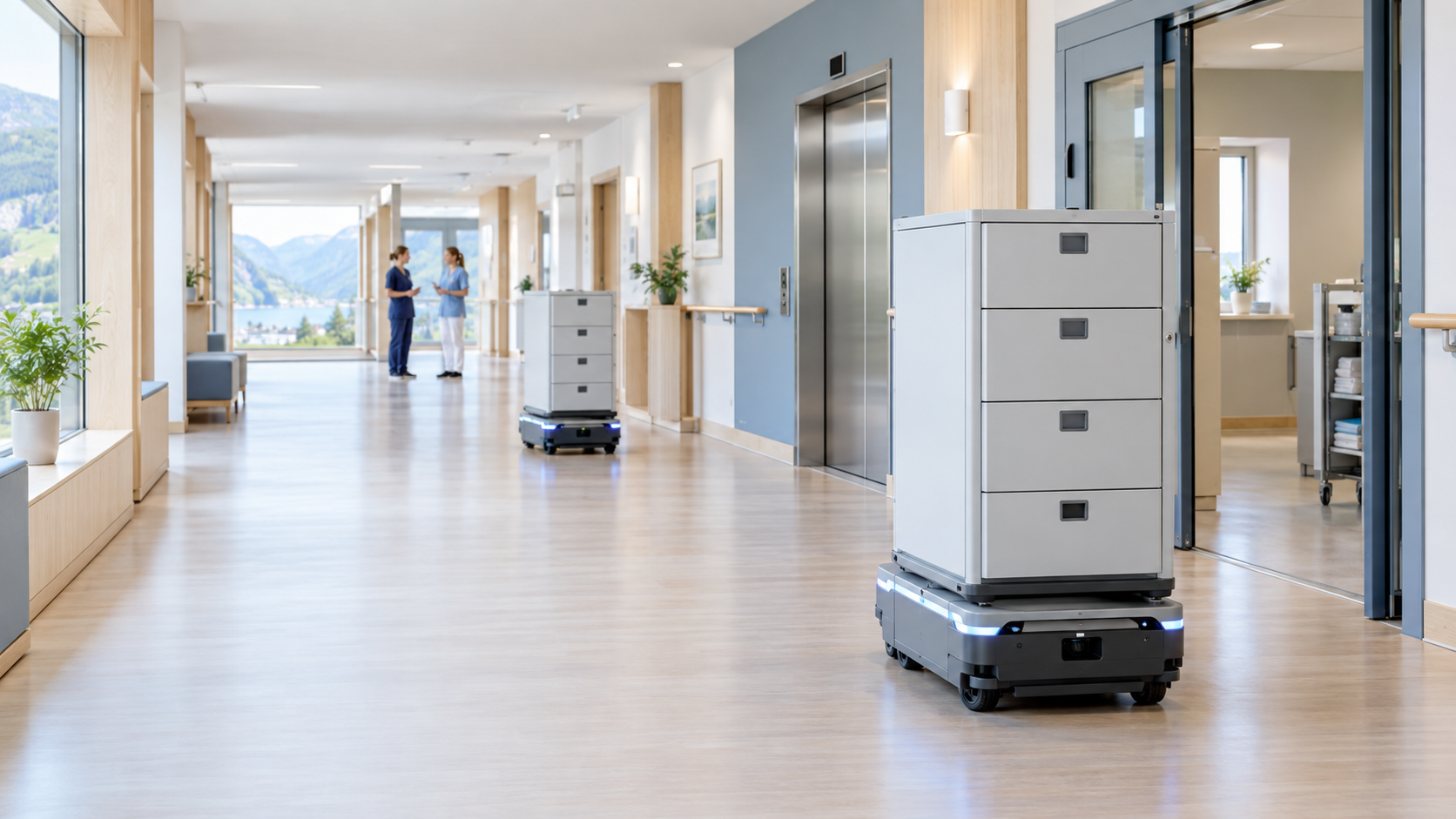
A practical implementation of this systems approach is described in a Norwegian hospital project with 15 mobile robots from Omron. The scope of services includes not only the vehicles themselves, but also a robotic cell for a container buffer and integration with building and digital systems. The project description explicitly mentions the integration of doors, elevators, and fire alarm systems. While it documents the technical breadth of the integration, it does not provide an independently verified cost-benefit analysis.
The difference is crucial. A successful technical demonstration proves that a vehicle can drive. Sustainable operation additionally requires that the entire supply chain functions even under high load, blocked routes, and unplanned changes.
Why customized cabinets make a strategic difference
Functionally adapted cabinets appear unspectacular compared to robotics. Economically, however, they can determine whether a transport process is largely automated or remains labor-intensive at its transfer points.
A suitable cabinet combines several functions. It holds goods for transport, protects them during transit, and presents them in a usable form at the destination. Depending on the design, it can also separate different product groups, restrict access, or enable clear identification. Which of these functions are actually available depends on the specific system and cannot be assumed across the board.
The mechanical interface is particularly important. Dimensions, weight, center of gravity, and mounting device must be compatible with the robot. If each cabinet is designed differently, the effort required for construction, handling, and spare parts supply increases. However, if recurring basic shapes are standardized, multiple processes can be implemented on the same technical basis.
At the same time, standardization should not be confused with homogenization. Cleaning materials, workshop components, documents, and medical supplies have different requirements. Therefore, an economically sound concept combines the most uniform possible transport and coupling interfaces with interior fittings tailored to specific needs.
The cabinet thus becomes an integral part of the process architecture. It influences how often material needs to be repacked, how long loading and unloading take, and whether a robot has to wait at the destination. These seemingly minor details directly impact transport capacity and therefore the investment calculation.
The most important preliminary work is done without robots
Before automating, it's essential to first determine which transport operations are actually necessary. Not every existing route deserves to be replicated technically. Some transport needs arise simply from inconvenient storage locations, unclear inventory levels, or an unsuitable division of responsibilities.
A reliable inventory therefore examines not only transport volumes. It also records triggers, time windows, distances, load levels, and the availability of destination stations. Additionally, it must reveal how frequently transports are urgent and what the consequences of delayed deliveries are.
A distinction must be made between person time and throughput time. Transport can take ten minutes but only require three minutes of active working time. Conversely, a short distance can cause a longer work interruption if employees have to leave their task, search for materials, and then get back into their original workflow.
These differences significantly alter the cost-benefit analysis. Those who equate every saved transport minute with a completely saved personnel cost minute may overestimate the benefit. Conversely, those who only consider explicitly documented transport hours may underestimate the actual reduction in workload.
The best starting point is therefore a comprehensible process model. It should show which tasks are eliminated after automation, which remain, and which are new. Even an automated system requires loading, cleaning, monitoring, maintenance, and regulated troubleshooting.
What international robotics figures actually prove
The international market indicates that mobile automation has long since moved beyond isolated demonstration projects. The International Federation of Robotics reports approximately 199,000 new units sold in its 2024 survey of professional service robots, representing a nine percent increase compared to the previous year. Transportation and logistics are among the key application areas.
However, these figures must be interpreted with rigorous methodology. The survey is based on a sample of 293 manufacturers out of a total of 944 companies surveyed. The results are not extrapolated to the entire industry. Furthermore, the composition of the sample changes, which is why the organization explicitly warns against making uncritical comparisons between different survey waves.
This does not allow for the derivation of an exact global AMR market size or a reliable Norwegian sales forecast. Likewise, the number of professional service robots cannot be equated with the number of autonomous transport robots. The categories do not completely overlap.
Nevertheless, the structural statement is relevant: Internal transport is an established application area for professional robotics. High initial investments and adaptation to industry-specific requirements are cited as key challenges. This highlights precisely those factors that are also crucial when combining mobile robots and customized cabinets.
For business decisions, this is more helpful than the largest possible market forecast. A growing market can improve selection and promote technological development. However, it does not replace the examination of whether one's own material flow offers enough suitable transport options for profitable operations.
Economic efficiency begins with the total costs
The purchase price of a robot is only one part of the investment. Depending on the configuration, additional costs include transport equipment, cabinets, charging stations, software, building modifications, and integration with existing IT systems. Furthermore, there are expenses for planning, testing, training, and commissioning.
Additional costs arise during ongoing operation. These can include maintenance, software updates, support, consumables, and internal support time. Troubleshooting is also a significant economic factor. A system that regularly requires manual intervention can negate some of its initially anticipated savings.
The introductory phase is particularly often underestimated. During this time, old and new processes may need to be maintained in parallel. Employees learn new routines, transfer stations are adapted, and transport rules are refined. This phase is not an unforeseen incident, but a planned component of the change process.
The benefits include saved working time, fewer interruptions, and potentially avoided additional costs. More reliable supply, better traceability, and reduced physical strain can also be important. However, these effects should not be translated into monetary terms without careful consideration.
A sound calculation therefore distinguishes between immediate cash-relevant savings, capacity gains, and quality improvements. All three can justify an investment. However, they have different impacts on budget, personnel planning, and performance.
Your intralogistics experts

Consulting, planning and implementation of complete solutions for high-bay warehouses and automated storage systems - Image: Xpert.Digital
More information here:
Economic advantages of autonomous robots in material flow
A model calculation reveals the crucial levers
The extent to which the results depend on the assumptions can be illustrated by an explicitly hypothetical example. The following values are not market prices and do not describe a specific Norwegian project. They serve solely to make the economic relationships comprehensible.
Let's assume a site invests a total of four million Norwegian kroner in vehicles, cabinets, software, and integration. The additional annual operating costs amount to 500,000 kroner. Currently, 5,000 working hours per year are spent on transportation and related activities.
If these hours are valued at an assumed full cost rate of 400 crowns, this results in a calculated potential savings of two million crowns annually. This amount is initially only a theoretical upper limit. It assumes that all the work under consideration is eliminated and its economic value can be fully utilized.
A reduction in costs of 75 percent would generate annual savings of 1.5 million crowns. After deducting the additional operating costs, one million crowns remain. The simple amortization period would then be four years.
If, however, only 50 percent of the potential is realized, the annual benefit drops to one million crowns. After operating costs, 500,000 crowns remain. The simple amortization period increases to eight years.
With 90 percent of the potential realized, the annual benefit reaches 1.8 million crowns. After deducting operating costs, 1.3 million crowns remain. The simple amortization period is then just over three years.
This simplified calculation does not take into account financing costs, taxes, residual values, or the ramp-up timeline. However, it illustrates the key factor: It is not solely the purchase price that matters, but above all, what proportion of the theoretical benefit is actually achieved.
Freed-up working time does not automatically translate into budget savings
The distinction between relief and cost savings is essential for an objective assessment. If employees spend less time on transport after automation, personnel costs do not automatically decrease. Initially, available labor capacity is created.
This capacity can be used in different ways. An organization can take on additional tasks, reduce overtime, or leave some vacancies unfilled. It can also increase its service quality without changing the number of employees.
Especially in skilled professions, the greatest benefit can lie in utilizing existing specialists more effectively for their core tasks. A medical professional, a technician, or a production worker generates different value through their respective core services than through repetitive material handling. However, the extent of this difference must be assessed within the specific context of each company.
The benefits become more difficult to utilize when the relief is spread across many people and short periods of time. Ten employees, each saving just a few minutes, add up to a total. However, this doesn't necessarily create a continuous block of time that can be used for other purposes.
Therefore, automation requires a follow-up organizational decision. Tasks, workflows, and responsibilities must be adjusted so that the freed-up time can actually be used. Without this change, part of the economic potential remains merely on paper.
Fleet size and utilization must match
The number of robots required cannot be meaningfully derived solely from the daily transport volume. Equally important are the duration of a complete transport cycle, the distribution of orders, and the time requirements of the recipients.
A complete cycle includes more than just the journey itself. Loading, picking up the cabinet, waiting times at doors or elevators, handover, and, if applicable, the return trip are all part of it. The more time these ancillary processes take, the fewer transports a vehicle can handle within a given period.
Furthermore, the distribution of demand must be considered. If many transports are needed simultaneously, a small fleet can be overloaded, even if it would have sufficient capacity on average throughout the day. Conversely, a fleet designed for rare peak periods can remain unused for large parts of the day.
From a business perspective, a balance must therefore be struck between high utilization and sufficient reserve capacity. A fully scheduled fleet can quickly fall behind schedule with a single disruption. Conversely, too much reserve capacity increases the cost per transport actually carried out.
Effective planning therefore incorporates multiple load scenarios. In addition to an average operating day, peak times, outages, and fluctuating transport volumes should be considered. The goal is not maximum theoretical capacity utilization, but rather economically viable performance under realistic conditions.
Building integration can be more important than driving speed
A faster robot doesn't solve any problem if it regularly waits in front of a closed door. Similarly, additional vehicle capacity is of little use if all transports have to use the same overloaded elevator.
Economic efficiency therefore depends heavily on the building infrastructure. Doors, elevators, transfer zones, and traffic areas determine how freely materials can move. Existing buildings may have different requirements than newly planned sites.
The Norwegian hospital example illustrates the importance of this integration. There, the coordination of mobile robots is explicitly linked to automatic doors, elevators, and fire alarm systems. Interfaces to inventory and transport software are also described. The vehicle is thus part of a larger technical infrastructure.
This leads to an important investment principle: Before purchasing additional robots, it should be examined whether bottlenecks can be eliminated more cost-effectively elsewhere. A better transfer station or a revised transport plan can be more economically efficient than another vehicle.
Even in new buildings, it's worthwhile to consider this early on. If automated material movements are only taken into account after the building design is complete, avoidable adjustments can occur. However, if transport routes and transfer points are considered from the outset, the technical integration can be designed more effectively.
Software controls the value of the overall system
As the fleet grows, the importance of overarching control increases. Multiple vehicles must distribute tasks efficiently, avoid conflicts, and consider priorities. At the same time, they must communicate with the systems that manage material requirements and inventory.
Several functions must be distinguished. Navigation determines how a vehicle reaches its destination. Fleet management decides which vehicle takes on which task. Process control defines when transport is required and its priority compared to other tasks.
The connection between these levels is particularly relevant for the operator. A vehicle can navigate technically correctly and still carry out an economically unsound task. For example, inappropriate prioritization can lead to an urgent delivery being postponed in favor of less important routine trips.
Software also influences long-term vendor lock-in. If transport rules, interfaces, and operational data are only usable within a closed environment, later expansions can become costly. Therefore, the evaluation should not only include the initial functionality but also data access, extensibility, and the cost of modifications.
A sustainable long-term architecture does not need to offer every conceivable technical openness. However, it should prevent simple organizational adjustments from causing disproportionately high development and service costs.
Security and contingency planning must be included in the calculation
Autonomous transport systems often operate in the same environment as employees and other building users. This creates requirements for safe and predictable operation. Economically relevant factors include not only potential accidents, but also situations where a system frequently stops as a precaution, thereby reducing its performance.
The design of the surroundings is therefore just as important as the vehicle technology. Confusing intersections, abandoned objects, and unsuitable transfer points can complicate operations. Clear rules are only helpful if they are compatible with the actual daily work routine.
Additionally, every site needs a backup system. If a robot, network connection, or central control system fails, critical transport operations must remain possible. This includes accessible materials, manually usable transport equipment, and clearly defined responsibilities.
Digital disruptions should also be considered. When transport orders and building access are coordinated via networked systems, access rights, software maintenance, and recovery procedures become operational issues. Security measures are therefore not an add-on without economic value, but rather an integral part of availability.
The crucial factor is not whether a system operates autonomously under ideal conditions. What matters is how long it remains usable under real-world conditions and how quickly normal operation can be restored after a malfunction.
Why employees have a say in practical success
A technically advanced system can fail economically if it makes work more difficult in other areas. This happens, for example, when employees have to wait a long time for a robot to arrive, repack materials multiple times, or perform additional confirmations without any discernible benefit.
The introduction of this system should therefore not be treated as a mere replacement of a means of transport. It changes tasks and responsibilities. Those who previously collected materials themselves will need to rely on a different process in the future. Those who previously handled transport may require new tasks in preparation, monitoring, or troubleshooting.
Early involvement of employees has direct practical value. They are familiar with recurring exceptions, unsuitable parking areas, and the actual reasons for urgent deliveries. This information is often missing from formal process descriptions.
At the same time, honest communication about economic goals is essential. If only relief is promised, but in reality, staff reductions are expected, avoidable conflicts will arise. Conversely, not every increase in productivity should be hastily interpreted as job cuts.
A sound implementation therefore specifies precisely which tasks will be eliminated, which will remain, and how the freed-up resources will be used. This clarity not only improves acceptance but also the verifiability of the subsequent results.
Where providers can actually create value
For mobile robotics providers, the economic value does not arise solely from vehicle production. Equally important are adapted transport technology, mechanical interfaces, software integration, and the ability to support stable on-site operation.
This shifts the competitive perspective. A seemingly inexpensive vehicle can become costly within the overall system if it requires extensive custom development. Conversely, a more expensive offering can prove economically advantageous if it reduces the need for modifications and provides more reliable support. The crucial factor is comparing costs over the entire lifespan of the vehicle.
The balance between standardization and customized solutions is particularly challenging. Too many custom designs increase development, documentation, and service costs. Conversely, an overly rigid standard solution may fail to meet the actual site requirements.
A modular approach therefore appears promising: uniform basic technology, combinable cabinet variants, and reusable software components. This is no guarantee of lower overall costs, but it creates a plausible basis for more efficiently addressing recurring requirements.
It remains important for the operator to be able to differentiate between services. Vehicle quality, integration expertise, and service capability are distinct attributes. They should not automatically be assumed to be of equal strength simply because they are offered under a single product or service package.
Sustainability requires a comparison of the entire process
Autonomous robots are sometimes prematurely categorized as a sustainable solution. However, an electric drive alone is not sufficient for this assessment. Manufacturing, batteries, spare parts, service life, and the actual costs avoided must also be considered.
An economically and ecologically sound approach therefore starts again with the process. If transport is consolidated and unnecessary routes avoided, less movement can be required for the same supply service. Conversely, if poorly organized individual transports are merely automated, some waste remains.
Repairability and reusability play a crucial role in cabinets and containers. A robust, adaptable design can be used across multiple phases of operation. Highly specialized components, on the other hand, can become problematic if requirements change or the associated vehicle is no longer available.
Capacity utilization is also relevant. A system that is underutilized spreads its production costs over a relatively small number of transports. A properly utilized, long-lasting fleet can perform better in this respect. However, a reliable environmental assessment requires concrete operational and product data.
The meaningful connection between economic efficiency and sustainability therefore does not lie in the blanket promise of green robotics. It lies in fewer unnecessary journeys, durable technology, and demonstrably more efficient supply chains.
Which key performance indicators demonstrate reliable success?
After implementation, the evaluation should not be limited to the number of trips completed. A high volume of transports can reflect both high demand and poor consolidation. The metric only becomes meaningful when considered in relation to time, costs, and service quality.
Key factors include the cost per completed transport, the required human intervention time, and reliability within agreed timeframes. Additional considerations are the availability of the overall system, as well as the duration and cause of disruptions.
It should also be verified whether the expected reduction in workload actually materializes. Are fewer overtime hours required? Is skilled personnel available for their core tasks for longer periods? Have search times and unplanned material flows decreased? Such questions link technical performance with operational benefits.
Accurate baseline measurements are crucial. Without reliable data on the previous state, improvements can only be substantiated to a limited extent. At the same time, changes in the scope of services must be taken into account. If a site handles more material after implementation, a simple comparison of total costs may be misleading.
A good performance review therefore considers productivity and output scope together. It shows not only whether the system works, but also whether it has actually advanced the organization economically.
The most convincing strategy combines automation with organizational discipline
Autonomous mobile robots and purpose-built cabinets can make a significant contribution to productivity. Their use is particularly plausible where regularly recurring transport takes place, labor time is expensive, and handover processes can be sufficiently standardized.
The limitations are equally clear. Low transport volumes, highly variable processes, or unsuitable building infrastructure can weaken profitability. The same applies if freed-up time cannot be used effectively or if the support effort is consistently higher than expected.
Norway is therefore less interesting as a stage for inevitable robotization, but rather as an example of a demanding economic balancing act. High labor costs increase the incentive for automation. However, they do not replace process knowledge or careful investment planning.
The most viable perspective focuses on the entire material flow. First, unnecessary routes are reduced. Then, suitable transport methods are standardized and automated. Finally, it is verified whether the freed-up resources actually create additional value.
In this model, the robot is neither an end in itself nor the sole driver of productivity. It is a tool within a better-organized supply chain. Those who take this distinction seriously can turn a technological investment into a lasting economic advantage. Those who overlook it risk simply perpetuating existing inefficiencies with modern technology.
Your global marketing and business development partner
☑️ Our business language is English or German
☑️ NEW: Correspondence in your native language!

Konrad Wolfenstein
I and my team are happy to be available to you as your personal advisor.
You can contact me by filling out the contact form here wolfenstein@xpert.digital:or simply call me at +49 7348 4088 965. My email address is
I'm looking forward to our joint project.