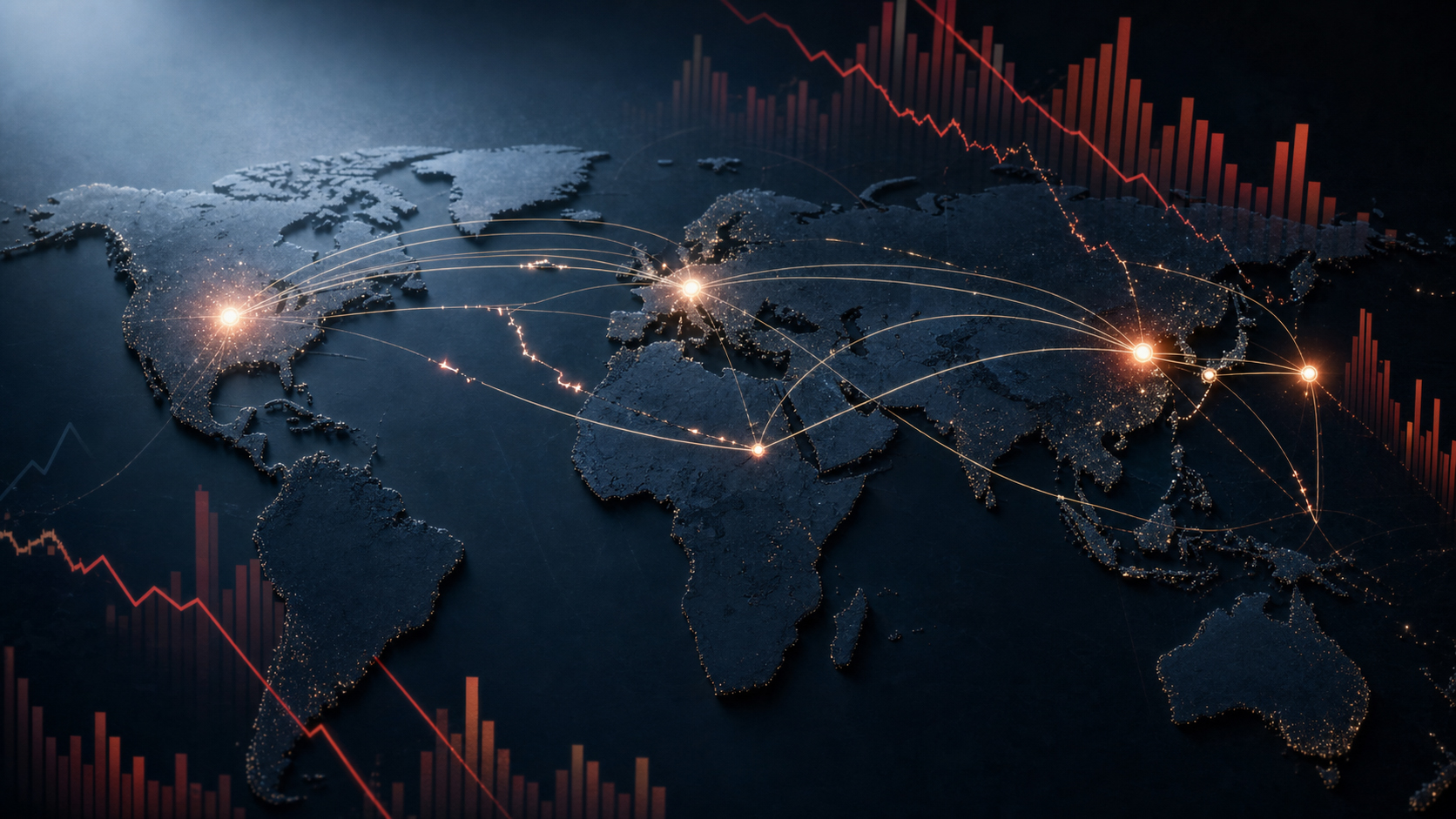
Global economic downturn: A year of disillusionment – Why Germany is suffering the most from the crisis – Image: Xpert.Digital
Tariffs, oil crisis and job slump: Is the US economic engine finally running out of steam?
The global economy is breaking apart: Who will lose in 2026 – and who will experience the great AI boom?
Why Germany's industry is collapsing while South Korea celebrates records
A year of disillusionment and extremes: How the year 2026 is splitting the global economy into two camps.
After a period of recovery, the global economy is facing a massive stress test. Geopolitical crises, exploding energy prices, and the return of inflation have drastically slowed global growth. But the economic shock is not affecting everyone equally: While the gigantic boom in artificial intelligence is driving economies like South Korea to historic records, the US is grappling with the consequences of its own tariff policies. Europe, and Germany in particular, is meanwhile mired in a deep structural crisis. Creeping deindustrialization, exorbitant electricity prices, and a stagnant backlog of reforms threaten to permanently leave the once-exporting nation behind. An in-depth analysis reveals that the current downturn is no coincidence, but rather the stark exposure of economic vulnerability – and the question of who will remain competitive in the future is being decided right now.
Global economic downturn 2026: When the recovery fails to materialize and everyone looks for someone to blame
Europe's unresolved problem: Why our economy will be left behind by Asia and the USA in 2026
The year 2026 has become a litmus test for the resilience of the global economy. After two years of relatively stable growth at around 3.5 percent, the global economy has cooled noticeably, and the reasons for this are multifaceted. The International Monetary Fund has repeatedly revised its growth forecast for 2026 downwards and now expects global growth of only three percent, with a recovery not expected until 2027 at 3.4 percent. This slowdown is no coincidence, but rather the result of a combination of geopolitical shocks, trade fragmentation, and structural disruptions that affect individual regions very differently. The armed conflict in the Middle East, which drove up oil prices and severely disrupted global trade, is acting as a catalyst, exposing existing weaknesses instead of creating them. At the same time, the artificial intelligence boom is creating headwinds that are at least cushioning the downturn in many industrialized countries, without, however, halting it. The result is a global economy that is splitting into two speeds: countries with strong links to the global technology value chain benefit, while energy importers and structurally weak economies fall behind.
Global inflation has risen again in parallel with the weaker economy and is projected to reach 4.7 percent in 2026, after standing at 4.1 percent in 2025. This marks a noticeable slowdown in the disinflationary trend that began in early 2024, plunging central banks worldwide into a dilemma: Should they cut interest rates to support growth, or keep them high to avoid jeopardizing price stability? This simultaneous occurrence of weaker growth and higher inflation is reminiscent of the stagflation fears of past decades, although the current situation is somewhat different due to the technological dynamism of AI investments. The World Bank paints an even more pessimistic picture, describing the current slowdown as the most significant setback since the COVID-19 pandemic.
America between tariff walls and job slump
The United States has long been considered the engine of global economic growth, but this image is increasingly cracking. American GDP grew by only 1.5 percent in the second quarter of 2026, down from 2.1 percent in the first quarter, a decline attributed to a classic supply shock from high oil prices and a growing trade deficit. The trade deficit in May increased by 42 percent compared to the previous month, reaching $77.6 billion – a clear indication that the tariffs imposed by the government have not achieved the hoped-for boost to domestic production. On the contrary, a comprehensive analysis shows that job growth has slowed by approximately 75,000 to 80,000 jobs per month since the introduction of the so-called "Liberation Day" tariffs in April 2024, amounting to nearly 900,000 lost jobs in the first year of the policy. The manufacturing industry in particular, which was supposed to benefit from the tariffs, consistently lost jobs, while labor force participation fell from 62.5 to 62.0 percent.
The labor market is now sending out clear warning signals. In February 2026, an unexpected 92,000 jobs were lost, while the unemployment rate climbed to 4.4 percent, marking the sixth contraction of the labor market since the current government took office. Between January 2025 and February 2026, civilian employment outside of agriculture shrank by 213,000 jobs, and by 571,000 since April 2024. The healthcare sector, which had acted as a reliable job engine in recent years, bore the brunt of the positive employment trend in 2025, while the rest of the labor market effectively collapsed. At the same time, the underlying dynamics of consumption and investment remain surprisingly robust: so-called core growth, which combines private consumption expenditure and gross private investment, rose by 3.9 percent in the second quarter, driven primarily by investments related to the AI boom. The US is thus experiencing a split economy, with the old economy suffering from tariffs, energy prices and weaker purchasing power, while technology and capital markets continue to be driven by AI euphoria.
Europe's competitiveness problem is becoming an open wound
The European Commission has significantly revised its spring forecast for the European Union downwards, partly due to the energy price shock resulting from the escalation in the Middle East. EU growth is now expected to reach only 1.1 percent in 2026, down from 1.5 percent last year, while the Eurozone is projected to reach just 0.9 percent. Inflation in the EU is estimated at 3.1 percent for 2026, a full percentage point higher than forecast just a few months ago, before weakening again to 2.4 percent in 2027. The long-term trend of declining unemployment is coming to a halt and stabilizing at around six percent, while budget deficits are expected to widen from 3.1 percent of GDP in 2025 to a projected 3.6 percent by 2027.
Behind these figures lies a structural problem that extends far beyond the current energy price shock: Europe's competitiveness in energy costs. Former Italian Prime Minister Mario Draghi, in his widely noted report, had already identified Europe's exorbitant electricity prices as a key obstacle to competition, and two years later an analysis shows that the energy sector is the slowest of all the reform areas in the Draghi report to be implemented, with an implementation rate of only 22.9 percent in January 2026. Industrial electricity prices in the EU are now roughly twice as high as in the US and around 50 percent higher than in China, almost exactly the ratio that Draghi originally lamented. This structural disadvantage is hitting European industry at a time when it is already under geopolitical pressure, facing technological competition from Asia, and experiencing weakening export demand. Europe is thus caught in a bind: short-term energy price shocks are compounding long-term structural disadvantages, without political reform processes keeping pace.
Germany's industry is fighting against its own decline
Germany, traditionally the industrial backbone of Europe, is going through a particularly difficult period. After a multi-year recession with a real GDP decline averaging 0.7 percent per year in 2023 and 2024, the German economy grew only marginally by 0.2 percent in 2025. The International Monetary Fund identifies the main causes of this downturn as tight monetary policy, increased energy costs, higher wage settlements, and weaker foreign demand for German capital goods, with the manufacturing and construction sectors being particularly affected. The significant decline in productivity in industry and construction is striking and is attributed to lower investment and a cyclical stockpiling of labor despite weak demand.
Forecasts for 2026 paint a contradictory picture. The joint economic forecast published in the spring by the economic research institutes predicted growth of only 0.6 percent – a significant downward revision of 0.6 percentage points compared to the autumn forecast, because the energy price shock overshadowed the fiscal stimulus from the government investment program. Surprisingly, the German economy then proved more robust than expected in the first half of 2026, with GDP growth of 0.2 percent in the second quarter, driven by expansionary fiscal policy and surprisingly strong industrial production internationally. At the same time, the ifo Business Climate Index fell to 84.4 points in April 2026, its lowest level since May 2020, because the crisis in the Middle East further dampened the already subdued sentiment in the industrial sector. The labor market is also showing cracks: In April 2026, the seasonally adjusted number of unemployed exceeded three million for the first time since 2011, while the ifo Employment Barometer fell to its lowest level since the COVID-19 pandemic. The ifo Institute also warns of a creeping deindustrialization that not only threatens overall economic growth but also structurally destabilizes rural regions, thereby giving additional impetus to populist forces on both political extremes. Around a quarter of German companies expected their business situation to worsen in 2026 at the end of 2025, while only just under 15 percent hoped for an improvement – a sentiment that ifo survey director Klaus Wohlrabe describes as completely devoid of any sense of optimism.
Our global industry and economic expertise in business development, sales and marketing

Our global industry and economic expertise in business development, sales and marketing - Image: Xpert.Digital
Industry focus areas: B2B, digitalization (from AI to XR), mechanical engineering, logistics, renewable energies and industry
More information here:
A thematic hub offering insights and expertise:
- Knowledge platform covering global and regional economies, innovation and industry-specific trends
- A collection of analyses, insights, and background information from our key areas of focus
- A place for expertise and information on current developments in business and technology
- A hub for companies seeking information on markets, digitalization, and industry innovations
Asia's economy in transition: Why China, Japan and South Korea are reacting so differently
Asia's two speeds: Export boom versus consumption slump
China is experiencing a significant economic slowdown this year, exemplifying the deep structural distortions within the Chinese economy. In the second quarter of 2026, the Chinese economy grew by only 4.3 percent, the weakest result since the pandemic-related lockdown at the end of 2022 and significantly below the 5 percent growth of the first quarter. The asymmetry of this development is particularly striking: while exports increased by 17.6 percent in the first half of the year and even by 27 percent in June, driven by global demand for AI and strong international demand for Chinese electric vehicles, domestic consumption lagged considerably, with retail sales growing by only 1.3 percent and fixed asset investment declining by 5.7 percent. This gap between an overheated export machine and sluggish domestic demand is considered by economists to be the real structural risk for Beijing, because job creation is not keeping pace with export growth and the real estate sector, where many Chinese households had tied up their savings, continues to falter. The World Bank forecasts a slowdown to 4.4 percent for the year as a whole, while the Chinese leadership itself has set a growth target of 4.5 to 5 percent.
Japan exhibits a completely different pattern of economic vulnerability. The growth forecast for fiscal year 2026 has been revised downward from 0.8 to 0.5 percent, with persistently high crude oil prices resulting from the Iran crisis, disrupted petrochemical supply chains, and the consequent loss of household purchasing power cited as the main causes. Real GDP growth in the second quarter of 2026 is even expected to be slightly negative, at minus 0.3 percent on an annualized basis, before a moderate but sluggish recovery is anticipated for the second half of the year. At the same time, core inflation, which excludes fresh food, is rising sharply, with an expected rate of 2.5 percent in fiscal year 2026, further straining the purchasing power of Japanese consumers. The Bank of Japan is thus faced with the delicate task of raising interest rates cautiously without stifling the fragile economic recovery, while at the same time a historically large government stimulus package of the equivalent of 783 billion dollars is intended to cushion the burden of rising living costs for households.
South Korea stands out among the major Asian economies as a clear winner in the current economic climate. Fueled by a veritable semiconductor supercycle driven by global AI demand, the South Korean government raised its 2026 growth forecast to 3.0 percent in July, the highest level in five years, after having projected only 2.0 percent in January. Exports are expected to increase by 40 percent year-on-year in 2026, while the current account surplus is projected to reach a historic high of $290 billion, more than double the previous record set the year before. A subsequent survey of economists in August 2026 raised the growth expectation even further to 3.3 percent. However, inflation is also picking up in South Korea, rising from an initial forecast of 2.1 percent to 2.6 percent, due to persistently high oil prices resulting from the Middle East conflict. South Korea thus exemplifies how strongly the AI technology cycle can benefit individual economies when they are structurally integrated into global value chains for cutting-edge technology, while at the same time dependence on a single growth driver, semiconductor exports, represents a significant concentration risk for the future.
What really explains the unequal impact
Looking at the findings in context, a clear pattern emerges regarding who is most affected by the global economic downturn and why. Germany is experiencing the deepest structural crisis because several contributing factors converge there: an energy-intensive industrial structure that suffers particularly from high European electricity prices, a creeping deindustrialization with a loss of added value and jobs, excessive bureaucracy, and outdated infrastructure that stifles investment. Europe as a whole shares this problem, exacerbated by the unresolved energy price competition issue, which Draghi diagnosed years ago and which, despite warnings, has made little progress. While the United States is macroeconomically more robust, its self-inflicted tariff policies have visibly damaged the labor market and created a trade deficit that undermines the intended reindustrialization.
Asia exhibits the strongest divergence. China suffers from a self-inflicted structural weakness in growth, caused by a collapsed real estate market and the resulting reluctance of private households to consume, while its export industry is artificially kept alive by AI demand. Japan is particularly hard hit by the external energy price shock because the country is almost entirely dependent on oil and gas imports, and its already fragile household consumption dynamics are further weakened by imported inflation. South Korea, on the other hand, benefits disproportionately because its economic structure is almost ideally aligned with the current global megatrend – AI-driven demand for semiconductors. The crucial insight, therefore, is that it is not the global shock itself that determines economic success or failure, but rather the specific structural vulnerability or resilience with which a country or region enters this shock. Those heavily dependent on energy imports, clinging to outdated industrial business models, or erecting politically self-inflicted trade barriers will pay the highest price in this phase of global economic downturn. However, those who are involved in promising technology fields can prosper even under adverse global conditions.
Looking ahead: Between risk and resilience
The crucial question for the coming quarters is whether the recovery expected by international institutions for 2027 will actually materialize, or whether the risks will worsen. The International Monetary Fund itself points out in its scenarios that a prolonged or escalating Middle East conflict, with oil prices exceeding $110 per barrel, could push the global economy to the brink of recession, with an estimated probability of around 35 percent for a mild global recession in 2026. Conversely, should the conflict subside and oil prices fall back to an average of $82 per barrel, as assumed in the baseline scenario, the global economy should indeed stabilize in a V-shaped recovery starting in 2027.
For Germany and Europe, the central structural challenge remains unresolved: Without a fundamental reform of energy policy and a reduction in bureaucratic hurdles, competitiveness vis-à-vis the US and China will remain permanently weakened, regardless of how the geopolitical climate develops. The United States faces the question of whether to rethink its trade policy to stabilize the labor market, while Asia exemplifies how technological specialization can become a decisive competitive advantage in times of global upheaval. The global economic downturn of 2026 is therefore less a uniform crisis than a stress test that ruthlessly exposes which economies have done their homework in recent years – and which have not.
📈🚀 From visibility to trust 👀🤝 Your scalable path with Xpert.Digital

From visibility to trust: Your scalable path with Xpert.Digital - Image: Xpert.Digital
In industrial B2B, sustainable business relationships rarely emerge overnight. They develop step by step – through visibility, professional relevance, recurring touchpoints, and growing trust. Xpert.Digital's 4-stage model addresses precisely this: It offers a structured path that begins with a manageable entry point and can evolve into deeper collaboration in business development if needed.
Instead of relying on loud marketing promises, this model puts the relationship at the forefront. Companies start with clearly defined, easily calculable measures and then decide, based on their own experience, how far they want to expand the collaboration. A key factor for this undisturbed trust-building process: The platform completely avoids annoying advertising ads, so the editorial focus remains solely on the companies' expertise.
More information here:
Consulting - Planning - Implementation

Konrad Wolfenstein
I would be happy to serve as your personal advisor.
You can contact me at wolfenstein∂xpert.digital or
Just call me on +49 7348 4088 965 .