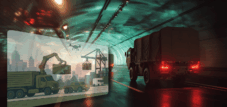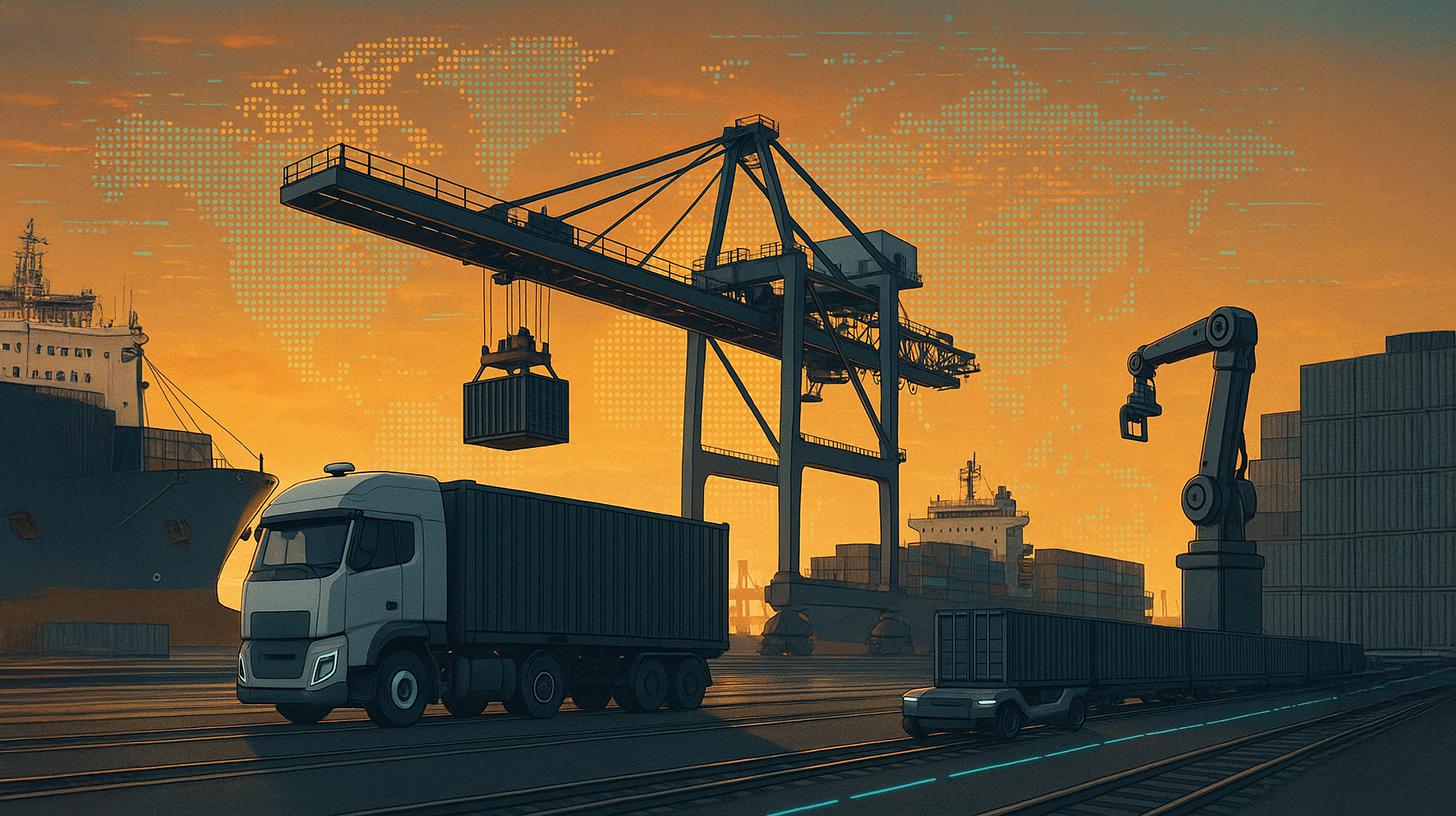
The future of global dual-use logistics: Strategic resilience in a fragmented world through intelligent infrastructure and automation – Image: Xpert.Digital
The epochal shift in global logistics and the new strategic imperatives
The dissolution of old certainties and the ingenious plan behind "dual-use": How the efficiency of defense logistics ensures that your packages always arrive

Dual-use logistics experts – Image: Xpert.Digital
The global economy is currently undergoing a fundamental transformation, a watershed moment that is shaking the foundations of global logistics. The era of hyper-globalization, characterized by the relentless pursuit of maximum efficiency and the "just-in-time" principle, is giving way to a new reality. This new reality is marked by profound structural breaks, geopolitical power shifts, and increasing fragmentation of economic policy. The once taken-for-granted predictability of international markets and supply chains is dissolving and being replaced by a period of growing uncertainty.
The figures paint a clear picture of this new volatility. Forecasts for 2025 indicate that 56% of all globally operating companies will be directly affected by geopolitical disruptions. Already, 94% of firms report significant revenue losses due to disruptions in their supply chains. Analyses show that a severe disruption statistically occurs every 3.7 years, with full recovery from such an event potentially taking two to three years. This new volatility is not a temporary phenomenon but a structural feature of the 21st century. It is forcing decision-makers in business and politics to reassess the fundamental assumptions upon which their strategies are based.
The rise of resilience as a strategic goal
In this new paradigm, a concept moves from the background to the strategic forefront: resilience. The ability not only to maintain supply chains after negative events, new regulatory requirements, or unforeseen shocks, but to continue them adaptively and in a strengthened state, becomes crucial for survival and competitiveness. Resilience and the associated agility are no longer merely desirable attributes, but are becoming just as important, if not more so, than pure cost optimization, which dominated thinking in recent decades.
Building resilience is a multifaceted undertaking. It requires a proactive and holistic approach that goes beyond traditional risk management strategies. Key components include diversifying the supplier base and transport routes to reduce dependence on single sources or routes. Companies and governments must establish a broad portfolio of suppliers and transport corridors for sensitive materials, products, and components to remain operational in times of crisis. This realignment represents a fundamental departure from the "lean" principle. Investments previously considered "redundant" or "inefficient"—such as maintaining alternative transport routes, building strategic buffer stocks, or qualifying secondary suppliers—are now re-evaluated as essential "resilience insurance." The calculation of the return on investment (ROI) for infrastructure and logistics projects must reflect this paradigm shift: the costs of unavailability far outweigh the costs of preparedness.
Smart Logistics Backbone: Xpert.Digital and its partners
According to Xpert.Digital and its partners, the concept of "dual-use" is undergoing a profound transformation in this new paradigm. Traditionally understood as a regulatory obstacle in export control law, dual-use is evolving into a proactive, strategic instrument for building national and economic resilience. It is no longer just about preventing the misuse of goods, but about actively promoting the dual use of infrastructures, technologies, and processes to ensure both economic prosperity and national security.
This article will demonstrate how the intelligent and synergistic integration of civilian and military logistics requirements, supported by groundbreaking technological innovations, represents the decisive competitive and security advantage of the future. It will examine how a "Smart Logistics Backbone," acting as a digital nervous system, enables a new generation of resilient infrastructure and how highly automated, AI-driven logistics hubs can become the stabilizers of fragile global supply chains.
Dual-use logistics redefined: From control regime to the foundation of national and economic resilience
The traditional view: Dual-use as export control
Historically and in current practice, the term "dual-use" is inextricably linked to the complex field of export control. Dual-use goods are products, software, and technologies that can be used for both civilian and military purposes. This dual usability carries the risk of misuse, which is why trade in such goods is subject to strict international and national controls.
The aim of these control regimes, such as the multilateral Wassenaar Arrangement, is to prevent the proliferation of weapons of mass destruction (NBC weapons) and delivery systems, as well as to prevent destabilizing conventional armaments in conflict regions. Within the European Union, Regulation (EU) 2021/821 governs trade in these goods. Its annexes, in particular Annex I, contain a detailed list of controlled goods, divided into ten main categories (from Category 0 "Nuclear materials" to Category 9 "Aerospace and propulsion") and five subgroups (from A "Systems" to E "Technology").
For companies trading in dual-use goods, this translates into significant administrative and procedural burdens. Export typically requires special permits issued by national authorities such as the Federal Office for Economic Affairs and Export Control (BAFA) in Germany. Various types of licenses exist, including EU-wide general export licenses (EUGEAs), national general export licenses (NGEAs), global licenses for a single exporter covering multiple goods and countries, and individual export licenses for a specific transaction. Companies are obligated to conduct comprehensive due diligence to ensure their products are not used for illicit purposes or to violate human rights. This traditional view frames dual-use primarily as a restrictive necessity—a hurdle to be managed to ensure compliance and avoid negative consequences.
The paradigm shift: Dual-use as a strategic infrastructure concept
The geopolitical and economic upheavals of recent years are forcing a fundamental paradigm shift in the understanding of dual-use. Instead of limiting the concept to individual, sensitive goods, the core idea of dual-use is increasingly being extended to entire systems and, above all, to strategically relevant transport infrastructures. This broader definition no longer focuses solely on the control of goods, but rather on the deliberate design and integration of logistics infrastructures and processes that meet both civilian and military requirements.
This approach transforms dual-use technology from a reactive control mechanism into a proactive tool for shaping national resilience. The central question is no longer simply: "How do we prevent the misuse of this technology?", but rather: "How can we design this infrastructure so that it strengthens our economy during normal operation and guarantees our security in times of crisis, disaster, or defense?"
The successful implementation of such a dual-use infrastructure requires close and institutionalized cooperation, so-called integrated governance, between the relevant stakeholders: military bodies such as the German Armed Forces and NATO, civilian authorities such as transport and economic ministries, infrastructure operators, and the private logistics sector. Such an approach breaks down traditional silos and creates synergies that would be unattainable with isolated planning approaches.
Civil-military cooperation (CMC) as an operational foundation
Civil-military cooperation (CMC) provides the operational foundation for this strategic infrastructure concept. In Germany, CMC is an established instrument that extends far beyond mere disaster relief and is considered essential for national and collective defense. Its core principle is the pooling of civilian and military forces and resources to enable their more effective deployment.
The National Security Strategy and the Defense Policy Guidelines emphasize that a sustainable overall defense is only possible through close cooperation between military and civilian partners. Military defense is not feasible without a functioning civil defense, and vice versa. This includes the protection of critical infrastructure, the maintenance of government functions, and the supply of provisions to the population and the armed forces.
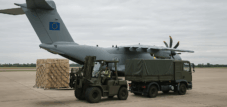
The German Armed Forces (Bundeswehr) provide assistance to civilian authorities in the event of natural disasters, major accidents, or, as during the COVID-19 pandemic, public health emergencies. In doing so, they provide not only personnel but also unique logistical capabilities and equipment, such as armored personnel carriers, swap body trucks, and engineering equipment. This cooperation is not a one-way street. In the event of a national emergency, the military relies on support from the civilian sector, for example, in terms of transport capacity, maintenance, or the provision of supplies. Civil-military cooperation (ZMZ) establishes the necessary structures, procedures, and, above all, the foundation of trust to ensure this collaboration functions smoothly in a crisis.
The added value for civilian modernization
The strategic realignment of logistics infrastructure based on the dual-use concept offers immense added value that extends far beyond mere security considerations. Investments made from the perspective of national resilience are not simply military expenditures, but represent a profound modernization of civilian infrastructure.
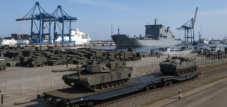
One example of this is combined rail-road transport. Upgrading rail networks for the transport of heavy military vehicles (e.g., increasing the load class to UIC track class D4) or expanding combined transport terminals with ramps for RoRo (roll-on/roll-off) loading of wheeled and tracked vehicles directly benefits the civilian economy. A more robust and efficient rail infrastructure relieves chronically congested roads, reduces traffic jams, noise, and, above all, CO2 emissions. Shifting long-distance transport from road to rail can reduce CO2 emissions by up to 80%.
These investments create a classic win-win situation. The economy benefits from more efficient, cost-effective, and environmentally friendly transport chains. Society benefits from reduced traffic congestion and an improved environmental footprint. And the state strengthens its strategic autonomy and capacity to act in times of crisis. Applying the dual-use principle to infrastructure projects transforms the political and economic justification for the necessary, often massive, investments. It is no longer a matter of a "military project" or a "civilian project," but rather a "national resilience project" that safeguards the economic prosperity, social resilience, and strategic sovereignty of Germany and Europe in an increasingly uncertain world.
The backbone of the future: The “Smart Logistics Backbone” as an integrated nervous system
Concept definition: What is a "Smart Logistics Backbone"?
A "Smart Logistics Backbone" is the consistent fusion of physical infrastructure—the bones and joints of global trade, such as ports, terminals, rail networks, and road corridors—with a comprehensive digital system that acts as an intelligent nervous system. This digital system collects, processes, and distributes data in real time across all nodes and actors in the supply chain. The goal is to create a seamless, flexible, and highly efficient supply chain that is fully integrated and synchronized at the physical, digital, and operational levels.
This concept goes far beyond the isolated digitization of individual companies or logistics hubs. It describes a networked ecosystem in which information flows as smoothly and in a standardized manner as the physical goods themselves. It is the backbone that enables a transition from reactive control of logistics processes to proactive, predictive, and ultimately self-optimizing orchestration.
The physical level: Smart Logistics Nodes
The fundamental building blocks of the physical backbone are the logistics hubs, which are evolving into "Smart Logistics Nodes" (SLNs). An SLN is defined as a seaport, airport, freight center, or inland terminal that utilizes advanced data exchange and information technologies to profoundly improve and automate its internal and external processes.
Leading global ports such as Shanghai, Rotterdam, Hamburg, and Los Angeles are pioneers in implementing Smart Logistics Network (SLN) concepts. They are leveraging technologies like the Internet of Things (IoT), big data analytics, and artificial intelligence (AI) to enhance their operational efficiency, sustainability, and security. A prime example of citywide integration that applies SLN principles to a metropolis is the Rio Operations Center (COR) in Rio de Janeiro. There, a central control center aggregates data streams from diverse sources—traffic management systems, weather radar, security cameras, social media, and citizen feedback systems—to create a unified, real-time overview of the city. This model of cross-departmental and cross-sectoral data fusion for controlling complex systems serves as a blueprint for the operation of a national Smart Logistics Backbone.
The digital level: The technological foundation
Internet of Things (IoT)
IoT sensors on containers, vehicles, cranes, and in warehouses act as the system's sensory organs. They deliver a continuous stream of real-time data on the condition, exact location, temperature, and estimated time of arrival of shipments and equipment. This creates unprecedented end-to-end transparency across the entire supply chain and forms the basis for all further optimization.
Artificial Intelligence (AI) and Predictive Analytics
AI algorithms are the brain of the backbone. They analyze the vast amounts of data from IoT sensors and other sources, identify patterns, predict future events such as demand spikes or potential disruptions, and suggest optimal courses of action. Predictive analytics makes it possible to move from simply looking at the past to actively shaping the future.
Digital Twins
A digital twin is a highly detailed, dynamic virtual representation of a physical object or system, such as an entire port terminal or logistics corridor. This virtual model is continuously fed with real-time data from the physical world. It enables the simulation of complex operational scenarios, the identification of bottlenecks, predictive maintenance planning, and the testing of the impact of strategic decisions before they are implemented in reality.
Data platforms and "neutral host" models
For data exchange to function effectively in an ecosystem with many different stakeholders (shipping companies, terminal operators, freight forwarders, customs, military), open yet secure data platforms are essential. These platforms provide standardized interfaces and protocols. Innovative "neutral host" operating models, such as those being tested in the Finnish LuxTurrim project for 5G networks in smart cities, could serve as a model here. A neutral operator provides the basic digital infrastructure (the backbone) on which various service providers can offer their services. This fosters innovation and prevents the creation of proprietary data silos.
The operational level: Integration and orchestration
The true strength of the Smart Logistics Backbone unfolds at the operational level, where the physical and digital worlds merge into a seamless unit. The backbone enables smooth, synchronized planning and control across various modes of transport, which is particularly crucial for combined rail-road transport.
Imagine this scenario: A ship approaching a port connected to the backbone network automatically transmits its precise, AI-calculated estimated time of arrival (ETA) to the port terminal's digital twin. The terminal then autonomously reserves a berth and the necessary container cranes. Simultaneously, the information is forwarded to the digital twin of an inland rail terminal, which proactively books a slot on a freight train. The system informs the end customer's freight forwarder of the exact time window in which the truck can pick up the container at the destination station. Every step is transparent, automated, and optimized.
This level of integration is a key prerequisite for the vision of the "Physical Internet" (PI), in which physical goods, packaged in standardized, smart containers, are routed like data packets through a global, open logistics network. A national smart logistics backbone is the crucial step in turning this future concept into reality. It creates a strategic advantage, a kind of "data gravitational field" that attracts efficiency, resilience, and innovation, and is difficult for competitors to replicate.
Consulting - Planning - Implementation

Markus Becker
I would be happy to serve as your personal advisor.
Head of Business Development
Intelligent warehousing solutions and automated container terminals: The quantum leap in global logistics
Revolution at the heart of logistics: Automated container terminals and high-bay container warehouses
The limitations of conventional terminals
Traditional container terminals, based on rubber-tired reach trucks (RTGs) or straddle carriers, are increasingly reaching their physical and operational limits. Their fundamental principle of "chaotic storage," where containers are stacked on top of each other to utilize space, leads to a fundamental efficiency problem. As soon as a container is needed that is not at the top of the stack, all the containers above it must first be moved. These unproductive handling movements, known as "reshuffling" or "housekeeping," account for 30% to 60% of all crane movements in a busy terminal.
This inefficiency has far-reaching consequences. The effective utilization of a conventional terminal is limited to approximately 70% to 80% of its theoretical capacity. If this threshold is exceeded, the number of necessary handling movements increases exponentially, and the terminal's performance collapses. Handling times for ships and trucks become unpredictable, leading to long waiting times and congestion at the gates, and operating costs rise due to the high energy and personnel expenditure on unproductive work. In a world that demands speed and predictability, this system represents a structural bottleneck.
The principle of the Automated High Racking System (AHRS / HBS)
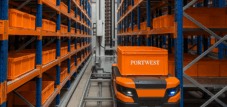
Automated high-bay storage systems (AHRS), often also referred to as high-bay storage (HBS), represent a radical break with the old paradigm. Instead of haphazardly stacking containers on top of each other, each individual container is stored in a dedicated, assigned, and digitally addressable shelf space – similar to a gigantic shoebox rack. Storage and retrieval are fully automated by rail-guided storage and retrieval machines (SRMs) or autonomous shuttles that move at high speed between the up to 50-meter-high rows of racks.
The decisive advantage of this system is the immediate, direct access to every single container at any time. Time- and energy-intensive reshuffling is completely eliminated. This means that 100% of all crane movements are productive – they are solely dedicated to storing or retrieving a container. This transition from "chaotic storage" to "deterministic storage" is the real quantum leap. The time and energy required to access any given container are no longer variable and unpredictable, but constant and precisely calculable. This predictability is the fundamental prerequisite for effective digitalization and AI-supported optimization of the entire port logistics process.
Quantifiable benefits of automation
Space efficiency
By consistently utilizing the third dimension, AHRS (Advanced High-Resolution Storage Systems) can triple or quadruple storage capacity on the same footprint or reduce the space required for the same number of containers by up to 90%. A practical example shows that 250 containers, which conventionally require 9,000 m², can be stored in an AHRS on just 950 m². This allows ports in densely populated areas to massively increase their capacity without having to develop expensive and scarce land.
Operating costs (OPEX) & capital expenditures (CAPEX)
The initial capital expenditure (CAPEX) for an AHRS is undoubtedly high. However, over the plant's lifetime, this is more than offset by massive savings in land costs and ongoing operating expenses (OPEX). Analyses indicate a reduction in OPEX of 25% to 55%, primarily due to a reduction in labor costs of up to 70%. Furthermore, the systems are more energy efficient; pilot projects demonstrated energy costs that were 29% lower than expected, along with significantly reduced maintenance requirements.
Throughput & Efficiency
Eliminating unproductive movements leads to a dramatic increase in handling speed. Performance indicators show up to 31.8 movements per hour on the landside. Truck turnaround times can be reduced to under 30 minutes, and in optimized systems even to just a few minutes, preventing congestion at terminals and drastically improving the efficiency of landside logistics.
Safety & Sustainability
AHRS are fully encapsulated, automated systems. The actual storage area is never entered by people, drastically reducing the risk of workplace accidents. Operation is entirely electric and can be powered by certified green electricity. Many designs integrate photovoltaic systems on the large roof surfaces and utilize energy recovery (recuperation) systems during braking or lowering of loads. This enables CO₂-neutral or even energy-positive operation and minimizes noise and light emissions, significantly improving acceptance in urban areas.
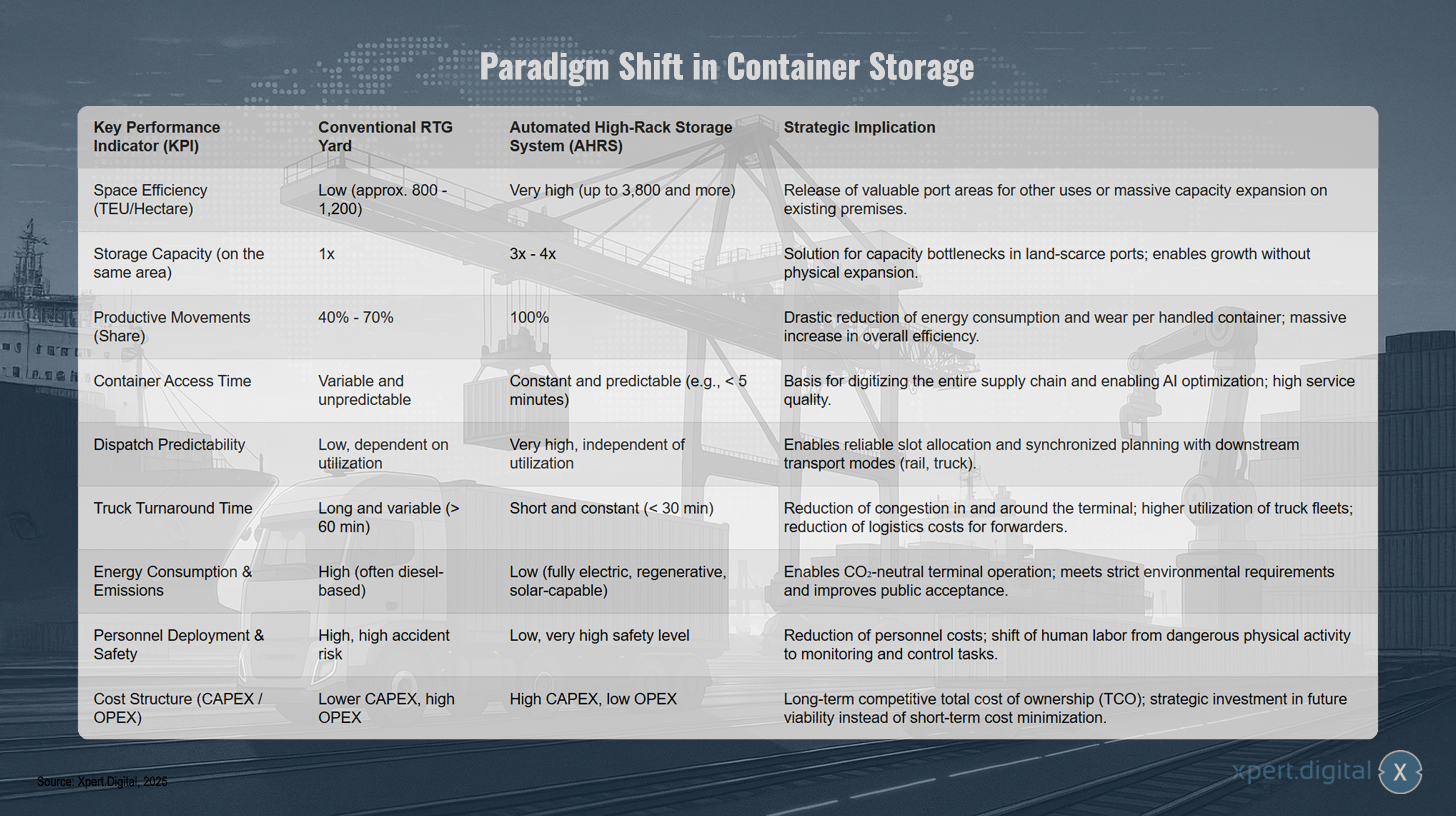
The following table summarizes the paradigm shift in container storage and highlights the strategic implications of the technological advantages.
Paradigm shift in container storage
Paradigm shift in container storage – Image: Xpert.Digital
The paradigm shift in container storage is clearly evident when comparing conventional RTG yards with automated high-bay racking systems (AHRS). While the space efficiency of conventional systems is rather low, at around 800 to 1,200 TEU per hectare, AHRS achieves values of up to 3,800 TEU and more, freeing up valuable port space or enabling massive capacity expansions on existing sites. Storage capacity on the same footprint increases three- to fourfold, thus resolving capacity bottlenecks in land-scarce ports and enabling growth without physical expansion. A further advantage lies in productive movements: these are only 40 to 70 percent in conventional yards, whereas they reach 100 percent in AHRS, drastically reducing energy consumption and wear per handled container and significantly increasing overall efficiency.
Container access times are variable and unpredictable in conventional systems, whereas in the automated system they are constant and predictable, for example, under five minutes. This forms the basis for the digitalization of the entire supply chain and enables AI optimizations while maintaining consistently high service quality. The predictability of handling is low in conventional yards and dependent on capacity utilization, whereas it is very high in the AHRS system and independent of capacity utilization. This allows for reliable slot allocation and synchronized planning with downstream transport modes such as rail and truck.
There are also significant differences in truck handling times: conventional yards have long and variable times, exceeding 60 minutes, while AHRS offers short and consistently under 30 minutes. This reduces congestion in and around the terminal, increases the utilization of truck fleets, and lowers logistics costs for freight forwarders. Energy consumption and emissions are high with conventional systems, often diesel-based, whereas the automated system is low, fully electric, regenerative, and solar-powered, enabling CO₂-neutral terminal operation, meeting stringent environmental regulations, and improving public acceptance. In terms of personnel and safety, conventional yards require significant resources and carry a high risk of accidents, while AHRS offers low personnel costs with a very high level of safety, shifting human labor from hazardous tasks to monitoring and control functions.
Finally, the cost structure reveals a difference between lower CAPEX and high OPEX for conventional systems compared to high CAPEX and low OPEX for automated systems. In the long term, this results in competitive total cost of ownership (TCO), making investment in AHRS a strategic decision for future viability rather than short-term cost minimization.
Challenges and Implementation
Despite its overwhelming advantages, implementing an AHRS (Advanced Heating and Retention System) is a complex and capital-intensive undertaking. The high initial investment, system complexity, and long implementation times of at least 12 months represent the biggest hurdles. The projects require meticulous planning that also takes into account stringent structural requirements for the foundation slab and fire protection.
A critical success factor is the seamless software integration of the AHRS warehouse management system (WMS) into the overarching terminal operating system (TOS). Only in this way can the full potential of automation be realized. To minimize investment risks, most AHRS concepts are modular and scalable. A terminal can start with an initial module and expand the system gradually, depending on capacity requirements and financing options. This approach also enables smaller ports to adopt the technology and ensures the future viability of their logistics infrastructure in global competition.
The intelligence of buffering: AI-controlled autonomous warehouses as stabilizers of the supply chain
The new role of buffer bearings
The experiences of recent years, particularly the vulnerabilities of traditional supply chains to unexpected bottlenecks revealed by the COVID-19 crisis, have underscored the need for more flexible and robust solutions. Buffer warehouses are no longer merely passive storage facilities for surplus goods, but are becoming active, dynamic hubs within the logistics network. They enable the decoupling of volatile upstream supply chains from more stable downstream production or distribution processes. In a dual-use context, they are crucial for stockpiling critical goods, from medical supplies in the event of a disaster to spare parts and ammunition in case of defense.
AI as the brain of the camp: From reactive to predictive
The decisive shift in the way modern buffer warehouses function is being driven by the use of artificial intelligence. AI systems act as the central brain of the warehouse, transforming inventory management from a reactive to a predictive process.
Advanced machine learning algorithms continuously analyze vast and heterogeneous datasets in real time. This includes not only internal data such as historical sales figures and current inventory levels, but also external factors such as market trends, weather forecasts, commodity prices, social media sentiment, and geopolitical risk indicators. From this data, AI identifies complex patterns and generates highly accurate demand forecasts.
This capability enables dynamic and precise inventory management. Instead of relying on rigid safety stock levels, the system can optimally adjust inventory levels to forecasted demand. This simultaneously avoids two costly extremes: overstocking, which ties up capital and incurs storage costs, and stockouts, which lead to production downtime or dissatisfied customers. AI-driven systems can also automatically trigger reordering processes as soon as forecasted minimum stock levels are reached, even suggesting optimal suppliers and order times.
Autonomous systems as an executing force
While AI makes the strategic and tactical decisions, autonomous systems are the executing force, the muscles of the intelligent warehouse. A new generation of logistics robots takes over the physical handling of goods:
Autonomous Mobile Robots (AMRs) and Automated Guided Vehicles (AGVs)
These systems navigate autonomously through the warehouses, transporting pallets, containers or individual products and continuously optimizing their routes to avoid collisions and minimize transport times.
AI-controlled cranes and storage and retrieval machines
In high-bay warehouses, AI algorithms control the movements of the cranes to optimize storage and retrieval strategies (e.g., storing frequently needed items closer to the goods issue area).
Robotic order picking systems
Robot arms, equipped with advanced 3D image processing and gripping technology, can pick individual items from containers and assemble them for shipping.
Automated quality control
AI-powered image recognition systems scan incoming goods for damage, check barcodes or labels, and automatically sort out defective products. This increases quality and reduces errors throughout the entire process chain.
The symbiosis: The intelligent, autonomous buffer storage
The true strength arises from the seamless symbiosis of AI as the brain and robotics as the executing body. This combination creates a cybernetic, self-optimizing system that learns and adapts in real time. The AI not only plans the optimal storage locations and transport routes, but also adjusts these plans to the current situation in a matter of seconds – for example, if an urgent order is received or a delivery truck arrives unexpectedly early.
This intelligent buffer warehouse thus becomes an "innovation lab" for the entire logistics operation of a company. New processes or strategies can be tested and validated here on a small scale before being rolled out company-wide. The efficiency gains are enormous: throughput times are drastically reduced, the error rate drops to near zero, and operating costs are lowered through the optimized use of personnel, space, and energy. The "goods-to-person" picking principle, in which robots deliver the required items directly to the employee's workstation, not only increases speed but also improves ergonomics and safety.
AI in military and dual-use logistics
The principles of AI-controlled autonomous warehousing are directly transferable to the highly demanding requirements of military and dual-use logistics. The military already makes extensive use of AI to create situational awareness by extracting relevant information and identifying threats from an overwhelming flood of sensor data (e.g., from satellites, drones, and reconnaissance vehicles).
This same approach can revolutionize military logistics. Instead of operating based on rigid plans, AI can predict the actual need for spare parts, ammunition, fuel, or medical supplies based on real-time operational data, damage reports, and projected operational outcomes. Autonomous systems such as delivery drones or unmanned ground vehicles can then take over the supply of units in the field or the restocking of field camps, reducing the risks to human logistics convoys.
In this safety-critical environment, the safety and security of AI systems is of paramount importance. The systems must be robust against hostile cyberattacks, manipulation, and technical failures. Their decisions must remain transparent and controllable, while humans must always retain final control ("human in the loop"). Developing such secure AI systems is a key challenge, but also a prerequisite for building a future-proof, resilient dual-use logistics system.
Consulting - Planning - Implementation
Markus Becker
I would be happy to serve as your personal advisor.
Head of Business Development
Digital, resilient, secure: Smart Logistics Backbone and the challenges and opportunities for business and politics
The job profile of the future dual-use logistics expert
The convergence of disciplines
The preceding analyses paint a clear picture: The logistics of the future is no longer an isolated field. It emerges at the complex intersection of global geopolitics, comprehensive civil-military defense planning, strategic infrastructure engineering, resilient IT architecture, and the profound application of artificial intelligence. The era in which logistics was primarily understood as an operational function for cost minimization is irrevocably over. Today, it is a central component of national and corporate strategy, whose individual domains—politics, technology, economics, and security—can no longer be considered separately. A state-of-the-art, automated terminal is worthless without a robust cybersecurity strategy. Brilliant AI optimization is useless if the regulatory framework for data exchange is lacking. A national resilience strategy remains theoretical if it is not translated into concrete, technologically advanced, and economically viable infrastructure projects.
From specialist to orchestrator
This convergence of disciplines demands a new type of expert. The specialist sought after in the past—be it a pure logistics expert, an IT architect, or a political consultant—can no longer grasp the complexity of the overall system alone. The future belongs to the strategic orchestrator. This role requires the rare ability to understand the interdependencies between different domains, to translate the respective technical languages, and to unite the various stakeholders toward a common goal. The orchestrator doesn't think in terms of individual projects, but rather in interconnected ecosystems. They plan not only the construction of a facility, but also the rules, data flows, and business models that make this facility a living part of a larger whole.
The required competency profile
The analysis yields a clear profile of requirements for this future dual-use logistics expert. He or she must possess a unique combination of skills:
In-depth expertise in digital transformation & automation
A sound understanding not only of the technologies themselves (AI, IoT, digital twins, robotics), but above all of their successful implementation in highly complex, safety-critical, and existing environments ("brownfield"). This includes the ability to conduct feasibility studies, design system architectures, and manage complex integration projects.
Holistic expertise in logistics and process optimization
The ability to think beyond the scope of individual logistics functions and to analyze entire value chains and supply chains holistically. The goal is to redesign processes not only to increase efficiency, but above all to create sustainable competitive and resilience advantages.
Visionary force in “Pioneer Business Development”
The strategic and entrepreneurial ability to design entirely new, often disruptive business and operating models based on technological and geopolitical developments. This means thinking beyond traditional industry boundaries and, for example, developing a data-driven service platform from an infrastructure investment.
Strong strategic and geopolitical understanding
The ability to place technological and logistical decisions within the broader context of global risks, national security interests and the goals of civil-military cooperation, and to convincingly represent them to decision-makers in politics and business.
The partner for the new era – A hidden gem
Addressing the outlined challenges exceeds the capabilities of most individual companies or consulting firms, which typically specialize in only one of the aforementioned disciplines. Building a national "Smart Logistics Backbone" or implementing a dual-use, automated port terminal requires a partner with the rare ability to orchestrate all these competencies.
Such a partner must have a proven track record of success in digital pioneering, ideally dating back to the early days of commercial AI and the internet to ensure technological depth. This technological expertise must be combined with deep, practical know-how in logistics consulting and process optimization. Crucially, however, the third, and rarest, component is the ability to engage in "pioneer business development"—that is, the strategic vision to create entirely new value creation models from the convergence of technology and demand.
Companies that embody this holistic profile are rare and often operate under the radar of the general public. They are not merely technology providers or traditional management consultants, but strategic pioneers. For decision-makers facing the monumental task of equipping their country's or company's logistics infrastructure for the 21st century, collaborating with such a partner can mean the difference between success and failure. An entity like Xpert.Digital, which demonstrably combines expertise in digital transformation, logistics consulting, and strategic business development, can be considered a kind of insider tip – an indispensable guide possessing the rare, comprehensive expertise essential for the success of nationally relevant dual-use infrastructure projects.
Strategic recommendations for decision-makers in business and politics
The transformation of global logistics into a resilient, intelligent, and dual-use system is a task for both government and society as a whole. It requires concerted efforts and bold decisions from stakeholders in politics and business. The following recommendations are intended to serve as a guide along this path.
For politics (federal and state level)
Rethinking dual-use funding
Funding programs that explicitly invest in dual-use infrastructure are urgently needed. The evaluation of funding applications should no longer be based on separate civilian and military uses, but rather on the combined strategic added value for resilience, the economy, and security as the central criterion. Projects such as the expansion of intermodal terminals or the creation of digital logistics platforms should be prioritized.
Creating a regulatory framework for the “Smart Logistics Backbone”
The free yet secure flow of data is the lifeblood of an intelligent logistics system. Policymakers must proactively create a clear legal framework that regulates data exchange across levels and companies. This includes establishing binding data standards and interfaces, clarifying liability issues, and ensuring the highest levels of data protection and data security, particularly when involving operators of critical infrastructure.
Institutionalize and deepen civil-military cooperation (CMC)
Civil-military cooperation (CMC) in the logistics sector must be transformed from a reactive mode (providing assistance on demand) to a proactive, strategic planning partnership. Existing joint planning and management bodies must be strengthened and equipped with the necessary expertise and resources. Regular, realistic exercises bringing together civilian logistics providers, disaster relief organizations, and the German Armed Forces are essential for testing procedures and solidifying cooperation.
For businesses (logistics companies, industry, port operators)
Strategically invest in resilience
Companies must radically reassess their supply chains, prioritizing resilience alongside cost and efficiency. This means actively investing in diversifying suppliers and transportation routes. Implementing technologies such as automated buffer storage to mitigate shocks and evaluating AHRS technologies for major transshipment points should be treated as strategic priorities.
Actively shaping public-private partnerships (PPPs)
The private sector should not wait for government initiatives, but rather actively approach policymakers and propose models for public-private partnerships to build the national logistics backbone. The expertise and innovative capacity of private companies are indispensable for technological implementation. They must signal their willingness to invest in joint, long-term resilience projects.
Investing in future skills
Technological transformation necessitates a massive skills development initiative. Companies must invest in retraining and further education for their employees to develop the skills required for operating, maintaining, and controlling highly automated and AI-driven systems. This applies not only to IT specialists but also to logistics professionals, dispatchers, and maintenance personnel, whose job profiles will fundamentally change.
Shared strategic priorities
Treat cybersecurity as a top priority
The increasing digitalization and networking of logistics systems is creating new, critical attack vectors. A successful cyberattack on a central logistics hub or the digital backbone can have catastrophic consequences for the economy and security of supply. Analyses show that cyber risks are among the fastest-growing threats to supply chains. Government and industry must make joint efforts to develop and implement a robust, multi-layered security architecture for critical digital logistics infrastructure.
Define and implement lighthouse projects
To manage the complexity and make the benefits of the concept tangible, policymakers and businesses should jointly identify one or more flagship projects and implement them with high priority. One possible project would be the creation of a first, fully integrated dual-use corridor connecting a seaport equipped with AHRS technology to a smart inland intermodal terminal via a digitized rail line. Such a project would serve as a blueprint for the national rollout, provide valuable practical experience, and impressively demonstrate the feasibility and immense benefits of the "Smart Logistics Backbone" approach.
Consulting - Planning - Implementation
Markus Becker
I would be happy to serve as your personal advisor.
Head of Business Development
Consulting - Planning - Implementation
Konrad Wolfenstein
I would be happy to serve as your personal advisor.
You can contact me at wolfenstein∂xpert.digital or
Just call me on +49 7348 4088 965 .