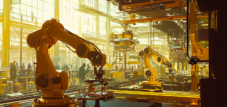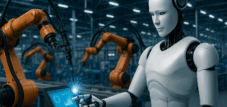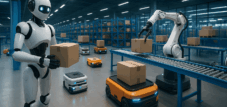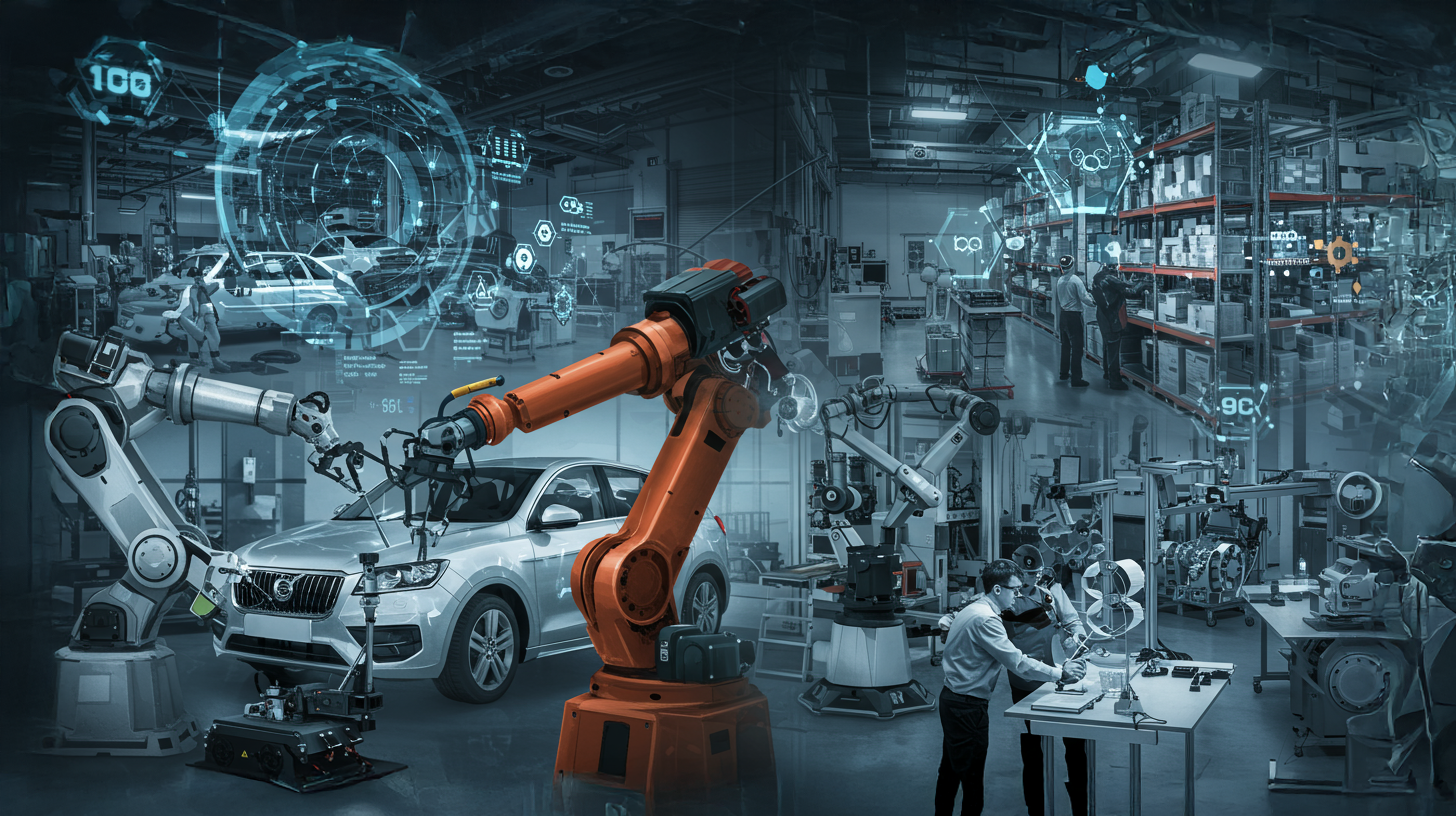
Germany's robotics boom: Robotics and automation in various industries – A comprehensive overview – Image: Xpert.Digital
The silent revolution: How AI and robotics are forever changing German industries
### Why Germany is among the world's best ### More than just industry: Cooking, caring, and bricklaying robots on the rise ### Robots that speak our language: This technology will soon change your everyday life ### Germany's secret helpers: How robots combat the skilled worker shortage and secure our future ###
How is robotics and automation developing in Germany?
Robotics and automation are experiencing a remarkable boom in Germany. In 2023, German industry installed more robots than ever before – a total of 28,355 new industrial robots, an increase of 7 percent compared to the previous year. The operational stock reached a new record high of 269,427 units, thus consolidating Germany's position as the largest robot market in Europe.
Germany has a robot density of 415 industrial robots per 10,000 employees, placing it third internationally – only South Korea and Singapore have higher rates. These figures demonstrate the high level of automation in the German economy and its pioneering role in Europe.
Revenue in the German robotics market is projected to reach approximately US$4.5 billion by 2025. Service robotics will dominate the market, boasting the largest projected market volume. Demand for automation solutions is steadily increasing in sectors such as manufacturing, healthcare, and logistics, driven in part by demographic shifts and the resulting skills shortage.
What role does robotics play in the logistics industry?
The logistics industry is facing a fundamental transformation through the use of robotics and AI technologies. In the coming years, the industry will experience a paradigm shift driven by advanced robotics and automation. Key developments focus on autonomous mobile robots (AMRs), AI-powered inventory management, automated sorting and packaging, and robotic process automation.
Leading companies like Sereact are developing AI-based robots specifically for logistics tasks. With "PickGPT," Sereact has developed the world's first Robotics Transformer, which combines Large Language Models with computer vision and enables robots to be instructed using natural language. This technology makes robotics accessible to employees without prior knowledge and is revolutionizing human-robot interaction in warehouses.
A practical example is the cooperation between Hörmann Intralogistics and Sereact: Through the targeted use of AI-based robotics solutions, the AutoStore portfolio is expanded and the efficiency of intralogistics projects is increased. The solution enables zero-shot learning, allowing picking robots to recognize and grasp new objects without prior programming.
Companies like Knapp present the AeroBot, a warehouse robotics system specifically designed for standard building heights, offering maximum storage density with maximum flexibility. Autonomous mobile robots, known as Open Shuttles, seamlessly integrate warehouse systems with workstations and production lines.
How is robotics changing the food industry?
The food industry is undergoing a significant transformation through robotics. Foodora, originally known as a delivery service, is now increasingly focusing on robotics in retail and testing innovative delivery models. The company is experimenting with delivery robots from Starship and drones from Aviant in Scandinavia, which offer great potential for sustainable, urban micro-logistics.
A particularly impressive example is the development of cooking robots. Companies like Aitme, founded by former Foodora CEO Emanuel Pallua, are developing robots that can cook lunch in under five minutes. These robots consist of two robotic arms that mix ingredients and heat them in pans, and can prepare up to 120 meals per hour.
At the University Hospital of Tübingen, robotic chefs from Goodbites are already in operation, capable of preparing up to 3,000 meals a day – theoretically around the clock. These systems can reduce labor costs by up to 80 percent and offer continuous availability without vacation or sick days.
Automation is also extending to agriculture: The German Research Center for Artificial Intelligence (DFKI) has developed the SHIVAA harvesting robot, which independently recognizes and picks ripe strawberries in open-field cultivation. The robot can harvest approximately 15 kilograms of fruit per hour and work for at least eight hours continuously.
What progress has been made in robotics in construction?
The construction industry is experiencing a technological breakthrough thanks to innovative robotic solutions. The development of cable robots for masonry work is particularly noteworthy. A revolutionary cable robot has been developed at the University of Duisburg-Essen that will be able to autonomously perform extensive masonry work in the future. This robot can independently overcome differences in height across multiple floors and offers a completely new approach to construction site automation.
The cable robot can not only lay bricks, but also move stones of different sizes, install lintels, and perform automated mortar application. This is based on Building Information Modeling (BIM), whose digital data is transferred directly to the robot. This enables seamless integration of planning and execution.
At TUM Munich, researchers are working on robots that can collaborate directly with humans on construction sites. These robots are equipped with grippers and mounted on mobile bases that can move freely. They bring precision to areas where humans reach their limits, complementing their abilities rather than replacing them.
This development shows that robots in the construction industry can not only take over physically demanding work, but can also help to inspire young people to enter the construction industry and counteract the shortage of skilled workers.
How do social robots support people with disabilities?
Social robots are evolving into important assistive technologies for people with disabilities. A project at Ravensburg-Weingarten University of Applied Sciences is researching how assistive robots can help people with physical disabilities in their daily lives. The robot "Kate" is designed to support users with simple everyday tasks, such as taking books from a shelf, clearing the table, or making coffee.
The Sawyer cobot is being used in an innovative project by Wertkreis Gütersloh gGmbH, Rethink Robotics, and the University of Duisburg-Essen to provide people with disabilities with better opportunities for inclusion, education, and participation. These collaborative robots can perform quality control checks directly at the workplace and handle automated production peaks.
Particularly noteworthy is the social robot Navel from Navel Robotics, which was specifically developed for caregiving. This empathetic robot can recognize and send nonverbal signals, which is essential for interpersonal interaction. In care facilities, Navel provides additional emotional and cognitive stimulation and supports social care.
The concept of social robotics goes far beyond mere functionality: these robots are intended to function as "butlers" and take over tasks when needed, without being intrusive. They can recognize emotions and react accordingly, making them valuable helpers in the social sector.
🎯🎯🎯 Benefit from Xpert.Digital's extensive, five-fold expertise in one comprehensive service package | BD, R&D, XR, PR & Digital Visibility Optimization

Benefit from Xpert.Digital's extensive, five-fold expertise in a comprehensive service package | R&D, XR, PR & Digital Visibility Optimization - Image: Xpert.Digital
Xpert.Digital possesses in-depth knowledge across various industries. This allows us to develop tailored strategies precisely aligned with the requirements and challenges of your specific market segment. By continuously analyzing market trends and monitoring industry developments, we can act proactively and offer innovative solutions. The combination of experience and expertise generates added value and provides our clients with a decisive competitive advantage.
More information here:
Autonomous robots on Mars: Germany's foray into space exploration
What developments are taking place in space research?
German space research is increasingly relying on autonomous robot swarms for Mars exploration. The German Space Agency's VaMEx (Valles Marineris Explorer) project is developing the world's first autonomous robot swarm for Mars exploration. The goal is to search for water and potentially life in the largest canyon in the solar system.
The robot swarm consists of various specialized units: drones map landscapes, ground vehicles like Artemis explore interesting locations, the climbing robot Crex handles difficult passages, and the transport rover Janus is particularly fast and robust. These robots communicate with each other via a planned 5G network on Mars.
The German Aerospace Center (DLR) is also testing the Scout Rover, a robot designed to move autonomously through caves. These caves could contain evidence of life, as they are protected from environmental influences and offer more moderate temperatures.
The developed technologies also have terrestrial applications: After earthquakes, autonomous robots could independently explore dangerous areas, search through debris, and find buried victims. A finalized plan for a European or German Mars mission is expected by 2030, with a possible launch around 2040.
How is robotics revolutionizing healthcare?
The healthcare sector is facing a robotic revolution, particularly in elderly care. Professor Sami Haddadin from the Technical University of Munich is developing the service robot GARMI, which aims to enable older people to live independently for longer. This robot combines butler functions with communication capabilities and telemedicine.
GARMI can assist with getting up, prepare small meals, and act as an interface to the outside world. The robot is equipped with ultra-lightweight gripper arms that are sensitive and capable of learning. In the event of unwanted contact, the arm stops moving within a thousandth of a second – significantly faster than human reactions.
Another innovative example is the E-BAR (Elderly Bodily Assistance Robot) from MIT, which acts as a mobile guide to assist elderly people with walking and standing. The robot can support a person's full body weight and is equipped with airbags that inflate in the event of an impending fall.
Social robots like LOVOT from Japan demonstrate how technology can provide emotional support. These "emotional devices" are warm, soft, respond to touch, and seek eye contact to evoke positive feelings and initiate social interaction.
What role does automation play in machining?
Machining processes are experiencing a significant increase in efficiency thanks to high-precision machining robots. The research project "Robots Made in Lower Saxony 2" (RoMaNi 2) developed a high-precision machining robot with a special drive train. This robot enables the machining of not only lightweight materials, but also metals and steels with a manufacturing tolerance of up to 0.1 millimeters.
FANUC, a world-leading robot manufacturer with over 100 models, offers solutions for a wide range of manufacturing applications. The ROBODRILL high-performance machining centers achieve tool change times of just 0.7 seconds and can handle tools weighing up to 4 kilograms.
German companies like Niederrhein Automation offer flexible automation solutions with cobots suitable for businesses of all sizes. These collaborative robots can work alongside employees without safety barriers and are suitable for a wide range of tasks such as assembly, welding, pick and place, palletizing, and machine tending.
Automation in manufacturing is being further advanced through the use of AI and machine learning. Humanoid robots are expected to be able to automate approximately 40 percent of tasks currently performed manually by 2030, with payback periods of less than 0.56 years.
What are the economic effects of robotics in Germany?
The German robotics and automation industry faces challenges, but also significant opportunities. Total revenue for 2025 is expected to reach €14.5 billion, representing a 10 percent decrease compared to the previous year. This decline is attributable to several factors: reluctance to invest due to geopolitical uncertainties, increasing competitive pressure from Asia, and dependence on the German automotive industry.
Despite current weaknesses, long-term developments show positive trends. In 2023, Germany produced a total of 34,788 industrial robots, achieving a market share of 6 percent of global demand. The market comprises manufacturers of classic high-performance robots and newer suppliers of cost-effective, low-cost robots.
The top 50 robot manufacturers in Germany exhibit a dynamic structure: Global players such as Bosch Rexroth, Linde Material Handling, Jungheinrich, and KUKA lead the ranking. Attractive application areas are emerging for suppliers of electronics, sensors, and software, as modern robots require extensive technical components.
Germany has a robot density of 415 units per 10,000 employees, placing it third internationally behind South Korea and Singapore. This high level of automation is crucial for the competitiveness of Germany, a high-wage country.
What future prospects does robotics offer?
The future of robotics in Germany is characterized by innovation and technological progress. German startups like Wandelbots are working on manufacturer-independent robot operating systems designed to promote the "democratization of robotics." Their operating system, Nova, aims to enable the programming and control of robots from various manufacturers without requiring specific technical expertise.
Companies like Robco from Munich specialize in modular robotics for medium-sized businesses and raised €39 million in a Series B funding round in 2024. These developments demonstrate that the German robotics startup scene remains innovative and dynamic despite changing market conditions.
The integration of artificial intelligence will further revolutionize robotics. AI algorithms enable robots to make independent decisions, recognize patterns, and adapt to new situations through self-learning. This opens up entirely new application possibilities in all industries.
In the future, 5G connectivity will enable machines to coordinate with each other in real time, further increasing the level of automation in the economy. Collaborative robotics, in which robots can react flexibly to unpredictable and complex requirements, will become the standard.
By 2030, an estimated 20 million humanoid robots will be in use, primarily in industrial applications. This development will not only increase efficiency but also create new jobs in the robotics industry and enhance the quality of existing jobs.
German robotics is thus facing a transformation that will affect all areas of life – from manufacturing and healthcare to space exploration. The key to success lies in the intelligent combination of human creativity and robotic precision.
We are here for you - Consulting - Planning - Implementation - Project Management
☑️ SME support in strategy, consulting, planning and implementation
☑️ Creation or realignment of the digital strategy and digitization
☑️ Expansion and optimization of international sales processes
☑️ Global & Digital B2B trading platforms
☑️ Pioneer Business Development

Konrad Wolfenstein
I would be happy to serve as your personal advisor.
You can contact me by filling out the contact form below or simply call me on +49 7348 4088 965 .
I'm looking forward to our joint project.
Write to me


Xpert.Digital - Konrad Wolfenstein
Xpert.Digital is a hub for industry focusing on digitalization, mechanical engineering, logistics/intralogistics and photovoltaics.
With our 360° Business Development solution, we support renowned companies from new business to after-sales.
Market intelligence, smarketing, marketing automation, content development, PR, mail campaigns, personalized social media and lead nurturing are part of our digital tools.
You can find more information at: www.xpert.digital - www.xpert.solar - www.xpert.plus
Keep in touch