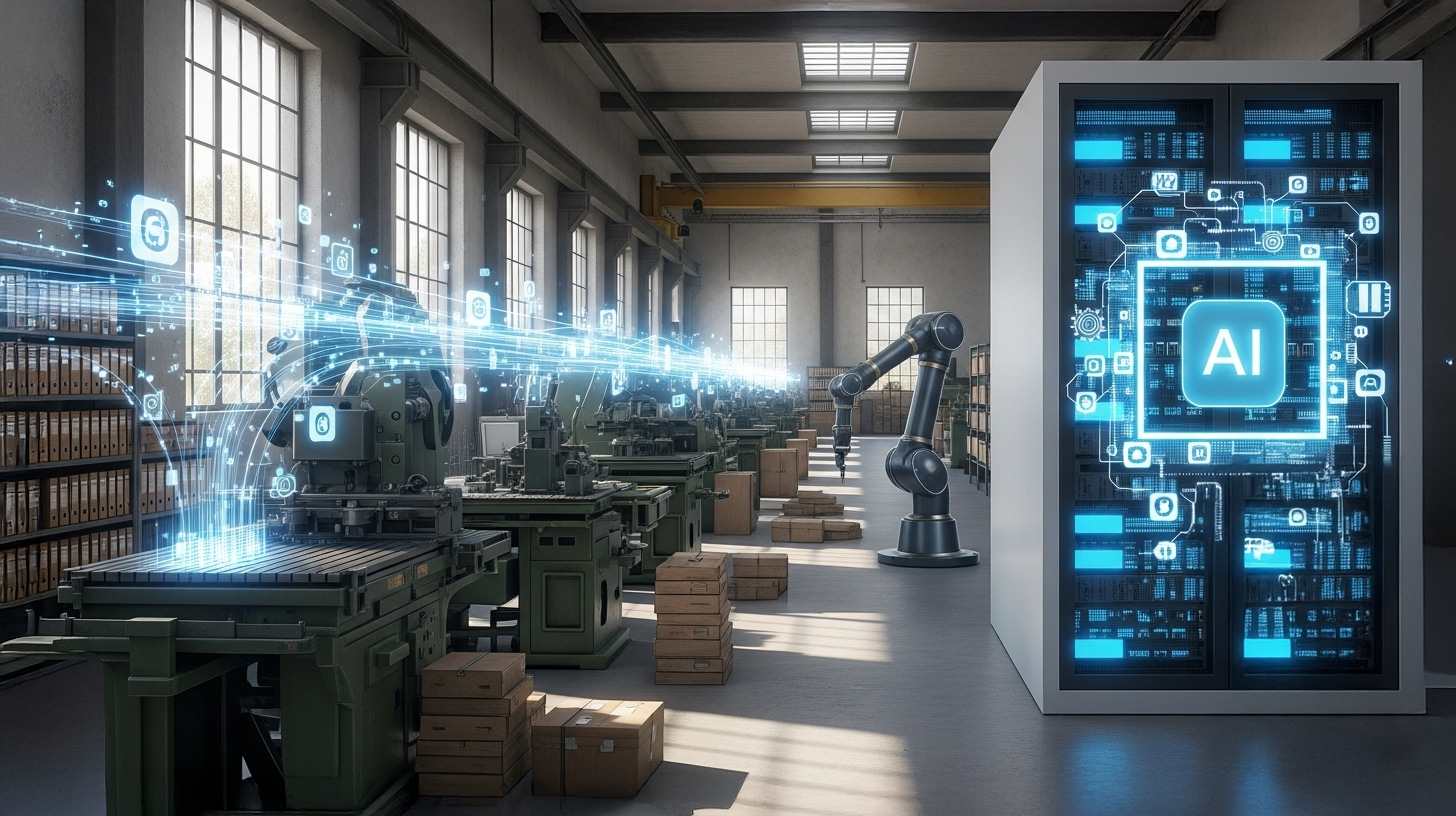
Germany's data treasure: How historical production data secures the AI advantage in mechanical engineering – Image: Xpert.Digital
More than just zeros and ones: The untapped data treasure that can save mechanical engineering
China's nightmare? Germany's secret AI weapon lies in old archives
German mechanical engineering, a global synonym for precision and quality, stands at a crucial turning point. In an era where artificial intelligence is rewriting the rules of industrial production, traditional engineering alone is no longer sufficient to defend its global leadership position. However, the future of market leadership will not be decided by the generation of ever more data, but by the intelligent use of an often overlooked yet invaluable asset that already lies dormant in companies' digital archives.
This capital is the treasure trove of historical production data accumulated over decades – the digital gold of the 21st century. Every sensor reading, every production cycle, and every maintenance report from past years reflects the unique DNA of German manufacturing processes. These vast, high-quality datasets form the foundation for a decisive competitive advantage in the age of AI. They enable machines to learn, optimize processes autonomously, and achieve a level of quality and efficiency that previously seemed unattainable.
Surprisingly, this treasure trove remains largely untapped. Although most companies recognize the importance of AI, many, especially SMEs, hesitate to implement it widely. They are stuck in the "pilot trap," caught in a vicious cycle of isolated projects, a lack of trust, and uncertainty about how to generate measurable profit from the mountains of data. This hesitancy is not a technological but a strategic hurdle—a "trust gap" that blocks the path to the future.
This article demonstrates why this reluctance poses a direct threat to competitiveness and how companies can close this gap. We explore how existing data treasures can be systematically unlocked through modern methods such as synthetic data and transfer learning, how managed AI platforms make implementation accessible and cost-effective for SMEs, and what concrete, measurable ROI companies can expect in areas such as predictive maintenance and intelligent quality control. It's time to shift our focus away from the perceived lack of data and activate the wealth that already exists.
The strategic imperative: From data treasure to competitive advantage
For the German mechanical and plant engineering sector, the integration of artificial intelligence (AI) is far more than a technological upgrade; it is the decisive lever for maintaining its global leadership position in a new industrial era. The industry is at a turning point where future competitiveness will depend not on the generation of new data, but on the intelligent utilization of a data treasure trove accumulated over decades. Those who hesitate now to unlock this treasure risk falling behind in a future characterized by data-driven autonomy, efficiency, and unprecedented quality.
Germany's unique starting position: A wealth of data meets engineering expertise
German mechanical and plant engineering possesses an exceptionally strong and globally unique starting position to take the lead in the AI-based industrial revolution. The foundations have already been laid, forming a base that international competitors cannot easily replicate. A world-leading robot density of 309 industrial robots per 10,000 employees testifies to an extremely high degree of automation. Only South Korea and Singapore have higher densities. Even more crucial, however, is the digital wealth created through the consistent implementation of Industry 4.0. German companies can draw upon a globally unique reservoir of digital machine data, accumulated over years and decades. This historical production data is the gold of the 21st century – a detailed digital representation of processes, materials, and machine behavior, unparalleled in its depth and quality. Coupled with internationally recognized German engineering expertise, this offers enormous potential to redefine the production of the future and develop Germany into a global center for industrial AI software.
However, reality reveals a remarkable discrepancy. Although two-thirds of German companies consider AI to be the most important technology of the future, studies show that only between 8% and 13% actively use AI applications in their processes. This hesitancy, particularly among SMEs, is not due to a lack of assets, but rather to the challenge of recognizing and activating the value of existing data.
The activation challenge: From data collection to value creation
The reasons for this reluctance are multifaceted, but at their core, they crystallize not as a scarcity of data, but as strategic hurdles: a lack of internal expertise in data analysis, a lack of trust in the new technology, and an inadequate strategy for leveraging the available data. Many companies are caught in the so-called "pilot trap": they initiate isolated pilot projects but shy away from broad implementation that systematically utilizes the wealth of data. This hesitancy often stems from a fundamental uncertainty about how to generate a clear return on investment (ROI) from the vast, often unstructured datasets. It is less a technological deficit than a "strategic trust gap." Without a coherent data utilization strategy and a clear implementation path, investments remain low and projects isolated. The lack of transformative success from these small experiments, in turn, reinforces the initial skepticism, leading to a vicious cycle of stagnation.
Competitiveness in Industry 4.0: Those who do not act now will lose out
In this environment, the global competitive landscape is changing rapidly. Traditional German strengths such as the highest product quality and precision are no longer sufficient as sole differentiators. International competitors, particularly from Asia, are catching up in terms of quality and combining this with greater speed and flexibility in production. The days of accepting a compromise between top quality and longer delivery times are over. The competition isn't waiting and isn't paying tribute to Germany's engineering heritage. Failing to utilize the existing wealth of data is therefore no longer just a missed opportunity, but a direct threat to long-term market leadership. Stagnant productivity gains and rising costs are putting additional pressure on the industry. The intelligent analysis of historical and current production data using AI is the key to unlocking the next level of productivity, making processes more flexible, and sustainably securing competitiveness in Germany, a high-wage location.
The gold in the archives: The inestimable value of historical production data
At the heart of any high-performance AI lies a high-quality and comprehensive dataset. This is precisely where the crucial, often overlooked advantage of German mechanical engineering lies. The operational data collected over decades within the framework of Industry 4.0 is not a byproduct, but a strategic asset of immense value. The ability to unlock and utilize this wealth of data will separate the winners from the losers of the next industrial revolution.
The anatomy of an AI model: Learning from experience
Unlike traditional automation, which relies on pre-programmed rules, AI systems are not programmed but trained. Machine learning (ML) models learn to recognize complex patterns and relationships directly from historical data. They require a large number of examples to internalize the statistical properties of a process and make reliable predictions.
This exact data already exists in German factories. Every production run, every sensor reading, every maintenance cycle of recent years has been digitally recorded and archived. This historical data contains the unique "DNA" of every machine and every process. It documents not only normal operation but also subtle deviations, material fluctuations, and the gradual changes that precede a later failure. For AI, these historical records are an open book from which it can learn what an optimal process looks like and which patterns indicate future problems.
The challenge of data quality and availability
However, simply possessing data is not enough. Its true value only unfolds through its preparation and intelligent analysis. The practical hurdles often lie in the structure of legacy data. It is frequently stored in different formats and systems (data silos), contains inconsistencies, or is incomplete. The central task is to clean and structure this raw data and make it available on a central platform so that AI algorithms can access and analyze it.
AI methods themselves can assist in this process. Algorithms can help find and correct data errors, inconsistencies, and duplicates, estimate missing values, and improve overall data quality. Therefore, building a robust data infrastructure, such as a data lake, is the first crucial step in unlocking the potential of archival data.
The “industrial quality paradox” as an opportunity
A common concern is that historical data from highly optimized German production processes represent the normal state 99.9% of the time and contain hardly any data on errors or machine failures. But this perceived problem is actually a huge opportunity.
An AI model trained on such a vast dataset of "good" conditions learns an extremely precise and detailed definition of normal operation. Even the slightest deviation from this learned normal state is detected as an anomaly. This approach, known as anomaly detection, is perfectly suited for predictive maintenance and predictive quality assurance. The system doesn't need to have seen thousands of failure examples; it simply needs to know perfectly what a flawless process looks like. Since German machine manufacturers possess enormous amounts of such "good" data, they have the ideal foundation for developing highly sensitive monitoring systems that detect problems long before they lead to costly breakdowns or quality losses.
Decades of perfecting production processes have thus unintentionally created the ideal dataset for the next stage of AI-supported optimization. Past successes will fuel future innovations.
A new dimension of digital transformation with 'Managed AI' (Artificial Intelligence) - Platform & B2B solution | Xpert Consulting

A new dimension of digital transformation with 'Managed AI' (Artificial Intelligence) – Platform & B2B solution | Xpert Consulting - Image: Xpert.Digital
Here you will learn how your company can implement customized AI solutions quickly, securely and without high entry barriers.
A managed AI platform is your all-inclusive, worry-free solution for artificial intelligence. Instead of dealing with complex technology, expensive infrastructure, and lengthy development processes, you receive a ready-made solution tailored to your needs from a specialized partner – often within just a few days.
The key advantages at a glance:
⚡ Rapid implementation: From idea to ready-to-use application in days, not months. We deliver practical solutions that create immediate added value.
🔒 Maximum data security: Your sensitive data stays with you. We guarantee secure and compliant processing without sharing data with third parties.
💸 No financial risk: You only pay for results. High upfront investments in hardware, software, or personnel are completely eliminated.
🎯 Focus on your core business: Concentrate on what you do best. We take care of the entire technical implementation, operation, and maintenance of your AI solution.
📈 Future-proof & scalable: Your AI grows with you. We ensure continuous optimization and scalability, and flexibly adapt the models to new requirements.
More information here:
Data augmentation for industry: GANs and synthetic scenarios for scalable, fault-resistant models

Data augmentation for industry: GANs and synthetic scenarios for scalable, fault-resistant models – Image: Xpert.Digital
From rough diamond to brilliant: Data refinement and strategic enrichment
The historical data trove of German mechanical engineering is an invaluable foundation. However, to fully exploit the potential of AI and make models robust for all conceivable scenarios, this real-world data trove can be selectively refined and enriched. This is where synthetic data comes into play – not as a replacement for missing data, but as a strategic tool to supplement and cover rare but critical events.
Synthetic data: Targeted training for emergencies
Synthetic data is artificially generated information that mimics the statistical characteristics of real-world data. It is created through computer simulations or generative AI models and offers the possibility of specifically creating scenarios that are underrepresented in real historical data.
While real-world data perfectly reflects normal operation, synthetic data can be used to generate thousands of variations of rare error patterns without producing actual scrap. Machine failures that might only occur every few years in reality can be simulated, thus preparing the AI model for critical situations. This approach elegantly resolves the "industrial quality paradox": it uses the wealth of real-world "good data" as a foundation and enriches it with synthetic "bad data" to create a comprehensive training set.
The hybrid data strategy: The best of both worlds
The most intelligent strategy lies in combining both data sources. A hybrid data strategy leverages the strengths of both worlds to develop extremely robust and precise AI models. The vast amounts of historical, real-world production data form the foundation and ensure that the model understands the specific physical conditions and nuances of the real-world manufacturing environment. The synthetic data serves as a targeted supplement to prepare the model for rare events, so-called "edge cases," and to increase its generalizability.
This hybrid approach is far superior to relying on a single data source. It combines the authenticity and depth of real-world data with the scalability and flexibility of synthetic data.
Generative models for data augmentation
A particularly powerful enrichment method is the use of generative AI models such as Generative Adversarial Networks (GANs). These models can learn from the existing set of real-world data and generate new, realistic, yet artificial data points based on that learning. For example, a GAN can generate 10,000 new, slightly different images of scratches on a surface from 100 real-world images. This process, known as data augmentation, multiplies the value of the original dataset and helps make the AI model more robust against small variations without the need for the laborious collection and manual labeling of additional real-world data.
In this way, the historical data trove is not only used, but actively expanded and refined. The combination of a solid foundation of real-world data and targeted enrichment with synthetic data creates a training basis that is unparalleled in its quality and depth, paving the way for next-generation AI applications.
Knowledge transfer into practice: The power of transfer learning
The utilization of decades' worth of accumulated data is significantly accelerated by a powerful machine learning technique: transfer learning. This approach makes it possible to extract the knowledge contained in vast amounts of historical data and efficiently apply it to new, specific tasks. Instead of training an AI model from scratch for each new product or machine, existing knowledge is used as a starting point, drastically reducing development effort and making AI implementation scalable across the entire company.
How transfer learning works: Reusing knowledge instead of learning it anew
Transfer learning is a process in which a model trained for a specific task is reused as the starting point for a model for a second, related task. The process typically proceeds in two phases:
Pre-training with historical data
First, a basic AI model is trained on a very large, comprehensive historical dataset. This could, for example, be the entire dataset of all production lines of a specific machine type from the last ten years. In this phase, the model learns the fundamental physical relationships, the general process patterns, and the typical characteristics of the produced parts. It develops a deep, generalized "understanding" of the process that extends beyond a single machine or a single order.
Fine-tuning for specific tasks
This pre-trained base model is then taken and further trained (fine-tuned) with a much smaller, more specific dataset. This could be the dataset of a new machine that has just been commissioned, or the data for a new product variant. Since the model no longer has to start from scratch, but already possesses a solid foundation of knowledge, this second training step is extremely data- and time-efficient. Often, just a few hundred or thousand new data points are sufficient to specialize the model for the new task and achieve high performance.
The strategic advantage for mechanical engineering
The business benefits of this approach are enormous for the mechanical and plant engineering sector. It transforms historical data into a reusable, strategic asset.
Faster implementation
The development time for new AI applications is reduced from months to weeks or even days. A model for the quality control of a new product can be quickly deployed by fine-tuning an existing base model.
Reduced data requirements for new projects
The barrier to using AI in new products or factories drops drastically, as there is no need to collect vast amounts of data again. A small, manageable amount of specific data is sufficient for adaptation.
Increased robustness
Models trained on broad historical data are inherently more robust and generalize better than models trained on only a small, specific dataset.
Scalability
Companies can develop a central basic model for a machine type and then quickly and cost-effectively adapt and roll it out to dozens or hundreds of individual machines at their customers' sites.
This strategy makes it possible to fully leverage the value of data collected over years. Every new AI application benefits from the knowledge gained from all previous ones, leading to a cumulative knowledge base within the company. Instead of running isolated AI projects, a networked, learning system is created that becomes more intelligent with each new application.
Specific applications and added value in mechanical engineering
The strategic use of historical production data, enhanced through targeted enrichment and efficiently deployed via transfer learning, creates concrete and highly profitable applications. These go far beyond incremental improvements and enable a fundamental shift towards flexible, adaptive, and autonomous production.
Intelligent quality control and visual inspection
Traditional, rule-based image processing systems quickly reach their limits when dealing with complex surfaces or varying conditions. AI systems trained on historical image data can achieve superhuman precision in these situations. By analyzing thousands of images of "good" and "bad" parts from the past, an AI model learns to reliably detect even the most subtle defects. This enables 100% real-time inspection of every component, drastically reducing scrap rates and raising product quality to a new level. The defect detection rate can be increased from approximately 70% with manual inspection to over 97%.
Predictive Maintenance
Unplanned machine downtime is one of the biggest cost drivers in manufacturing. AI models trained on long-term historical sensor data (e.g., vibration, temperature, power consumption) can learn the subtle signatures that precede machine failure. The system can thus accurately predict when a component needs maintenance, long before a costly breakdown occurs. This transforms maintenance from a reactive to a proactive process, reducing unplanned downtime by up to 50% and significantly lowering maintenance costs.
Flexible automation and adaptive production processes
The market trend is clearly moving towards individualized products, even down to "batch size 1," which requires highly flexible production systems. A robot trained with historical data from thousands of production runs with different product variants can learn to adapt to new configurations independently. Instead of being painstakingly reprogrammed for each new variant, the robot adjusts its movements and processes based on learned patterns. This reduces changeover times from weeks to hours and makes manufacturing small batch sizes economically viable.
Safe human-robot collaboration (HRC)
Safe human-robot collaboration without physical barriers requires robots to understand and anticipate human movements. By analyzing sensor data from existing work environments, AI models can learn to recognize typical human movement patterns and safely adapt their own actions accordingly. This enables new work concepts that combine human flexibility with robot strength and precision, thereby improving productivity and ergonomics.
Process optimization and energy efficiency
Historical production data contains valuable information about resource consumption. AI algorithms can analyze this data to identify patterns in energy and material consumption and uncover optimization potential. By intelligently controlling machine parameters in real time, based on insights from historical data, companies can reduce their energy consumption, decrease material usage, and thus not only save costs but also make their production more sustainable.
All these use cases have one thing in common: they transform passively collected data from the past into an active driver for future value creation. They enable the leap from rigid, pre-programmed automation to true, data-driven autonomy that can adapt to dynamic environments.
EU/DE Data Security | Integration of an independent and cross-data-source AI platform for all business needs

Independent AI platforms as a strategic alternative for European companies - Image: Xpert.Digital
AI Game Changer: The most flexible AI platform - Tailor-made solutions that reduce costs, improve your decisions and increase efficiency
Independent AI platform: Integrates all relevant company data sources
- Rapid AI integration: Tailor-made AI solutions for businesses in hours or days, instead of months
- Flexible infrastructure: Cloud-based or hosting in your own data center (Germany, Europe, free choice of location)
- Maximum data security: its use in law firms is irrefutable proof
- Deployment across a wide variety of enterprise data sources
- Choice of own or different AI models (DE, EU, USA, CN)
More information here:
Scalable AI for mechanical engineering: From legacy data to predictive maintenance and near-flawless quality
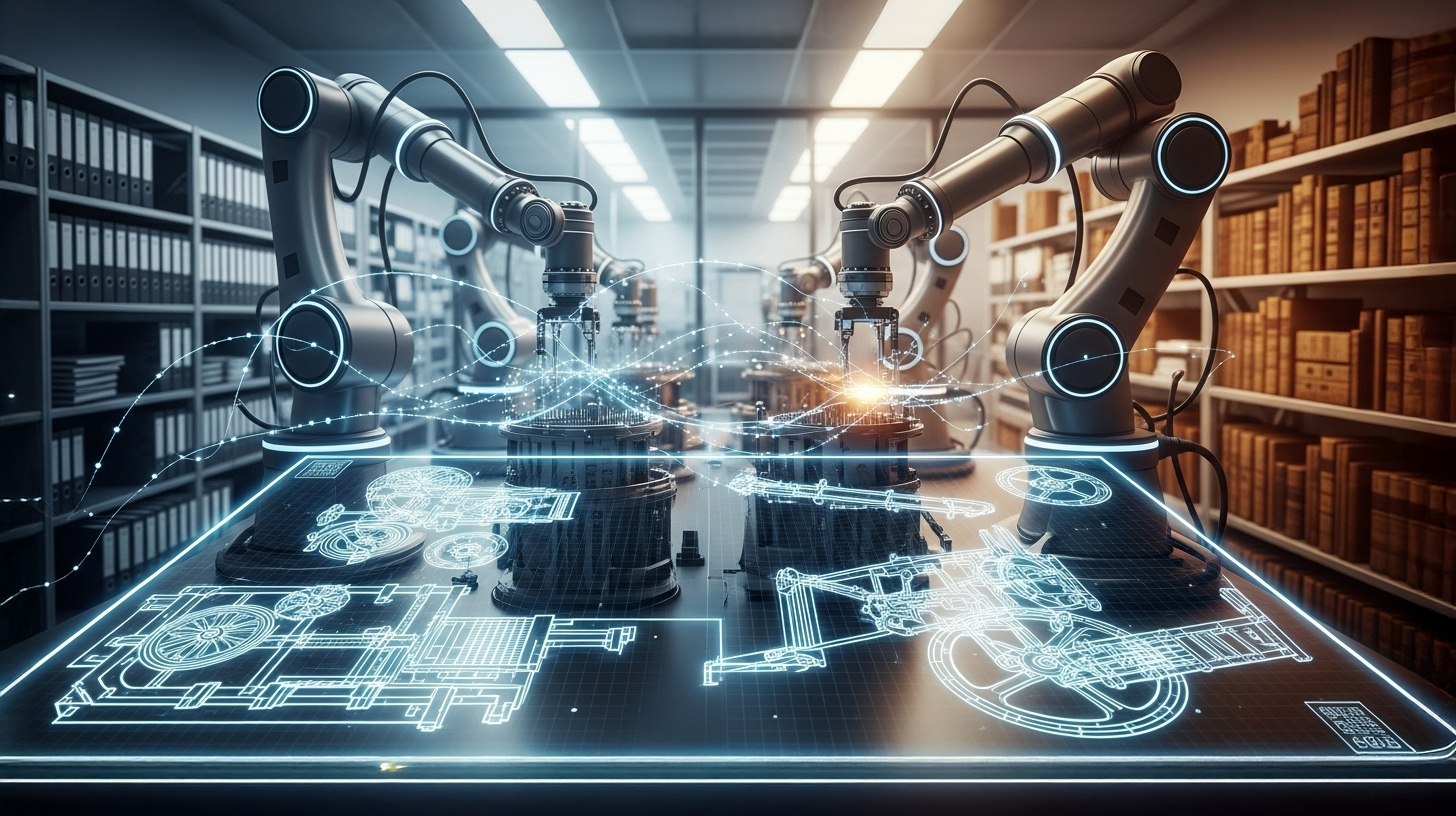
Scalable AI for mechanical engineering: From legacy data to predictive maintenance and near-flawless quality – Image: Xpert.Digital
Implementation: Unlocking the data treasure with managed AI platforms
Strategically leveraging the wealth of data accumulated over decades is technologically demanding. Analyzing massive datasets and training complex AI models requires significant computing power and specialized expertise. For many medium-sized machine manufacturers, this hurdle seems insurmountable. This is precisely where managed AI platforms come in. They offer a turnkey, cloud-based infrastructure that covers the entire process from data preparation to operating the AI model, making the technology accessible, manageable, and cost-effective.
What is a managed AI platform and how does MLOps work?
MLOps (Machine Learning Operations) is a systematic approach that professionalizes and automates the development of AI models. Similar to DevOps in software development, MLOps establishes a standardized lifecycle for AI models, ranging from data preparation through training and validation to deployment and continuous monitoring in production. A managed AI platform, such as those offered by providers like Google (Vertex AI), IBM (watsonx), or AWS (SageMaker), provides all the tools and necessary infrastructure to implement these MLOps workflows as a service. Instead of building their own server farms and managing complex software, companies can access a ready-made, scalable solution.
Advantages for SMEs: Reduce complexity, create transparency
For German SMEs, these platforms offer crucial advantages in unlocking the value of their historical data:
Access to high-performance computers
Training AI models on terabytes of historical data requires immense computing power. Managed platforms offer flexible access to high-performance GPU clusters on a pay-as-you-go model, eliminating massive upfront investments in hardware.
Democratization of AI
The platforms simplify the complex technical infrastructure. Companies can concentrate on their core competency – analyzing their production data – without having to hire experts in cloud architecture or distributed computing.
Scalability and cost efficiency
The costs are transparent and scale with actual usage. Pilot projects can be launched with low financial risk and, if successful, seamlessly rolled out to the entire production process.
Reproducibility and Governance
In an industrial environment, the traceability of AI decisions is crucial. MLOps platforms ensure clean versioning of data, code, and models, which is essential for quality assurance and regulatory compliance.
Step-by-step: From legacy data to an intelligent process
The implementation of an AI solution should follow a structured approach that begins with the business problem, not the technology. The data asset becomes the central resource.
1. Strategy & Analysis
Objectives: Identification of a clear business case with measurable added value.
Key questions: What problem (e.g., scrap, downtime) do we want to solve? How do we measure success (KPIs)? What historical data is relevant?
Technology focus: Analysis of business processes, ROI calculation, identification of relevant data sources (e.g. MES, ERP, sensor data).
2. Data & Infrastructure
Objectives: Consolidation and processing of the historical data trove.
Key questions: How can we merge the data from the various silos? How do we ensure data quality? What infrastructure do we need?
Technology focus: Building a central data platform (e.g., data lake), data cleansing and preparation, connecting data sources to a managed AI platform.
3. Pilot project & validation
Objectives: To demonstrate technical feasibility and business value on a limited scale (Proof of Value).
Key questions: Can we train a reliable predictive model using a machine's historical data? Will we achieve the defined KPIs?
Technology focus: Training an initial AI model on the platform, validating performance using historical and new data, and possibly enriching with synthetic data.
4. Scaling & Operation
Objectives: To roll out the validated solution to the entire production process and establish a sustainable operation.
Key questions: How do we scale the solution from one to one hundred machines? How do we manage and monitor the models during operation? How do we ensure updates?
Technology focus: Leveraging the platform's MLOps pipelines for automated re-training, monitoring, and large-scale deployment of models.
This approach transforms the complex task of data utilization into a manageable project and ensures that technological development always remains closely aligned with business objectives.
Cost-effectiveness and amortization: The ROI of data activation
The decision to make a strategic investment in artificial intelligence must be based on sound economic principles. It's not about investing in an abstract technology, but about activating an existing, yet previously untapped asset: the wealth of historical data. Analysis shows that this investment in data utilization will pay for itself within a manageable timeframe and, in the long term, unlock new value creation potential.
Cost factors of AI implementation
The total cost of activating the data consists of several components. Using a managed AI platform avoids high initial investments in hardware, but there are ongoing costs:
Platform and infrastructure costs
Usage-based fees for the cloud platform, computing time for model training and data storage.
Data management
Costs for the initial consolidation, cleaning and preparation of historical data from various systems.
Personnel and expertise
Salaries for internal staff (domain experts, data analysts) or costs for external service providers who assist with implementation and analysis.
Software and licenses
Potential licensing costs for specialized analysis or visualization tools.
Measurable success metrics and KPIs
To calculate the ROI, quantifiable benefits resulting directly from the better use of existing data must be compared to the costs:
Hard ROI metrics (directly measurable)
Productivity increase: Measured by Overall Equipment Effectiveness (OEE). Analyzing historical data can uncover bottlenecks and inefficiencies and significantly increase OEE.
Quality improvement: Reduction of the reject rate (DPMO). AI-supported quality control, trained on historical defect data, can increase the defect detection rate to over 97%.
Reducing downtime: Predictive maintenance, based on the analysis of long-term sensor data, can reduce unplanned downtime by 30-50%.
Cost reduction: Direct savings in maintenance, inspection, and energy costs. Siemens was able to reduce manufacturing time by 15% and production costs by 12% through AI-optimized production planning based on historical data.
Soft ROI metrics (indirectly measurable)
Increased flexibility: The ability to respond more quickly to customer requests, as the effects of process changes can be better simulated based on historical data.
Knowledge preservation: The implicit knowledge of experienced employees contained in the data becomes usable for the company and is retained even after they leave.
Innovative strength: Analyzing data can lead to completely new insights into one's own products and processes, thus stimulating the development of new business models.
Payback periods and strategic value
Practical examples show that investing in data utilization quickly pays off. One study found that 64% of manufacturing companies using AI are already seeing a positive ROI. One manufacturer achieved an ROI of 281% within a year by using AI in quality control. The payback period for targeted projects in quality control or process optimization is often only 6 to 12 months.
The true economic value, however, extends beyond the ROI of a single project. The initial investment in data infrastructure and analytics is the building of an enterprise-wide "capability factory." Once the wealth of data has been extracted, processed, and made accessible via a platform, the costs for subsequent AI applications drop dramatically. The data prepared for predictive maintenance can also be used for process optimization. The quality model trained for product A can be quickly adapted for product B using transfer learning. The data and the platform thus become a reusable, strategic asset that enables continuous, data-driven innovation across the entire company. The long-term ROI is therefore not linear, but exponential.
A unique opportunity for German mechanical engineering
The German mechanical and plant engineering sector is at a crucial crossroads. The next industrial revolution will not be won through even more precise mechanics, but through the superior use of data. The widespread assumption that the sector suffers from a lack of data is a fallacy. Quite the opposite is true: thanks to decades of engineering expertise and consistent digitalization within the framework of Industry 4.0, German mechanical engineering sits atop a data treasure of inestimable value.
This report has shown that the key to future competitiveness lies in activating this existing asset. Historical production data contains the unique DNA of each process and each machine. It is the ideal foundation for training AI models that will usher in a new era of efficiency, quality, and flexibility. The challenge is not data generation, but data utilization.
The strategic refinement of this real-world data through targeted enrichment with synthetic data for rare events, and the use of transfer learning for the efficient scaling of AI solutions, are the methodological keys to success. They enable the full exploitation of the data treasure trove and the development of robust, practical AI applications.
The applications – from drastically reducing machine downtime and achieving virtually error-free quality control to flexible "batch size 1" production – are no longer visions of the future. They offer concrete, measurable added value with short payback periods.
The biggest hurdle is now not technological, but strategic. The complexity of data analysis and the required computing power appear to be a barrier for many medium-sized businesses. Managed AI platforms solve this problem. They democratize access to state-of-the-art AI infrastructure, make costs transparent and scalable, and provide the professional framework for generating sustainable competitive advantages from historical data.
The combination of this unique data treasure and its accessibility through modern platforms presents a singular opportunity. It offers German mechanical engineering a pragmatic and economically viable path to transfer its existing strengths – excellent domain knowledge and high-quality machine data – into the new era of artificial intelligence. Now is the time to shift our focus away from the perceived scarcity of data and concentrate on the wealth we already possess. Those who begin systematically leveraging their data treasure now will not only secure their position as global technology leaders but also play a key role in shaping the future of industrial production.
We are here for you - Consulting - Planning - Implementation - Project Management
☑️ SME support in strategy, consulting, planning and implementation
☑️ Creation or realignment of the AI strategy
☑️ Pioneer Business Development

Konrad Wolfenstein
I would be happy to serve as your personal advisor.
You can contact me by filling out the contact form below or simply call me on +49 7348 4088 965 .
I'm looking forward to our joint project.
Write to me


Xpert.Digital - Konrad Wolfenstein
Xpert.Digital is a hub for industry focusing on digitalization, mechanical engineering, logistics/intralogistics and photovoltaics.
With our 360° Business Development solution, we support renowned companies from new business to after-sales.
Market intelligence, smarketing, marketing automation, content development, PR, mail campaigns, personalized social media and lead nurturing are part of our digital tools.
You can find more information at: www.xpert.digital - www.xpert.solar - www.xpert.plus
Keep in touch