Military and Defense: Race in Orbit – The new mission of the German Armed Forces Space Command – Creative image on the topic, with AI: Xpert.Digital
Danger to our network: What the German Armed Forces are really doing in space – How the German Armed Forces intend to protect German satellites
The eye in orbit: These are the systems Germany uses to monitor space
Jamming, scrap metal, and espionage: How Germany is preparing for the conflict in space
Our modern daily lives hang by an invisible thread – more precisely, by thousands of satellites in low Earth orbit. Whether it's car navigation, the smooth operation of global financial transactions, our energy supply, or disaster relief: without a functioning space infrastructure, public and economic life would grind to a halt within minutes. But the once pristine expanse above our heads has long since transformed into a densely populated and increasingly militarized space. Space debris, targeted electronic jamming, and the development of anti-satellite weapons by major powers like Russia and China pose a massively growing threat. In response to this new geopolitical reality, Germany established the Bundeswehr's Space Command. What still sounds like science fiction to many has long since become a stark security policy necessity. The following article sheds light on how the armed forces from Uedem in the Lower Rhine region defend our security in space, what technological hurdles still need to be overcome, and why this new race in orbit is about far more than just national prestige.
Race in orbit: How Germany defends its skies: When space becomes a defensive field, prestige alone is no longer enough
A new frontier of national security
The view of the sky has fundamentally changed in recent years. What was once considered a distant, virtually untouched expanse is now a densely populated, economically vital, and increasingly militarized space. Over 3,000 active satellites currently orbit the Earth, accompanied by millions of fragments of space debris, ranging from decommissioned rocket stages to remnants of exploded objects. This density in low Earth orbit not only creates physical risks from collisions but also geopolitical tensions, because modern economies and armed forces alike depend on the uninterrupted operation of satellite-based systems. Navigation, communication, banking, energy supply, and disaster relief now function smoothly only if the space infrastructure operates reliably. It is precisely within this tension between civilian dependence and military vulnerability that Germany, with the Bundeswehr Space Command, has created an institutional response that goes far beyond symbolic significance.
From coordination point to key operational dimension
The German Armed Forces Space Command, headquartered in Uedem on the Lower Rhine, was officially established on July 13, 2021, by then-Defense Minister Annegret Kramp-Karrenbauer. This was not a completely new creation, but rather the logical consolidation of existing structures. Since 2009, the Air Force, in cooperation with the German Aerospace Center (DLR), had operated the Space Situational Awareness Centre in Uedem, which had accumulated years of experience in dealing with space debris, collision warnings, and space weather. In September 2020, the Air and Space Operations Centre, another predecessor structure, was added and subsequently fully integrated into the new command. In April 2023, the Space Command was officially established as an independent, joint service agency, thereby elevating its organizational status, although it remains subordinate to the Inspector of the Air Force.
The command's personnel development reflects the increasing importance of the space dimension. At its establishment in 2021, the unit had approximately 80 to 90 positions, distributed among soldiers and civilian employees. From the outset, plans envisioned significant growth, with a target of around 220 to 250 positions by 2027. This continuous expansion demonstrates that this is by no means a prestige project with modest ambitions, but rather a structurally growing capability designed for the long term. In July 2026, the command celebrated its fifth anniversary, an occasion used by the German Armed Forces themselves to emphasize its evolution from a mere pooling of expertise to what is officially termed an indispensable component of the German armed forces' combat readiness.
The trigger: Growing threats instead of mere curiosity
The establishment of the command was not an abstract strategic exercise, but a direct response to an escalating threat in low Earth orbit. As early as May 2021, in the announcement document on the future of the Bundeswehr (German Armed Forces), the then Minister of Defense and the Inspector General made it clear that the air and space dimension needed to be strengthened. The Bundeswehr's public communication surrounding the commissioning was unequivocal: the threat level in space was increasing, and the protection of its own space systems was a genuine military task for the armed forces. This formulation marked a break with the previously prevailing perception of space as primarily a civilian or scientific domain.
One of the specific reasons for this escalation was the increasing development of anti-satellite weapons by Russia and China. Both countries have repeatedly demonstrated in recent years their ability to target satellites. In November 2021, Russia launched its interceptor missile against one of its own decommissioned satellites, Kosmos 1408, creating a significant amount of dangerous space debris that has since threatened numerous other objects in orbit. China, in turn, possesses a broad arsenal of ground-based electronic warfare systems, directed-energy weapons, and interceptor missiles specifically designed to disrupt, damage, or destroy enemy satellites. Furthermore, there are reports of Russian efforts to equip satellites with nuclear warheads in the future. If such a weapon were detonated in low Earth orbit, it could instantly destroy large parts of the civilian and military satellite infrastructure, with potentially devastating consequences for the global communications and security architecture. Even though the Russian satellite systems of this type known so far are apparently not yet equipped with a live warhead, according to security experts, the basic capability is considered a serious escalation level.
Besides these dramatic extreme scenarios, the daily work of the command is primarily shaped by more commonplace, but equally effective, forms of threat. The deliberate disruption and deception of satellite signals, known in technical jargon as jamming and spoofing, is no longer an exception, but occurs almost daily somewhere in the world. Such electronic attacks can falsify GPS signals, disrupt military communication channels, or severely interfere with civilian navigation for ships and aircraft, without a single physical object in orbit having to be destroyed. This form of warfare is particularly insidious because it is difficult to detect and operates below the threshold of open military conflict.
Mission and dual structure of the command
The German Armed Forces Space Command is a command authority of the Air Force and is considered the central authority of the armed forces for the planning and execution of space operations. Its mission can be broadly divided into four core areas, which are understood as ongoing operational tasks: the creation of a reliable space situational awareness picture, operational support from space, the planning and execution of military space operations, and the ongoing operation of the German Armed Forces' space systems. In a crisis, the command functions as the so-called Space Component Command under the command of the German Armed Forces Operational Command and is closely integrated into multinational, particularly NATO-based, structures.
Organizationally, operational work is divided into two departments with different levels of maturity. The Space Situational Awareness Department forms the structural interface to the interdepartmental Space Situational Awareness Center, which is jointly operated with the German Aerospace Center (DLR) and the German Space Agency (DSA). Here, near-Earth space is monitored around the clock in continuous shifts, potential threats to German and allied satellites are identified, and the effects of so-called space weather, i.e., solar wind activity, on orbital and terrestrial systems are analyzed. This dual civil-military leadership is a remarkable organizational model that integrates civilian scientific expertise with military operational logic. The second department, Planning and Conducting Space Operations, is still under development. Its future task will be to coordinate any necessary military countermeasures with the relevant Bundeswehr agencies based on the space situational awareness assessment. The fact that this department is only just being established illustrates that Germany is currently more focused on the role of observation and analysis than on the role of active military response capability in space.
Technical basis: The eye in orbit
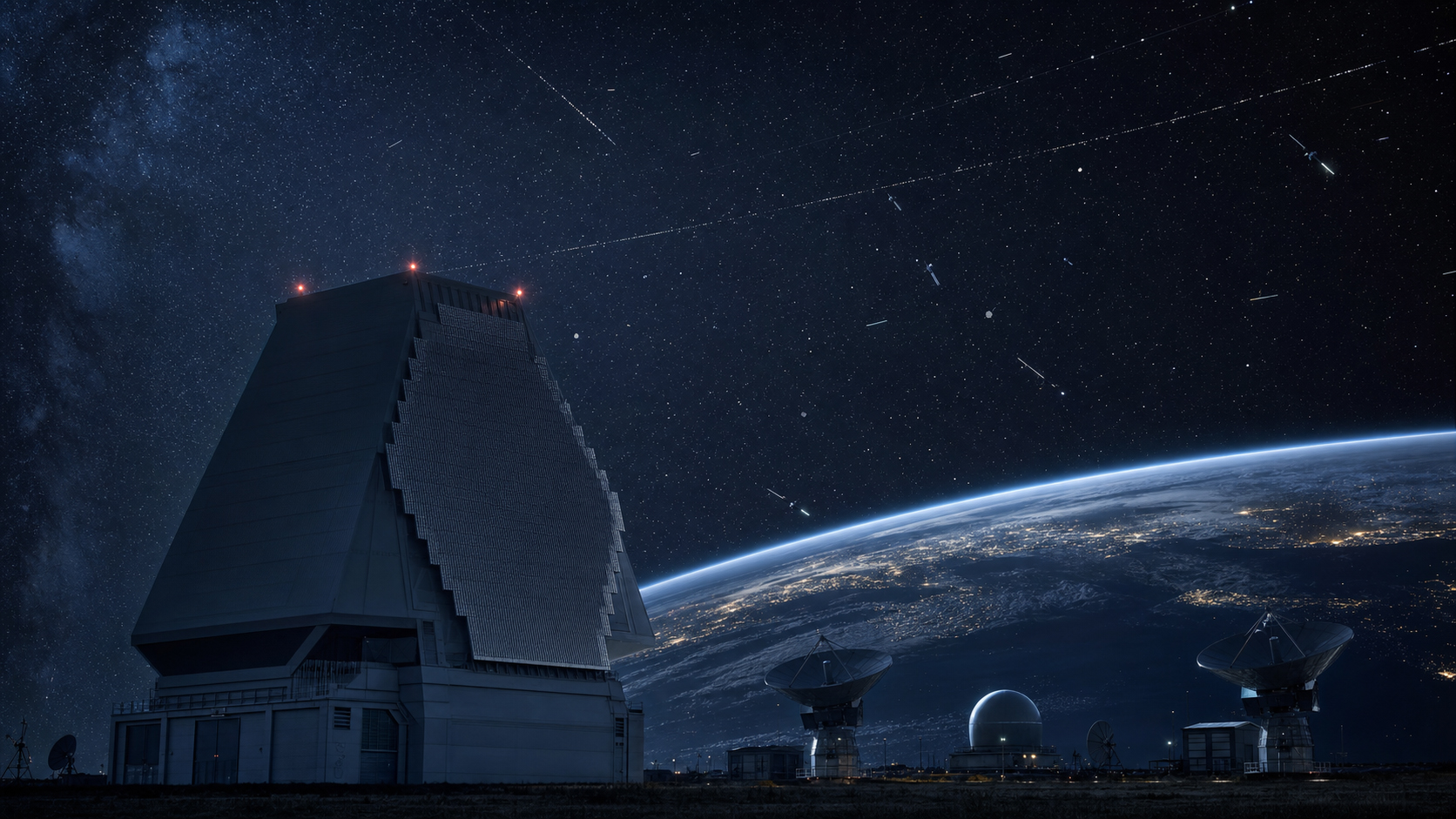
Without reliable sensors, any assessment of space conditions remains purely theoretical. A key technological pillar of Germany's contribution to space surveillance is the GESTRA radar system, short for German Experimental Space Surveillance and Tracking Radar. Developed and built by the Fraunhofer Institute for High Frequency Physics and Radar Techniques on behalf of the German Aerospace Center (DLR), it is stationed at the Schmidtenhöhe military training area near Koblenz. The system consists of two 18-meter-long containers with a total of 256 transmit and 256 receive modules, which operate as a phased-array antenna and can detect objects at altitudes between 300 and 3,000 kilometers. The first successful detection of space objects occurred in November 2019; since then, the system has been continuously developed and is now in advanced operational testing.
The significance of GESTRA lies not only in its technical capabilities but also in the strategic independence it provides for Germany and Europe. Until now, European space situational awareness has been heavily reliant on American data. With its own sensor systems like GESTRA and the complementary Tracking and Imaging Radar, operated jointly with the Fraunhofer Institute, Germany is gradually reducing this dependency and simultaneously contributing to the European Space Situational Awareness Network (EU SST), within which the Space Situational Awareness Centre in Uedem is responsible for a European orbital data catalog. This dimension of sovereignty is by no means politically insignificant, because those who rely on foreign data risk losing control over their own ability to react in a crisis.
In the summer of 2025, this cooperation was further strengthened through a formal agreement. The German Space Agency (DSA) within the German Aerospace Center (DLR) and the German Space Command (DSW) concluded a joint-use agreement that regulates a virtually complete exchange of data. This ensures that civilian and military agencies can access a common, consistent database instead of generating parallel and potentially contradictory situational awareness profiles. This close integration of civilian and military space observation is a unique feature of the German model in international comparison and is frequently cited as a model for other European countries.
Hub for Security and Defense - Advice and Information


Hub for Security and Defense - Image: Xpert.Digital
The Security and Defence Hub offers expert advice and up-to-date information to effectively support companies and organizations in strengthening their role in European security and defence policy. Working closely with the SME Connect Defence Working Group, it particularly promotes small and medium-sized enterprises (SMEs) that wish to further develop their innovative capacity and competitiveness in the defence sector. As a central point of contact, the Hub thus creates a crucial bridge between SMEs and European defence strategy.
Related to this:
Security in orbit: Why Germany is massively expanding its space command
Political anchoring: Space as a strategic dimension
The institutional upgrading of the Space Command coincides with a fundamental reassessment of space policy in Germany. The National Security Strategy explicitly states that space has become increasingly important for national security in recent years. The secure use of space, particularly satellite communication, navigation, and Earth observation data, is considered essential for numerous areas of civilian life, while at the same time the military use of space for modern armed forces has gained considerable importance. In this document, the Federal Government announces its intention to devote increased attention to space as a strategic dimension and to expand its capabilities in this area.
This formulation is noteworthy because it explicitly classifies space not merely as an information space, but as an independent operational and physical dimension alongside land, air, sea, and cyberspace. The operational and defensive capabilities of Germany and its allies thus depend directly on reliable, continuous data flows, functioning communication, precise navigation, and early warning – capabilities that all rely to a considerable extent on satellite infrastructure. The concept of a unified command structure for the space dimension was therefore a guiding principle for the command's design from the outset: instead of fragmenting responsibilities across different branches of the armed forces, situational awareness, operational support, operational planning, and system operation were to be consolidated at a central location.
Economic dimension beyond the military
Today's enthusiasm for space differs fundamentally from the race for prestige and ideological dominance waged between the two Cold War superpowers some 70 years ago. Back then, the primary goal was symbolic superiority: the first satellite, the first human in space, the first step on the moon. Today's motivation is considerably more pragmatic and, at the same time, economically far-reaching: it's about a new dimension of globalization, about extending one's economic sphere into orbit. Satellite-based communication networks, Earth observation for agriculture and climate monitoring, global navigation systems for logistics and mobility, and, in the future, new forms of the space industry and space tourism are increasingly transforming space into a regular economic infrastructure zone.
From this economic perspective, a distinct logic of vulnerability emerges. The more modern economies rely on orbital infrastructure, the more attractive this infrastructure becomes as a target for state and non-state actors seeking to inflict economic or military damage. The failure of key navigation satellites could cripple significant portions of the global financial system, supply chains, and energy infrastructure within hours, because timestamps, location data, and communication protocols often depend on satellite-based systems. The military security mandate of the Space Command is therefore inextricably linked to the economic interest in a stable, resilient space infrastructure. Both dimensions—the security policy dimension and the economic dimension—reinforce each other and together justify the growing political priority that has been accorded to this issue in recent years.
International context and cooperation formats
Germany is by no means alone in establishing its space command; rather, it is part of an international trend in which numerous Western states have developed their own military space structures in recent years. The United States founded the United States Space Force as an independent branch of the armed forces in 2019, France established its own space command in 2019, and the United Kingdom has also created similar structures. Within NATO, space was officially recognized as an independent operational domain in 2019, which has significantly facilitated the multinational coordination of military space activities. In operational situations, the German Space Command is closely integrated into these multinational structures and does not operate in isolation, but rather as part of a coordinated network of allied armed forces.
At the same time, Germany is pursuing a policy of arms control in space at the diplomatic level. In September 2022, Germany, along with other states, joined a moratorium on destructive anti-satellite weapons tests, initially initiated unilaterally by the United States. This step can be interpreted as an attempt to curb at least the most dangerous and damaging testing practices for the entire space industry, despite growing military capabilities in orbit. Every successful kinetic test against a satellite generates thousands of new pieces of debris that pose a threat to all users of low Earth orbit for decades, regardless of their nationality or intended purpose. Germany is thus attempting to pursue military capability development and diplomatic damage control in parallel – a balancing act that is becoming increasingly difficult in light of the ongoing military build-up by other major powers.
Critical appraisal and open questions
While the establishment and expansion of the space command may seem understandable given the described threat situation, several questions remain that a dispassionate analysis should not ignore. First, the command's personnel and financial resources remain modest by international standards. With a target of approximately 220 to 250 positions by 2027, the German structure remains significantly smaller than comparable institutions in the United States or even France, a fact that can certainly be questioned given Germany's economic size and security policy responsibilities within Europe. Second, the "Planning and Conducting Space Operations" department, crucial for active military response capabilities, is, as described, still under development. This means that Germany currently possesses primarily observation and analysis capabilities, but not yet fully developed operational countermeasures of its own in the true sense.
Third, the question of technological sovereignty remains a persistent issue. Even though GESTRA represents an important step toward reducing dependence on American space situational awareness data, the system, by its own admission, is still experimental and not yet fully operational. A European, resource-independent network of sensors, capable of guaranteeing a reliable, independent space situational awareness even in strained transatlantic relations, is thus in the planning stages but not yet fully realized. Fourth, and finally, Germany's diplomatic stance, which pursues both arms control and military capability development, places it in a precarious position whose coherence will likely be difficult to maintain in the long run should Russia and China actually continue to develop their anti-satellite weapons capabilities, including potential nuclear options.
Overall, the development of the German Armed Forces' Space Command demonstrates that Germany has recognized the strategic importance of low Earth orbit and taken it seriously institutionally. The combination of civilian and military cooperation in the Space Situational Awareness Centre, the gradual expansion of its own sensor capabilities, and its clear anchoring in the National Security Strategy attest to a well-considered, albeit not yet fully completed, development process. Given the speed at which other major powers are expanding their space capabilities, both civilian and military, it remains to be seen in the coming years whether the pace of German development is sufficient to truly keep pace with the growing importance of this dimension.
Consulting - Planning - Implementation

Markus Becker
I would be happy to serve as your personal advisor.
Head of Business Development
Chairman SME Connect Defense Working Group
Consulting - Planning - Implementation
Konrad Wolfenstein
I would be happy to serve as your personal advisor.
You can contact me at wolfenstein∂xpert.digital or
Just call me on +49 7348 4088 965 .