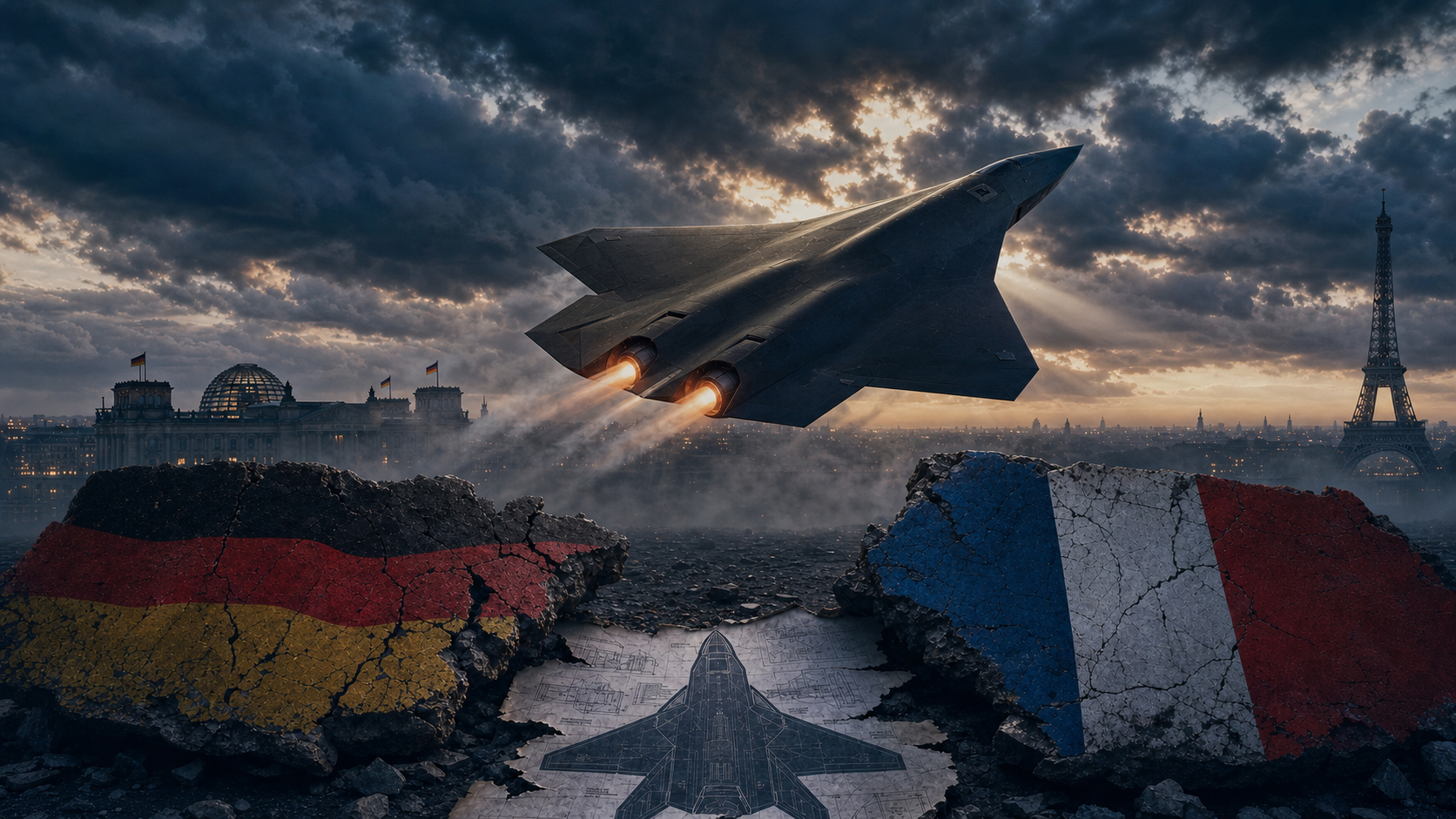
Europe's most expensive arms flop: Airbus versus Dassault – The dream of the super-jet has burst – what this means for the German Armed Forces – Image: Xpert.Digital
Controversy over the new fighter jet: France is furious, but for the German arms industry, the FCAS project's demise is a gain
End of the 100 billion euro project: Why the dispute with France is still Germany's greatest opportunity
After nearly a decade of arduous struggle, the European FCAS project, a project of the century, is history. What was once celebrated as a shining symbol of Franco-German friendship and the backbone of future European air defense has crumbled under the weight of national pride, irreconcilable industrial power claims, and deep strategic differences. Under Chancellor Friedrich Merz and President Emmanuel Macron, Europe is drawing a final line under the joint development of the fighter jet. But while the failure of the 100-billion-euro project may at first glance appear to be a security policy disaster, closer examination reveals a completely different picture: For Germany and its defense industry, the end of the dysfunctional partnership with France could be the long-awaited breakthrough – and the starting signal for a genuine strategic realignment in times of historic threats.
The end of FCAS – Germany's strategic realignment
After nine years of grueling negotiations, repeated crises, and countless extensions, German Chancellor Friedrich Merz and French President Emmanuel Macron officially finalized in June 2026 what had long been decided internally: the Franco-German-Spanish arms project FCAS (Future Combat Air System) will not be pursued in its original form. The joint development of a next-generation fighter jet by Airbus and Dassault has failed – and with it, a project that was intended to represent not only military but also symbolic aspects of the Franco-German partnership. What at first glance appears to be a European defeat, upon closer examination reveals itself to be a complex web of industrial power struggles, national sovereignty concerns, and strategic decisions that could ultimately prove advantageous for Germany.
A dream that never really wanted to begin – The origin story of FCAS
The Future Combat Air System (FCAS) was launched in 2017 by President Macron and then-Chancellor Angela Merkel. The idea was as elegant as it was ambitious: Germany and France, the two cornerstones of the European Union, were to jointly develop a networked, sixth-generation air combat system – a manned fighter jet surrounded by autonomous drone swarms, embedded in a digital combat cloud, ready for deployment from 2040. Spain joined as a third, equal partner in 2019, when the defense ministers signed a joint development agreement at the Le Bourget Air Show. The total cost of the project was estimated at around €100 billion – making FCAS the most expensive European defense project ever planned.
The industrial composition reflected the political ambition: Airbus Defence and Space took the lead on the German side, Dassault Aviation on the French side, and the defense company Indra on the Spanish side. MTU Aero Engines from Germany, Safran from France, and ITP Aero from Spain joined forces for the propulsion system. The radar developer Hensoldt from Germany was also slated to contribute to the demonstrator phase. On paper, the consortium appeared to be a prime example of European defense integration – but behind the scenes, serious tensions were brewing from the very beginning.
The real core of the conflict – power, technology, and national pride
The failure of FCAS cannot be reduced to a single cause. It was the cumulative result of structural tensions that were inherent in the project from the outset. At the heart of the conflict lay a simple but irreconcilable question: Who is in charge?
From the outset, Dassault Aviation insisted on a leading role in the development of the actual combat aircraft, the so-called New Generation Fighter (NGF). Dassault CEO Éric Trappier argued that his company had decades of experience in building combat aircraft – the Rafale, as a modern multirole fighter jet, was Trappier's strongest argument. Airbus, on the other hand, builds civilian airliners and military transport aircraft, but has no independent history in the construction of high-performance combat aircraft. From this perspective, Dassault's demand for leadership seemed entirely justified.
But Airbus Defence, representing the interests of Germany and Spain, insisted on equal participation – a so-called co-leadership. Two nations against one, two corporations against one: The governance structure was fraught with conflict from the outset. The escalation unfolded in several waves. In October 2025, Airbus CEO Guillaume Faury publicly declared that Dassault could leave the program if it was not satisfied. In March 2026, Dassault CEO Trappier followed up: If Airbus did not want to work with Dassault, the project was dead. Trappier made it unequivocally clear that he needed a clear leadership role – not just on paper, but in the substance of the decision-making processes.
Behind the apparent dispute over governance lay a deeper problem: the question of intellectual property and future export rights. Whoever develops the key technologies of a fighter jet controls, in the long term, who is allowed to export them and under what conditions. France traditionally had a more open export policy than Germany, which operates under strict arms export restrictions. These differing national interests ultimately made genuine industrial integration impossible. Added to this were diverging military requirements: Germany primarily needed a long-range bomber (within the framework of NATO's nuclear sharing arrangements), while France prioritized an agile, exportable multirole fighter jet. Building two aircraft in one was simply not feasible from a design perspective.
Nine years of missed opportunities – The economic balance sheet of stagnation
The economic costs of the FCAS stall are difficult to quantify, but substantial. Since 2017, several billion euros have been invested in the various demonstrator and preparatory phases without yielding any significant technological results. The German Bundestag alone approved 4.5 billion euros for an early development phase. Europe's defense industry has thus remained stuck for almost a decade on a project that was internally considered a failure long ago.
The opportunity costs are particularly relevant: While Germany and France argued over percentages and governance structures, the British-Italian-Japanese competing project, GCAP (Global Combat Air Programme), made technological progress. The GCAP consortium – consisting of BAE Systems, Leonardo, and the Japanese company JAIE – has already reached a significantly more advanced stage of development. The time lost by FCAS cannot be recovered.
For the German defense industry, the ongoing standstill meant strategic paralysis. Airbus Defence and Space, with a revenue of €12.1 billion in 2024 and growth of 5.1 percent compared to the previous year, was unable to fully utilize its fighter jet development capabilities. The company was even forced to cut 2,000 jobs at the end of 2024 – despite the general arms boom that catapulted companies like Rheinmetall to new record revenues. Rheinmetall achieved its highest revenue ever in 2024, at €9.8 billion, an increase of 36 percent. This contrast exemplifies how the FCAS dispute cut Airbus Defence off from the growth opportunities afforded by the boom.
The strategic context – Europe and defense autonomy
The failure of FCAS comes at a time when Europe is under more pressure to strengthen its defense capabilities than it has been since World War II. Russia's war of aggression against Ukraine has fundamentally altered the security landscape. At the 2025 NATO summit, the alliance partners committed to increasing their defense spending to five percent of GDP by 2035. Germany welcomes this new target and is increasing its defense budget accordingly.
In this context, the question of technological sovereignty takes on a new dimension. In 2026, the EU published its work program entitled "Europe's Moment of Independence" and aims for European defense readiness by 2030. A study by the Kiel Institute for the World Economy, signed by, among others, former EADS CEO Thomas Enders, estimates the necessary investments for genuine European defense autonomy at around €50 billion per year. The failure of FCAS makes it clear that this autonomy will not be achieved through symbolic prestige projects, but rather through effective industrial cooperation.
Germany is now the world's fifth-largest arms exporter. The industry employs 105,000 people and generates a turnover of 31 billion euros – with a strong upward trend. In this growth market, Germany needs clear industrial responsibilities and effective consortia, not years of governance debates with a partner who claims 80 percent of the added value for itself.
Why France remained on a collision course – The Dassault dilemma
Dassault's stance in the FCAS negotiations was internally consistent, even if counterproductive from a European perspective. The company is a national flagship of France, privately owned but closely intertwined with the French state. The Rafale is not just an export success – it is an expression of French grandeur, of the claim to national military and industrial independence. Trappier has never denied this position: he wants control of the fighter jet because he considers this control legitimate and a prerequisite for industrial success.
For Dassault, attempting to accept Airbus as a co-leader was not merely a matter of ego, but a fundamental strategic question. If Airbus had an equal say in the design of the fighter jet, the selection of suppliers, and the markets served, Dassault would lose control over its core business. Furthermore, since Airbus is a European corporation headquartered in the Netherlands with a strong presence in Germany, France, Spain, and the UK, export decisions would have been significantly slowed down by the need to negotiate with the German arms export bureaucracy.
France – or more precisely, Macron's government – tried until the very last minute to save the project. The Élysée Palace only confirmed the failure hours after the German announcement, adding, in telling terms, that the German authorities believed "no further pressure on the companies was possible." This wording speaks volumes: Paris saw itself as the one willing to compromise, while Berlin pulled the plug. The reality was probably more complex – but the political narrative has been established.
Hub for Security and Defense - Advice and Information

Hub for Security and Defense - Image: Xpert.Digital
The Security and Defence Hub offers expert advice and up-to-date information to effectively support companies and organizations in strengthening their role in European security and defence policy. Working closely with the SME Connect Defence Working Group, it particularly promotes small and medium-sized enterprises (SMEs) that wish to further develop their innovative capacity and competitiveness in the defence sector. As a central point of contact, the Hub thus creates a crucial bridge between SMEs and European defence strategy.
Related to this:
50 to 70 billion euros and industrial sovereignty: Does Germany's go-it-alone approach to the fighter jet pay off?
Germany's new path – opportunities beyond marriages of convenience
The end of the Franco-German FCAS cooperation opens up a strategic freedom of action for Germany that it lacked during nine years of dependence on a dysfunctional partnership. The perspectives are manifold:
The so-called two-aircraft solution, long demanded by Airbus employees, the IG Metall union, and the German Aerospace Industries Association, is now becoming a reality. Germany and Spain can jointly develop their own fighter jet – under the leadership of Airbus Defence, without Dassault's involvement. Spain is a reliable partner: Airbus and Spanish industry have collaborated successfully for decades on the Eurofighter program. The ILA 2026 in Berlin, taking place from June 10 to 14, is the deliberately chosen setting for Berlin's restart – a symbolic stage for its ambition to be Europe's leading aviation nation.
The Swedish defense company Saab is considered a potential partner for the German fighter jet project. Airbus and Saab already have existing cooperative structures, and Sweden brings specific expertise in the field of fighter jets (Gripen). A partnership with Saab would be attractive for Germany because it would enable genuine co-leadership – without the power-political tensions that have characterized the relationship with Dassault from the outset.
In parallel, the option of joining the British-Italian-Japanese GCAP consortium remains open. Italian Prime Minister Meloni is said to have signaled a willingness to open the consortium to German participation during a meeting with Chancellor Merz in early 2026. However, GCAP is already further along in its development, which would relegate Germany to a junior partner role – a situation that would be politically difficult to justify, but, given the Dassault experience, still preferable to another blockade.
The Combat Cloud remains – What survives from FCAS
Despite the failure of the joint fighter jet project, the entire FCAS concept is not dead. Chancellor Merz has clarified that the overarching system architecture – the so-called Combat Cloud for networking various weapon systems, as well as the Collaborative Combat Aircraft (CCA) program – will be continued. This is both economically and strategically sound.
The Combat Cloud is the most technologically and conceptually innovative element of FCAS. A networked air combat system that integrates various aircraft types, drones, satellites, and ground systems in real time represents the true quantum leap compared to current capabilities—not the aircraft itself. The fighter jet is ultimately just one of several platforms within this system. If Germany and France can network their data and systems via a shared Combat Cloud, operational interoperability will be maintained, even if the aircraft are from different manufacturers.
For Airbus Defence, this means the company can now concentrate on its core strengths – systems integration, networking technology, and drone development. These areas represent the future of modern warfare, as the war in Ukraine has clearly demonstrated. Drones are fundamentally changing warfare; the German Armed Forces are already planning to procure unmanned systems even before introducing a new manned combat aircraft. The freedom of choice Germany gains from the end of the FCAS program could accelerate what is long overdue strategically.
The question of power within Europe – Who draws which lessons?
The failure of FCAS is also a lesson in the mechanisms of European arms cooperation and the structural limits of Franco-German collaboration. Both countries have drawn different conclusions from the project – and both will try to shape the narrative to their advantage.
France will portray FCAS as Germany's withdrawal. The Élysée Palace didn't choose the phrase "German pressure on the companies" by chance. Paris wants to avoid the failure being associated with Dassault's inflexibility, as that would damage France's reputation as a reliable partner – especially at a time when Paris is advocating for European defense integration. For Macron, FCAS was a personal prestige project; he launched it in 2017 and defended it until the very end.
Germany, on the other hand, is deliberately using this moment to signal its industrial capability. Defense policy experts from the CDU/CSU alliance emphasize that German aviation expertise exists and now needs to be demonstrated. This message is also directed domestically: at an industry that needs planning certainty after years of uncertainty, and at a society that, in light of the arms boom, is questioning whether the expenditures are strategically sound.
The Greens, in turn, see Merz's communication disaster as proof of a lack of foreign policy competence. Defense policy expert Jeanne Dillschneider criticizes the fact that the Chancellor must now present a concrete plan for future Franco-German arms cooperation if he truly takes his claim as a European seriously. This criticism is not unfounded: anyone who terminates a multi-billion-euro project owes more than a shrug. The absence of a clearly communicated Plan B at the time of the announcement has weakened the diplomatic weight of the move.
Economic opportunities and risks of Germany's special path
Beyond the political rhetoric, the crucial question is posed in sober economic terms: Is Germany actually capable of developing its own fighter jet – and is it financially viable?
The industrial prerequisites are in place, but not without gaps. Airbus Defence possesses engineering expertise in systems integration and avionics, but lacks independent experience in building high-performance combat aircraft. MTU is a competent engine developer, but developing a fighter jet engine on its own exceeds the capabilities of a single company. Hensoldt contributes radar expertise. The capability gaps that Germany has in the area of pure combat aircraft manufacturing are real – and a partner like Saab or an entry into GCAP is therefore not a sign of weakness, but rather strategic prudence.
Financially, the project is undoubtedly feasible. As part of a period of transition, Germany has significantly increased its defense budget. The NATO target of five percent of GDP provides the defense industry with a planning horizon that allows for long-term independent development. Experts estimate that an independent German fighter jet program, in partnership with Spain and possibly Sweden, could have a total volume of 50 to 70 billion euros – significantly less than FCAS in its original design, since the focus is on a joint aircraft rather than a complete system.
The decisive economic advantage for Germany would lie in maintaining complete technological sovereignty over the core product. Whoever controls the key technologies of a fighter jet controls, in the long term, the export markets, licensing revenues, and industrial jobs. With a 70 percent stake for Dassault—as was demanded at one point—Germany would have become structurally dependent, which would have meant the opposite of sovereignty. The lesson from the FCAS debacle: Arms cooperation must be symmetrical, or it will fail due to national self-interest.
A look ahead – what comes next
The end of FCAS is a date, not an endpoint. The coming months and years will show whether Germany uses its newly gained strategic freedom of action or falls into further stalemate.
The ILA 2026 air show in Berlin provides Chancellor Merz with a platform to communicate Germany's realignment. An announcement of concrete cooperation negotiations with Spain and Saab, combined with a commitment to Combat Cloud as a joint European platform, would demonstrate that Berlin has learned from past mistakes. The goal must be a smaller, more focused consortium with clear leadership structures, capable of delivering a deployable system by 2045.
Europe faces its most serious security crisis since the Second World War. The answer to this challenge cannot be another decade of institutional stagnation. In this sense, the failure of FCAS is not a tragedy, but a watershed moment: a forced realpolitik that paves the way for more effective structures. If Germany seizes this opportunity, the most expensive failure in European defense history could become the starting point for Europe's future air defense – this time on a more solid industrial and political foundation.
Consulting - Planning - Implementation

Markus Becker
I would be happy to serve as your personal advisor.
Head of Business Development
Chairman SME Connect Defense Working Group
Consulting - Planning - Implementation
Konrad Wolfenstein
I would be happy to serve as your personal advisor.
You can contact me at wolfenstein∂xpert.digital or
Just call me on +49 7348 4088 965 .