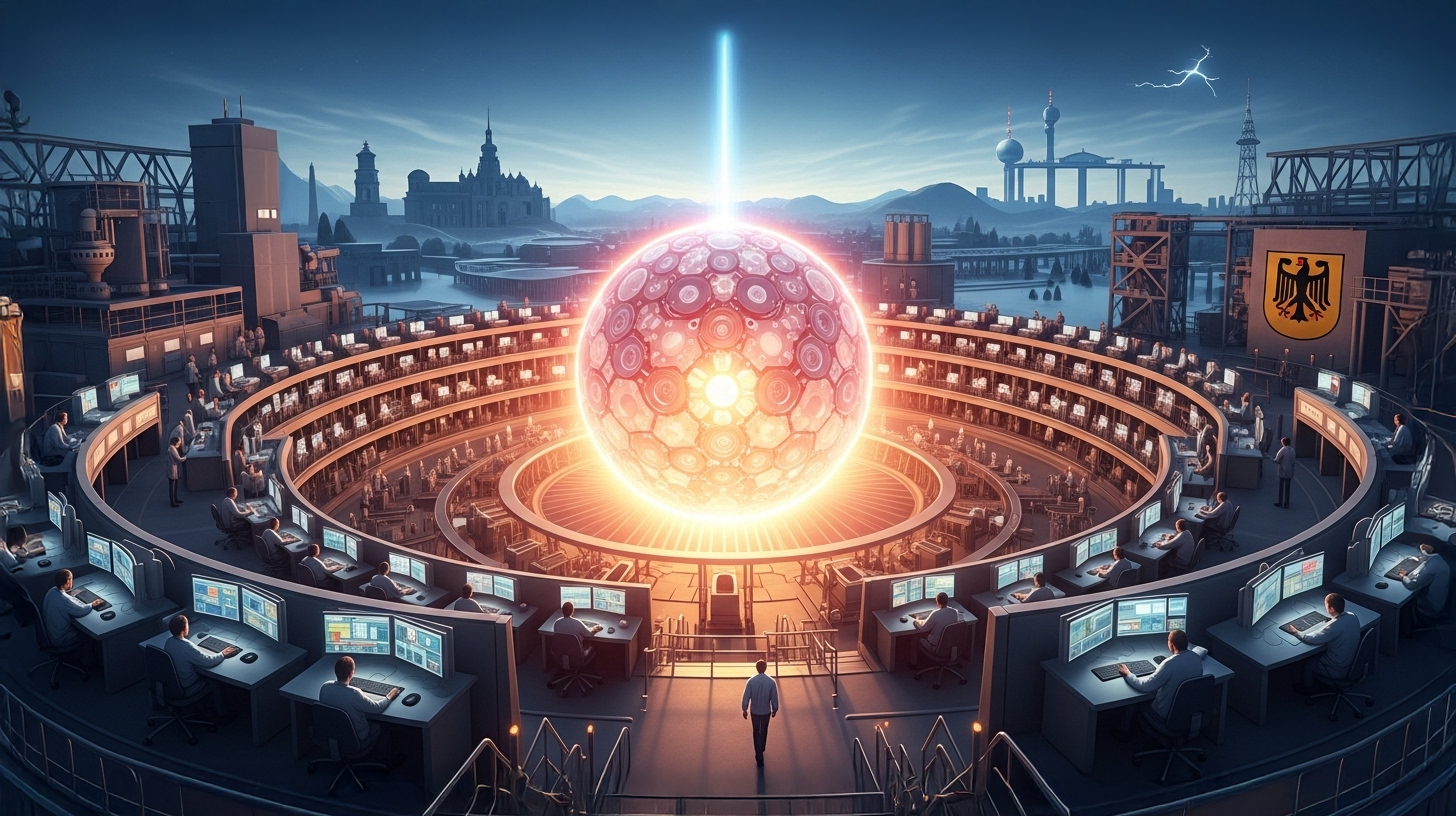
Bringing the sun to Earth through nuclear fusion: Why Germany wants to build the world's first fusion power plant – Image: Xpert.Digital
German start-ups are gripped by fusion fever: After the US breakthrough, the race for the energy of the future has begun – this is why Germany now has the best chance of building a fusion power plant
What is nuclear fusion and why is it so important?
Nuclear fusion is considered one of the most promising ways to solve the global energy problem. In this process, light atomic nuclei fuse together, releasing enormous amounts of energy, just as happens in the sun. Unlike conventional nuclear fission, used in nuclear power plants, fusion does not produce long-lived radioactive waste and cannot get out of control.
The decisive breakthrough came in 2022 at the Lawrence Livermore Laboratory in California, when, for the first time, more energy was produced than consumed in nuclear fusion. This scientific achievement transformed the dream of unlimited energy from a theoretical possibility into a tangible reality. Since then, there has been an intense global race to be the first to build a working fusion reactor.
Why is Germany a top candidate for the first fusion plant?
Germany possesses excellent prerequisites for a leading role in nuclear fusion. The industrial base is already in place, as are highly qualified specialists and a strong research landscape. Interestingly, even the American breakthrough in Livermore was achieved with German technology – the special glass for the laser system came from the Mainz-based company Schott, and the mechanical engineering company Trumpf was also involved.
The German government recognized the potential and adopted the Fusion Action Plan in October 2025. This plan stipulates that over two billion euros should be invested in fusion research by 2029. The stated goal is ambitious: Germany is to host the world's first commercial fusion power plant.
Which German companies are leaders in merger research?
Three German startups have established themselves as pioneers in nuclear fusion, working with different technological approaches to realize the dream of clean energy. Marvel Fusion, based in Munich, focuses on laser fusion and has already raised €385 million. However, the company plans to relocate part of its development to the USA, raising questions about the fate of the German know-how.
Proxima Fusion, also based in Munich, is a spin-off from the Max Planck Institute for Plasma Physics and focuses on stellarator technology. In 2025, the company received record funding of €130 million, the largest private investment in European nuclear fusion. Focused Energy, from Darmstadt, is working on inertial confinement fusion using laser technology and has raised $200 million. RWE has joined as a strategic partner with an investment of €10 million.
How does nuclear fusion work technically?
The practical implementation of nuclear fusion is one of the greatest technological challenges of our time. The hydrogen isotopes deuterium and tritium serve as fuel. Deuterium is abundant in seawater, while tritium is very rare and must be produced primarily within fusion reactors themselves by irradiating lithium with neutrons.
To enable fusion, temperatures of approximately 150 million degrees Celsius must be reached. Under these extreme conditions, the atomic nuclei fuse to form helium, releasing 17.6 megaelectronvolts per reaction. The energy contained in one kilogram of deuterium-tritium mixture is equivalent to that of 55,000 barrels of diesel or 18,630 tons of lignite.
What are the biggest technical challenges?
The development of a functional fusion power plant faces several critical challenges. Tritium production is one of the most difficult tasks, as this fuel is scarce in nature and must be produced within the power plant itself. Scientists are working on breeding tritium from lithium through neutron bombardment, but this technology is not yet mature.
Another problem is the extremely powerful magnets required to confine the hot plasma. These high-temperature superconducting magnets are technically extremely complex and must function reliably to control the plasma. Furthermore, materials must be developed that can withstand the intense neutron radiation without losing their structural integrity.
What progress has been made in German fusion research?
German fusion research has achieved remarkable successes in recent years. In 2025, Wendelstein 7-X in Greifswald, the world's largest stellarator facility, set a new world record for the so-called triple product. This product of particle density, temperature, and energy confinement time is the key parameter for progress in fusion physics.
A new peak value of over 43 seconds was achieved, surpassing even previous records for tokamak facilities. More than 700 project proposals for work on the facility were submitted, of which approximately 200 received the highest priority. These successes underscore Germany's position as a leading research nation in nuclear fusion.
What political measures is the Federal Government planning?
The Fusion Action Plan, adopted in October 2025, comprises eight concrete areas of action. Research funding is to be strengthened, with funding under "Fusion 2040" being increased to up to €1.7 billion. In addition, a fusion ecosystem of science and industry is to be established to promote knowledge transfer and establish value chains.
A key point is the planned regulatory reform. In the US and the UK, nuclear fusion is already regulated differently than nuclear fission, which provides greater planning certainty for private investments. Germany is lagging behind in this area, which is why the companies involved in mergers are demanding a corresponding adjustment of the regulations.
What do the German companies involved in mergers demand from politicians?
The three leading German companies involved in the merger have issued a joint position paper outlining clear demands for policymakers. They are calling for government funding of three billion euros to close the financing gap in the deep-tech sector. This sum may seem large, but it would flow directly into German industry, as the expensive lasers and magnets would have to be manufactured domestically.
A key point of criticism is the German approach to new technologies. As one industry representative noted, Germany typically establishes regulations before development even begins. This regulatory zeal makes innovation unnecessarily expensive and slow. Companies are calling for a less bureaucratic approach, such as those that have already been successfully implemented with other technologies.
Our EU and German expertise in business development, sales and marketing

Our EU and German expertise in business development, sales and marketing - Image: Xpert.Digital
Industry focus areas: B2B, digitalization (from AI to XR), mechanical engineering, logistics, renewable energies and industry
More information here:
A thematic hub offering insights and expertise:
- Knowledge platform covering global and regional economies, innovation and industry-specific trends
- A collection of analyses, insights, and background information from our key areas of focus
- A place for expertise and information on current developments in business and technology
- A hub for companies seeking information on markets, digitalization, and industry innovations
The 2030s as the starting point? When will fusion power plants actually supply electricity?
When will the first fusion power plants go into operation?
The timelines for the first operational fusion power plants vary depending on the technology and the company. German startups plan to have their first reactors operational as early as the beginning of the 2030s. However, these early plants will not yet operate economically, but will serve to demonstrate the technology.
Experts anticipate that truly commercially viable and economically viable fusion power plants will not be available until the late 2030s or early 2040s. The international ITER project in France, which was intended to pave the way, is struggling with significant delays and will not begin operating with the relevant deuterium-tritium fuel until 2039.
Is nuclear fusion truly safe and environmentally friendly?
Nuclear fusion offers crucial safety advantages over conventional nuclear fission. An uncontrolled chain reaction is physically impossible, as only a few grams of fuel are present in the reactor. If the energy supply fails, the reaction automatically stops. Furthermore, the radioactive fuels have significantly shorter half-lives than the fission products of conventional nuclear power plants.
Nevertheless, fusion also produces radioactive waste, primarily through the activation of the reactor walls by neutron radiation. These materials must be safely stored for several hundred years, but are less problematic than highly radioactive nuclear waste. Scientists are working on special low-activity radioactive materials that could be recycled after 50 to 100 years.
What economic challenges exist?
The economic viability of fusion power plants has not yet been conclusively proven. Experts assume that the costs will initially be comparable to, or even higher than, those of conventional nuclear power plants. Due to its high investment costs, a fusion power plant must be operated continuously to be profitable.
A potential problem is that fusion power plants are designed as baseload power plants, while the energy system of the future will require more flexible, controllable facilities. In a system dominated by renewable energies, power plants must be able to be ramped up and down quickly. Large, complex fusion facilities are not ideally suited for this.
How will fusion be integrated into the future energy system?
The role of nuclear fusion in the future energy system is controversial. While proponents argue that fusion power plants are important as a reliable baseload source, critics see them as too inflexible for a system with a high share of renewable energies. However, fusion power plants could be used for energy-intensive industrial processes and the production of green hydrogen.
An important aspect is that nuclear fusion is not intended to replace renewable energies, but rather to complement them. Energy demand will increase sharply in the coming decades, not least due to data centers and digitalization. In this growing market, various clean energy sources can coexist without displacing each other.
What role does international competition play?
Germany is engaged in intense international competition for leadership in nuclear fusion. Besides the USA, which achieved a significant milestone with the Livermore breakthrough, China, Japan, and other countries are also working intensively on the technology. The delayed ITER project demonstrates that even established international collaborations are struggling with problems.
German companies emphasize that their main competitor is time, not other firms. If one company succeeds in bringing a technology to market maturity, it benefits the entire industry. Nevertheless, it is clear that Germany must act quickly to avoid squandering its technological lead and to prevent German know-how from being commercialized in other countries.
How large is the job creation potential of the mergers and acquisitions industry?
Nuclear fusion could become a significant economic driver in Germany. Investments amounting to several billion euros would primarily benefit German industry, as lasers, magnets, and other components would need to be produced domestically. Unlike other energy technologies, where manufacturing capacities have often migrated abroad, this presents an opportunity to establish a complete value chain in Germany.
The fusion industry would not only create direct jobs, but also jobs at suppliers and service providers. Regions like the former power plant site in Biblis could benefit from repurposing it for fusion facilities, replacing lost jobs with new, future-proof positions. The competence and excellence centers planned by the German government are intended to provide additional impetus for innovation.
What risks and challenges remain?
Despite all the progress, significant risks remain in the development of nuclear fusion. The technology is not yet mature, and many critical problems remain unsolved. The development of neutron-resistant materials is still in its infancy, and industrial-scale tritium production has not been proven.
Another risk lies in financing. The necessary investments are enormous, and private investors often shy away from the high technical risk. Without massive government support, the development will not be possible. At the same time, there is a risk that the technology will prove uneconomical or be overtaken by other forms of energy.
What does all this mean for Germany's energy future?
Nuclear fusion represents a strategic opportunity for Germany to reduce its global dependence on natural resources for energy and to assume a technological leadership role. The German government's action plan demonstrates that policymakers have recognized this potential and are prepared to invest significant resources.
However, nuclear fusion will not be available in time for the current energy transition. By 2045, the target year for Germany's climate neutrality, fusion power plants will not yet be able to play a significant role. The technology is more of an investment in the energy supply of the second half of the century.
Balancing opportunities and challenges
Germany has a realistic chance of playing a leading role in the global race for the first commercial nuclear fusion reaction. Its existing industrial base, research excellence, and political commitment create favorable conditions. German companies are working on various promising approaches and have already attracted significant private investment.
At the same time, the challenges should not be underestimated. The technical problems are complex, the funding gaps are large, and international competition is fierce. There is a risk that Germany will once again develop a technology that is then commercialized elsewhere. Without decisive political action and a simplification of regulations, Germany's lead could quickly be lost.
The next few years will be crucial. If Germany sets the right course, it could indeed be the first country to harness the power of the stars for terrestrial energy supply. This would not only be a scientific triumph, but also an important building block for long-term energy security and climate protection.
Your global marketing and business development partner
☑️ Our business language is English or German
☑️ NEW: Correspondence in your native language!

Konrad Wolfenstein
I and my team are happy to be available to you as your personal advisor.
You can contact me by filling out the contact form here wolfenstein@xpert.digital:or simply call me at +49 7348 4088 965. My email address is
I'm looking forward to our joint project.
☑️ SME support in strategy, consulting, planning and implementation
☑️ Creation or realignment of the digital strategy and digitization
☑️ Expansion and optimization of international sales processes
☑️ Global & Digital B2B trading platforms
☑️ Pioneer Business Development / Marketing / PR / Trade Fairs
🎯🎯🎯 Benefit from Xpert.Digital's extensive, five-fold expertise in one comprehensive service package | BD, R&D, XR, PR & Digital Visibility Optimization
Benefit from Xpert.Digital's extensive, five-fold expertise in a comprehensive service package | R&D, XR, PR & Digital Visibility Optimization - Image: Xpert.Digital
Xpert.Digital possesses in-depth knowledge across various industries. This allows us to develop tailored strategies precisely aligned with the requirements and challenges of your specific market segment. By continuously analyzing market trends and monitoring industry developments, we can act proactively and offer innovative solutions. The combination of experience and expertise generates added value and provides our clients with a decisive competitive advantage.
More information here: