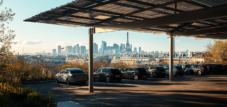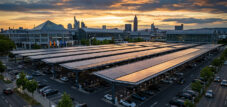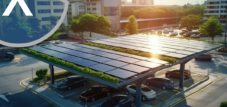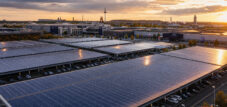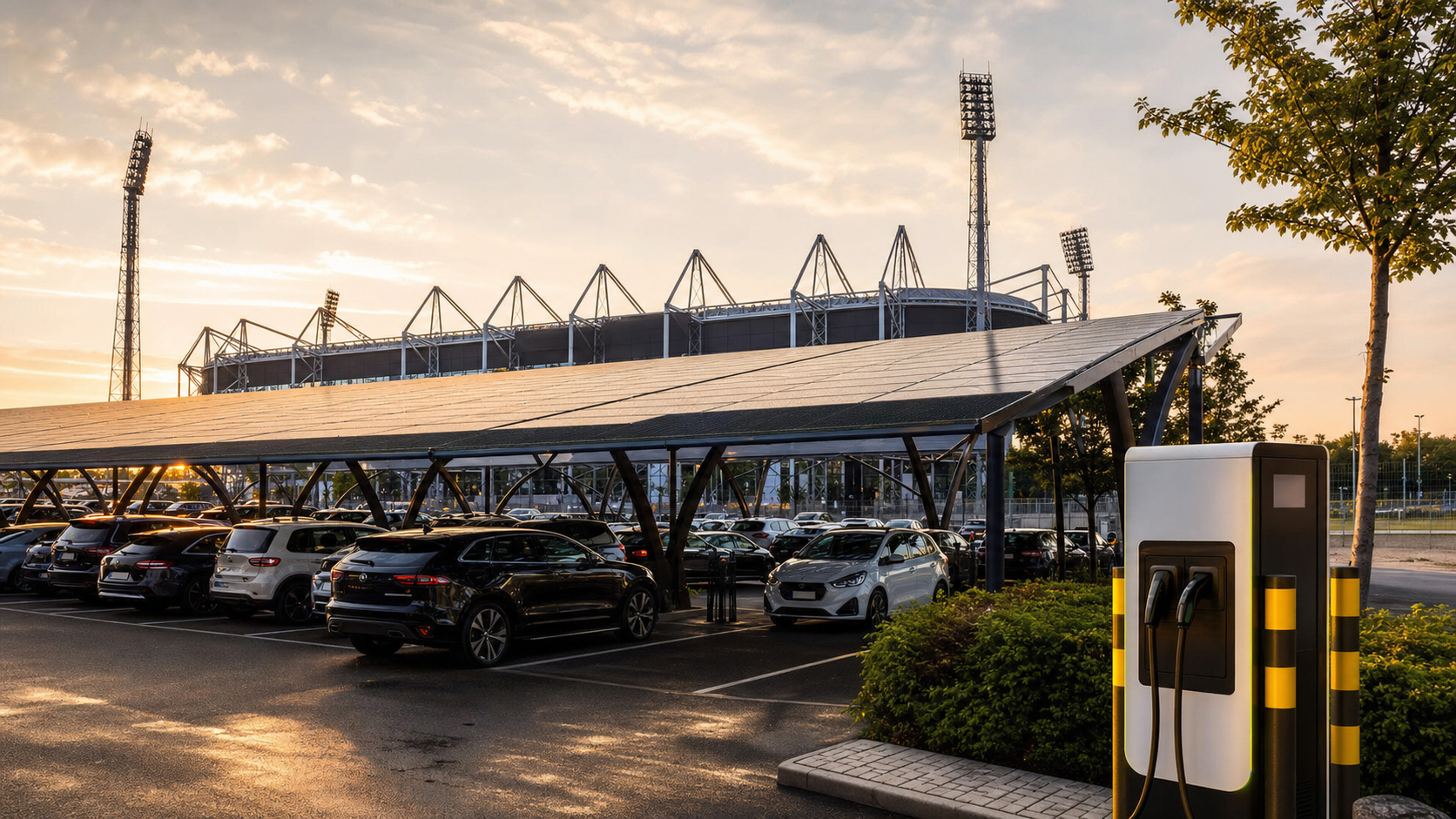
Solar parking lots & solar carports: From thermal baths to stadiums – Why more and more operators are covering their parking lots with solar panels – Creative image: Xpert.Digital
Solar boom above the car: The underestimated energy reserve of our cities
A brilliant move for the energy transition: Why German parking lots are now becoming power plants
For a long time, they led a rather dreary existence in urban areas as gray, sealed surfaces: German parking lots. But this perception is currently changing radically. Whether at the pension office, the thermal baths, the district administration building, or directly at the stadium of a Bundesliga soccer club – open parking spaces are increasingly becoming the most important power plant locations for the energy transition. This boom is fueled by a combination of new legal solar obligations in the federal states, the pressing desire for energy self-sufficiency, and the perfect synergy between electricity generation and local charging infrastructure. The following economic analysis, using six current examples from Landau, Laatzen, Mainz, Konstanz, Iserlohn, and Bad Wörishofen, shows why the roof over the car holds enormous economic potential – and where the patchwork of federal regulations and German bureaucracy are still hindering expansion.
Why the German parking lot is becoming the most important power plant location for the energy transition
For decades, parking lots in Germany were considered an energy-inefficient asset: sealed surfaces that generated neither revenue nor benefit beyond parking cars. This perception is now undergoing a fundamental shift, as municipalities, social security institutions, football clubs, and leisure facilities are discovering the roof over cars as one of the most economically attractive surfaces for photovoltaics. Five current examples from Landau, Laatzen, Mainz, Konstanz, Iserlohn, and Bad Wörishofen illustrate the diverse dynamics across regions and the underlying economic forces.
Solar carports are therefore economically attractive because they simultaneously utilize two scarce resources: sealed, already used land and grid connection points in close proximity to consumers. Unlike ground-mounted solar installations on greenfield sites, they do not compete for land with agriculture or nature conservation areas, and unlike rooftop installations on existing buildings, they often eliminate the need for the complex structural analysis of older buildings. This makes the parking space one of the last large, previously underestimated energy reserves in urban areas.
Tailwind from the government rather than from the market
How state laws turn an ancillary facility into an investment obligation
The real driving force behind the current construction boom is less pure economics than state legislation. Eleven of the sixteen German states have now enacted mandatory photovoltaic (PV) requirements for rooftops, and several have explicitly extended this requirement to large, open parking facilities. The thresholds vary considerably: In Baden-Württemberg and Hamburg, the requirement already applies to more than 35 new parking spaces, in Lower Saxony it will soon apply to more than 25, while Schleswig-Holstein only mandates a system for more than 100 parking spaces. North Rhine-Westphalia requires commercial developers with more than 35 parking spaces to install solar panels on the roof, unless a tree is planted every five parking spaces – an alternative option that is rarely used in practice because it is less attractive from an urban planning perspective than the solar solution.
This fragmented, state-specific approach creates a peculiar patchwork of investment incentives. In Rhineland-Palatinate, a developer only has to comply with the solar energy regulation requirement if the building has fifty or more parking spaces, and initially only for commercial and public buildings, while a comparable project in Baden-Württemberg becomes subject to this requirement even with significantly fewer parking spaces. For investors, this means that location decisions are now actually being made with solar energy regulations in mind, which can lead to noticeable regional distortions of competition in a federal system like Germany. At the same time, the example of Landau in the Palatinate shows that even where the formal requirements are more narrowly defined, public authorities voluntarily go considerably further than the law demands.
The district as a pioneer of administration
When a government agency becomes a power plant operator
A solar carport with thirty-three covered parking spaces and charging facilities for electric vehicles is being built at the district administration building in Landau in der Pfalz – a project that the district of Südliche Weinstraße has been planning for some time and is now putting into practice. What is remarkable here is not so much the absolute scale, which remains manageable compared to other projects, but rather the strategic message: a public administration is investing in its own energy generation where it itself acts as both user and operator.
This situation is economically attractive because public authorities typically have very long planning horizons and can more easily access subsidies and low-interest municipal loans than private investors. Rhineland-Palatinate itself mandates a limited photovoltaic requirement for new buildings and roof renovations of public buildings, meaning the district administration building in Landau is not only acting as an example but is also driven by regulatory requirements. For the district, the real economic advantage lies in the combination of on-site electricity generation for the administrative buildings, the ability to charge municipal vehicle fleets, including electric vehicles, at the same location, and a visible contribution to the district's publicly communicated climate strategy.
The pension fund is building a power plant
How a social security institution became the region's largest private energy producer
The project by the German Pension Insurance Braunschweig-Hannover at its headquarters in Laatzen is on a much larger scale. Around three hundred parking spaces there have been covered with photovoltaic panels, creating, according to regional media, the largest installation of its kind between the Harz Mountains and the coast. The German Pension Insurance itself confirms the completion of the new solar panels at its location and integrates the project into its broader sustainability strategy. Regional reports now refer to the installation as the largest solar park in the Hanover region.
What is economically remarkable about this case is that the client is not a typical energy company, but a public social security institution with a huge workforce and a correspondingly high electricity demand for its office buildings, data centers, and increasingly, electric vehicles for its employees. For an organization of this size, a system of this scale is worthwhile simply because the energy generated can be consumed directly on-site, thus at least partially eliminating expensive grid connection fees and levies. At the same time, the project serves as a symbol that even institutions with a less entrepreneurial focus are now actively participating in the expansion of renewable energies, not least because in Lower Saxony, solar roofs are now legally required for parking spaces with more than fifty, and from 2025 onwards, for those with more than twenty-five.
Football meets the energy transition
Why a Bundesliga club suddenly becomes a solar operator
The Bundesliga football club Mainz 05 is also building solar carports at its stadium and simultaneously installing electric vehicle charging points for visitors. At first glance, it seems unusual for a sports club to take on the role of an energy producer, but on closer inspection, the logic behind it is quite sound. Stadium parking lots are characterized by a very specific usage pattern: On match days, they are heavily frequented, but on other days they are often completely unused and lie fallow during the day, even though the sun is still shining.
This asymmetry makes stadium parking lots ideal candidates for solar carports, because the space is already available and maximum electricity generation is possible on non-match days without any competition for space. For a club like Mainz 05, the MEWA Arena, as a venue, also has a significant energy demand of its own, for example for floodlights, beverage cooling, kitchen facilities, and, not least, the charging infrastructure for fans, who increasingly arrive in electric vehicles. Furthermore, such a project can be perfectly integrated into the club's sustainability communication, which, given the growing societal pressure on major sporting events to reduce their environmental footprint, has considerable reputational value.
When climate protection meets building law
The conflict in Konstanz Paradise as a lesson in German administrative reality
The expansion isn't proceeding smoothly everywhere. The Paradies district of Konstanz serves as a prime example of how ambitious municipal climate goals can be thwarted by the strict limitations of current building regulations. Konstanz has set itself the goal of becoming largely climate-neutral by 2035 and, to achieve this, plans to increase its installed photovoltaic capacity from the current 18.6 megawatts to approximately 150 megawatts. Ironically, a private developer in the Paradies district, who wants to build a solar carport, officially submitted a building application at the end of January for a system whose planned location lies outside the legally defined building boundary.
Paradies is not just any residential area, but a district where parking has been particularly scarce and politically contentious for years. Of the approximately 2,500 parking spaces, over 1,000 are reserved for residents, while several hundred more are only available to the public with time restrictions. In such a regulated and contested parking environment, the interests of climate protection, which pushes for every available roofable surface for solar power, clash directly with a complex, historically developed network of zoning plans, parking regulations, and residents' interests. This case exemplifies a structural problem of Germany's energy transition: climate targets are formulated at the city-wide level, but their implementation is piecemeal, involving individual building applications where every deviation from the building line becomes a separate administrative procedure that can take months.
The scalable City Solar Carport Module for businesses, cities and municipalities

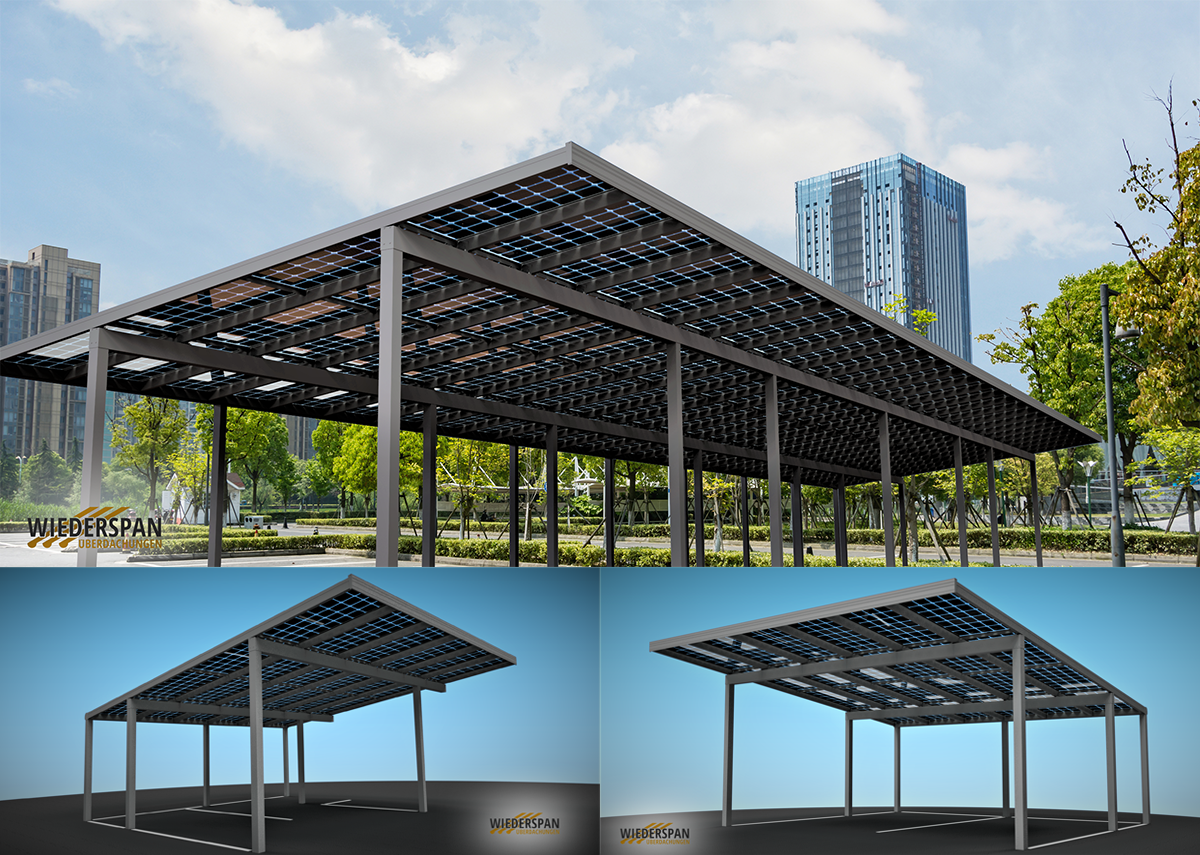
Solar canopy: Solar-covered parking lot - Image: Wiederspan.Solar
More information here:
We can also offer alternative solar-powered large parking lot systems!
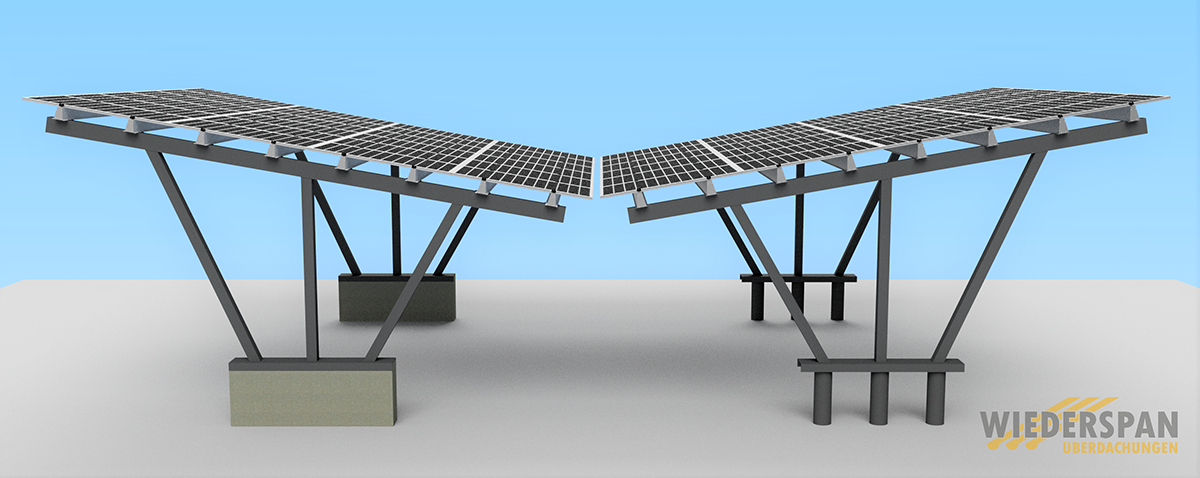
Photovoltaic systems for large parking lots - Image: Wiederspan.Solar
👉🏻 Let us advise you 👈🏻
👉🏻 Cars and trucks both possible! 👈🏻
We would be happy to help you find the optimal solar roof for your needs.
Our preferred city solar carport or solar carport module
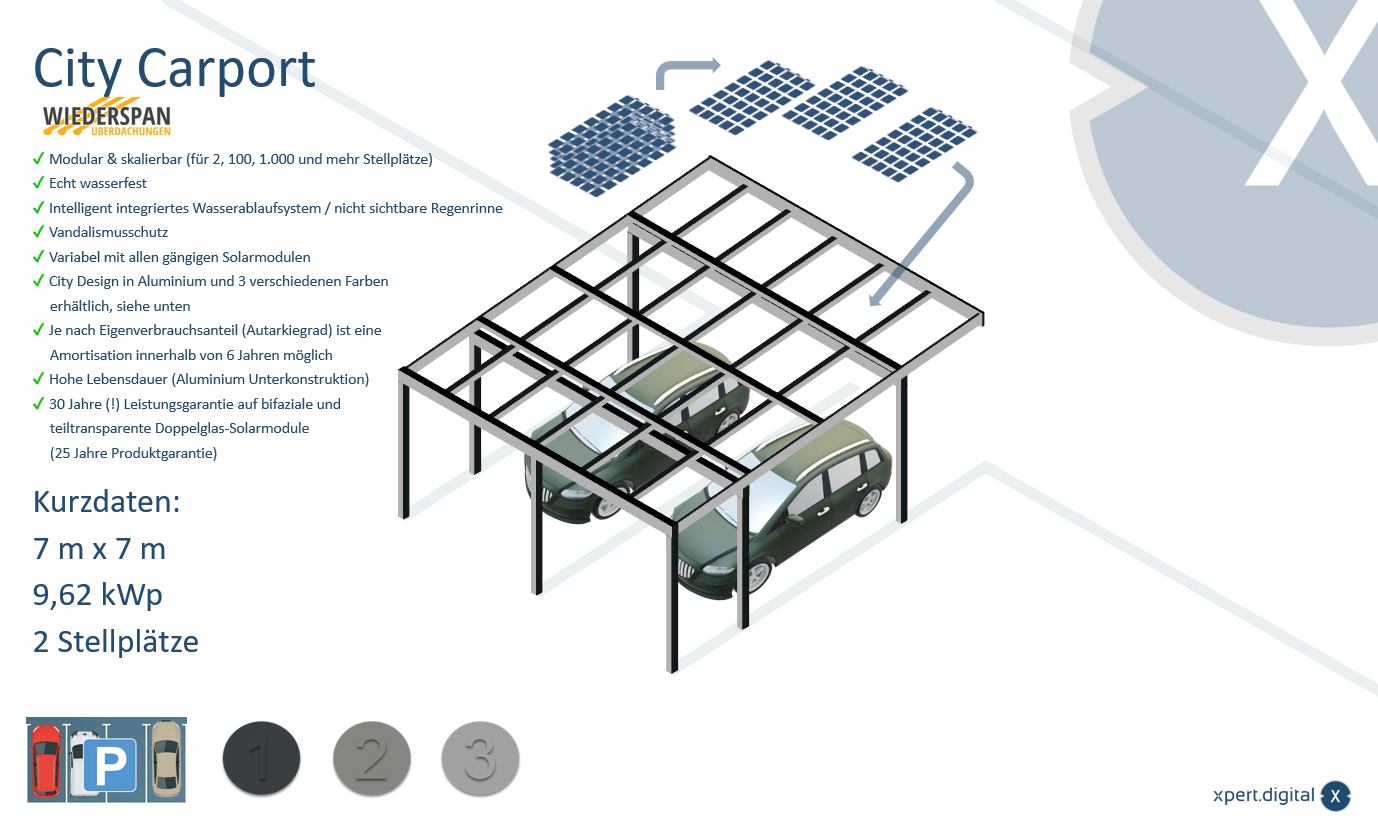
The City Solar Carport - with enhanced impact and vandalism protection - Image: Xpert.Digital
Advantages at a glance
- Support & Made in Germany
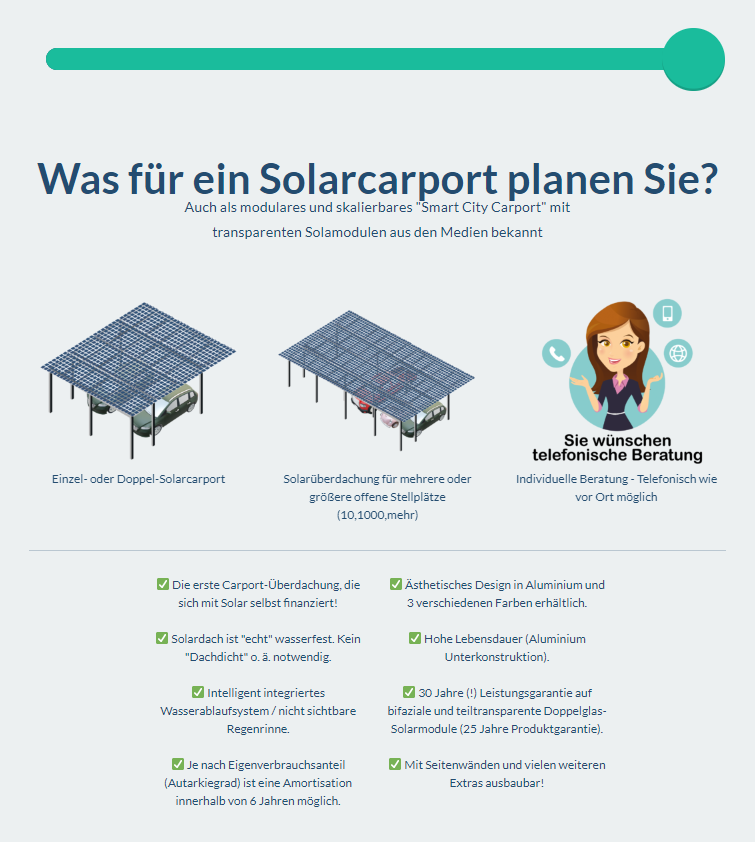
- Modular & scalable (for 2, 100, 1,000 and more parking spaces)
- Truly waterproof
- Integrated water drainage / concealed rain gutter
- Vandalism protection, optionally with integrated impact protection
- Compatible with all common solar modules
- City Design available in aluminium and 3 different colours
- Depending on the level of self-consumption (degree of self-sufficiency), amortization is possible within 6 years
- Long service life (aluminum substructure)
- 30-year (!) performance guarantee on bifacial and semi-transparent double-glass solar modules (25-year product guarantee)
- Reduction of urban heat islands
- Building-integrated photovoltaics
- Ideally suited for transparent and translucent double-glass solar modules with overhead mounting approval!
The economic potential of solar carports: Synergies for municipalities and businesses
The Sauerland region is moving towards
Why medium-sized cities are now also pushing into the pioneering role
In Iserlohn, the city administration is currently examining whether a large municipal parking lot is suitable for the construction of a solar carport. The process is still in its early stages, and the specific location remains undecided. Unlike in Landau or Laatzen, this is explicitly not an ongoing construction project, but rather an early evaluation phase in which the administration and political representatives are first determining which municipal areas are technically, legally, and economically suitable for such a project.
The case of Iserlohn illustrates that the current solar carport trend is by no means limited to large cities or financially strong special cases, but is increasingly reaching medium-sized towns in rural areas as well. For towns of this size, the construction of the first large solar carport is often a deliberately chosen showcase project with which the administration and city council want to position themselves as pioneers of the local energy transition, even before a statewide legal obligation compels them to do so. Precisely because North Rhine-Westphalia has already enshrined the solar panel requirement for commercial parking lots in its state building code since 2024, while public municipal parking lots are not necessarily affected in the same way, this creates an interesting opportunity for voluntary municipal engagement.
The spa town as a blueprint for self-sufficiency
How a leisure business can become independent of the electricity market within a year
The most technically ambitious of the six projects is located in Bad Wörishofen. The Bad Wörishofen thermal baths have opened their new solar carport, which provides shelter for 300 parking spaces, 28 electric vehicle charging points, and a battery storage system with a capacity of approximately 4,000 kilowatt-hours. The photovoltaic system itself has a capacity of 1.34 megawatts, was installed by the company Timeless Planet, and is complemented by three battery storage units from the manufacturer Fenecon with a total capacity of 3.864 megawatt-hours, as well as a dedicated transformer station for grid integration. Construction took place from April to November, the investment amounted to 3.8 million euros, and amortization is expected within eight years.
Particularly revealing is the statement that, under full sunshine, the system can cover up to 180 percent of the total energy needs of the thermal baths, including the adjoining sauna area. This, combined with the battery storage, enables complete self-sufficiency with solar power on sunny days. For an energy-intensive operation like a thermal bath, which requires large quantities of heat and electricity year-round for pool water, saunas, and air conditioning, this self-sufficiency rate represents a significant economic advantage against volatile energy prices. Moreover, the path to achieving this was planned for the long term: As early as 2022, the thermal baths began to rely more heavily on photovoltaics due to rising gas prices. Initially, only 20 percent of the electricity demand could be met by smaller rooftop systems before the major step of completely covering the parking lot was taken, with an estimated investment volume of up to €2.4 million. The actual cost of €3.8 million demonstrates that such projects often become more expensive in the implementation phase than calculated in the early planning stages, providing valuable experience for investment planning in comparable businesses.
Economic logic behind the investment wave
Why the combination of roof, electricity and charging point pays for itself so quickly
Looking at the six projects together reveals a common economic pattern. A solar carport combines three value creation levels, each of which would be economically viable on its own, but when realized together, they unleash significant synergies. The first level is the weather protection for parked vehicles, a benefit that drivers traditionally pay for through parking fees or rental surcharges. The second level is the electricity generation itself, which incurs virtually no additional land costs on an already sealed and unused roof surface. The third level is the ability to charge electric vehicles directly at the point of generation, thereby minimizing grid losses and combining investments in separate charging infrastructure with the solar system.
For private operators like those in Landau in the Palatinate, regional solar providers calculate an annual yield of approximately 4,346 kilowatt-hours and a payback period of just under fourteen years for a typical single carport with a peak output of around 3.5 kilowatts. For larger commercial installations, such as the one in Bad Wörishofen, this payback period is significantly reduced to around eight years due to economies of scale and the possibility of full self-consumption. This difference explains why large institutional operators such as social security providers, municipalities, and leisure companies are currently the driving force behind the expansion, while private single carports remain considerably more economically hesitant despite the zero percent VAT on photovoltaic components.
A patchwork of legal regulations acts as both a brake and an accelerator
How the federal system simultaneously generates speed and friction
The German federal states deliberately chose different approaches when formulating their solar energy obligations, which leads to considerable friction in practice. While Baden-Württemberg, Berlin, Bremen, and Hamburg have the most comprehensive obligation, covering both new buildings and roof renovations of all building types, Mecklenburg-Western Pomerania, Saarland, Saxony, Saxony-Anhalt, and Thuringia have not yet enacted any legal regulations. This lack of uniformity means that identical construction projects are subject to completely different requirements depending on their location, significantly increasing planning complexity for nationwide companies, retail chains, and leisure corporations.
At the same time, this very fragmentation of regulations reveals an interesting side effect: federal states with stricter regulations are effectively becoming early indicators and testbeds for the scalability of solar carports, whose experience can then be adopted by other states. The requirement generally applies only to open parking lots and not to parking garages. This is economically significant because parking garages, as vertical solutions, are considerably more expensive per parking space but simultaneously consume less land, while the solar panel requirement adds an extra layer of value to open parking lots, making them more attractive in a direct cost comparison with parking garages.
What the investment wave means for the energy transition as a whole
An underestimated building block with limited but real leverage
The total number of projects considered here – from thirty-three parking spaces in Landau to three hundred each in Laatzen and Bad Wörishofen – may seem modest compared to the installed capacity of large open-field solar parks. And indeed, no single solar carport project will decide Germany's energy transition on its own. However, the aggregation of many such projects across thousands of parking spaces nationwide adds up to a considerable increase in generation capacity, which also has the crucial advantage of being generated directly at the point of consumption, thus relieving the strain on transmission grids instead of burdening them further.
The psychological effect of such visible projects is also particularly valuable from an economic perspective. Unlike a solar park in a remote field, citizens encounter solar carports daily while shopping, attending matches, visiting government offices, or going to the spa. This everyday visibility generates acceptance for the energy transition in a way that abstract statistics on installed gigawatt-hours can hardly achieve. For precisely this reason, the expansion of solar carports is likely to gain further momentum in the coming years, driven by the gradual tightening of state laws and decreasing parking space requirements, as in Lower Saxony – even in places like Konstanz's Paradies district, where building regulations still present a hindrance in individual cases.
The Xpert.Solar solar carport planner
Solar parking spaces are a promising way to generate renewable energy while simultaneously optimizing the limited space available in cities and urban areas. However, there are indeed some challenges that can hinder the implementation of such parking spaces.
One of the biggest hurdles is the high cost and planning effort associated with installing solar panels in parking lots. Not only must the cost of the solar panels themselves be considered, but also the cost of the infrastructure required to connect them to the power grid. Furthermore, the space required for the installation of the solar panels must be precisely planned and coordinated to ensure effective use of the available area.
Another obstacle is bureaucratic hurdles and permitting procedures, which can complicate the installation of solar panels in parking lots. Depending on the region or country, different regulations and rules may apply, further complicating the approval and implementation process.
Despite these challenges, there is high demand for solar parking spaces, as they represent an effective way to promote renewable energy while simultaneously optimizing space utilization in urban areas. With careful planning and collaboration between the stakeholders, the obstacles can be overcome to facilitate the implementation of such parking spaces.
➡️ We specialize in providing consulting and planning support for such solar carport projects and in advancing their implementation.
➡️ Our solar carport planner simplifies the process.
➡️ We are here for you for the next steps, thus minimizing costs and effort for you.

Xpert.Solar solar carport planner
More information here:
Your partner for business development in the fields of photovoltaics and construction
From industrial rooftop PV to solar parks and larger solar parking lots
☑️ Our business language is English or German
☑️ NEW: Correspondence in your native language!

Konrad Wolfenstein
I and my team are happy to be available to you as your personal advisor.
You can contact me by filling out the contact form here wolfenstein@xpert.digital:or simply call me at +49 7348 4088 965. My email address is
I'm looking forward to our joint project.
☑️ EPC services (Engineering, Procurement and Construction)
☑️ Turnkey project development: Development of solar energy projects from start to finish
☑️ Site analysis, system design, installation, commissioning, maintenance and support
☑️ Project financier or intermediary of capital providers