
From (international) market signal to business: Eleven providers at a glance – Creative image on the topic, with AI: Xpert.Digital
From market signal to business opportunity: How XMedia monitoring can support B2B companies
More than just leads: How market information becomes qualified sales opportunities
Focusing on international B2B markets: How companies can identify relevant opportunities earlier
International B2B companies face a key challenge: they must identify relevant market changes early and derive concrete steps from them. An investment announcement, a new location, or a technological development can indicate future demand. However, a market signal is not yet a sales opportunity – and a large lead list is not yet a reliable competitive advantage. The crucial factor is whether a company correctly interprets the information, connects it to its own offering, and develops a suitable next step.
This is where Xpert.Digital's XMedia monitoring comes in. As part of the XHub process chain, it aims to combine market observation with the development of sales opportunities, professional content production, and publication. The goal is for information to not simply end up as a collection of news items or contacts, but to be usable for further business and communication tasks. This is particularly interesting for companies that operate in international markets, want to strategically utilize their internal resources, and more closely integrate research, marketing, and sales.
However, this approach is not a guarantee of success. A process architecture alone does not guarantee qualified opportunities or additional revenue. Its potential value depends on how reliably sources are verified, signals are evaluated, assumptions are identified, and results are translated into sales activities. The transitions between analysis, content creation, and outreach must also be clearly defined.
A comparison of eleven providers shows that market research, project data, contact information, intent signals, trade publications, and sales tools can be used in various combinations. Some offerings cover multiple work steps, while others provide particularly in-depth support for specific tasks. Therefore, the selection process depends not only on features or data volume, but also on which tasks the provider actually handles – and which remain within the company.
The central question is how a relevant observation can be transformed into a viable business opportunity: through careful analysis, appropriate professional communication, and a transparent approach to potential customers. This is precisely the criterion by which XMedia monitoring and XHub should be measured to determine whether they make a concrete contribution to international B2B market development.
Those who only collect leads are leaving the business to the competition
Xpert.Digital's XMedia monitoring can give international B2B companies a competitive edge because it treats market observation not as an end product, but as the starting point for a cohesive business development strategy. Its advancement over a mere collection of news items or contacts lies in the integration of information gathering, economic analysis, sales opportunity development, expert content creation, and publication within the XHub process chain.
However, the economic advantage doesn't arise simply from a company seeing more information or publishing it in additional languages. It only arises when relevant observations are translated more quickly into a well-founded decision, a suitable solution, and reliable access to the potential customer. Whether this advantage actually materializes must be verified based on concrete results; the described process architecture is not yet a general proof of success.
Information alone does not create an advantage
A company can be exceptionally well-informed and still miss business opportunities. Management reads market reports, marketing follows industry trends, sales researches target companies, and product development monitors new technologies. As long as these activities don't converge, knowledge remains fragmented. The problem then lies less in a lack of data than in a lack of connection between knowledge and action.
The extent to which digital infrastructure now varies is illustrated by the prevalence of artificial intelligence. In 2025, around 20 percent of the surveyed EU companies with at least ten employees were using AI technologies, compared to 13.5 percent the previous year. For small businesses, the figure was around 17 percent, for medium-sized businesses around 30 percent, and for large businesses around 55 percent. These figures describe the surveyed company sizes and economic sectors, not all self-employed individuals or micro-enterprises.
This does not allow for the derivation of a success rate for monitoring. Rather, the figures show that companies with different technical and organizational resources are competing for the same market opportunities. An integrated external service can therefore be particularly attractive where a company does not want to build complete internal teams for research, international technical communication, and digital sales support.
The crucial factor is not the number of AI tools used. What matters is which tasks are reliably completed and how well their results are integrated into the next stage of the process. A company with numerous software subscriptions may react more slowly than a smaller competitor with a few, well-integrated processes.
Contact is not yet an opportunity
A lead can be a contact address, a download, a trade fair conversation, or a company that matches the desired customer profile. A sales opportunity requires more: a comprehensible business reason, a plausible need hypothesis, and a justified next step. This distinction is particularly important in industrial projects because different locations, budgets, decision-making roles, and investment cycles can be hidden behind the same company address.
Buyers' information gathering methods are also changing. In a survey of 646 B2B buyers from August and September 2025, 67 percent preferred a purchasing experience without sales representatives; 45 percent had used AI in a recent purchase. These are survey results, not a statement that consulting-intensive industrial transactions will be entirely contactless in the future.
This presents a more demanding challenge for suppliers. Those who cannot clearly explain the problem they solve during a customer's independent research risk being overlooked in the subsequent supplier selection process. A large contact list does not automatically compensate for this shortcoming. Conversely, a well-prepared conversation starter can be valuable, even if the customer has not yet made a specific request.
MQL and SQL should therefore not be misunderstood as a guarantee of sales. A Marketing Qualified Lead (MQL) is qualified according to marketing criteria, a Sales Qualified Lead (SQL) according to agreed-upon sales criteria. The specific characteristics required must be defined by each company. Neither a label nor a scoring system replaces the assessment of need, budget, decision-making process, and actual delivery capability.
What constitutes a reliable market signal
A market signal is initially an observable indication of a potential change. A new location, a regulatory requirement, a technology program, or an investment announcement can point to future demand. However, its economic significance only becomes clear within the context. A site expansion may require new logistics technology, but it can also be implemented with existing equipment.
Professional evaluation therefore distinguishes three levels. First, there is the verifiable factual information. This is followed by the interpretation of its potential consequences. Only then is a business hypothesis developed for a specific provider. Combining these levels easily creates a false sense of certainty: a planned expansion is then prematurely transformed into a supposedly ready-to-buy customer.
XMedia monitoring within XHub is designed as a continuous observation of relevant market information. The sales opportunity function built upon this monitoring is intended to further analyze selected developments regarding their business significance. This introduces a separate qualification step between the discovery of a news item and its economic utilization.
Suitable criteria for evaluation include timeliness, reliability, strategic fit, and feasibility. Additional questions include: What are the arguments against an investment? Is financing identifiable? Has the problem already been solved? What information is missing? A professional opportunity analysis therefore includes not only arguments for pursuing the project but also uncertainties and potential exclusion criteria.
Why XMedia goes beyond observation
The real development lies not in reinventing global market signals. Project information, media monitoring, contact data, and digital interest signals have long existed as independent service areas. XMedia monitoring is more interesting as part of a process logic in which information, once collected, is not left unused but made available for further economic and communicative purposes.
XHub combines market research, sales opportunities, AI-powered content production, project management, WordPress publishing, and an archive. This allows insights from research to be reused across multiple work contexts, instead of having to be gathered anew for each task.
This connection professionalizes the work on two levels. In terms of content, it forces the question of why a development is relevant to a specific business model. Organizationally, it creates a pathway for translating this assessment into texts, projects, and market activities. The potential advantage therefore lies in the interfaces between activities, not solely in the performance of a single module.
Monitoring itself should not be considered the sole domain of every subsequent function. Contact management belongs to business development, publication to publishing, and technical processing to the platform. More precisely, XMedia is information access within a broader service model. Its full benefit depends on the subsequent services actually being agreed upon and implemented.
XHub connects previously separate work
In a fragmented organization, the same finding can be processed multiple times. The research team creates a briefing, the editorial team conducts further research for the article, the sales department locates the companies involved, and the international branch begins its own analysis. Each step can be useful; the problem lies in the unnecessary repetition of work that has already been completed.
An integrated process chain can offer synergistic benefits here. The initial analysis provides the background for an opportunity, its technical refinement supports a contribution, and the documented result remains available for later discussions. The XHub architecture is designed for such a combination of information processing, editorial work, publication, and archiving.
Economically relevant factors include not only visible processing times. Follow-up questions, version conflicts, lack of clear responsibilities, and lost context also generate costs. By improving these handoff processes, a company can utilize existing capacity more effectively without having to reassign every specialized task internally.
Data consistency is essential. Information that appears contradictory in different versions loses credibility. Therefore, clear processing statuses, expert approvals, and the separation of internal hypotheses from published facts are integral to professional process design. Faster processing is only an advantage if it is not negated by additional correction efforts.
Early detection, targeted action
The time advantage of global market monitoring lies primarily in preparation. Understanding a development early allows you to test your solutions, fill in any missing expertise, and develop a suitable conversation starter. This is quite different from rushing out a promotional message after every company announcement.
In a long-term industrial project, early contact can help explain technical alternatives before requirements are finalized. At the same time, the development may still be too uncertain to justify a significant amount of sales time. Therefore, professionalization doesn't require immediately acting on every signal, but rather making an appropriate decision between observing, investigating further, contacting, and discarding.
For international companies, the linguistic and regional dimensions also come into play. A signal can be relevant in a local market without yet appearing in the usual international industry media. A sensible monitoring approach should therefore tailor its source coverage specifically to the actual target markets. Unlimited global comprehensiveness, on the other hand, would be an unrealistic benchmark.
The advantage then doesn't lie in possessing exclusive news. It can lie in better integrating publicly available information with one's own offering. Two competitors might see the same news item; only one will develop a well-founded solution and an achievable next step from it.
Specialist content becomes part of business development
In this model, specialist content fulfills a different role than isolated advertising. It makes the interpretation of a market change comprehensible, explains technical relationships, and shows under what conditions a solution can be economically viable. At Xpert.Digital, content production is linked to research and its own publishing infrastructure.
This connection can also improve internal quality. Anyone who has to clearly explain a customer problem often discovers ambiguities in their own reasoning. If it's unclear who is affected or what the economic benefit is, the opportunity may not yet be sufficiently qualified.
A published technical article should not simply be used to disseminate an internal sales hypothesis. Confidential information, unproven project assumptions, and individual target account considerations require different treatment than publicly available, reliable market information. Therefore, reuse does not mean adopting the information verbatim.
The value of technical content extends beyond simply generating immediate inquiries. A text can support preparation for a conversation, serve as an explanation for a technical decision-maker, or deepen an existing customer relationship. Such effects cannot be fully captured by a single click count.
Multilingualism needs local relevance
Xpert.Digital provides content in 27 languages and connects this international content availability with its industry hub. This creates an infrastructure to make a specialist topic accessible beyond the German-speaking market.
The economic logic is sound: the fundamental research doesn't need to be completely repeated for every language version. Additional effort is required, particularly for translation, expert review, localization, and maintenance. This allows the costs of the initial analysis to be spread across multiple uses.
However, 27 language versions do not guarantee uniform reach or identical business success. A market may have different technical understandings, different search terms, and different decision-making processes. Therefore, to measure success, language availability, actual visibility, and qualified response must be considered separately.
Operational market capability remains essential. A company should not generate demand in a country if it cannot guarantee delivery, service, regulatory approval, or commercial processing there. International communication opens doors; it does not replace a robust internationalization strategy.
Quasi-in-house requires clear responsibility
Xpert.Digital describes its collaboration as an external, quasi-in-house solution for industry partners, combining operational tasks in marketing, content, and sales. The model is thus geared towards closer and more continuous collaboration than a purely ad-hoc content commission.
This can be advantageous for the client if internal capacity is lacking or existing expertise is not regularly translated into marketable communication. An external unit can combine research and implementation. However, the company must provide sufficient access to products, use cases, and business objectives.
Quasi-in-house does not mean that responsibility can be completely outsourced. Strategic priorities, technical commitments, pricing decisions, and customer approvals remain the responsibility of the company. Even an external partner needs clearly defined points of contact and agreed-upon channels of response.
Contractually important aspects also include data access, usage rights, confidentiality, documentation, and transferability. A model is only sustainable if the customer can understand the resulting information and relationships in the long term. Lower internal setup costs should not be achieved at the expense of unnecessary knowledge dependency.
🎯🎯🎯 Data-driven B2B industry hub as a quasi-in-house solution


The quasi-in-house solution: How Xpert.Digital closes operational gaps in B2B marketing and sales – Smart Content-Driven Business - Image: Xpert.Digital
Xpert.Digital is a data-driven B2B industry hub led by Konrad Wolfenstein . The company acts as an external, quasi-in-house solution for industrial partners, closing operational gaps in marketing, content, and sales – without requiring additional resources on the client side.
More information here:
XMedia Monitoring: The Key to Business Opportunities
Eleven providers in the service profile
The following overview compares eleven providers based on the same areas of expertise. It is not a quality ranking: Integrated service models, media offerings, contact platforms, and research tools are categorized according to their role in the business process. Xpert.Digital is listed first as the starting point of the analysis, followed closely by LinkedIn Sales Navigator. The numbering is for orientation purposes only.
Table 1
| Provider | Research and opportunity assessment | Contact and sales support |
|---|---|---|
| 1. Xpert.Digital | XMedia monitoring and structured sales opportunity development within the XHub process chain. | Partner-specific business development and strategic relationship building in the agreed quasi-in-house model. |
| 2. LinkedIn Sales Navigator | Person and company search, lead and account notifications; buyer intent from Advanced onwards. | InMail and relationship functions; TeamLink tariff- and booking-dependent, extended CRM integrations in Advanced Plus. |
| 3. Global Data Marketing Solutions | Industry information, audience intelligence, and target account planning. | Account-based marketing, lead generation, nurturing, and engagement analysis. |
| 4. Informa TechTarget | Buyer information and intent data, especially in the technology sector. | Sales information and, depending on the offer, leads with verified purchase projects. |
| 5. Vogel Communications Group | B2B market research and industrial target group information. | MQL and SQL services as well as strategy and campaign support. |
| 6. Industrial Information Resources | Verified industrial projects with investment values, project phases, timelines and equipment requirements. | Project participants and contact persons as a basis for targeted in-house sales efforts. |
| 7. ZoomInfo | Company, contact, event and intent data for account prioritization. | CRM enrichment, data transfers and automated sales workflows. |
| 8. Cognism | Company and contact data as well as sales and intent signals by product package. | Verified contact data, CRM enrichment, and sales integrations. |
| 9. Leadfeeder, formerly Dealfront | Identification of companies behind website visits and engagement analysis. | Account prioritization, target audience lists, contact information, and CRM activation. |
| 10. Feedly Market Intelligence | AI-supported market, technology and competitive intelligence as well as information synthesis. | Information and analysis for in-house intelligence and business development teams. |
| 11. Meltwater | Media monitoring, social listening, and trend, topic, and reputation analysis. | Media contacts and support for communication processes. |
Table 2
| Provider | Specialist content and distribution | Performance model | To organize at the customer's location |
|---|---|---|---|
| 1. Xpert.Digital | Individual specialist content and a dedicated industry hub with content availability in 27 languages. | Interlinking research, opportunity development, content and publishing. | Objectives, solution expertise, approvals and sales responsibility; operational division of labor according to contract |
| 2. LinkedIn Sales Navigator | Sharing and tracking of own materials via Smart Links from Advanced onwards; no comparable editorial production service with the described range of functions. | A tool for social selling, decision-maker research, and relationship building. | Economic evaluation, content, personal approach and continuous sales management |
| 3. Global Data Marketing Solutions | Editorial content and distribution via our own B2B publications. | Integrated marketing offering with data, specialist content and demand development. | Individual sales takeover and customer-specific project processing according to agreed division of labor |
| 4. Informa TechTarget | Specialist content, content syndication, and programs for visibility and demand. | Buyer intelligence, specialist communication and sales support. | Technical and economic qualification, discussions and conclusion |
| 5. Vogel Communications Group | Specialist content and national and international distribution via media and agency networks. | Industry-oriented media and agency services with broad overlap in services. | Qualification criteria, contact establishment and sales development according to scope of services |
| 6. Industrial Information Resources | Industry information and analysis; no proof of an identically designed individual 27-language publishing package. | Specialized industrial project and plant intelligence. | Check delivery capability, select projects, manage contacts and organize professional communication |
| 7. ZoomInfo | Data-driven campaign activation instead of automatically included ongoing editorial content. | Data and automation platform for in-house marketing and sales teams. | Strategy, professional classification, content and individual sales work |
| 8. Cognism | Data provision for in-house marketing and sales activities. | Sales intelligence with a focus on contact quality and data maintenance. | Opportunity assessment, content, outreach, and business development |
| 9. Leadfeeder, formerly Dealfront | Website and data-based campaign activation, not a similar editorial service in the described model. | Website-centric lead generation; brand unification under Leadfeeder 2026. | Build relevant website traffic, interpret signals, organize content and conversations |
| 10. Feedly Market Intelligence | Curated newsletters, reports and research sharing; no automatically included external editorial team. | A tool for research, analysis, and internal knowledge sharing. | Economic prioritization, operational networking and external market development |
| 11. Meltwater | Press release distribution, newsletters and website newsfeeds depending on the solution. | Communication intelligence and PR-oriented distribution. | Industrial opportunity assessment, technical qualification and sales processing |
The last column describes typical remaining tasks, not all conceivable additional services. The specific offer must be reviewed to determine exactly which tasks will be undertaken. A platform can technically enable many things without requiring the corresponding operational personnel to perform them.
LinkedIn unlocks the decision-making level
LinkedIn Sales Navigator adds a people and relationship perspective to the comparison. The provider differentiates between Core, Advanced, and Advanced Plus. Advanced search, insights into saved leads and accounts, and InMail support research and outreach. Buyer Intent and Smart Links are offered in Advanced and Advanced Plus; advanced CRM integrations are assigned to Advanced Plus. With TeamLink, the booking method should also be noted: The current comparison refers to Advanced Plus or an Advanced package purchased through a sales representative.
The economic benefit lies in identifying who might be relevant within a target company and how to establish contact. However, finding a manager is not automatically the technical decision-maker for a specific project. Networking supports the research process but does not replace the examination of the actual buying center.
XMedia monitoring and Sales Navigator are therefore not necessarily alternatives. An observed trend can initially lead to a needs hypothesis. Sales Navigator can then be used to search for suitable functions, people, and shared connections. This combination connects the opportunity and access without predetermining a sale.
Smart Links should also be precisely categorized. This function allows materials to be shared in a bundled manner and their engagement to be tracked. However, it does not include a service for research, the production of specialist articles, or publication in international specialist media.
Integrated media offerings are serious points of comparison
GlobalData Marketing Solutions, Informa TechTarget, and Vogel have significant overlaps in services with individual components of the Xpert.Digital model. They not only combine information with advertising but also offer expert content, targeted audience engagement, and demand forecasting. A comparison that reduces them to mere data providers would be factually incomplete.
GlobalData combines industry insights with target account selection, journalistically developed content, distribution, and campaign measurement. Its Lead Intelligence offering complements engagement data with account information and indicators of business changes, extending its capabilities beyond a simple lead list.
Informa TechTarget combines technology content and buyer information with sales support. Projects are qualified in corresponding proposals by providing details on the purchase intention, budget phase, role, and timeframe. For technology providers, this close connection to actual research and project activity can be an important benchmark.
Vogel combines B2B market research, editorial services, trade media, events, and agency offerings. Strategy, content, distribution channels, and MQL/SQL services are explicitly offered as a unified package. The practical question for comparison, therefore, is not whether integrated communication exists, but rather how individually, continuously, and sales-oriented it is implemented in each contract.
Project depth is irreplaceable
Industrial Info Resources is particularly relevant when specific plant and investment projects are the reason for sales. The project database covers twelve global industrial markets and includes information such as project scope, investments, timelines, equipment requirements, participating companies, and contact persons. Projects are tracked through different phases and status changes.
This structure is valuable for companies whose sales are closely linked to the construction, expansion, or modernization of industrial plants. General trend monitoring can supplement such information but does not automatically replace verified project detail. Conversely, a project database does not necessarily develop company-specific value propositions or ongoing technical communication.
ZoomInfo and Cognism place greater emphasis on company, contact, and interest data. Both support the prioritization and enrichment of sales processes. ZoomInfo combines intent data with integrations and workflows; Cognism emphasizes contact quality, CRM maintenance, and relevant company signals.
For an industrial company, a combination of tools can be beneficial. Project data provides the specific impetus, contact details and networking tools facilitate access, and a research and content function develops the technical arguments. Multiple tools are not a disadvantage if responsibility, data transfer, and follow-up are clearly defined.
Different signals require different tools
Leadfeeder primarily monitors which companies are active on their own websites. The unification of the Dealfront brand under the Leadfeeder name was announced in March 2026. The described offering combines website identification with company and contact data, target group creation, workflows, and integrations.
The particular value lies in its close connection to one's own digital offering. The limitation is that website monitoring only shows a specific segment of market development. A company may have a significant investment need without having visited its own website. Conversely, a visit does not necessarily indicate a purchase intention.
Feedly Market Intelligence supports the monitoring of numerous external sources, AI-powered information aggregation, and the sharing of insights via reports, newsletters, and integrations. It is therefore more than a simple news reader, but remains a tool whose results must be evaluated economically and implemented operationally.
Meltwater focuses on media intelligence, social listening, reputation management, and communication processes. Media contacts, press distribution, and newsletters are part of its portfolio. These signals can be relevant for market understanding, but they don't automatically answer the same questions as an industrial project qualification.
Seven levels instead of function lists
A meaningful comparison distinguishes between information gathering, economic assessment, opportunity development, networking, content creation, distribution, and operational support. These seven levels describe different tasks. A long product list doesn't necessarily indicate whether the provider handles the entire process themselves or merely offers the customer technical capabilities.
Information gathering answers the question of what is changing. Economic analysis clarifies why the change might be relevant. Opportunity development connects it to a customer problem and a solution hypothesis. Establishing contact opens the door. Content makes the benefits clear. Distribution creates touchpoints. Operational support keeps the process moving forward.
Xpert.Digital combines several of these levels within its described model. This is the core of its positioning. GlobalData, Informa TechTarget, and Vogel also have overlaps across several levels, while other providers offer particularly deep support for individual work steps.
The key business question is therefore: What internal hours and expertise remain required after the purchase? A seemingly inexpensive tool may demand significant in-house work. A more comprehensive service can be economical if it actually takes over relevant tasks. Without considering this, prices and performance figures are only comparable to a limited extent.
Economic efficiency begins with the total expenditure
Economic efficiency should be considered at the level of the entire process. Costs include not only licenses and fees, but also setup, internal coordination, data maintenance, expert review, translation, and follow-up. Additional factors include potential switching costs and the effort required to integrate results into existing systems.
On the benefits side, there are potential time savings, better decisions, and additional business opportunities. These factors should not be added together uncritically. Time saved only translates into additional financial gain if it is used productively or if it eliminates actual costs. Even better preparation can be valuable without immediately generating revenue.
For XMedia and XHub, a plausible chain of effects must therefore be examined: less duplicate research, faster qualification, better professional preparation, and more consistent market development. Whether this results in a positive contribution depends on the initial situation and its implementation. A universally applicable return on investment or a reliable, fixed efficiency percentage cannot be derived from the service description.
A sensible approach therefore focuses on clearly defined topics, target industries, and markets. Only when it becomes clear which signals are relevant and which follow-up work is effective should the scope be expanded. More data volume is no substitute for a functioning learning loop.
Measure what actually improves decisions
Success measurement begins before the first deal is closed. Meaningful process metrics include the proportion of technically relevant signals, the time until their evaluation, and the number of demonstrably qualified opportunities. Reasons for rejection are equally important: they reveal whether the system is learning to fit the market or repeatedly delivering the same unsuitable topics.
When it comes to content and distribution, companies shouldn't just count views. It's more important to consider whether relevant industries, functions, and countries are being reached, and whether the content is demonstrably being used in conversations. International availability and qualified engagement are separate metrics.
In sales, accepted opportunities, actual conversations, progress in the decision-making process, and later the contribution margin are what count. Clear documentation prevents existing contacts or foreseeable deals from being retrospectively attributed entirely to monitoring.
The measurement should take different time periods and customer segments into account. Early research may only lead to a project much later. Therefore, in addition to key performance indicators (KPIs), an objective evaluation of progress is needed. Neither simply attributing success to the last contact nor a blanket attribution of success to every published post is convincing.
Quality limits all automation
AI can support the processing of large amounts of information. The documented XHub approach combines such support with content production and other work steps. However, this does not automatically guarantee the validity of the generated ratings.
The most problematic aspects are not obviously false texts, but rather plausible conclusions based on weak evidence. A technically feasible solution may be economically unattractive. A planned project may fall through. A contact may have the wrong responsibility. Professional review must therefore examine the assumptions relevant to the decision, not just language and format.
International communication also increases the demands on technical terminology and consistency. An error can spread across multiple language versions. Therefore, verified source texts, traceable updates, and a correction process are all the more important.
Data protection, usage rights, and permissible forms of communication must also be assessed separately. The technical availability of contact details or platform functions alone does not answer how they may be used lawfully and in a way that is compatible with one's reputation. A reputable process requires clear responsibilities and, if necessary, legal review.
Independence does not require a claim of exclusivity
The comparison supports Xpert.Digital's independent positioning, but not a proven German or European unique selling proposition. The integrated offerings of GlobalData, Informa TechTarget, and Vogel already demonstrate that the combination of data, specialist content, and distribution is not an exclusive feature.
A more precise statement is: Xpert.Digital combines XMedia monitoring, sales opportunity development, specialist content, and its own publishing infrastructure within a partner-specific working model. The potential advantage lies in processing information across multiple stages, keeping it within its context.
This means that Xpert.Digital doesn't have to replace every contact database, nor does it need to possess the largest amount of data in every specialized field. For the customer, its integrative role can be crucial. Specialized data, personal networks, and existing sales structures can be used in a complementary way.
Where the market advantage actually arises
The decisive competitive advantage is not simply a wealth of information, but the ability to act on it with sound reasoning. For an international B2B company, a signal becomes valuable when its relevance is understood, the appropriate solution is evaluated, and credible market access is established. Combining these steps is the core perspective behind XMedia monitoring.
The XHub process chain provides a structured framework for this. Multilingual publishing can expand professional visibility. LinkedIn Sales Navigator can complement the personal and relationship level. Project and contact platforms can provide additional depth. The service profiles differ, but they don't have to be pitted against each other.
The potential advantage arises when a competitor sees an interesting piece of information, while your own company already knows what problems might arise from it, which assumptions need to be examined, and who is suitable for a constructive discussion. Not every one of these hypotheses will lead to sales. However, a professional process increases the transparency of the selection process and prevents relevant insights from being overlooked.
This is where the economically compelling development lies: not automatically more leads, but a better connection between market understanding, expert communication, and consistent business development. Whether this translates into a lasting competitive advantage depends on the quality of the implementation, not the size of the dashboard.
📈🚀 From visibility to trust 👀🤝 Your scalable path with Xpert.Digital

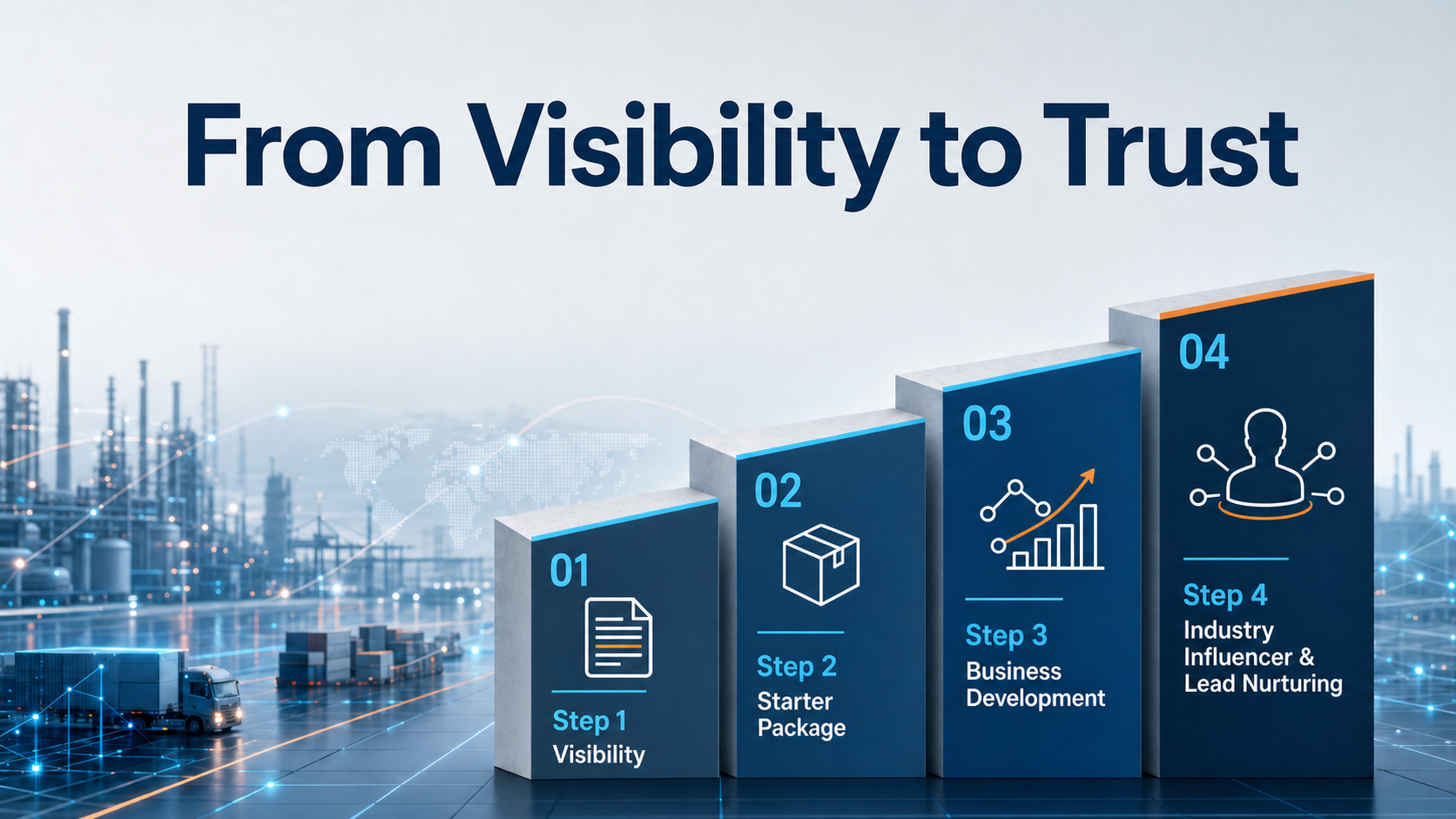
From visibility to trust: Your scalable path with Xpert.Digital - Image: Xpert.Digital
In industrial B2B, sustainable business relationships rarely emerge overnight. They develop step by step – through visibility, professional relevance, recurring touchpoints, and growing trust. Xpert.Digital's 4-stage model addresses precisely this: It offers a structured path that begins with a manageable entry point and can evolve into deeper collaboration in business development if needed.
Instead of relying on loud marketing promises, this model puts the relationship at the forefront. Companies start with clearly defined, easily calculable measures and then decide, based on their own experience, how far they want to expand the collaboration. A key factor for this undisturbed trust-building process: The platform completely avoids annoying advertising ads, so the editorial focus remains solely on the companies' expertise.
More information here:
Your global marketing and business development partner
☑️ Our business language is English or German
☑️ NEW: Correspondence in your native language!

Konrad Wolfenstein
I and my team are happy to be available to you as your personal advisor.
You can contact me by filling out the contact form here wolfenstein@xpert.digital:or simply call me at +49 7348 4088 965. My email address is
I'm looking forward to our joint project.