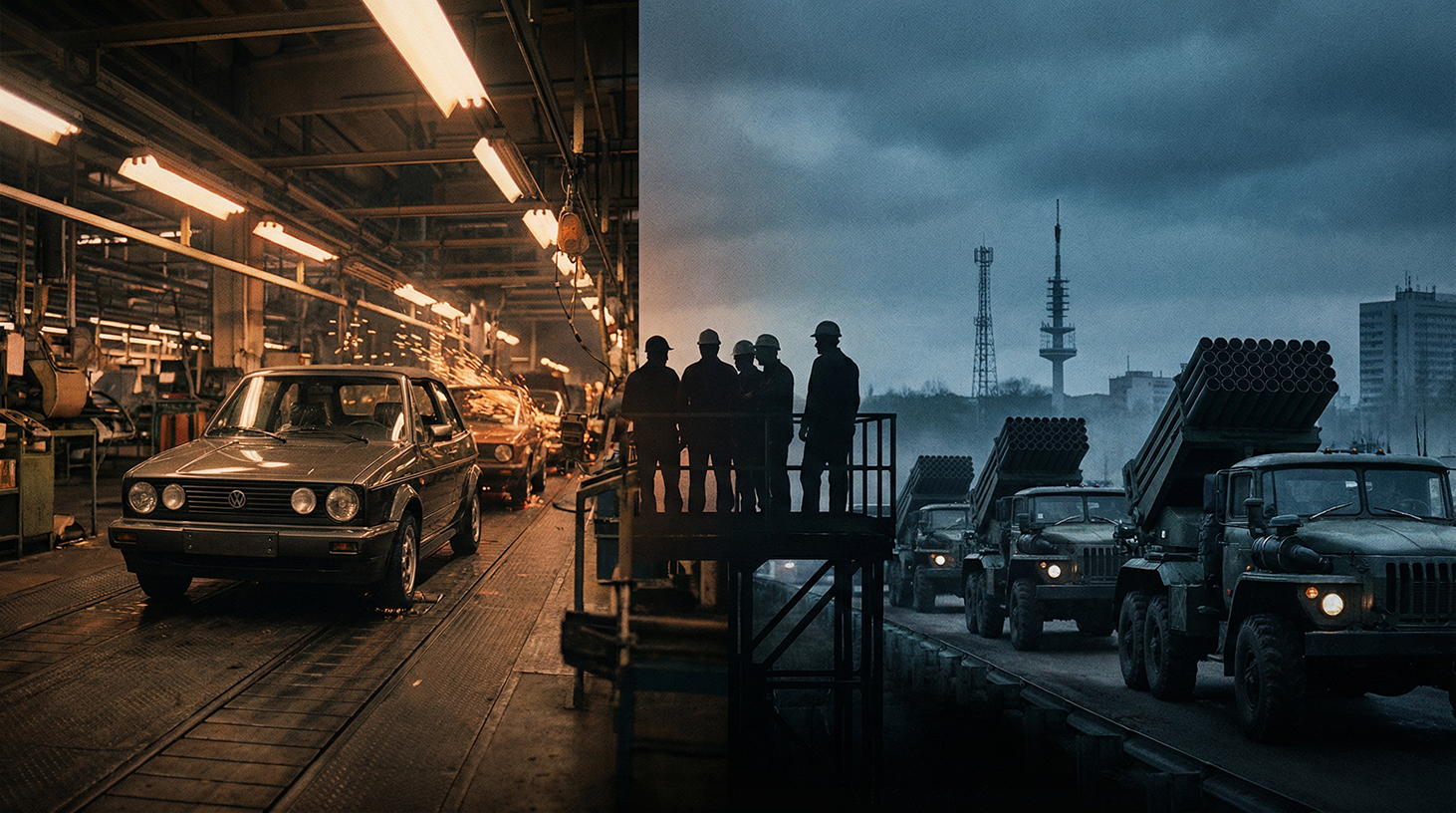
From convertible to Iron Dome: How VW wants to save its Osnabrück plant – Will this traditional factory now become a military forge? – Image: Xpert.Digital
Secret military prototypes: Will the VW plant in Osnabrück soon be building for the arms industry?
Missile defense instead of T-Roc: The dramatic turning point at the VW plant in Osnabrück
No more cars: Will an Israeli defense system save 2,300 VW jobs?
The Volkswagen plant in Osnabrück is at a crossroads: With lucrative convertible orders drying up in the foreseeable future and the Volkswagen Group mired in a deep, historic structural crisis, the long-established site is threatened with closure. But now, a rescue plan that is as spectacular as it is delicate is emerging. Instead of civilian cars, secret military vehicles and components for the Israeli "Iron Dome" missile defense system could soon be rolling off the assembly line in Osnabrück. This radical realignment not only reflects the existential economic crisis in the automotive industry but also marks the industrial beginning of the new security policy reality in Europe. For 2,300 employees, it may be their last chance – for the company, a historic taboo broken.
Between industry and defense: Why a car factory is becoming a symbol of Germany's new security reality
The Volkswagen plant in Osnabrück is no ordinary factory. Spanning over 430,000 square meters, it is the industrial heart of a city that has been writing automotive history for more than a century. Once world-famous as the Karmann plant – producing the Karmann Ghia, the Golf Cabriolet, and countless special editions – the site carries the DNA of a specialized low-volume manufacturer deep within it. But in the spring of 2026, this place faces a decision that extends far beyond the automotive industry. The question is no longer which convertible will be produced next, but whether cars will be built at all – or instead, components of a missile defense system that will shape the European security architecture of the coming decades.
Around 2,300 people currently work for Volkswagen Osnabrück GmbH in Osnabrück. The plant has established itself within the group as a center of excellence for convertibles, small production runs, and special vehicles. However, this niche status has now become an existential weakness: With the foreseeable end of production of the T-Roc Cabriolet – the last convertible under the Volkswagen brand – by the end of 2027, the only remaining major order will be lost. Porsche, the second major customer with the 718 Boxster and the 718 Cayman, has already announced that it will not be placing any further orders with Osnabrück, as its own production capacity in Zuffenhausen will be sufficient for the planned electric version. The plant is thus effectively facing a production gap for which there is currently no firm solution.
From soft-top to soft launch: The military prototypes from Osnabrück
Recent developments of remarkable significance demonstrate that Osnabrück is not passively awaiting its fate. As early as February 2026, two military vehicles, developed under the strictest secrecy at the VW plant in Osnabrück, were presented at the Enforce Tac security and defense trade fair in Nuremberg. The prototypes bear the unassuming designations MV.1 and MV.2 – MV stands for Military Vehicle. Notably, the VW emblem was completely covered on both vehicles; they were displayed at the booth of a company specializing in military conversions.
Technically, these vehicles are not simple conversions of civilian models, but rather fundamentally new developments. The MV.1 is based on the Amarok and was specifically designed for tactical operations. It features a modular loading platform for various mission modules, two separate power systems (12 and 24 volts), a new center console for radio equipment and computer workstations, special stealth lighting, and blackout switches for covert operations. The MV.2, based on the Crafter, is designed as a mobile command, medical, or logistics platform with a fully configurable interior. Both vehicles have a stealth mode that reduces their electromagnetic, acoustic, and thermal signatures. The fact that engineers in Osnabrück developed these vehicles in just four months demonstrates the technological potential of the location.
The Iron Dome option: Suppliers for Europe's security umbrella
Even more far-reaching than the military vehicles is the now-publicized negotiation option with the Israeli defense company Rafael Advanced Defense Systems. According to a Financial Times report citing several insiders familiar with the matter, Volkswagen is in concrete talks about manufacturing components for the Iron Dome air defense system. The core of the deal would not be the production of interceptor missiles themselves—VW remains steadfast in its principle of not manufacturing weapons—but rather the production of carrier vehicles, launchers, and generators that serve as the logistical and technical backbone of the system. For Rafael, Osnabrück would be a strategic bridgehead into the European market; for Volkswagen, a potential lifeline for the plant. According to one insider, the goal is explicitly ambitious: not only to preserve all jobs but possibly even to expand the site.
The Iron Dome system has been in operation for approximately 15 years and is considered the most thoroughly tested short-range missile defense system in the world. A single Iron Dome battery costs an estimated $100 million, according to the American Center for Strategic and International Studies. The interceptor missiles themselves, known as Tamir interceptors, cost between $40,000 and $150,000 each, depending on the year of production and the source. Rafael's Chairman of the Board, Yuval Steinitz, emphasized that Iron Dome thus has the most cost-effective interceptor missiles worldwide. The system has already been sold to European countries such as Finland and Greece, and other countries—including Germany—are in negotiations for procurement. The German government is also reportedly actively supporting plans for the production of Iron Dome components in Osnabrück.
The arms boom as a structural tailwind
The idea of a civil-military realignment of the VW plant in Osnabrück comes at a time when Europe is investing in defense and security on a historically unprecedented scale. In 2024, EU member states collectively spent €343.2 billion on defense – an increase of 19 percent compared to the previous year. Germany clearly leads the European rankings with €90.6 billion, accounting for 26.4 percent of total EU defense spending. The European Defence Agency forecasts a further increase to €381 billion for 2025, which is almost double the figure for 2020. The German federal budget for 2026 allocates more than €108 billion to defense alone, divided into €82.69 billion in the regular defense budget and €25.51 billion from the special Bundeswehr fund. This is a level that Germany last reached during the Cold War.
This influx of capital creates a structural demand for defense components that European industry can barely meet with its current capacity. At the end of 2025, the German Bundestag approved arms purchases worth €50 billion in a single resolution – the most extensive defense procurement decision in the history of the Bundeswehr (German Armed Forces). Rheinmetall is involved in 53 individual projects with a total volume of more than €88 billion, while Diehl Defence is involved in 21 procurement lines worth €17.3 billion, primarily in air defense. In this environment, the search for additional production capacity is not an optional consideration, but an industrial policy necessity. The Israeli company Rafael recognized this long ago: as early as 2018, it concluded a cooperation agreement with the Romanian company Romaero for the local production of Iron Dome components, and according to Rafael's Chairman of the Board, Steinitz, the company already produces defense systems such as the Trophy anti-tank system and the MELLS guided missile system in Germany. The Osnabrück project would be the next logical step.
Hub for Security and Defense - Advice and Information


Hub for Security and Defense - Image: Xpert.Digital
The Security and Defence Hub offers expert advice and up-to-date information to effectively support companies and organizations in strengthening their role in European security and defence policy. Working closely with the SME Connect Defence Working Group, it particularly promotes small and medium-sized enterprises (SMEs) that wish to further develop their innovative capacity and competitiveness in the defence sector. As a central point of contact, the Hub thus creates a crucial bridge between SMEs and European defence strategy.
Related to this:
VW in a bind: How Osnabrück is becoming a key player in Europe's air defense
Volkswagen's structural crisis as a catalyst
The pressure on the Osnabrück plant, however, cannot be viewed in isolation, but rather embedded in a profound, group-wide crisis. Volkswagen nearly halved its profits in 2025 and, according to reports in Manager Magazin, is preparing an expanded cost-cutting program aiming for a 20 percent reduction in group-wide costs – equivalent to around 60 billion euros – by the end of 2028. CEO Oliver Blume and CFO Arno Antlitz outlined this goal to the group's 120 top executives in mid-January 2026. A total of around 50,000 jobs are to be cut across the entire German VW Group by 2030, following a restructuring program agreed upon at the end of 2024 that would eliminate 35,000 jobs. While compulsory redundancies and formal plant closures have been ruled out, economic reality shows that a plant without production is essentially useless.
Shortly before Christmas 2024, the rating agency S&P lowered its outlook for Volkswagen to negative and explicitly pointed to the risk that the company could miss key financial targets. As a result, CFO Antlitz had to mobilize six billion euros in liquidity through the sale of receivables and other measures. Against this backdrop, the Osnabrück option appears not as an expression of an aggressive diversification strategy, but rather as defensive pragmatism: A plant that can no longer produce cars must produce something else – or close down.
The ethical and strategic boundary: arms suppliers without weapons
Volkswagen is treading on conceptually sensitive ground in Osnabrück. For a corporation that has consciously avoided military supply chains for decades, distinguishing between defense components and weapons in the strict sense is no small matter. A company spokesperson clearly stated the official line: Volkswagen categorically excludes weapons production. At the same time, the military prototypes MV.1 and MV.2, as well as the Iron Dome negotiations, demonstrate that the company's internal definitions of permissible defense component production are undergoing a significant shift. Carrier vehicles, launchers, and generators for a missile defense system are not weapons of war in the legal sense – however, they are integral components of a system designed precisely for this purpose.
This gray area is politically and ethically problematic, but widespread in industrial practice. Numerous German companies supply components for military systems without themselves being considered arms manufacturers: suppliers of commercial vehicles, generator manufacturers, and electronics companies. Rafael itself already produces in Germany, including anti-tank systems such as the MELLS. According to Handelsblatt, several Israeli defense companies are simultaneously in talks with German automakers – an indication that the convergence of automotive expertise and defense technology is not an isolated phenomenon, but a structural trend in the market. The technological basis for specialized trucks, robust generators, and carrier systems that Osnabrück has built up through decades of small-scale production is precisely what Rafael needs to scale up Iron Dome systems in Europe.
Geopolitics as a client: Europe's new security logic
Behind the debate surrounding the Volkswagen plant in Osnabrück lies a fundamental geopolitical shift. The Russian attack on Ukraine in February 2022 irreversibly altered the European security architecture. European defense, treated for decades as a secondary issue under the NATO umbrella, has become a central area of investment for political decision-makers. Air defense is a particular focus: drones, cruise missiles, and ballistic missiles have demonstrated the vulnerability of urban and industrial infrastructure in Ukraine. No European country can afford to treat air defense as a purely niche military problem anymore.
In this context, the Iron Dome occupies a special strategic position. The system has proven itself in thousands of real-world deployments in Israel and is considered the only fully tested short-range missile defense system available in significant numbers. Yuval Steinitz, Chairman of the Board of Directors of Rafael, has explicitly invited Germany to participate in the production of this technology and thus actively contribute to the defense of all of Europe. For the German government, the offer is doubly attractive: On the one hand, it creates production capacity for a system that the Bundeswehr (German Armed Forces) might want to procure itself; on the other hand, it secures industrial jobs in Germany, which is of considerable domestic political importance. The link between security policy and industrial policy is no coincidence, but rather an expression of a new state doctrine that finds its clearest expression in defense budgets.
What's at stake: A comprehensive economic overview
The economic significance of the Osnabrück case extends far beyond the plant itself. Around 2,300 direct jobs are at stake, along with an unknown number of indirect jobs in the regional supply chain. The plant, formerly a Karmann subsidiary, filed for insolvency in 2009 before Volkswagen acquired it from the bankruptcy estate for approximately €39 million. Since then, VW has invested significantly in modernization and established a state-of-the-art small-series production facility. Another closure or the plant remaining idle would represent a considerable setback, both economically and politically, particularly in a region where the automotive industry has traditionally been a major economic force.
At the same time, this example illustrates the profound impact of structural change on the German automotive industry. Volkswagen is grappling with declining sales in China, growing competition from the Asian electric vehicle segment, increasing cost pressures, and political uncertainties stemming from US tariffs. The Osnabrück plant is not an isolated case, but rather an early indicator. Plants specializing in small production runs and niche models are becoming increasingly difficult to justify within a corporate restructuring focused on economies of scale and electrification. The only economically rational alternative to new orders is an orderly withdrawal – an outcome that would be catastrophic for the workforce and the region.
The Iron Dome option is no panacea. It's a gamble: on Europe continuing to invest heavily in air defense, on Rafael and VW finding a viable cooperation structure, on the ethical and legal framework for defense component production within the group being aligned, and on the German government's political support translating into concrete orders. If the gamble succeeds, Osnabrück could become a model for a new form of industrial transformation – from civilian manufacturing to dual-use production that combines automotive expertise with defense technology requirements. If it fails, the plant faces a standstill by 2028 at the latest, from which a return to regular automotive production is hardly conceivable given the group's current situation.
Consulting - Planning - Implementation

Markus Becker
I would be happy to serve as your personal advisor.
Head of Business Development
Chairman SME Connect Defense Working Group
Consulting - Planning - Implementation
Konrad Wolfenstein
I would be happy to serve as your personal advisor.
You can contact me at wolfenstein∂xpert.digital or
Just call me on +49 7348 4088 965 .