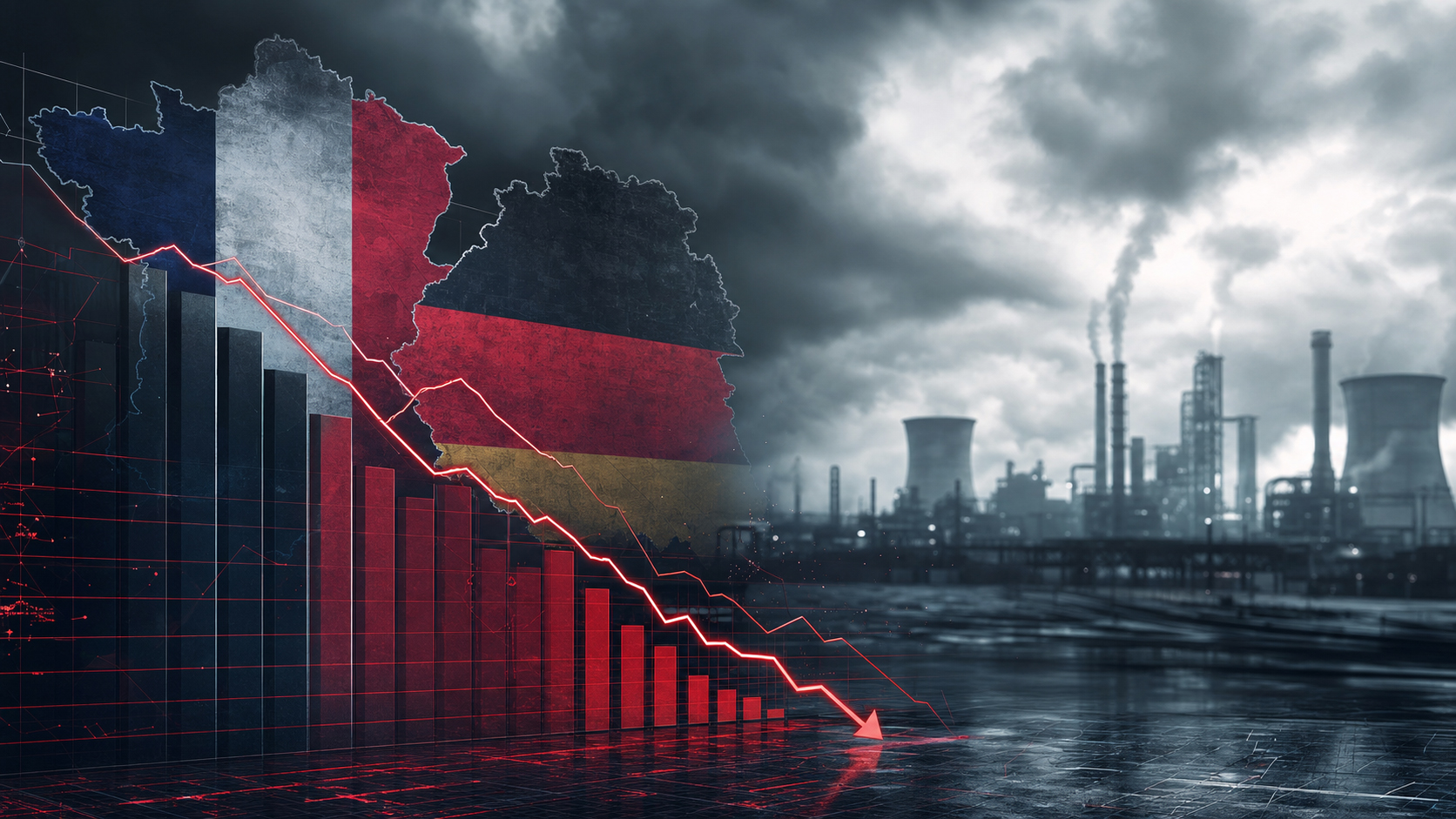
Warning signal from the neighboring country: Why France's debt shock reveals Germany's true crisis – Image: Xpert.Digital
520,000 industrial jobs lost: Is Germany knowingly heading towards financial catastrophe?
Record debt and corporate exodus: How German prosperity is currently disappearing in secret
The convenient self-deception: Why the secure job in the public sector is a fatal misconception
While the German public often views France's exploding budget deficit critically, yet from a comfortable distance, a far more dangerous development is unfolding right on its own doorstep. The recent downgrade of France's credit rating is not an isolated problem for our neighbor, but a stark warning signal for all of Europe. Yet instead of learning from the French crisis, Germany is lulled into a false sense of fiscal security. The true difference between the two largest economies in the Eurozone lies deep within the core of the problem: While France suffers from chronically excessive government spending, Germany is systematically dismantling its own economic foundation – industrial value creation. Unprecedented deindustrialization, a historic collapse in investment, and the quiet exodus of entire industries are eroding the very basis from which our welfare state and a steadily growing public sector are financed. The following analysis ruthlessly exposes why current economic data lays bare the convenient excuse of German politicians and why the French fate could soon become the blueprint for the collapse of German prosperity.
When two engines fail simultaneously: France's debt explosion and German self-deception
Why a purely French problem is actually a European warning sign
By the end of June 2026, the French central government had accumulated a budget deficit of approximately €107 billion, exceeding the original projections by about 14.4 percent. Extrapolating this trend to the entire year, the central government alone could reach a deficit of around six percent of GDP, while the overall government deficit, including social security, regional and municipal budgets, could rise to around eight percent of GDP. This would mean France would exceed the three percent limit stipulated in the Maastricht Treaty by more than double. The rating agency Fitch has already reacted, downgrading France's credit rating from AA minus to A plus, citing a persistently increasing debt burden, political instability, and the lack of a credible consolidation path. Planned tax increases are currently projected to generate only about nine billion euros in additional revenue, while structural reforms remain elusive. Because France is the second-largest economy in the Eurozone, a reassessment of its credit risk could have a significant impact on the entire European bond market.
The convenient excuse for why this doesn't affect us
In German public debate, the French budget crisis is often dismissed as an expression of specifically French political dysfunction, such as the fragmented party system and the stagnation of reforms under successive governments. This view, however, overlooks the fact that both countries face the same fundamental structural question: whether their economies can sustainably generate enough added value to finance government spending commitments. While France's problem is primarily fiscal in nature, resulting from decades of high government spending coupled with a comparatively weak industrial base, Germany's challenge stems from the gradual erosion of its own industrial value-added base, which has traditionally formed the backbone of government financing.
The shrinking foundation of the German economy
German industry lost approximately 124,100 jobs in 2025, following a loss of 56,000 the previous year. Since the pre-crisis year of 2019, the total loss in the core manufacturing sector has reached about 266,200 jobs, representing a decline of almost five percent. Other surveys, depending on the definition of the sectors included, even cite figures as high as 520,000 lost industrial jobs since 2019. The Federation of German Industries (BDI) reported in July 2026 that around 15,000 industrial jobs were being lost each month, describing the sector as entering a critical phase and experiencing a gradual deindustrialization. Within the previous twelve months, the manufacturing sector had lost a total of 177,000 jobs, while insolvency figures in the second quarter of 2026 reached a peak not seen in two decades. The automotive industry alone lost around 50,000 jobs in 2025 and about 111,000 jobs since 2019, a decline of 13 percent, with the Association of the Automotive Industry expecting a loss of up to 225,000 jobs by 2035.
Particularly revealing is the weakness in investment underlying this job loss. An international study puts Germany's net productive investment at only around 0.2 percent of its gross domestic product, while China reaches about 23 percent, India around 14 percent, the United States about four percent, and the European Union average around two percent. Essentially, this means that Germany is increasingly depleting its industrial capital stock instead of modernizing it, while competing economies are building new production capacities. In the metal and electrical industries, which are particularly important for prosperity, private investment in equipment has already plummeted by more than 20 percent compared to 2019, and since 2020, companies have been investing less in new machinery than they are simultaneously depreciating, thus obsolete their machinery and further eroding their competitiveness.
When an entire industry retreats
At BASF's headquarters in Ludwigshafen, the number of full-time positions fell below 30,000 in May 2026 for the first time since 1954, while the company has cut around 7,000 jobs worldwide since January 2024. In August 2025, the energy-intensive industry produced four percent less than the previous year, adjusted for calendar effects. The chemical industry, which accounts for around ten percent of German industrial production and employs 460,000 people, is undergoing a silent exodus that threatens to erode supplier networks and research infrastructures that have grown over decades. A survey of 1,000 companies conducted by the consulting firm Horváth in cooperation with the Handelsblatt newspaper shows that 60 percent of the companies expect further job cuts at their German locations by 2030, while genuine growth with new jobs is increasingly taking place in foreign markets. The surveyed companies identified not primarily the much-cited bureaucracy, but rather the comparatively high personnel costs as the main reason. The German Association of the Automotive Industry (VDA) also cites high taxes and levies, expensive energy, and excessive bureaucracy as mutually reinforcing disadvantages for Germany as a business location. At the same time, according to the Institute for Employment Research (IAB), the German economy is currently lacking around 1.7 million skilled workers – a shortage that, according to estimates by the Centre for European Economic Research (ZEW), causes an annual loss of added value of approximately 90 billion euros, more than the entire federal budget for education and research.
The misconception that tax money is created out of thin air
The core of the misjudgment described at the outset lies in a fundamental misunderstanding of the nature of government financing. A state does not generate its own added value, but merely distributes funds that have previously been earned by companies, employees, and the self-employed and paid in through taxes and social security contributions. Those employed in the public sector or receiving social benefits who consider their income directly guaranteed by the state and therefore unaffected by economic cycles fail to recognize that these payments are ultimately financed by the profits of a competitive private sector. If this profitability declines permanently because production facilities relocate abroad and jobs disappear, the financial basis for salaries, pensions, subsidies, and social benefits inevitably comes under pressure, even if this effect is delayed and initially mitigated politically through additional borrowing.
🎯🎯🎯 Data-driven B2B industry hub as a quasi-in-house solution


The quasi-in-house solution: How Xpert.Digital closes operational gaps in B2B marketing and sales – Smart Content-Driven Business - Image: Xpert.Digital
Xpert.Digital is a data-driven B2B industry hub led by Konrad Wolfenstein . The company acts as an external, quasi-in-house solution for industrial partners, closing operational gaps in marketing, content, and sales – without requiring additional resources on the client side.
More information here:
France as a cautionary tale: Is Germany's economy, despite its top rating, headed for crisis?
Figures that expose the German spending logic
The end of the promise of prosperity: When declining value creation exposes the flaws in social systems
The 2026 federal budget projects total expenditures of approximately €520.5 billion, of which tax revenues of roughly €383.8 to €387.2 billion cover only about three-quarters. The remainder must be financed through net borrowing, estimated at approximately €89 to €98 billion for the federal government alone. Including special funds such as the Climate and Transformation Fund and the Special Fund for Infrastructure, total expenditures amount to approximately €630 billion, of which almost one-third is financed by borrowing. The Federal Court of Auditors anticipates that federal debt will rise to approximately €2.7 trillion by 2029 and that the interest rate in the federal budget will reach almost twelve percent that year, corresponding to interest payments of over €66 billion. The overall government budget deficit, which stood at 2.7 percent of GDP in 2024 and 2025, is expected to widen to around four to four and a half percent of GDP this year, while the debt-to-GDP ratio is projected to rise from 62.2 percent in 2024 to approximately 66.5 percent in 2026 and to around 76.5 percent by 2028. According to calculations by the Federation of German Taxpayers, total new government borrowing will increase by more than €218 billion in 2026, while at the same time tax revenues are expected to exceed €1 trillion for the first time – a double record of both revenue and new borrowing occurring simultaneously.
Why rating agencies are still remaining silent, but are taking a closer look
Fitch, Standard & Poor's, and Moody's all reaffirmed Germany's top credit rating in spring 2026, with the outlook remaining stable. However, in early August 2026, initial doubts about the sustainability of this rating surfaced publicly, as the high and still-rising debt is causing increasing concern, even though the three leading agencies have not yet revised their assessments. This situation is similar in its dynamics to what France has already experienced, where warning signs were also long considered manageable before the reality of the figures forced a rapid reassessment. The crucial difference lies in the fact that Germany currently still benefits from a significantly better initial rating and a lower debt-to-GDP ratio, but is structurally more dependent on an internationally competitive industrial sector than France, whose economy is more broadly diversified and more service-driven.
The deceptive security of public sector jobs
What is remarkable about the current phase of job losses in Germany is that it is unfolding differently than previous industrial crises. Most employees are not losing their jobs through classic mass layoffs, but rather because companies simply aren't filling vacant positions. By 2025, only around 6.6 million people will be employed in the manufacturing sector, while the share of industry in total employment has fallen from 22 percent in 2014 to just 19 percent. At the same time, the public sector continues to grow, which creates the impression of relative stability in the short term, but in the long term distributes the financial burden among a shrinking number of productive workers. This shift explains why many public sector employees perceive the industrial crisis as an abstract phenomenon that doesn't affect them personally, even though their own income security ultimately depends on precisely the value creation that is currently eroding.
When factory closures lead to empty city centers
The loss of industrial jobs has repercussions that extend far beyond the skilled workers and engineers directly affected. Suppliers, craft businesses, logistics companies, service providers, retailers, restaurants, and the regional real estate market are all impacted, as declining employment and lower incomes weaken local purchasing power. Industry economists point out that for every job at an automotive manufacturer, three to five supplier companies typically depend on it, meaning that the job cuts at the manufacturers themselves that have come to light so far represent only the tip of a much larger iceberg. Regionally, this effect is particularly concentrated in the industrial southwest of Germany, where the employers' association Südwestmetall reported a loss of 32,450 jobs for 2025 alone, representing a decrease of more than 70,000 jobs compared to the peak in 2019. Such regional chain reactions simultaneously weaken municipal tax revenues and increasingly prompt young, qualified workers to leave economically weakened regions, further exacerbating the downward trend.
France as a blueprint for a possible German future
The crucial lesson from the French experience lies not in the direct transferability of the figures, but in the mechanism itself. France demonstrates how quickly seemingly sound fiscal planning can falter when structural reforms are postponed for years and the economy does not grow fast enough to bear the burden of expenditure. While Germany currently enjoys better fiscal starting conditions with a lower debt-to-GDP ratio and a more stable credit rating, the underlying value-added base on which this stability rests is already measurably eroding. The combination of a shrinking industrial sector, below-average net investment of only 0.2 percent of GDP, a structural shortage of skilled workers, and simultaneously record-high borrowing can be interpreted as a kind of delayed version of the French problem, in which the symptoms have so far been masked by a more favorable starting position.
What really matters beyond partisan infighting
The crucial economic policy question for the coming years is under what conditions companies will be willing to invest and produce in Germany again, and to maintain or create jobs. Without an internationally competitive industry, a high-performing welfare state cannot be financed in the long term, because without sufficient value creation, there is simply no pool of resources for distribution, regardless of which political party sets the spending priorities. Competitiveness is not an abstract economic indicator, but rather the prerequisite for ensuring that political promises regarding pensions, healthcare, infrastructure, and social security can be kept in the long run. Current data on weak investment, job losses, and rising national debt indicate that this foundation is already more severely damaged in Germany than the still-stable credit ratings and the comparatively moderate debt ratio might initially suggest.
📈🚀 From visibility to trust 👀🤝 Your scalable path with Xpert.Digital

From visibility to trust: Your scalable path with Xpert.Digital - Image: Xpert.Digital
In industrial B2B, sustainable business relationships rarely emerge overnight. They develop step by step – through visibility, professional relevance, recurring touchpoints, and growing trust. Xpert.Digital's 4-stage model addresses precisely this: It offers a structured path that begins with a manageable entry point and can evolve into deeper collaboration in business development if needed.
Instead of relying on loud marketing promises, this model puts the relationship at the forefront. Companies start with clearly defined, easily calculable measures and then decide, based on their own experience, how far they want to expand the collaboration. A key factor for this undisturbed trust-building process: The platform completely avoids annoying advertising ads, so the editorial focus remains solely on the companies' expertise.
More information here:
Consulting - Planning - Implementation

Konrad Wolfenstein
I would be happy to serve as your personal advisor.
You can contact me at wolfenstein∂xpert.digital or
Just call me on +49 7348 4088 965 .