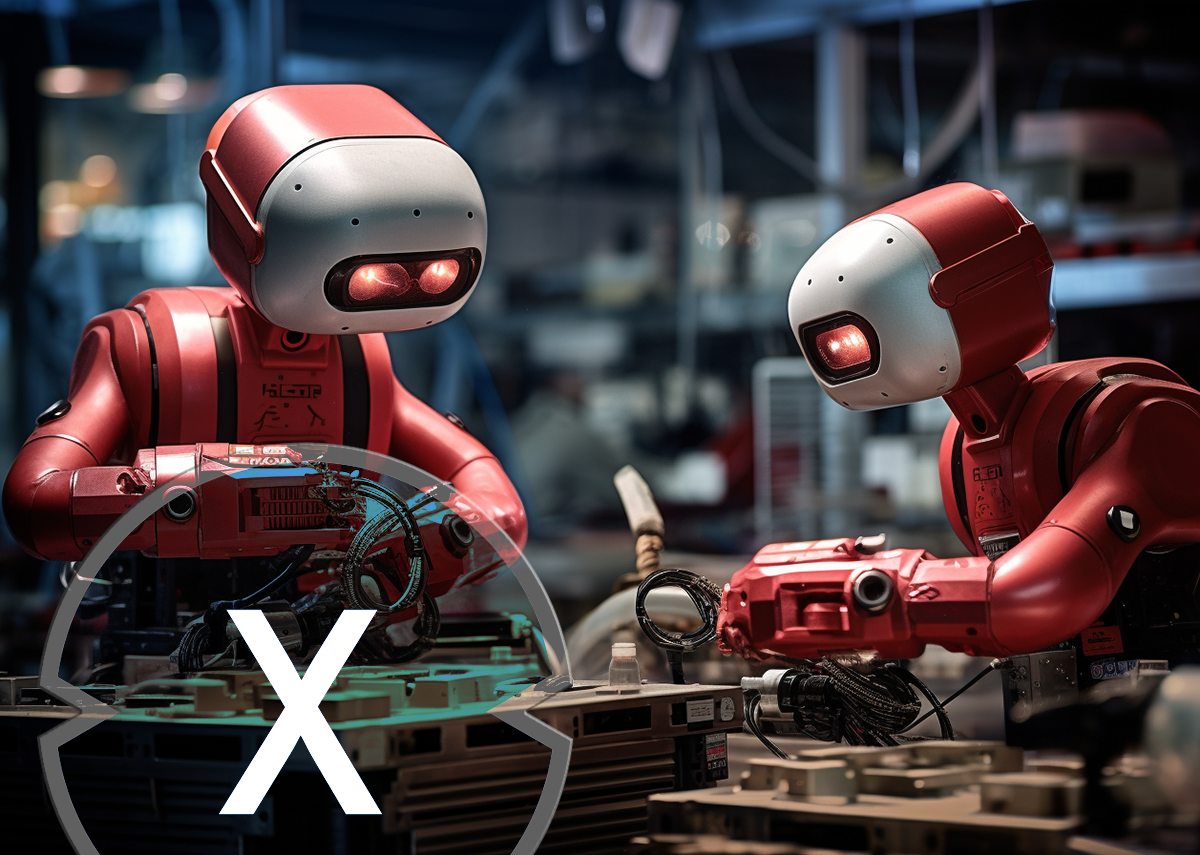
Flexible and modular logistics such as intralogistics: Flexible and modular conveyor systems – cobots (collaborative robots) and autonomous mobile robots (AMRs) – Image: Xpert.Digital
🔧 The importance of flexibility in intralogistics
🔄 Intralogistics in Transition
Intralogistics represents an essential sub-sector of logistics, taking place within a company's operational area. The focus is on optimizing and automating warehousing, conveying, and handling processes. With the growth of e-commerce and the ongoing globalization of markets, the demands on intralogistics are also increasing. Intralogistics systems must become increasingly flexible and modular to adapt to changing market conditions and dynamics.
🤖 The role of cobots and AMRs in intralogistics
🤝 Cobots and AMRs: Helpers of the future
Flexibility in intralogistics is significantly increased through the use of modular conveyor systems, collaborative robots (cobots), and autonomous mobile robots (AMRs). These technologies are transforming traditional warehouse and production environments and helping companies to make their processes more efficient and economical.
🏭 Modular conveyor systems and their advantages
🛠️ Modularity and adaptability
Modular conveyor systems are designed to adapt quickly and easily to changing requirements. A company that, for example, expands its product range or needs to manage seasonal fluctuations in production and output can benefit from these systems. Modules such as roller conveyors, belt conveyors, vertical conveyors, and rotary tables can be combined and reconfigured as needed. This allows for rapid adaptation to new processes without the need for extensive capital investment.
🌐 Networking and intelligent process control
🤖 Intelligent control and communication
In addition to modular construction, networking within these systems plays a crucial role. Using interface standards and integrated control systems, modular conveyor systems can be flexibly expanded or reduced not only in their physical structure but also in their functionality. Furthermore, the integration of sensor technologies enables intelligent process control. In this way, the systems can autonomously react to changes in the material flow and optimize it.
👷 Human-robot collaboration: The new possibilities
👫 Human-machine collaboration
The increasing importance of cobots in intralogistics should not be underestimated. Cobots are designed to work hand in hand with human employees. They are generally smaller, more flexible, and easier to program than conventional industrial robots. Cobots can be used for a wide variety of tasks, from simple handling of goods and order picking to performing more complex assembly tasks.
🚀 Autonomous Mobile Robots (AMRs) – A Revolution in Intralogistics
🚜 AMRs: Independent Logistics Assistants
Autonomous mobile robots (AMRs) represent another driver of innovation in intralogistics. These intelligent vehicles are capable of moving independently within warehouse and production environments. Equipped with advanced sensors and navigation systems, they can transport goods autonomously from one location to another without requiring human intervention or fixed conveyor routes. Route planning occurs in real time, allowing obstacles to be avoided and the most efficient path to be selected.
💡 Artificial Intelligence (AI) as a enabler for AMRs
🧠 AI: Key factor for AMRs
The ongoing development of artificial intelligence (AI) plays a fundamental role in the functionality of automated retail management systems (ARMS). Linking AMRs with intelligent inventory management systems enables the optimization of logistics processes through predictive analytics and real-time decision-making. Intelligent algorithms ensure that goods flows are perfected and inventory levels are optimally utilized. This allows for maximum efficiency, speed, and cost-effectiveness.
🏢 Smart Factories: The Future of Production and Intralogistics
🏭 Smart Factories: A networked future of production
The interplay of cobots, AMRs, and modular conveyor systems forms the basis for so-called smart factories, where production and intralogistics are fully networked and automated. In such state-of-the-art environments, communication between the individual components is seamless and real-time. Machines coordinate their activities independently and adapt flexibly to changes in the production process.
🎓 The changing employee profile through intralogistics systems
📘 Qualification for the future
An important aspect that must not be overlooked in the discussion surrounding automated and flexible intralogistics systems is employee training. As job profiles change with the use of robotics and automation, employees are required to develop new skills. Qualification and further training measures are therefore essential to prepare the workforce for working with these new technological tools and to fully utilize their potential.
🌱 Ecological aspects of intralogistics
🌿 Sustainability in logistics
Last but not least, ecological considerations also play an important role. Intralogistics systems can contribute to environmental protection through the optimized use of resources and energy, the avoidance of unnecessary transport routes, and the increase of material and energy efficiency. Flexibility and modularity mean adaptability not only to economic but also to ecological requirements.
🔗 Intralogistics as the key to Industry 4.0
🔝 Outlook: Intralogistics as a success factor
In modern intralogistics, numerous factors interlock to support companies on their path to Industry 4.0. Modular conveyor systems, cobots, and AMRs are not only tools for increasing efficiency and productivity, but also symbols of the changing world of work and the responsible use of our resources. Intelligently networked intralogistics thus becomes a driving force in creating sustainable and future-proof production and working environments.
📣 Similar topics
- 🤖 Cobots: Revolution in human-robot collaboration
- 🏭 Modularity: The building block for flexible intralogistics
- 🛰️ Autonomous mobile robots (AMRs) in intelligent logistics
- 🔄 Optimizing warehouse processes through networking
- 🦾 Using artificial intelligence for efficient logistics
- 🌟 Smart Factories: The future model of intralogistics
- 🎓 The changing world of work through automation and robotics
- 💡 Sensor technologies in intralogistics: One step ahead
- 🌱 Ecological sustainability in intralogistics
- ⚙️ Flexibility and modular systems as an answer to market dynamics
#️⃣ Hashtags: #Intralogistics #Cobots #Automation #SmartFactory #SustainableLogistics
📌 More on the topic of robotics



🎯🎯🎯 Benefit from Xpert.Digital's extensive, five-fold expertise in one comprehensive service package | BD, R&D, XR, PR & Digital Visibility Optimization


Benefit from Xpert.Digital's extensive, five-fold expertise in a comprehensive service package | R&D, XR, PR & Digital Visibility Optimization - Image: Xpert.Digital
Xpert.Digital possesses in-depth knowledge across various industries. This allows us to develop tailored strategies precisely aligned with the requirements and challenges of your specific market segment. By continuously analyzing market trends and monitoring industry developments, we can act proactively and offer innovative solutions. The combination of experience and expertise generates added value and provides our clients with a decisive competitive advantage.
More information here:
🔄🤖 Flexible and modular conveyor systems, cobots (collaborative robots) and autonomous mobile robots (AMRs)
📦 Today's intralogistics
Today's intralogistics reflects technological progress, manifested in the rapid development of automation and robotics solutions. Embedded in a digital infrastructure increasingly driven by artificial intelligence (AI) and networked systems, we are witnessing the rise of a new era in material flow and warehouse systems engineering.
🤖 Progress through technology: Product innovations
Integration of new technologies: A variety of solutions
With the ongoing integration of modern technologies, manufacturers are continuously improving and diversifying their product offerings. This includes the use of robotics and advanced sensor technology, which form an essential basis for intelligent automation solutions. The range extends from complex conveyor systems that can independently adapt to changing operating conditions to mobile material handling equipment and autonomous vehicles that create seamless transitions in the logistics chain.
🔩 Modular and adaptable: Flexible conveyor technology
Flexibility in modular systems: New potentials
Among these new developments are modular conveyor systems that stand out due to their flexibility. These systems allow for rapid adaptation to changing production processes and are characterized by easy integration into existing warehouse layouts. For example, with components such as A-frames and picking solutions based on "goods-to-person" principles, impressive performance figures of up to 500 picks per hour can be achieved. These efficiency gains are particularly important in environments with a high throughput of small-format products.
💾 Digital Intelligence: Intralogistics Software
Software as the core element: The control center of modern intralogistics
A key component for the efficiency of today's intralogistics systems is the software responsible for plant control. Nearly all leading plant manufacturers are expanding their software offerings to handle more complex and extensive tasks. Software systems specifically designed for this purpose offer features such as real-time data acquisition, process optimization, and even predictive maintenance to minimize downtime.
🤝 Human and machine: Cobots and AMRs
Collaboration of the future: Robotics and humans in harmony
Another innovation in intralogistics is the increasing prevalence of cobots (collaborative robots) and autonomous mobile robots (AMRs), which work seamlessly alongside humans and offer flexible support in various work areas. Their capabilities range from simple transport tasks to assisting with more complex activities such as picking or packing in warehouses. Automated guided vehicles (AGVs) navigate autonomously through warehouses, and their intelligent control systems allow for dynamic adaptation to changing routes and obstacles.
🏗️ Maximized space utilization: Innovative storage solutions
Space optimization: Efficiency in warehousing
Innovative storage solutions, such as the use of new storage lifts and overhead conveyor technologies, make it possible to maximize the use of available storage space and to optimize material flows. Mobile racking and channel storage shuttles offer the possibility of flexibly adjusting storage density and support scalable storage solutions that can grow with the business.
🤲 Gripping technology: Specialized automation
Gripping innovations: Precision in product handling
In addition, system developers also make use of the latest developments in the field of warehouse automation, such as specialized appliances for piece picking systems that can grip items stably and quickly using suction cups – a significant improvement over traditional finger-shaped grippers.
🧊 Special storage: Adaptable systems
Specialized storage solutions: Effective management of special conditions
For materials requiring special storage conditions, such as long goods, innovative cassette and honeycomb storage systems offer tailored solutions. The high adaptability of these systems to the shape and size of the materials being stored results in maximum utilization of storage space. Integrated stacker cranes, capable of handling loads of up to 1.5 tons, not only minimize empty runs but also optimize the entire storage process.
❄️ Extreme Handling: Solutions for Cold Environments
Innovations for extreme conditions: Adaptations for cold
The challenges posed by environmental conditions are also taken into account: New solutions for handling in extremely cold environments, such as heated pallet magazines with integrated heating fans, significantly improve working conditions in cold store environments.
🔁 Dynamic pallet systems: AMR technologies
Flexibility in pallet handling: AMR use in focus
However, technological development is not limited to stationary solutions. Innovative storage and transport solutions, such as the application of shuttle technology to pallet transport using AMR-based systems, are revolutionizing pallet handling. They offer not only increased flexibility and expandability compared to fixed conveyor systems, but also a substantial increase in efficiency.
🚀 The future of intralogistics: Intelligent value chains
The next generation: networking and intelligence
All these developments are part of a larger trend toward intelligent value chains, where people and technology work hand in hand. The synergy of automation, robotics, and intelligent software solutions creates a new level of productivity and efficiency in warehouse and logistics centers. The close integration of all components is crucial for seamless interaction in modern logistics environments and serves as the foundation for the intralogistics of the future.
📣 Similar topics
- 🤖 Modern intralogistics: a reflection of technological progress
- 🌐 Digitalization and AI: The drivers in intralogistics
- 🏗️ Flexibility through modular conveyor systems
- ⚙️ Intelligent automation with advanced sensors
- 🖥️ Software innovations for efficient plant control
- 🤝 Cobots and AMRs: The future of collaboration
- 🚀 Innovative storage solutions for maximum space utilization
- ✨ New gripping technologies in warehouse automation
- ❄️ Intralogistics adaptations for extreme conditions
- 🔄 Revolution in pallet handling through AMR systems
#️⃣ Hashtags: #Intralogistics #Digitalization #Automation #Robotics #WarehouseSolutions

Xpert.Plus Warehouse Optimization - High-bay warehouses and pallet warehouses: Consulting and planning
🔄 Intelligent value chains in intralogistics
🌐 Interoperability and seamless integration
The intelligent value chains that drive modern intralogistics create a complex ecosystem in which various components interact to ensure an efficient flow of materials. In this context, it is becoming increasingly clear that seamless integration and interoperability between devices, systems, and platforms are crucial for creating a truly agile and flexible production environment.
💡 Use of Big Data and AI
To overcome the diverse challenges in intralogistics, data collected by sensors and robots is used, for example, to monitor and optimize logistical processes in real time. Big data and AI applications play a central role here. They make it possible to gain valuable insights from large data sets, which can be used to further fine-tune processes and improve decision-making.
📦 Evolution of Warehouse Management Systems
Warehouse Management Systems (WMS) have also evolved. They are now more than just inventory control tools; they have grown into comprehensive management platforms capable of controlling and monitoring all aspects of a modern warehouse. This enables improved inventory accuracy, more efficient picking processes, and a reduction in errors.
🧠 AI-driven process optimization
It is becoming clear that the use of AI and machine learning algorithms in WMS allows processes not only to be monitored but also to be proactively improved. For example, algorithms can recognize patterns and trends in order picking processes, making it possible to predict where bottlenecks might occur. Another example is the use of AI for route planning of AGVs and AMRs, which enables dynamic adjustment of traffic flow in the warehouse to avoid delays and keep the supply chain running smoothly.
🌍 IoT and Industry 4.0 for networked production ecosystems
Furthermore, developments such as the Internet of Things (IoT) and Industry 4.0 are accelerating connectivity within the supply chain. The networking of machines, equipment, goods, and logistics systems creates a "smart factory" in which production and logistics processes are digitized and largely autonomously controlled. This networking enables the collection and analysis of data on an unprecedented scale. As a result, not only can efficiency and productivity be increased, but new business models can also be developed.
🍃 Towards Green Logistics and Sustainability
Such a smart factory also forms the basis for resource-efficient production, as it contributes to waste reduction and the optimal use of raw materials. In a world where sustainability is becoming increasingly important, these technological advances offer companies the opportunity to minimize their environmental impact while simultaneously increasing their efficiency and competitiveness.
🚛 Technologies for environmental protection and cost reduction
The concept of "green logistics" is gaining momentum in this context. It is recognized that the use of intelligent and energy-efficient technologies can not only reduce costs but also contribute to environmental protection. For example, optimized transport routes can reduce CO2 emissions. Similarly, renewable energy systems can be implemented in logistics centers to further minimize the carbon footprint.
💪 Human-machine collaboration
The innovative strength of intralogistics is also evident in the increasing collaboration between humans and machines. Ergonomic aids and exoskeleton-like devices are being developed to support human workers while simultaneously reducing physical strain. These technologies enable employees to lift heavier loads or perform tasks that could be tiring over long periods, leading not only to increased productivity but also to improved workplace safety.
🔝 Scalability and adaptability
Finally, the development of intralogistics solutions places a strong emphasis on scalability and flexibility. Companies must be able to adapt their logistics systems quickly and easily to changing market demands. This requires a high degree of agility and a willingness to innovate from suppliers of conveyor technology and intralogistics systems.
🚀 Continuous innovation and improvement
Intralogistics today is characterized by continuous innovation and improvement, driven by rapid developments in robotics, sensor technology, artificial intelligence, and networked systems. These technologies will further increase the efficiency and intelligence of value chains and make intralogistics future-proof, while simultaneously addressing new challenges such as sustainability and human-machine collaboration.
📣 Similar topics
- 🌐 The role of interoperability in modern intralogistics ecosystems
- 🔍 Using Big Data and AI for more efficient intralogistics
- 📍 Further development of Warehouse Management Systems (WMS)
- 🚀 AI-driven process optimization in logistics
- 🤖 The integration of AI into conveyor technologies and material flow systems
- 🌿 Sustainability and Green Logistics in Intralogistics
- 💡 Technological developments and their impact on the Smart Factory
- 🏭 The development of resource-efficient production methods
- 🤝 Human-machine collaboration in modern logistics
- ⚙️ The importance of scalability and flexibility in intralogistics systems
#️⃣ Hashtags: #Intralogistics #DigitalTransformation #SmartFactory #GreenLogistics #Industry40
We are here for you - Consulting - Planning - Implementation - Project Management
☑️ Smart City & Factory: Industry expert for energy-efficient 5G buildings and halls, as well as consulting and installation of solar systems
☑️ Xpert.Plus - Logistics consulting and logistics optimization
☑️ Industry expert, here with his own Xpert.Digital industry hub with over 2,500 specialist articles

Konrad Wolfenstein
I would be happy to serve as your personal advisor.
You can contact me by filling out the contact form below or simply call me on +49 7348 4088 965 .
I'm looking forward to our joint project.
Write to me


Xpert.Digital - Konrad Wolfenstein
Xpert.Digital is a hub for industry focusing on digitalization, mechanical engineering, logistics/intralogistics and photovoltaics.
With our 360° Business Development solution, we support renowned companies from new business to after-sales.
Market intelligence, smarketing, marketing automation, content development, PR, mail campaigns, personalized social media and lead nurturing are part of our digital tools.
You can find more information at: www.xpert.digital - www.xpert.solar - www.xpert.plus
Keep in touch