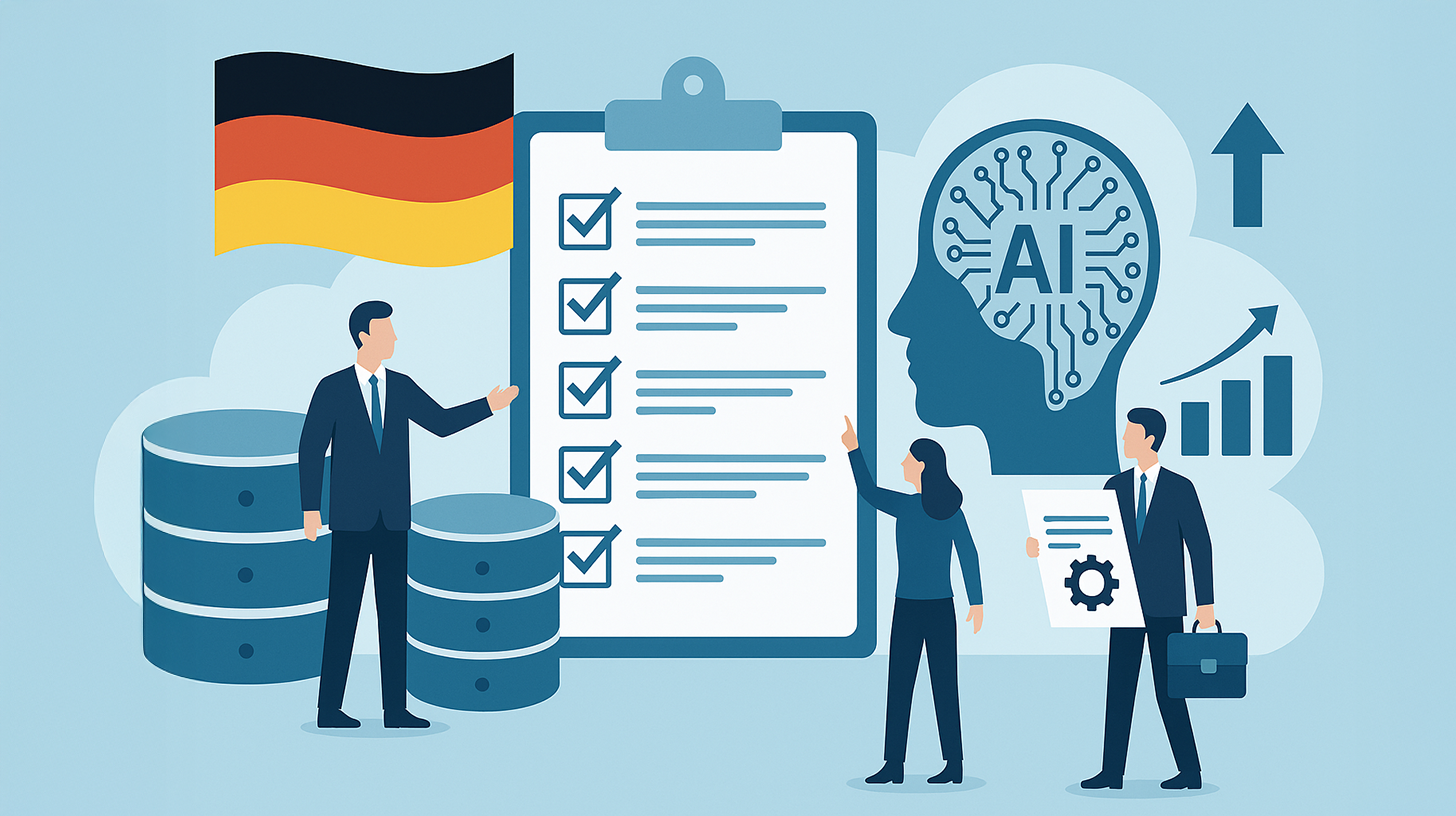
The five-point plan: How Germany wants to become a world leader in AI – data gigafactory and public contracts for AI startups – Image: Xpert.Digital
Germany's path to becoming an AI nation: Can Europe hold its own in the global race?
Why is establishing itself as a leading AI nation of strategic importance for Germany?
The current global technology landscape is characterized by intense competition in the field of artificial intelligence (AI), often described as the "AI race." This race is primarily led by the United States and China, which are making massive investments in research, development, and infrastructure. For a highly developed industrial nation like Germany, positioning itself in this field is not merely an option, but a strategic necessity. AI is no longer a niche technology, but is evolving into a fundamental, baseline innovation that will determine future economic competitiveness, national security, and geopolitical influence.
For Germany, whose prosperity is largely based on its strength in key industries such as mechanical engineering, the automotive industry, and medical technology, a technological lag in the field of AI poses existential risks. A loss of technological leadership in these sectors would not only erode the economic foundation but also lead to a critical dependence on foreign technology providers. The urgency of this challenge is underscored in political strategy papers that emphasize the urgent need for decisive action.
In response to this global dynamic, the German Federal Government has formulated strategic plans aimed at establishing Germany at the forefront of AI nations worldwide. A key element of this strategy is a five-point plan by the Minister for Digital Affairs, outlining the essential areas of action for strengthening Germany's position as an AI hub. This plan serves as a guideline for a comprehensive transformation, ranging from targeted support for domestic startups and the development of a sovereign data infrastructure to the establishment of a values-based regulatory framework.
Analyzing this plan reveals a deeper strategic dimension. Given the enormous investment gap between Europe and the US or China, the German and European strategy cannot simply mirror American or Chinese approaches. Rather, it is the blueprint for an asymmetric competitive strategy. This strategy aims to prevail not through sheer financial superiority, but through the intelligent use of specific strengths: the close integration of AI with a strong industrial base, the creation of a trustworthy, values-based ecosystem, and the establishment of digital sovereignty as a mark of quality. The following sections will analyze the five pillars of this strategy in detail and illuminate their implications, challenges, and opportunities.
Related to this:


Promoting innovation through public procurement
What role does public procurement play in promoting AI start-ups in Germany?
A key lever for strengthening the domestic AI ecosystem lies in the strategic realignment of public procurement. In Germany, the state acts as the largest single IT purchaser, awarding contracts worth hundreds of billions of euros annually to private companies. This immense market volume represents a significant economic factor and holds enormous potential for targeted innovation promotion.
The current strategy criticizes existing procurement practices as "uncontrolled growth" and calls for targeted management of government digital spending. The core of the proposal is to strategically award public contracts to German and European AI startups, rather than primarily to established, often US-based, technology giants. This measure is intended to serve as an "innovation boost" by providing young, innovative companies with market access they would otherwise struggle to achieve.
However, reality shows that this potential is hardly being exploited. Studies demonstrate a strikingly low participation rate among startups in public tenders. Only about 11% of German startups even participate in such processes, and a mere 7% actually win a contract. Consequently, the share of public contracts in these companies' total revenue is correspondingly low, at less than 5%. This illustrates a significant discrepancy between the potential market represented by the government as a customer and the ability of startups to access this market. The targeted awarding of public contracts is therefore understood not only as financial support but also as a fundamental mechanism for market liberalization and the validation of new technologies.
What hurdles do innovative young companies encounter in public procurement law?
The limited success of startups in public tenders can be attributed to a number of specific bureaucratic and legal hurdles enshrined in German and European procurement law. These hurdles are often tailored to the needs of large, established companies and represent insurmountable obstacles for young, agile firms.
One of the biggest challenges is the eligibility requirements. Public sector clients often demand proof of a certain minimum annual turnover, which can frequently be twice the estimated contract value. For a start-up still in its growth phase and naturally with lower turnover, this requirement is virtually impossible to meet. Added to this is the demand for comprehensive references for comparable projects from the last three fiscal years. This creates a classic chicken-and-egg problem: no public contracts, no references, and no references, no public contracts.
Furthermore, the complexity and length of procurement procedures deter many startups. Preparing tender documents is time-consuming and resource-intensive, placing a significant burden on small teams. Procurement law itself is characterized by a high density of regulations and a two-tiered structure: contracts below certain EU thresholds are subject to national regulations such as the German Procurement Ordinance for Contracts Below the Threshold (UVgO), while contracts above these thresholds must be tendered Europe-wide and are subject to more complex regulations such as the German Act Against Restraints of Competition (GWB) and the German Procurement Ordinance (VgV). This legal complexity further raises the barrier to entry and leads many innovative companies to avoid the public sector as a potential client from the outset.
What solutions and reforms are being discussed to make it easier for start-ups to access public contracts?
To overcome the obstacles described, various solutions are being discussed at the legal and political levels. These aim to make procurement law more flexible and innovation-friendly without abandoning the fundamental principles of transparency and competition.
At the legal level, instruments already exist that startups can use to compensate for their disadvantages. These include the formation of "bidding consortia," in which several smaller companies join forces to pool resources for a larger contract. Another option is "qualification lending," where a startup "borrows" missing qualifications, such as references or revenue figures, from an established partner company, which in return commits to making its resources available if awarded the contract.
At the political level, there are comprehensive reform proposals, such as the 7-point plan from the digital association Bitkom. This plan calls, among other things, for greater application of existing innovative procurement criteria, the creation of new evaluation standards explicitly tailored to startups, and the harmonization of the fragmented legal frameworks. A key element is the professionalization of procurement agencies. Staff in these agencies need the expertise to evaluate innovative AI solutions, which often requires specialization and targeted training. Another important instrument is the "innovation partnership." This is a special procurement procedure explicitly designed to develop an innovative solution jointly with a company—a solution not yet available on the market. It is therefore ideally suited for procuring novel AI technologies and promotes cooperation between the public sector and innovative providers.
The following table summarizes the key challenges and the corresponding solutions:
Innovation instead of low price: New opportunities for start-ups in securing contracts
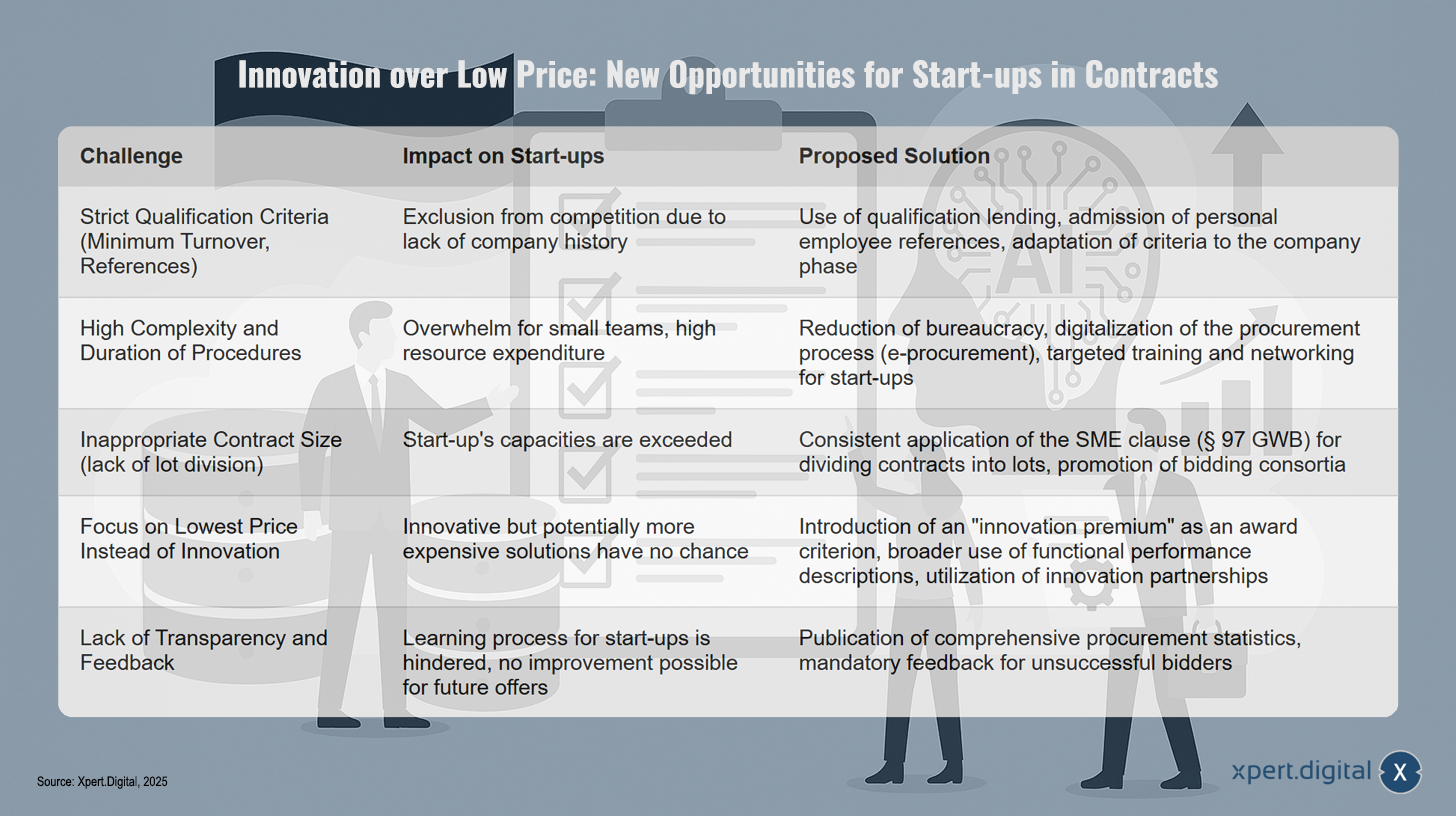
Innovation instead of low price: New opportunities for start-ups in securing contracts – Image: Xpert.Digital
Start-ups face various hurdles when bidding for contracts, which can open up new opportunities through innovation rather than simply focusing on the lowest price. Strict eligibility criteria, such as minimum revenue and references, often exclude young companies from the competition due to a lack of established track record. Solutions such as utilizing the qualifications of existing companies, accepting personal references from employees, and adapting the criteria to the respective stage of the company's development could help here. The high complexity and length of procurement processes overwhelm small teams and result in significant resource expenditure. Therefore, reducing bureaucracy, digitizing procurement processes (e.g., through e-procurement), and providing targeted training and networking opportunities for start-ups would be beneficial. The often unsuitable contract size, where the lack of lot-based tendering exceeds the capacities of small companies, can also be improved by consistently applying the SME clause (§ 97 GWB) to divide contracts into lots and promoting bidding consortia. Another crucial point is the focus on the lowest price, which disadvantages innovative but potentially more expensive solutions. The introduction of an "innovation bonus" as an award criterion, the broader use of functional specifications, and the utilization of innovation partnerships can open up new opportunities. Ultimately, a lack of transparency and feedback hinders the learning process for startups and prevents improvements in future bids. The publication of comprehensive procurement statistics and mandatory feedback for unsuccessful bidders would support this process.
What are the economic consequences of specifically favoring domestic companies?
The strategic intention to preferentially award public contracts to "domestic AI companies" represents a form of industrial policy that, however, is in tension with established economic principles and the European legal framework. The core of this tension lies in the conflict between promoting a national technology ecosystem and the potential efficiency losses resulting from restricted competition.
EU procurement law is based on the fundamental principles of the single market: transparency, equal treatment, and non-discrimination. These principles are designed to ensure that the most economically advantageous tender is awarded the contract, regardless of the bidder's national origin. This open competition is considered a key driver of economic growth and is estimated to contribute significantly to the EU's GDP. Policies that explicitly favor domestic companies undermine this principle and risk violating EU law.
From an economic perspective, such a protectionist measure can lead to higher costs for the public sector. If competition is artificially restricted by excluding international suppliers, the remaining domestic bidders can command higher prices. Studies on the effects of local preference in procurement indicate that this can increase costs for taxpayers and reduce the efficiency of public spending.
In contrast, there are the industrial policy arguments. Proponents of such a strategy argue that temporary preferential treatment is necessary to give a young, strategically important industry like AI a fair chance in global competition. A government contract can act as a crucial "first customer" for a startup, not only generating revenue but also serving as an important reference, thus facilitating access to private markets and further venture capital. It is therefore a strategic trade-off: higher costs and potential efficiency losses in the short term are accepted in order to build a sovereign and competitive domestic technology base in the long term and avoid critical dependencies. Implementing this strategy thus requires a careful balancing act to promote domestic industry without jeopardizing the fundamental pillars of the European single market.
🎯📊 Integration of an independent and cross-data-source AI platform 🤖🌐 for all business needs


Integration of an independent and cross-data-source AI platform for all business needs - Image: Xpert.Digital
AI Game Changer: The most flexible AI platform - Tailor-made solutions that reduce costs, improve your decisions and increase efficiency
Independent AI platform: Integrates all relevant company data sources
- This AI platform interacts with all specific data sources
- From SAP, Microsoft, Jira, Confluence, Salesforce, Zoom, Dropbox and many other data management systems
- Rapid AI integration: Tailor-made AI solutions for businesses in hours or days, instead of months
- Flexible infrastructure: Cloud-based or hosting in your own data center (Germany, Europe, free choice of location)
- Maximum data security: its use in law firms is irrefutable proof
- Deployment across a wide variety of enterprise data sources
- Choice of own or different AI models (DE, EU, USA, CN)
Challenges that our AI platform solves
- Lack of fit of conventional AI solutions
- Data protection and secure management of sensitive data
- High costs and complexity of individual AI development
- Shortage of qualified AI specialists
- Integration of AI into existing IT systems
More information here:


Germany in the AI race: The key to national computing infrastructure and promoting innovation despite strict regulations and bureaucratic hurdles
Building a national computing infrastructure
What is the current state of data center infrastructure in Germany and why is it crucial for AI?
Computing power forms the fundamental backbone of the digital economy and is the indispensable resource for the development and operation of modern AI applications. Large AI models, especially basic models, require immense computing capacity for training, which involves billions of parameters and vast amounts of data. Without a powerful and scalable infrastructure of computing and data centers, the ambition to become a leading AI nation is unattainable.
Germany currently boasts the largest data center capacity in Europe. Frankfurt am Main has established itself as a central hub, largely due to the DE-CIX, one of the world's largest internet exchange points, located there. This concentration ensures excellent connectivity and attracts investment from global cloud providers and colocation service providers.
Despite this leading position in Europe, a relative analysis reveals a more nuanced picture. When available computing power is considered in relation to economic output, measured by gross domestic product (GDP), Germany lags behind other nations. Countries like the UK and the Netherlands have a higher density of computing power per billion euros of GDP. Globally, the gap with the US and China, which dominate the market, is even more pronounced. This relative gap signals a potential bottleneck that could limit Germany's ability to keep pace in the global AI race. The country's digital sovereignty and technological capabilities thus depend directly on the strength and expansion of this critical infrastructure.
Related to this:

What does the demand for a "gigafactory for data" mean in the context of the AI strategy?
The term "Gigafactory," originally coined by Tesla for its enormous factories for the mass production of batteries, is used as a powerful metaphor within the framework of Germany's AI strategy. The demand for "at least one Gigafactory" in Germany is not to be understood literally as a single factory, but rather as a political commitment to building hyperscale data centers specifically designed to meet the extreme demands of AI applications.
A "gigafactory for data" symbolizes a qualitative and quantitative leap in national computing infrastructure. It's no longer just about operating conventional data centers for standard cloud services, but about creating facilities capable of handling the most computationally intensive tasks – above all, training AI base models with trillions of data points. Such facilities require a massive concentration of specialized hardware (especially GPUs), extremely high energy density, and sophisticated cooling systems.
This demand implies the strategic necessity of creating a sovereign computing infrastructure that enables German and European companies to develop and operate AI models domestically. This reduces dependence on the cloud platforms of American hyperscalers and strengthens digital sovereignty. The "Gigafactory" is thus the physical foundation for the ambition to become an independent "cloud nation" and to be able to compete globally for technological leadership in AI.
What are the biggest challenges in expanding data center capacity in Germany?
The ambitious plan to massively expand national computing power is encountering a number of significant physical, regulatory, and societal challenges. These bottlenecks demonstrate that digital transformation fails at very concrete, non-digital limits if these are not proactively addressed.
The biggest challenge is energy supply. Data centers, and especially those for AI applications, have enormous and steadily increasing electricity consumption. The energy demand of German data centers could almost double by 2030 compared to today. This clashes with the high energy prices in Germany, which represent a significant competitive disadvantage compared to other countries and can make investments unattractive.
A second major obstacle is the lengthy planning and approval processes. In Germany, it takes significantly longer than the EU average to approve and build a new data center. These bureaucratic delays create investment uncertainty and slow down the urgently needed expansion of the infrastructure.
Thirdly, the large land requirements of data centers are increasingly leading to land-use conflicts. The construction of large server farms on farmland or near residential areas is meeting with resistance from farmers, conservationists, and local residents, who fear land sealing and noise pollution.
Finally, sustainability presents a key challenge. Data centers produce a vast amount of waste heat, which is mostly released unused into the environment. Although legal requirements for waste heat utilization exist, practical implementation often fails due to a lack of infrastructure, such as connected district heating networks. This leads to a trilemma between the goal of AI leadership, the energy transition, and climate protection targets. The expansion of AI infrastructure can jeopardize climate goals if it is not embedded in an integrated energy and urban development strategy from the outset.
Related to this:

Reducing bureaucracy and the free flow of data
What tensions exist with the demand for an unimpeded flow of data for AI applications?
The demand to reduce bureaucracy so that data can flow freely is a central, but also highly complex, aspect of the AI strategy. It touches upon the core tension of the European approach to digitalization: the conflict between the absolute need for large data sets to promote innovation and the equally absolute commitment to strict data protection to safeguard fundamental rights.
Artificial intelligence, and machine learning in particular, is data-driven. The performance and accuracy of AI models depend directly on the quantity and quality of the data used to train them. From a technological development perspective, free and uncomplicated access to vast amounts of data is therefore a fundamental prerequisite for remaining competitive in the global market. The demand for a "flowing" data environment is thus a plea for innovation-friendly framework conditions.
This imperative for innovation, however, clashes with the European legal framework, shaped by the General Data Protection Regulation (GDPR). The GDPR is not designed to stifle innovation, but rather as a framework for protecting fundamental civil liberties. It is based on principles such as data minimization (only the minimum amount of data necessary should be processed), purpose limitation (data may only be used for the purpose for which it was collected), and the requirement of a clear legal basis for all data processing, often in the form of informed consent. These principles are in natural tension with the "data hunger" of AI development, leading to considerable legal uncertainty for companies and researchers.
What specific bureaucratic and legal hurdles do AI developers face in the area of data protection?
For AI developers in Germany and Europe, the tension between data requirements and data protection manifests itself in a number of concrete legal and bureaucratic hurdles that arise directly from the GDPR and its interpretation.
The principle of data minimization presents a fundamental challenge. While the GDPR requires limiting the processing of personal data to what is necessary for the purpose, many advanced AI models rely on analyzing vast, nonspecific datasets to identify patterns. AI's "data hunger" directly contradicts the required data economy.
Closely related to this is the hurdle of purpose limitation. According to the GDPR, data may only be collected for specified, explicit, and legitimate purposes. However, the training of basic AI models is often carried out for a multitude of potential future applications that are not even foreseeable at the time of training. This makes defining a specific purpose difficult and creates legal gray areas.
Another major hurdle is the requirement for a lawful basis for processing. For training AI models with personal data, often collected from the internet, it is practically impossible to obtain explicit and informed consent from every single individual. Developers therefore often invoke "legitimate interest," but its scope is legally controversial and is being interpreted increasingly restrictively by data protection authorities, leading to considerable legal uncertainty.
Finally, the often opaque workings of complex AI systems, the so-called "black box" problem, clash with the transparency obligations of the GDPR. Citizens have a right to information about the logic behind automated decisions. If even the developers can no longer trace the precise decision paths of a deep learning model, this right can hardly be guaranteed. These obstacles, taken together, mean that AI development in Europe is associated with a higher legal risk and greater bureaucratic burden than in other parts of the world.
Related to this:
How does the European AI law attempt to strike a balance between innovation and regulation?
The European AI law represents the most comprehensive attempt to date to create a regulatory framework that manages the risks of AI without stifling innovation. It is the central response to the aforementioned tension and embodies a strategic decision for a third way between the laissez-faire approach of the US and the state-controlled AI development in China.
The core of the AI law is its risk-based approach. Instead of regulating AI across the board, the law differentiates according to the potential harm an application poses. AI systems with an "unacceptable risk," such as government social scoring or manipulative techniques that influence human behavior, are completely prohibited. Systems with a "high risk," used in critical areas such as medical diagnostics, personnel recruitment, or the justice system, are subject to strict requirements regarding transparency, data security, human oversight, and documentation. The vast majority of AI applications classified as low risk, such as spam filters or AI in video games, remain largely unregulated.
At the same time, the AI Act contains explicit mechanisms for promoting innovation, specifically targeting startups and small and medium-sized enterprises (SMEs). The most important instrument is the so-called "regulatory sandbox." These are controlled legal experimentation spaces where companies can develop and test innovative AI systems under the supervision of the relevant authorities, without having to immediately face the full sanctions of the law for unintentional violations. These sandboxes are intended to create legal and planning certainty, facilitate market access, and promote dialogue between innovators and regulators. The AI Act is therefore not only a protective instrument but also a strategic attempt to create a reliable and trustworthy framework that guides innovation and is intended to serve as a long-term competitive advantage.
🎯🎯🎯 Benefit from Xpert.Digital's extensive, five-fold expertise in one comprehensive service package | BD, R&D, XR, PR & Digital Visibility Optimization

Benefit from Xpert.Digital's extensive, five-fold expertise in a comprehensive service package | R&D, XR, PR & Digital Visibility Optimization - Image: Xpert.Digital
Xpert.Digital possesses in-depth knowledge across various industries. This allows us to develop tailored strategies precisely aligned with the requirements and challenges of your specific market segment. By continuously analyzing market trends and monitoring industry developments, we can act proactively and offer innovative solutions. The combination of experience and expertise generates added value and provides our clients with a decisive competitive advantage.
More information here:
Europe's path to digital sovereignty through its own AI base models: EU AI law as a competitive advantage in the international technology race
European sovereignty in AI base models
Why is the development of our own European AI base models of strategic importance?
The development and control of AI base models, also known as foundational models, has become a matter of central strategic importance for the future of Europe. These models are the technological foundation upon which a multitude of future AI applications will be built. Complete dependence on models developed and controlled exclusively by companies in the US or China poses significant risks to Europe's digital sovereignty.
Digital sovereignty describes the ability of states, companies, and citizens to shape their digital transformation autonomously and avoid critical technological dependencies. When the fundamental AI infrastructure is in the hands of non-European actors, numerous risks arise. First, there is an economic dependency that can lead to unfavorable conditions or restricted access to key technologies. Second, data processed on US cloud platforms is potentially subject to access by US authorities under laws such as the CLOUD Act, which conflicts with European data protection principles.
Thirdly, and perhaps most importantly, AI base models are not value-neutral. They are trained with data that reflect cultural, societal, and ethical perspectives. Models primarily trained with data from the American or Chinese cultural sphere can contain biases that are incompatible with European values and norms. Developing our own European base models is therefore essential to ensure that the AI of the future is built on a foundation that respects fundamental European values such as democracy, the rule of law, and the protection of fundamental rights. Initiatives like GAIA-X, which aim to create a sovereign European data infrastructure, are an important step in this direction.
Related to this:

What is the current status of the development of AI basic models “Made in Europe”?
Despite a significant investment gap compared to the US and China, a dynamic scene for the development of basic AI models has established itself in Europe, pursuing its own differentiated strategy. Instead of trying to build the largest and most powerful general-purpose models, many European players are focusing on specific niches and quality features.
A leading German company in this field is Aleph Alpha. The Heidelberg-based startup specializes in developing AI models that are not only powerful but also transparent and explainable ("explainable AI"). This focus on trustworthiness and sovereignty makes Aleph Alpha an important partner for the public sector and regulated industries. The company recently adjusted its strategy, concentrating more on smaller, specialized models for specific applications, a move seen as a strategic shift away from direct competition with global hyperscalers.
Another promising European company is Mistral AI, which has gained considerable attention through the release of powerful open-source models. The open-source approach promotes transparency and allows a broad community of developers to build upon and adapt the technology.
Furthermore, there are government-funded initiatives such as OpenGPT-X, a project involving Fraunhofer Institutes, which promotes the development of open and trustworthy language models for Europe. At the University of Würzburg, the first large language model trained exclusively on German data, "LLäMmlein," was also developed to break the dominance of English-language training data and improve the quality for the German language. These examples demonstrate a clear strategic direction: Europe does not primarily compete on the sheer size of its models, but rather on specialization, openness, transparency, and adaptation to the specific linguistic and regulatory needs of the European market.
What role does EU regulation, in particular the AI law, play in the global competition of AI models?
European regulation, especially the AI law, plays an ambivalent and much-debated role in the global AI competition. On the one hand, there are concerns about "overregulation from Brussels," which could burden European developers with high compliance costs and bureaucratic hurdles, potentially putting them at a disadvantage compared to more agile competitors from the US and China. Critics fear that strict regulations could slow down innovation and, in particular, create a barrier to market entry for startups.
On the other hand, the AI law is increasingly understood as a strategic instrument that can create long-term competitive advantages. By establishing the world's first comprehensive legal framework for AI, the EU is creating legal and planning certainty for companies and users. This clear framework can attract investment and strengthen trust in AI applications. The law also explicitly considers the needs of SMEs and start-ups by providing innovation-friendly instruments such as the aforementioned regulatory sandboxes and differentiating fines according to company size.
Perhaps the most important strategic function of EU regulation lies in the so-called "Brussels Effect." Since the European single market is indispensable for global technology companies, they will be forced to adapt their products and models to stringent EU requirements in order to operate there. In this way, the EU is effectively exporting its regulatory standards and value-based vision of AI to the entire world. Regulation thus transforms from a potential burden into a powerful instrument for shaping the global landscape. Instead of competing in a purely technological race, which Europe might lose due to investment gaps, the EU is shifting the competition to the level of governance models, where it is establishing a leading position through a clear, value-based, and comprehensive legal framework.
International cooperation and AI based on European values
What does it mean to claim that AI should be developed according to "European values"?
The ambition to develop artificial intelligence according to "European values" is a central guiding principle of the German and European digital strategy and the decisive differentiating factor in global competition. This is less about a specific technical architecture than about embedding AI systems in a robust legal and ethical framework that reflects the fundamental rights and democratic principles of Europe.
This values-based approach is most clearly enshrined in the EU AI Directive. The principles enshrined therein define what constitutes "European AI": it must be human-centered, meaning that humans must always retain ultimate control (human oversight). It must be safe, robust, and transparent, so that its decisions are comprehensible and it cannot be easily manipulated. A core principle is non-discrimination, which requires that AI systems do not reinforce existing societal biases or create new ones. The protection of privacy and data sovereignty, through its close link to the GDPR, is another fundamental pillar. Finally, aspects such as social and environmental well-being are also identified as objectives for AI systems.
In practice, this approach manifests itself in clear prohibitions and strict regulations. AI applications that fundamentally contradict European values, such as state-run social scoring modeled on the Chinese system or systems for unconscious behavioral manipulation, are completely prohibited in the EU. High-risk applications are subject to strict regulations designed to ensure that these systems operate fairly, securely, and transparently. "AI according to European values" is thus a political and societal project that inextricably links technological development with the protection of fundamental rights and democratic processes.
Related to this:

How can an “exchange on equal terms” be structured with technology leaders like the USA?
The demand for an "exchange on equal terms" with technology leaders like the USA is an expression of the pursuit of digital sovereignty. It implies a shift away from the role of a mere technology consumer and regulator towards that of an active and equal participant in shaping the global digital order. Several factors are crucial for achieving this position.
First, being on a level playing field requires in-house technological expertise. Only those who possess relevant AI models, research capacities, and a strong startup ecosystem will be perceived as serious partners in technological dialogues. The efforts described in the previous sections to build a domestic AI industry and infrastructure are therefore a fundamental prerequisite.
Secondly, "equal footing" is based on the strength of the European single market. As one of the world's largest and most powerful economic areas, the EU can leverage its market power as political leverage. Global companies depend on access to the European market, which gives the EU a strong negotiating position when setting standards and rules.
Thirdly, and crucially, a level playing field is achieved through a coherent and globally influential regulatory framework. The AI Act is the central instrument here. It defines a clear European position and compels international partners to engage with European visions of values-based AI. Instead of merely reacting to American or Chinese standards, Europe is proactively setting its own. The goal is to prevent Europe from being technologically and regulatoryly "divided" by the US by presenting a united front with a clear, independent agenda.
What strategic implications arise from the global race between regulatory systems?
The global competition for leadership in artificial intelligence is not only a race of technologies and investments, but increasingly also a competition of regulatory systems and the associated societal visions. Three distinct models are emerging, each setting different priorities.
The European model, enshrined in AI law, is a comprehensive, risk-based, and fundamental rights-based approach. It prioritizes safety, trust, and ethical guidelines and seeks to guide innovation within a clearly defined legal framework. Its goal is to become a global model for responsible AI governance.
The US model is traditionally more market-oriented and innovation-driven. The focus is on minimizing regulatory hurdles to accelerate the technological development and commercialization of AI. Regulation is often reactive and sector-specific, rather than implemented through a comprehensive, preventative legal framework. The strategy aims to secure technological dominance by granting maximum freedom to leading companies.
The Chinese model is state-directed and geared towards achieving national strategic goals. Regulation is agile and can be quickly adapted to new technological developments, but it also serves to strengthen state control and oversight. Innovation is heavily promoted by the state, but always in line with the government's political objectives.
The strategic implication for Germany and Europe is that their own values-based approach must be actively positioned as a strength and a unique global selling point. In a world increasingly aware of the potential risks of AI, the label "trustworthy AI" can become a decisive competitive advantage. The success of the European strategy will depend on whether this regulatory framework can be established not as a barrier to innovation, but as a seal of approval for safe, fair, and high-quality AI systems that are in demand worldwide – especially in critical and sensitive application areas.
Related to this:


We are here for you - Consulting - Planning - Implementation - Project Management
☑️ SME support in strategy, consulting, planning and implementation
☑️ Creation or realignment of the AI strategy
☑️ Pioneer Business Development

Konrad Wolfenstein
I would be happy to serve as your personal advisor.
You can contact me by filling out the contact form below or simply call me on +49 7348 4088 965 .
I'm looking forward to our joint project.
Write to me


Xpert.Digital - Konrad Wolfenstein
Xpert.Digital is a hub for industry focusing on digitalization, mechanical engineering, logistics/intralogistics and photovoltaics.
With our 360° Business Development solution, we support renowned companies from new business to after-sales.
Market intelligence, smarketing, marketing automation, content development, PR, mail campaigns, personalized social media and lead nurturing are part of our digital tools.
You can find more information at: www.xpert.digital - www.xpert.solar - www.xpert.plus
Keep in touch