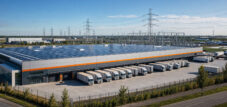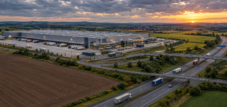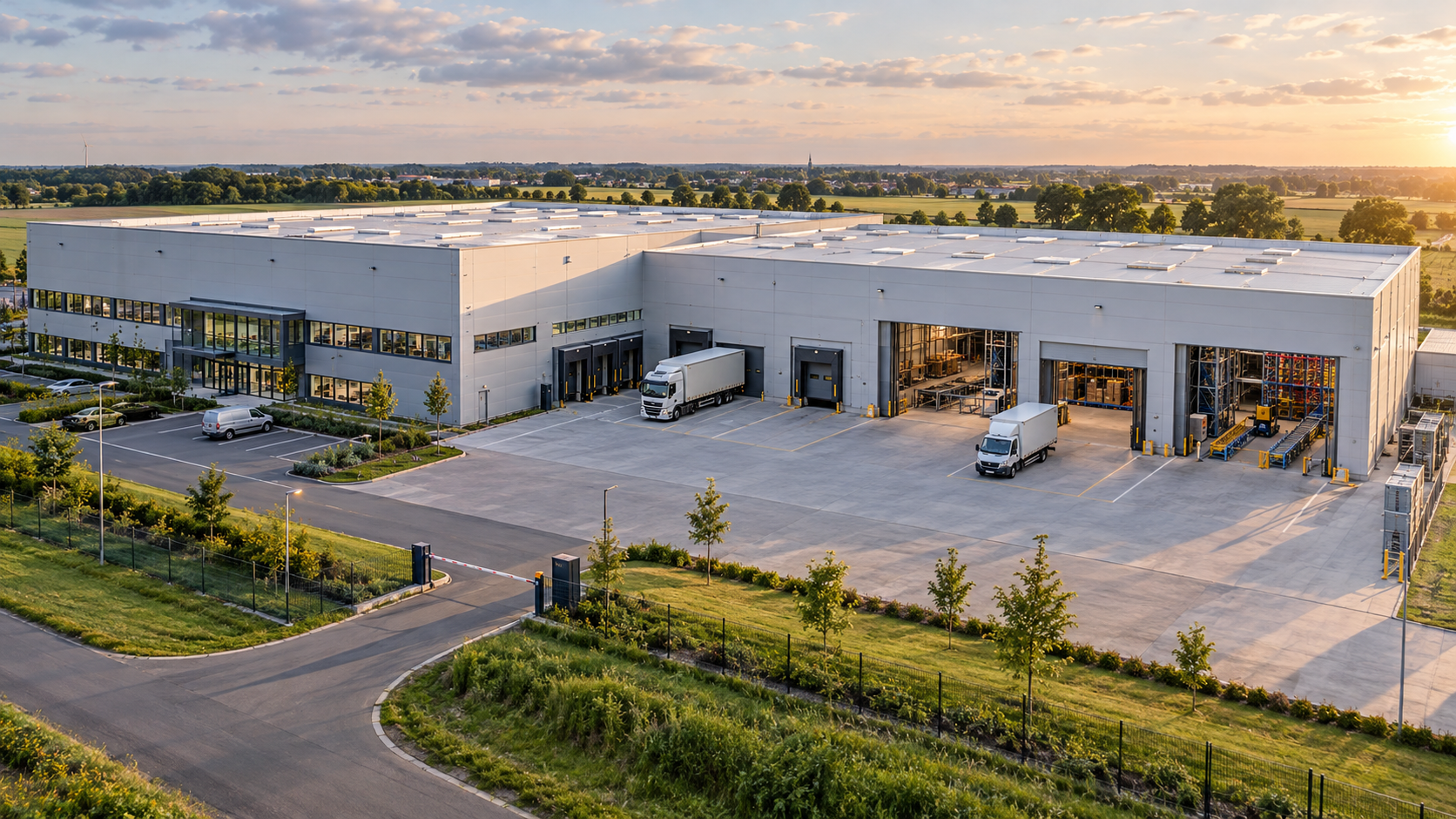
Fewer routes, faster processes: Hänsch is focusing on Herzlake and expanding its logistics center – creative image on the topic, with AI: Xpert.Digital
Automated warehouse and new halls: This is how Hänsch is preparing for further growth
Hänsch is building in Herzlake: 4,200 square meters for the next growth phase
Largest investment in the company's history: Hänsch reorganizes its logistics
Hänsch is building a new logistics center at its headquarters in Herzlake, paving the way for further growth. The project, to be completed in two phases, will include halls with approximately 4,200 square meters of usable space. Plans include a large shipping warehouse, an automated small parts warehouse, and modern office space. The project is more than just an expansion of the company premises: it aims to reorganize existing processes, shorten distances, and make the material supply for production more reliable.
For the manufacturer of optical and acoustic warning systems, this is a strategic decision. With more than 1,000 products, growing demand, and over 300 employees, logistical complexity is also increasing. Hänsch therefore doesn't want to wait until warehousing and shipping become bottlenecks to react, but rather proactively adapt its infrastructure to the next stage of development. Since the company's founding in 1984, there has been no major investment or construction project at the site.
However, the economic benefits don't depend solely on the additional space. The crucial factor will be whether Hänsch can effectively integrate inventory, goods movements, and digital systems to ensure materials arrive faster and more reliably where they are needed. If this is achieved, the new center can not only increase productivity and improve delivery capabilities but also strengthen the Herzlake location in the long term.
Hänsch is building its next growth stage: Those who do not control their flow of goods will lose out in industrial competition
Hänsch's new logistics center in Herzlake is far more than just additional warehouse space. It represents a strategic reorganization of the company, its material flows, and its future growth opportunities. Two halls with a total usable area of approximately 4,200 square meters are being built in two phases at the company headquarters. The plans include a spacious shipping warehouse, an automated small parts warehouse, and about 200 square meters of modern office space. With this project, Hänsch is combining structural expansion, process optimization, automation, and location strategy. Since the company's founding in 1984, there has been no major investment or construction project at this location.
The project is particularly relevant from an economic perspective because a medium-sized industrial company doesn't just react to acute capacity bottlenecks, but rather adapts its logistics infrastructure to the next stage of development. The central question, therefore, is not how many additional square meters are created. What matters is how productively this space is used, which lead times can be reduced, how reliably production is supplied, and whether the anticipated growth can be managed without new organizational friction. A modern logistics center only creates value when it better connects inventory, routes, information, and responsibilities.
The construction project is both a commitment to the company's headquarters in Herzlake and to industrial value creation in Germany. Hänsch could have outsourced individual functions, leased additional space elsewhere, or continued operating the existing structure with temporary solutions. Instead, internal logistics at the main plant are being reorganized. This decision ties up capital but simultaneously creates control over key processes. For a company that develops, manufactures, and internationally distributes optical and acoustic warning systems, this control is a crucial component of delivery capability, product quality, and customer loyalty.
Established structures become a bottleneck
The company's premises in Herzlake have grown alongside the business for over four decades. New buildings and functional areas have been added, existing spaces expanded, and adapted to changing requirements. Such growth is typical for successful medium-sized industrial companies. Initially, it is economical to continue using existing buildings and gradually expand capacity. However, as the company grows, structural disadvantages arise: goods receipt, warehousing, production, and shipping are no longer in the ideal sequence, materials have to be moved multiple times, inventory is spread across different zones, and employees lose time traveling, during handovers, or searching for components.
At Hänsch, goods receiving and shipping are now located in inconvenient locations from an infrastructural point of view. This situation is not merely a spatial problem. Every unnecessary movement creates additional work without increasing the product's value from the customer's perspective. Additional transport increases staffing requirements, occupies vehicles and space, complicates prioritization, and raises the risk of delays or errors. The larger the product range and the more production grows, the more pronounced the impact of these inefficiencies becomes on costs and delivery times.
The economic logic of the new building therefore begins with eliminating historically grown process inefficiencies. In the future, processes from goods receipt through production to shipping will be centrally managed. Ideally, this will create a clear, streamlined material flow with minimal cross-contamination: Incoming components are inspected, recorded, and stored; required parts are transferred to production as needed; finished products go directly to the shipping warehouse, order picking, and loading. Such an order not only reduces walking and driving distances but also simplifies responsibilities, key performance indicators, and operational control.
Especially with a portfolio of more than 1,000 products, managing the sheer variety of variants is crucial. Warning lights, beacons, special signaling systems, and other solutions for police, fire departments, rescue services, airports, and municipal users consist of diverse electronic, mechanical, and optical components. Variants, customer-specific requirements, and varying batch sizes increase logistical complexity. A warehouse that functioned adequately at lower volumes can quickly become a bottleneck as the number of parts and demand increase. Therefore, the investment focuses on a point that determines the efficiency of the entire value chain.
4,200 square meters as a productivity program
The planned usable area of approximately 4,200 square meters should not be confused with a simple expansion of existing space. From an economic perspective, it is a platform on which processes can be redesigned. Additional space alone does not reduce costs. In the worst-case scenario, it increases travel distances, raises inventory, and masks inefficient processes. Only a consistent arrangement of storage zones, workstations, conveyor technology, IT systems, and traffic routes transforms square meters into productivity.
The new building allows Hänsch to organize its logistics without having to work around existing structural limitations. Instead of adapting individual areas to available space, material flow and the building itself can be planned holistically. This is a significant advantage over ongoing, smaller-scale renovations. The positions of gates, shelves, picking stations, and transfer points can be tailored to anticipated quantities, product structures, and process steps. Safety requirements, ergonomics, and energy supply can also be integrated from the outset.
A generously sized shipping area is of particular importance from a business perspective. Shipping is the last internal step before the customer and must absorb fluctuations in production, order intake, and transport pickups. If it is too small or poorly organized, finished goods accumulate, loading units are repeatedly rearranged, and urgent shipments crowd out regular orders. More and better-structured shipping space creates buffers, improves route planning, and facilitates a clear separation by customer, region, delivery date, or transport mode. This stabilizes on-time delivery without necessarily requiring an increase in finished goods inventory.
The approximately 200 square meters of office space complement the warehouses with an often underestimated factor: the proximity of control and execution. Logistics today is no longer a purely physical activity. Inventory management, scheduling, order release, shipping documentation, customs matters, quality assurance, and incident management are data-intensive tasks. Short communication channels between operational staff and administrative functions can identify problems more quickly and accelerate decision-making. Modern offices directly involved in the process thus not only improve workplace quality but also increase responsiveness.
The small parts warehouse becomes the nerve center
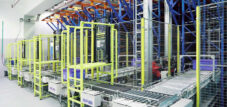
The automated small parts warehouse is likely to become the technological core of the project. In electronics and device manufacturing, numerous small components must be reliably, space-efficiently, and in the correct sequence provided. With manual storage, search times, distances traveled, and potential errors increase with the number of items. Automated systems deliver containers or parts to defined workstations according to the goods-to-person principle. This eliminates the need for employees to navigate long aisles; instead, the required items are delivered directly to the workstation in a controlled manner.
The immediate benefits lie in higher storage density, faster retrieval, and improved inventory transparency. An automated system can utilize available vertical space more efficiently and standardize access. The warehouse management software knows which item is located where, what stock is reserved, and when replenishment is needed. For production, this translates to a more reliable material supply. Missing parts, searches, and unresolved inventory discrepancies can be reduced, provided master data, accounting practices, and interfaces are correct.
Automation, however, is not an end in itself. A rigid system can create new bottlenecks if demand forecasts are inaccurate, product structures change significantly, or IT integration is inadequate. Hänsch must therefore consider not only current demand but also future changes in the product range. Container sizes, storage capacity, throughput, redundancy, and expansion options must be designed so that the warehouse is neither permanently oversized nor too small after just a few years. Maintenance, spare parts supply, emergency operation, and cybersecurity must also be included in the cost-benefit analysis.
The greatest productivity gains occur when the automated small parts warehouse doesn't operate in isolation, but is fully integrated with inventory management, production planning, and quality assurance. In this way, a customer order can trigger material requirements, production can retrieve prioritized components, and every movement is digitally documented. The warehouse thus becomes an information-driven system. Its data can provide insights into consumption patterns, bottleneck items, inventory risks, and process deviations. This improves not only daily operations, but also purchasing, planning, and capital commitment.
Shorter routes change the cost structure
Logistics costs are often underestimated in many industrial companies because they are spread across multiple cost centers. Lead times appear as personnel expenses, internal transport as overhead costs, excess inventory as tied-up capital, and late deliveries as sales problems. A centralized logistics center makes these interrelationships more transparent. By shortening routes and reducing transfers, the cost per material movement decreases. At the same time, a higher volume can be handled with the same number of employees.
The productivity gains are particularly significant when existing bottlenecks are slowing down the entire production process. If an assembly line is waiting for small parts, not only is logistics unproductive, but machines, workstations, and skilled production workers also lose time. A more reliable supply of materials therefore stabilizes the production rhythm and increases the utilization of existing equipment. The company gains capacity without having to meet every additional demand with proportionally more personnel or machines.
Shorter distances also improve ergonomics. Fewer steps, less lifting, and a clearer layout of workstations reduce physical strain. The economic benefits are indirectly reflected in lower absenteeism, improved work quality, and greater job attractiveness. In a region with low unemployment and a limited supply of skilled workers, this is no small matter. Modern working conditions help retain employees and attract new talent.
However, savings are not automatically visible upon commissioning. During the start-up phase, parallel systems, training, data cleansing, and process adjustments can initially incur additional costs. The crucial metric is therefore not the short-term reduction of individual personnel hours, but rather the development of the total costs per order or product unit. This includes warehouse operations, energy, maintenance, depreciation, IT, error costs, inventory, and delivery performance. Only this comprehensive view reveals whether the new logistics system is fulfilling its economic purpose.
Growth needs a robust buffer
Hänsch is responding to continuous personnel growth and increasing demand for its products and solutions with the new building. The company now employs more than 300 people and is one of Europe's leading providers of optical and acoustic warning systems. Production takes place in Herzlake and Sternberg, among other locations, while sales activities extend to several European markets. Logistics at the main site must therefore not only support local production processes but also enable supply to supra-regional and international markets.
A central logistics center creates a growth buffer. This buffer is not synonymous with unused space. It consists of reserves in storage space, throughput, shipping capacity, IT performance, and organizational flexibility. Such reserves prevent every growth spurt from immediately triggering new temporary solutions. This is relevant for customers because increased demand or larger projects can be processed more quickly. For the company, it reduces the risk of sales successes being thwarted by internal capacity limitations.
At the same time, the buffer must be measured with economic discipline. Too much reserve capacity puts a strain on returns and liquidity, especially in an uncertain economic environment. Too little reserve, on the other hand, leads to new bottlenecks early on. The optimal size therefore depends on sales scenarios, product mix, seasonal peaks, and planned expansions. Implementing the project in two phases makes sense in this context. A phased approach distributes capital requirements and project risks and allows lessons learned from the first phase to be incorporated into the subsequent expansion.
The investment should also be seen as a real option. With the new infrastructure, Hänsch acquires not only current capacity, but also the opportunity to grow faster in the future, introduce additional products, or integrate production steps. This option has economic value, even if its precise benefits cannot be fully calculated today. In volatile markets, the ability to react to opportunities is often just as important as immediate cost reduction.
Your intralogistics experts

Consulting, planning and implementation of complete solutions for high-bay warehouses and automated storage systems - Image: Xpert.Digital
More information here:
Growth through resilience: Logistics center as a future project
More resilience, but no independence
The past few years have shown that supply chains cannot be evaluated solely on the basis of lowest unit costs. Geopolitical tensions, transportation disruptions, fluctuating demand, and shortages of electronic components have increased the importance of availability and responsiveness. Hänsch sources components both regionally and from Asia. The new logistics center cannot eliminate these dependencies, but it can improve how they are managed.
Improved inventory data enables more precise risk management. Critical parts can be distinguished from non-critical standard components, ranges can be assessed more realistically, and safety stocks can be set more effectively. This is more important than simply building up inventory across the board. While high inventory levels increase supply security in the short term, they tie up capital, require space, and pose a write-off risk in the event of technical changes. Efficient logistics help to resolve the trade-off between availability and capital commitment in a more nuanced way.
Centralization also creates new risks of concentration. When significant material flows pass through a central warehouse, technical malfunctions, IT failures, fire damage, or faulty master data can disrupt large parts of operations. Resilience therefore requires redundancies and contingency plans. These include alternative booking and picking procedures, spare parts kits for critical system components, data backups, clear restart plans, and regular drills. An automated warehouse is only robust if the failure of its automation has been considered.
Supplier strategy remains crucial. A modern warehouse cannot automate the process of delayed deliveries. However, it provides better information about which suppliers, parts, or transport routes pose the greatest risk. This transparency enables measures such as secondary sourcing, regional procurement, adjusted batch sizes, or longer-term agreements. The new building thus strengthens operational resilience but does not replace strategic purchasing or active supplier management.
Capital commitment versus future viability
As the largest investment in the company's history, the project ties up considerable financial and organizational resources. The exact investment volume is not publicly known, so neither the amortization period nor the return on investment can be reliably quantified. However, it is clear that the economic benefits consist of several components: lower process costs, higher capacity, fewer errors, improved delivery reliability, more modern workplaces, and the option for further growth. Some of these effects can be measured directly, while others are reflected in avoided risks and prevented bottlenecks.
Financing such a property differs from a pure software investment. Buildings and technical equipment provide tangible assets and can be depreciated over the long term. At the same time, the capital is tied to the location. Should demand develop differently than expected, a specialized logistics space cannot easily be repurposed. Therefore, the planning must incorporate sufficient flexibility, for example, through adaptable storage zones, modular technology, and a hall structure that allows for diverse uses.
The timing is challenging. Construction prices for commercial buildings in Germany continued to rise in 2025 and 2026. At the same time, the manufacturing sector remained sluggish, and new construction activity in logistics properties was below previous peaks. A large owner-occupier investment is particularly noteworthy in such an environment. It suggests that operational benefits and location-specific requirements are given greater weight than short-term economic uncertainty.
For Hänsch, the alternative to new construction likely also incurred costs. Continued temporary solutions, longer travel distances, growing inventory, and operational delays are not free, even if they don't appear as a large sum in any single investment calculation. A sound decision, therefore, doesn't compare new construction with inaction, but rather new construction with the ongoing costs of the existing structure. The greater the demand and the variety of options, the more expensive inaction becomes.
Herzlake will become part of the investment logic
The decision to locate in Herzlake is not based solely on emotional or historical considerations. The site offers an industrial environment, comparatively affordable land, and an established workforce. The municipality has approximately 10,500 inhabitants but boasts remarkably strong employment growth. Since 1990, the number of employees subject to social security contributions at the workplace has nearly doubled. Around 46 percent of employees work in the manufacturing sector, significantly more than the average for Lower Saxony. Hänsch is therefore investing not in an isolated rural location, but in a specialized regional industrial hub.
The Emsland region as a whole also boasts a strong industrial base. The share of manufacturing in employment is significantly higher than the state average, while unemployment remains low. This structure fosters supplier relationships, technical expertise, and a culture of medium-sized manufacturing. For Hänsch, this regional anchoring is an advantage because established employees, suppliers, and training partnerships could not be transferred to another location without incurring substantial costs.
The transport connections are solid, though not comparable to major European logistics hubs. Herzlake is located on the B 213 and E 233 highways and is connected to the A 1 and A 31 motorways via regional routes. Local rail transport is currently used primarily for freight and tourist traffic. For a manufacturer of high-quality, relatively compact systems, the location is viable. The business model doesn't require a seaport right on the doorstep, but reliable road transport and easy access to European customers are essential.
The location's advantage also has a downside. Low unemployment intensifies competition for skilled technical workers, logistics personnel, and trainees. Hänsch cannot solve this problem through automation alone. The company still needs qualified employees for plant operation, maintenance, IT, scheduling, and process improvement. Investing in modern workplaces is therefore also a tool for regional employer competition.
A signal for regional small and medium-sized enterprises
For Herzlake, the project has a greater significance than just the construction activity itself. A long-term corporate investment stabilizes local value creation, employment, and municipal revenues. During the construction phase, planners, construction companies, tradespeople, and technical equipment suppliers benefit. Once operational, contracts are generated for maintenance, energy, cleaning, transport, and other services. Such indirect effects are often particularly noticeable in rural areas because larger industrial companies are closely connected to regional networks.
More important than short-term construction impulses is the long-term commitment effect. A company that expands its central logistics at its main plant increases the likelihood of developing other functions at the same location. Production, development, quality assurance, and logistics reinforce each other. New products can be industrialized more quickly when developers, manufacturing, and material supply work closely together both spatially and organizationally. This allows a regional location to retain expertise that would be lost in a purely cost-driven relocation.
The project also sends a signal to other medium-sized companies. At a time when investments are often postponed, it demonstrates that growth isn't solely driven by sales or new products. The often invisible infrastructure behind production must also grow. Those who only modernize their logistics when delivery problems are already costing them customers are investing too late. Hänsch, on the other hand, treats internal goods movement as a strategic competitive advantage.
Nevertheless, the regional impact should not be overstated. A logistics center may create fewer additional jobs per square meter through automation than a labor-intensive production hall. Its value lies more in securing and increasing the productivity of existing industrial jobs. For Herzlake, however, this is crucial. Highly productive locations have a better long-term chance of maintaining wages, training, and investment than locations that rely solely on increased manual labor for growth.
Energy becomes a factor of production
Hänsch is combining the expansion with the goal of more sustainable value creation. The company can already cover its production energy needs, particularly during the summer months, with its own generation. The new building will further enhance the ability to coordinate energy production, building technology, and operations. Large roof areas are generally suitable for photovoltaics, while efficient lighting, heat recovery, and intelligent controls can reduce consumption.
Economically, self-sufficiency is primarily a tool for mitigating electricity price risks. While automated storage technology, conveyor systems, IT, and building technology increase electricity demand, they often operate more consistently and predictably than many production processes. High self-consumption improves the profitability of photovoltaics because less electricity needs to be fed into the grid at lower prices. Crucially, generation and consumption must align perfectly. Storage systems can improve this alignment, but their cost-effectiveness depends on load profiles, electricity tariffs, and investment costs.
Sustainability encompasses more than just energy. Shorter internal routes reduce vehicle movements and indirect consumption. Higher storage density limits the additional space required per item. Digital inventory management can prevent overstocking and obsolete components. At the same time, every new building generates gray emissions through concrete, steel, insulation materials, and technical installations. A credible assessment must therefore consider construction and operation across the entire life cycle, rather than solely highlighting future electricity generation.
For customers and automotive partners, verifiable environmental performance indicators are becoming increasingly important. The logistics center can help Hänsch to systematically record energy consumption, material movements, and emissions. This makes sustainability not just a topic of communication, but an integral part of process control. The better the data quality, the more easily ecological improvements can be combined with cost reductions.
The real construction site is digital
The visible part of the project consists of halls, foundations, gates, and racks. However, the more challenging aspect lies in the data and software. An automated warehouse requires error-free master data, clear storage strategies, and stable interfaces with inventory management, production planning, and shipping. If units of measure, dimensions, weights, or booking rules are incorrect, automation will only accelerate flawed processes.
Therefore, commissioning should be understood as a transformation project. Processes must be documented, responsibilities clarified, and exceptions reduced. Employees from logistics, production, purchasing, IT, and quality assurance should jointly define how materials are prioritized, blocked, replenished, and inventoried. The technical system then reflects these rules. If old, unconventional processes are digitized without review, a large portion of productivity potential remains untapped.
The data from the new center opens up additional possibilities. Real-time information on inventory, order progress, and throughput can reveal deviations earlier. Forecasting models can identify consumption patterns, optimize reorder points, and prepare for seasonal peaks. Artificial intelligence is not a replacement for sound core processes. It only becomes valuable when data is complete, up-to-date, and semantically unambiguous.
Cybersecurity is also an integral part of operational security. Networked warehouse technology, remote maintenance, and ERP interfaces expand the attack surface. Access rights, network segmentation, logging, and secure recovery procedures must therefore be planned from the outset. A production shutdown due to an IT incident can quickly outweigh the expected efficiency gains. Digitalization increases transparency but simultaneously creates new dependencies that must be professionally managed.
Modern logistics is changing work
Automation will change tasks in goods receiving, warehousing, and shipping. Physically demanding routes and repetitive search tasks will decrease, while monitoring, troubleshooting, quality control, and system operation will become more important. This is neither a complete replacement of human labor nor mere technical support. It is a shift in skill sets.
This development can be attractive for employees if training and participation are adequate. Those who experience the existing processes daily are familiar with bottlenecks and exceptions that are easily overlooked in planning models. Incorporating these experiences early on increases the practicality of the new system. At the same time, participation reduces the risk of automation being perceived as a threat and weakened by informal workarounds.
Hänsch trains around 30 young people in various fields and also needs technical specialists. The new center can serve as a learning environment where traditional warehouse logistics, mechatronics, IT, and data analysis converge. This is a significant advantage for a rural employer. Modern technology makes apprenticeships more visible and demonstrates that industrial work outside of major cities can be challenging and future-oriented.
Automation doesn't eliminate the need for personnel. It makes it more predictable and requires more qualified staff. During peak periods, the plant can handle higher volumes without a proportional increase in the workforce. At the same time, the importance of fewer, but critical roles in maintenance and system administration increases. Hänsch must therefore build up redundant knowledge bases so that operations are not dependent on individual experts.
Success is not measured at the topping-out ceremony
Whether a project is economically successful cannot be determined by the size of the halls or the speed of construction. Key performance indicators (KPIs) after commissioning are crucial. These include the throughput time from goods receipt to storage, the lead time for production, order picking performance, inventory accuracy, on-time delivery, and the cost per order. Space utilization, energy consumption, plant availability, and accident rates should also be measured.
Equally important is the capital commitment. If improved transparency leads to lower safety stock levels, this frees up liquidity. Conversely, if the larger warehouse simply encourages the stocking of more material, the impact on the balance sheet can be negative. Therefore, the project's logic should not be to fill available space as quickly as possible. The goal must be to achieve higher availability with appropriate inventory levels.
Another key success factor is scalability. If sales increase, throughput should initially be able to be increased through software optimization, additional operating hours, or modular technology. If further construction is necessary even with moderate growth, the initial dimensions were too small. If large areas remain permanently unused, the initial dimensions were too large. This two-stage approach offers the opportunity to readjust capacities based on actual operational data.
Ultimately, the investment must translate into a tangible benefit for the customer. Shorter and more reliable delivery times, fewer errors, and improved responsiveness are results that impact the market. Customers don't buy internal logistics, but they do perceive its quality. Especially with safety-critical products for emergency services and government agencies, reliability is a key component of the service promise.
A bold step based on sober logic
The new logistics center is not a spectacular prestige project, but a fundamental industrial infrastructure decision. Its economic logic lies in the combination of centralization, automation, data integration, and capacity expansion. Hänsch is eliminating spatial inefficiencies that have arisen from decades of growth and creating a structure designed to accommodate further expansion. This is both defensive, because it safeguards existing performance, and offensive, because it opens up additional market opportunities.
The risks remain real. Construction costs, start-up problems, technical dependencies, and potential weak demand can extend the amortization period. A centralized, automated system demands high data quality and professional fault management. Furthermore, being tied to a rural location requires ongoing investment in training, employer attractiveness, and transport connections. However, none of these challenges negates the strategic necessity of efficient logistics.
For Herzlake, the project is a sign of industrial continuity. The site is not only being managed but also functionally upgraded. For Hänsch, it offers the opportunity to generate growth primarily from productivity rather than from additional temporary solutions. And for German SMEs, the project demonstrates that competitiveness is often determined where it is hardly visible from the outside: between receiving, the shelves, production, and shipping.
The clear outlook is therefore this: The investment is economically sound and strategically consistent, provided Hänsch manages the new building not as a completed construction project, but as an ongoing operational and data project. The greatest leverage lies not in the 4,200 square meters themselves. It lies in the ability to make every material flow simpler, more transparent, and more reliable within this space. If this succeeds, the logistics center will not only have been the largest project in the company's history, but will also form the infrastructure for its next phase.
Your global marketing and business development partner
☑️ Our business language is English or German
☑️ NEW: Correspondence in your native language!

Konrad Wolfenstein
I and my team are happy to be available to you as your personal advisor.
You can contact me by filling out the contact form here wolfenstein@xpert.digital:or simply call me at +49 7348 4088 965. My email address is
I'm looking forward to our joint project.