The electricity grid and heat pumps as scapegoats: Why Germany has failed for years in grid expansion – Image: Xpert.Digital
Gas heating: A cost trap: Why fossil fuel heating will soon become a financial time bomb
Hidden winner: Why the heat pump dominates new construction despite political chaos
Billions in costs due to network bottlenecks: The bitter price for decades of waiting
The debate surrounding Germany's energy transition is increasingly dominated by emotional narratives and political framing. Heat pumps, in particular, are repeatedly caught in the crossfire: Are widespread blackouts imminent? Will our heating systems soon be shut off in winter? A sober look at the facts, statistics, and technological developments, however, paints a completely different picture. It's not modern heating technology or electromobility that are overloading our infrastructure, but rather the decades-long neglect of modernizing the electricity grid that is now catching up with the country. While targeted fear-mongering unsettles homeowners and hinders crucial investments, economic reality speaks for itself: Anyone still relying on fossil fuels is inevitably falling into a foreseeable cost trap. The following article dispels the most common myths surrounding grid stability and the much-discussed electricity throttling law (§ 14a EnWG), sheds light on the true costs of our energy policy, and shows why, despite all the resistance, heat pumps have long since dominated the market for new buildings.
It's not the heat pump, but politics that is overloading the grid
The fear question and its statistical refutation
When regional media outlets like MDR ask whether Thuringia's electricity grids can still handle the growing number of heat pumps, the framing is already inherent in the question. It implies an impending overload, a loss of control, a crisis. The answer MDR itself provides completely dismantles this implication: According to SWE Erfurt Netz GmbH, over 90 percent of all applications for connecting new heat pumps in Erfurt are approved. Heat pumps were planned for 80 percent of new buildings in Thuringia in 2025. This is not a sign of an overburdened infrastructure, but rather evidence of a market transformation already underway in new construction.
The temptation to construct a dramatic supply crisis out of the inevitable growing pains of a major infrastructure decision is a recurring pattern in the energy policy debate in Germany. What regularly gets lost in this discussion is that grid management—that is, the active intervention in load flows and feed-in—is not a symptom of failure, but rather a core task of every modern grid operator. For years, wind turbines have been throttled back during grid congestion, frequencies stabilized, and loads shifted. Control centers and automated systems were developed precisely for this purpose. Anyone who interprets this feedback loop as an indication of a loss of control has not grasped the fundamental principle of system operation.
Related to this:


Fear narratives as a structural brake on transformation
The framing surrounding the alleged grid overload is by no means harmless. It acts as a psychological brake on investment decisions that are urgently needed. Consumers who believe their heat pump application might not be approved, or who fear their heating could be dimmed on a winter night, postpone their decision. This hesitation has had a measurable effect on the market since 2023: After the record year of 2023, heat pump sales in Germany plummeted in 2024, with production falling by 59.4 percent compared to the previous year. The German Heat Pump Association (BWP) primarily blamed this on the political uncertainty surrounding the Building Energy Act, which forced millions of homeowners into a holding pattern.
It would be methodologically dishonest to attribute the fear-mongering narratives solely to tabloid sensationalism. Parts of the fossil fuel industry, certain political actors, and even segments of the conservative trades have a structural interest in maintaining uncertainty about the reliability of electric heating systems. A gas burner, which requires no grid approval, is not subject to control interventions by the grid operator, and whose installation is not dependent on the capacity of a particular street, thus appears to be a less risky option. This apparent advantage ignores the political and financial pressures that will make fossil fuel heating systems increasingly expensive in the future.
What Section 14a of the German Energy Industry Act (EnWG) really means and what it doesn't
At the heart of the debate surrounding grid security lies an instrument that is regularly misinterpreted: the grid-oriented control of controllable consumer devices according to Section 14a of the German Energy Industry Act (EnWG), which came into force in a revised version on January 1, 2024. The law authorizes grid operators to temporarily reduce the output of heat pumps, wallboxes, and similar devices to a minimum of 40 percent of their nominal power in critical grid situations. No one needs to suffer in the cold, as Frank Heidemann of SWE Erfurt Netz explicitly clarifies: the interventions only affect short time windows, and a modern heat storage system easily bridges these periods.
What Section 14a of the German Energy Industry Act (EnWG) effectively represents is a transitional regime that accompanies the physical expansion of the grid until sufficient capacity has been created. It is not a permanent state, but rather an intelligent buffer instrument. In return for accepting the controllability of the grid, consumers receive reductions in network charges in three different modules. This is a market-compliant incentive mechanism, not an admission of failure. The Federal Network Agency and the grid operators explicitly describe this approach as a necessary bridge until grid expansion has caught up. The instrument is preventive, not reactive, and it demonstrates that those responsible for the system are clearly aware of both the challenge and a solution.
The real deficit: decades of neglected infrastructure policy
The real explosive potential of the current grid debates lies not in the question of whether heat pumps pose a threat to the grid, but in the fact that Germany has a massive investment backlog to make up. Erfurt, according to its own figures, needs at least twelve substations instead of nine; one is planned for Erfurt-Stotternheim, the construction of which will cost at least 20 million euros. Construction of a new substation in Gotha is expected to begin in 2027, with completion planned for 2029. A new power line is to be built in southern Thuringia. This sounds like an emergency program, but it is simply the normal catch-up of infrastructure that should have been built when it was foreseeable in the early 2010s that electromobility and heat pumps would become mass-market technologies.
The situation is even more drastic at the federal level. According to the 2023 Network Development Plan (NEP), the investment required for expanding the electricity transmission network alone is estimated at €327.7 billion by 2045. The distribution networks, to which heat pumps, solar panels, and wallboxes are directly connected, will require just over €200 billion by 2045, according to updated estimates from the Federal Network Agency. Overall, the investment required for electricity, heat, hydrogen, and CO2 networks thus exceeds €600 billion. This amount is not a consequence of the energy transition, but rather, to a considerable extent, the accumulated cost of years of political reluctance to expand infrastructure.
Network bottlenecks and their true costs
A frequently cited argument against the energy transition concerns so-called redispatch costs, i.e., the expenses for balancing grid congestion. These figures are real and substantial: In 2022, when there was a simultaneous gas shortage and skyrocketing wholesale prices, grid congestion management costs rose to €4.2 billion. In 2023, they fell to around €3.1 billion. For 2024, the Federal Network Agency reported preliminary total costs of around €2.78 billion, a decrease of 17 percent compared to the previous year. However, in December 2024, monthly costs reached a new high of €370 million, the highest since the energy crisis.
These figures are significant and must be taken seriously. However, it is also crucial to put them into context: The high redispatch costs do not primarily result from too many heat pumps or photovoltaic systems on the low-voltage grid, but rather from the structural north-south divide in the German transmission network. In the north, massive amounts of wind power are generated, which cannot be transported to the south due to insufficient transmission capacity. Wind turbines are curtailed, while in the south, conventional power plants are ramped up. Therefore, it is the delayed expansion of the high-voltage transmission lines that primarily causes these billions in costs, not the consumer side. And every euro spent on redispatch today is a euro that could have been saved through timely grid expansion.
What virtual power plants reveal about the future of the grid
Jena is showing where the journey is headed. In the JenErgieReal real-world laboratory for the energy transition, funded by the Federal Ministry for Economic Affairs and Energy with more than 20 million euros, a virtual power plant structure is being built by the end of 2027. This structure will network electricity and heat producers, consumers, and storage facilities in real time and enable intelligent control. The project combines photovoltaics, large-scale storage, combined heat and power plants, electromobility, and residential buildings into a digitally controlled overall system. Electric vehicles will be integrated as mobile short-term storage units, and waste heat from fast-charging stations will be fed into district heating networks.
The overarching goal is remarkably well-defined: to meet the rapidly increasing electricity demand resulting from the energy, heating, and transportation transitions with as little large-scale grid expansion as possible. The virtual power plant is not a stopgap measure, but rather the conceptual core of a grid architecture in which flexibility is inherent. If every heat pump, every photovoltaic system, and every battery storage unit can react to grid signals in real time, a self-regulating system emerges that dampens peak loads without necessarily requiring the construction of new power lines. According to its initiators, JenErgieReal is a pioneering project intended to serve as a blueprint for other cities. It is tangible proof that grid operators are not waiting, but taking action.
Innovative photovoltaic solution for cost reduction (up to 30%) and time savings (up to 40%)

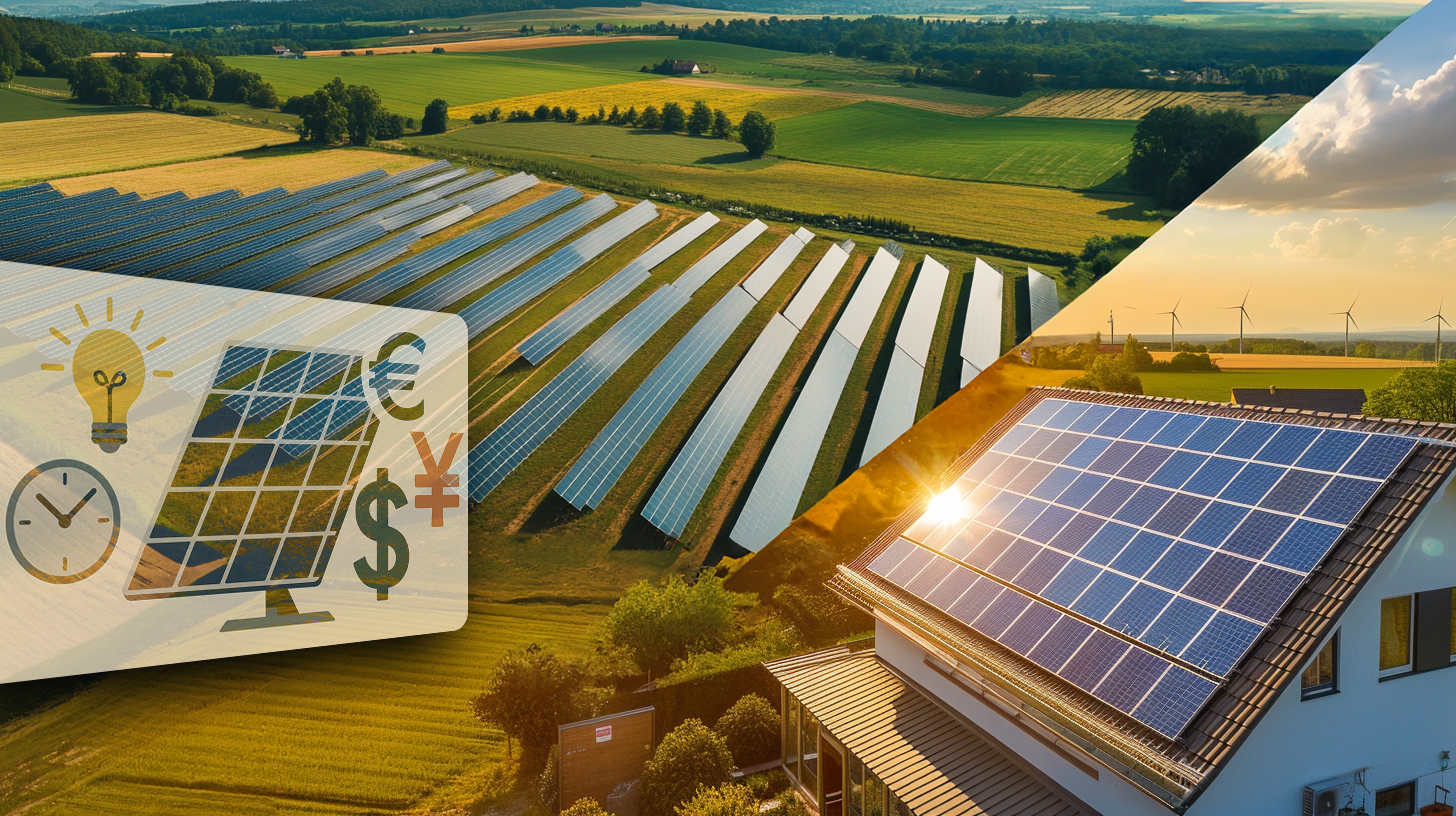
Innovative photovoltaic solution for cost reduction and time savings - Image: Xpert.Digital
More information here:
Heat pump vs. gas: Why your next 20 years could be more expensive
The economic comparison: What fossil fuel heating really costs
The debate about grid bottlenecks and heat pump connections is regularly conducted without drawing the obvious macroeconomic and household comparison: What does the alternative cost? Between 2021 and 2024, natural gas for households became 36 percent more expensive, district heating 42 percent, and heating oil 47 percent. Compared to the second half of 2021, the reference period before the energy crisis, gas prices for households were still 79.1 percent higher in the second half of 2025. According to calculations by Verivox, a family with gas heating in a single-family home paid an average of €2,202 for heating costs in 2025, an increase of 12.7 percent compared to the previous year.
In direct comparisons, the economic superiority of heat pumps becomes increasingly clear. An efficient heat pump with a seasonal performance factor (SPF) of 4 generates the same amount of heat for an average single-family home for around €1,337 per year, which corresponds to annual savings of approximately €925, or 41 percent, compared to gas heating. Even a heat pump with an SPF of only 2.7 is still around 13 percent cheaper than gas. Stiftung Warentest, in its analysis from autumn 2025, confirms that operating a gas heating system in an average older building costs between €700 and €1,000 more per year than operating a modern heat pump. The heat pump is the most cost-effective heating technology to operate in Germany.
Related to this:


The CO2 price and the cost structure of the next decades
What this snapshot of the cost comparison doesn't yet fully reflect is the structural price development of fossil fuels in the coming years. The national CO2 price rose from €45 to €55 per ton on January 1, 2025, and is expected to be between €55 and €65 in 2026. For an annual gas consumption of 20,000 kilowatt-hours, this increase results in additional costs of over €300 due to the CO2 surcharge alone. From 2028, the European Emissions Trading System 2 (ETS 2), a new emissions trading system for the building and transport sectors, will come into effect, making the CO2 price market-based and thus potentially significantly higher.
The forecasts from the analysis firm BloombergNEF are revealing in this context: The new EU emissions trading system could drive the price of a ton of CO2 up to €149 by 2030. Heating oil and natural gas could subsequently become 31 to 41 percent more expensive. Anyone installing a fossil fuel heating system today is essentially financing a time bomb in their own household budget. Over a 20-year period, this price development fundamentally alters the cost-benefit analysis in favor of heat pumps, even if their initial purchase costs still exceed those of a gas heating system.
The market is sending clear signals – despite political uncertainty
Market data from recent years tells a story marked by fluctuations, but with a clear trend. In 2024, 69.4 percent of all completed residential buildings in Germany were constructed with heat pumps as their primary heating source, compared to 31.8 percent in 2014. For single-family homes, the figure was 74.1 percent. Of the new buildings approved in 2024, 81 percent planned to use heat pumps. These are not marginal shifts, but rather a structural dominance of the technology in the new construction sector.
The temporary market slump for heat pumps in 2024, which pushed sales down to 193,000 units after significantly higher sales in 2023, can be explained economically: The political debate surrounding the Building Energy Act triggered a classic freeze response in a sensitive investment segment. The recovery began immediately once funding conditions became clear and political stability returned. In the first quarter of 2025, sales had already risen by 35 percent to 62,000 units, and the German Heat Pump Association (BWP) projected 260,000 units sold for 2025. The message is clear: The market wants heat pumps, and above all, it needs one thing: political reliability.
Investment needs and the question of financing architecture
Given the enormous investment volume required for grid expansion, estimated at around €320 billion for transmission networks alone by 2045, plus more than €200 billion for distribution networks, the question of financing architecture is of paramount importance. According to the German Association of Energy and Water Industries (BDEW), approximately €13.4 billion was invested in transmission networks and €8.6 billion in distribution networks in 2024. By 2030, the annual investment is projected to rise to €16.4 billion for transmission networks and €15.4 billion for distribution networks. These increases are substantial, but they are manageable when compared to the costs of inaction.
The redispatch costs, which currently consume billions of euros annually and burden consumers through grid fees, are essentially avoidable. Had Germany pursued grid expansion more consistently in the 2010s, when the EEG subsidies were already driving a massive increase in renewable energy feed-in, these expenditures would have been substantially lower. As early as January 2024, the Tagesschau news program quoted experts pointing out that the rising grid fees resulting from redispatch efforts directly impact electricity prices, with a family of four paying around €100 more per year in grid fees at that time than just a short while before. The failure to expand the grid is therefore not an abstract oversight, but a very concrete, daily bill.
Acceleration as a regulatory policy task
The structural problem lies not in the technology, not in the will of the grid operators, and not in a lack of willingness among households to switch to heat pumps. It lies in the institutional architecture of the German planning and permitting system. Planning approval procedures for transmission lines in Germany can take many years, even though acceleration laws have brought improvements in recent years. The construction of a new substation in Gotha, from planning to completion, scheduled for 2029 after construction began in 2027, will take several years in terms of physical construction alone. The parallel planning approach, i.e., the simultaneous processing of partial permitting steps, remains underdeveloped in many municipalities.
The German Association of Energy and Water Industries (BDEW) has repeatedly addressed this problem, explicitly calling for faster planning and approval processes as well as more investment-friendly grid regulation. This stems from the understanding that even ample capital is of no use if administrative processes are too lengthy. While the Federal Ministry for Economic Affairs and Energy has launched various initiatives to accelerate these processes, the gap between Germany's proclaimed speed and the reality of bureaucratic procedures remains significant. This institutional inertia is not a law of nature; it is a political decision, and it comes at a price.
Sector coupling as a systemic imperative
The integration of electricity, heating, and mobility infrastructure, also known as sector coupling, is not a political buzzword but a technical necessity for a stable and cost-effective energy system. Heat pumps, as controllable loads, can, with the right system design, help utilize surplus wind power that would otherwise have to be curtailed. Electric vehicles, acting as buffer storage, can alleviate grid congestion in both directions. Thermal storage systems in buildings decouple electricity consumption from heating demand, thus mitigating the simultaneity of peak loads.
The real-world laboratory in Jena demonstrates that these theoretical potentials are technically feasible and already functioning in test operation. The digital platform developed there is intended to serve as a blueprint for other cities in Germany. Crucially, such a system does not replace grid expansion, but rather significantly complements and reduces it. If Germany were to equip its distribution network nationwide with intelligent control technology and simultaneously accelerate physical expansion, a leverage effect would result, making the transition far more efficient than purely physical grid expansion alone could achieve. The technology exists. The real bottlenecks are the approval processes, the regulatory framework, and the political will.
Climate policy without a waiting room
Behind the entire debate about grid capacity and heat pump connections lies a deeper economic and ethical question: What is the price of waiting? The climate catastrophe, to use a term whose urgency is well-documented scientifically, doesn't factor in German permitting processes. Every building that is fitted with a gas heating system today instead of a heat pump is a system with a lifespan of 20 to 25 years, which will likely have to operate in an increasingly hostile regulatory and price environment for fossil fuels. The capital destruction inherent in this decision often only becomes apparent to individual owners once it has already occurred.
At the same time, grid expansion is progressing, slower than necessary, but with increasing investment momentum. The rise in annual grid investments from around €22 billion in 2024 to a planned almost €32 billion by 2030 is substantial. Heat pumps installed today will be connected to a grid in ten years that is better suited to them than the current one. The investment is therefore worthwhile in two ways: for individual households through lower operating costs, and for the overall system through the strengthening of infrastructure demand, which justifies and finances grid investments. Fear is not a helpful advisor in this context. Infrastructure and technology provide the basis for an informed decision, and this basis, upon a sober review of the data, clearly favors electric heating.
🎯🎯🎯 Data-driven B2B industry hub as a quasi-in-house solution


The quasi-in-house solution: How Xpert.Digital closes operational gaps in B2B marketing and sales – Smart Content-Driven Business - Image: Xpert.Digital
Xpert.Digital is a data-driven B2B industry hub led by Konrad Wolfenstein . The company acts as an external, quasi-in-house solution for industrial partners, closing operational gaps in marketing, content, and sales – without requiring additional resources on the client side.
More information here:
Your global marketing and business development partner
☑️ Our business language is English or German
☑️ NEW: Correspondence in your native language!

Konrad Wolfenstein
I and my team are happy to be available to you as your personal advisor.
You can contact me by filling out the contact form here wolfenstein@xpert.digital:or simply call me at +49 7348 4088 965. My email address is
I'm looking forward to our joint project.