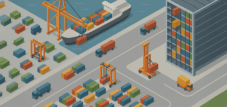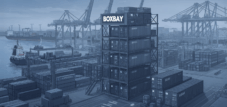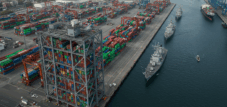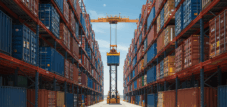
Container high-bay warehouses and container terminals: The logistical interplay – expert advice and solutions – Creative image: Xpert.Digital
Container high-bay warehouses: The future of global container and port logistics
Vertical storage is revolutionizing container terminals and container ports worldwide
Global container logistics faces enormous challenges. More than 90 percent of global trade is handled by sea, and container sizes are constantly increasing. At the same time, traditional container terminals are reaching their physical and operational limits. Limited port space, increasing transshipment volumes, and the need for ever more efficient handling have led to a revolutionary development: the high-bay container warehouse.
This innovative technology promises to fundamentally change container logistics. Instead of stacking containers horizontally as before, they will be stored vertically in multi-story steel racking structures. This not only allows for a drastic increase in storage capacity within the same area, but also revolutionizes all processes at the container terminal.
Fundamentals of container high-bay warehouse technology
Technical design and function
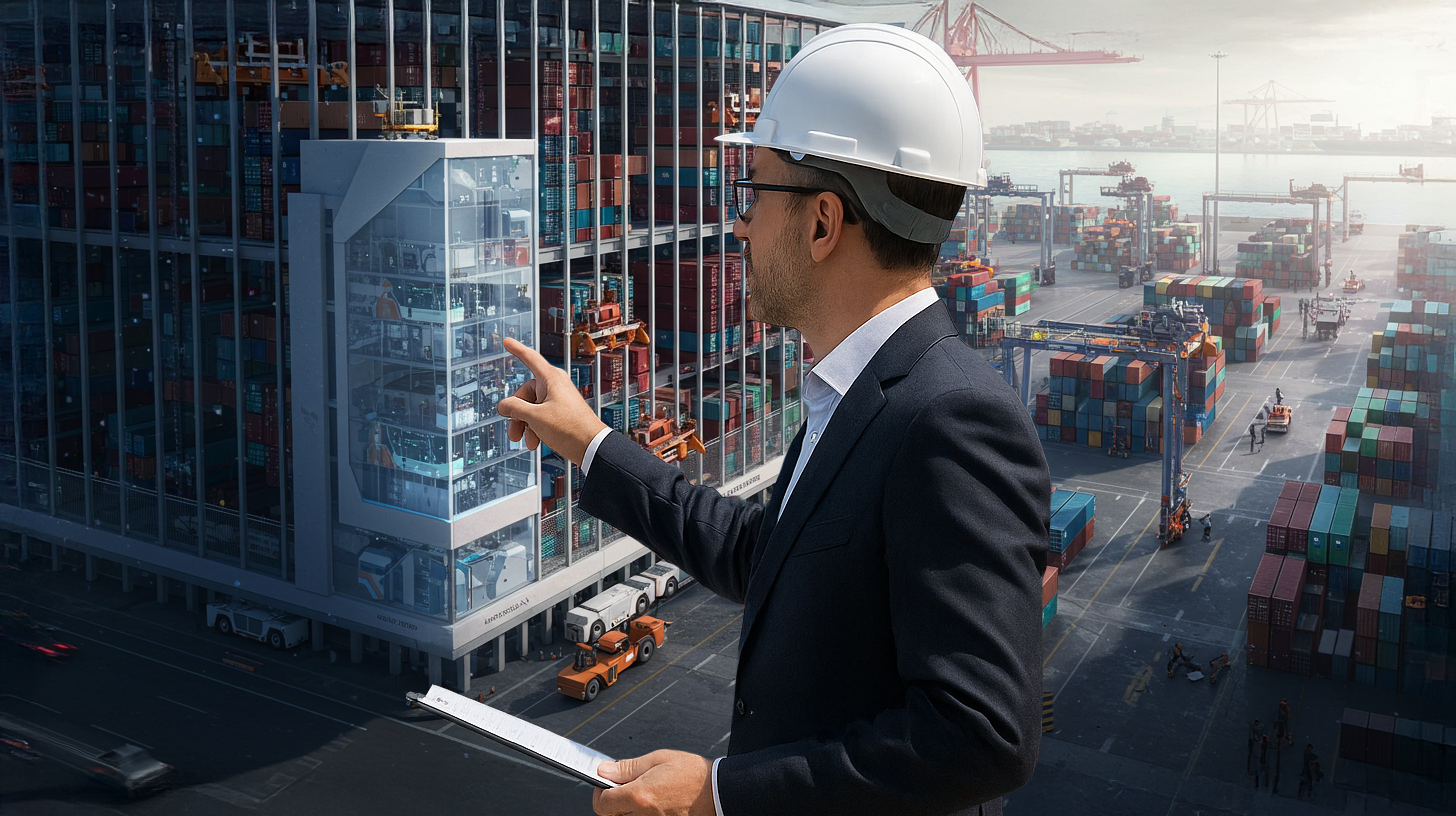
A container high-bay warehouse is a fully automated storage system specifically designed for handling standard shipping containers. Its fundamental architecture differs radically from conventional container yards. While traditional terminals stack containers horizontally on the ground, high-bay warehouses utilize a vertical storage philosophy within massive steel racking structures.
The core of the system consists of the storage and retrieval machines, also known as stacker cranes. These rail-guided cranes move in the narrow aisles between the rows of racks and can precisely store and retrieve containers at heights of up to eleven levels. Each container has its own individual storage location, meaning the racking structure bears the entire weight and containers no longer have to rest on top of each other.
Storage and retrieval are fully automated. When a container arrives at the terminal, it is identified at special transfer stations and picked up by the storage and retrieval machines. The system automatically calculates the optimal storage location, taking into account various factors such as weight, destination port, planned departure time, and current capacity. During retrieval, each container can be accessed directly without restacking other units.
Software architecture and control systems
The performance of a container high-bay warehouse depends crucially on its software architecture. Three interconnected system levels control the complex processes: the Terminal Operating System (TOS), the Warehouse Management System (WMS), and the Warehouse Control System (WCS).
The Terminal Operating System (TOS) acts as a central planning platform for the entire terminal. It communicates with external partners such as shipping companies, freight forwarders, and rail transport companies, manages ship arrivals and truck time slots, and coordinates all container movements across the terminal. The TOS defines the strategic parameters, such as which containers arrive when and by what time they must be ready for specific ships.
The Warehouse Management System (WMS) handles the tactical level of warehouse control. It manages every single container in the system, optimizes storage locations, and plans movements so that frequently used containers are placed in advantageous positions. The WMS also performs predictive relocations, in which containers are moved to better positions even before they are actually picked up.
The Warehouse Control System (WMS) represents the operational level and controls the physical movements of the storage and retrieval machines in real time. It translates the planning specifications of the WMS into concrete machine commands and continuously monitors the system status. These three software levels work seamlessly together and enable complete automation of warehouse processes.
Increased efficiency and operational advantages
Revolutionizing turnover speed
High-bay container warehouses achieve dramatic improvements in turnaround times. The most important metric is truck handling time, which in conventional terminals is often 30 to 90 minutes or more. These waiting times arise primarily from searching for the desired container and the time-consuming restacking of stacked units.
A high-bay warehouse can reduce these times to under 20 minutes. This is due to direct access to every container without restacking. When a truck arrives at the terminal, the requested container is already in the optimal position thanks to software-controlled pre-planning, or it can be provided by the storage and retrieval machines within minutes. This speed is accompanied by unprecedented predictability, as the system can offer guaranteed delivery times.
Ship handling also benefits significantly from high-bay warehouse technology. Containers can be provided in the exact loading sequence, thus reducing ship turnaround times. Since no time is lost searching for or restacking containers, valuable berth space can be used more efficiently.
Space efficiency and capacity increase
The most important advantage of container high-bay warehouses lies in their enormous space efficiency. While traditional container yards can typically only stack four to six containers on top of each other, high-bay warehouses allow for up to eleven storage levels. This vertical densification results in a tripling of storage capacity on the same footprint.
This space saving is particularly valuable in expensive port areas, where land is often scarce and costly. Instead of developing new terminal areas or expanding existing ones horizontally, ports can significantly increase their capacity by building high-bay warehouses on existing land. This is not only economically advantageous but also more environmentally sustainable, as no new land needs to be sealed.
The increased capacity also has a positive impact on the terminal's flexibility. Larger buffer capacities make it possible to better absorb fluctuations in shipping traffic and remain operational even in the event of unforeseen circumstances. This is particularly important given the trend towards ever larger container ships, which can load and unload several thousand containers during a single port call.
Integration into the terminal ecosystem
Interfaces to existing systems
Container high-bay warehouses are not isolated systems, but must be seamlessly integrated into the existing terminal infrastructure. The transfer points between the high-bay warehouse and the other terminal areas are of critical importance in this process.
On the water side, the connection is made via automated transport systems. Driverless transport vehicles or rail-mounted gantry cranes transport the containers between the container bridges on the quay and the transfer stations of the high-bay warehouse. These systems are also fully automated and can efficiently handle large quantities of containers.
On the land side, special truck docking stations are being set up where the containers are placed directly onto the truck chassis. These stations are designed to enable fast and safe transfers. In parallel, there are connections to rail terminals where containers can be loaded onto railway wagons.
Integrating different transport systems requires precise coordination. The terminal operating system must synchronize all movements to prevent congestion and waiting times. Modern terminals use simulation software and artificial intelligence to optimize these complex material flows.
Automation and human-machine cooperation
Although container high-bay warehouses are highly automated, people still play an important role. However, automation is leading to a change in job profiles. Instead of physical labor, monitoring, control, and maintenance tasks are becoming increasingly important.
Modern terminals rely on an intelligent division of labor between humans and machines. Humans handle complex decisions requiring flexibility, while machines perform repetitive and physically demanding tasks. This leads not only to greater efficiency but also to improved working conditions and increased safety.
Remote control of container cranes is one example of this development. Instead of sitting at dizzying heights in crane cabins, crane operators can control the container cranes from comfortable control stations on the ground. This improves both workplace quality and efficiency, as one crane operator can operate multiple cranes.
Sustainability and environmental benefits
Energy efficiency and emission reduction
Container high-bay warehouses offer significant advantages for the environmental footprint of container terminals. The electric storage and retrieval machines are considerably more energy-efficient than the diesel-powered straddle carriers used in conventional terminals. Because they run on rails and utilize regenerative braking systems, they consume less energy per container moved.
The compact design of high-bay warehouses also reduces energy consumption for lighting and air conditioning. Because the aisles are narrow and the storage area is concentrated, fewer areas need to be illuminated and heated. Modern systems also utilize LED lighting with motion detectors to further minimize energy consumption.
Another sustainability advantage lies in the reduction of noise and light emissions. High-bay warehouses are generally enclosed or covered facilities, which significantly reduces noise levels for the surrounding area compared to open container yards. This is particularly important in urban port areas, where terminals are often located near residential neighborhoods.
Long-term resource conservation
The increased space efficiency of high-bay container warehouses contributes to resource conservation. Since less land is required, less natural habitat needs to be used for port expansions. This is particularly relevant in coastal areas, where port developments often encroach on ecologically sensitive areas such as tidal flats or marshlands.
The steel structures of the high-bay warehouses are also durable and can be recycled at the end of their service life. Compared to the frequent modifications and expansions of conventional container yards, they offer a more sustainable infrastructure. The automated systems also have a longer lifespan than conventional container handling equipment because they operate more precisely and exhibit less wear.
Consulting - Planning - Implementation

Markus Becker
I would be happy to serve as your personal advisor.
Head of Business Development
Port challenge: New technologies for efficient container storage
Challenges and Implementation
Technical and economic hurdles
The introduction of high-bay container warehouses involves significant investment. Initial costs are considerably higher than for conventional container yards, as complex steel structures and sophisticated automation technology are required. These high capital costs must be recouped through operational savings and increased handling capacity.
The technical complexity of these systems also requires specialized expertise in planning, construction, and operation. Terminal operators must train their staff accordingly and establish new maintenance and service structures. This poses particular challenges for smaller port operators.
Another critical point is system integration. Container high-bay warehouses must be seamlessly integrated with existing terminal operations. This often requires extensive adjustments to IT systems and operational processes. Furthermore, structural limitations at existing terminals can complicate implementation.
Adaptation to local conditions
Not every port is equally suitable for high-bay container warehouses. The geological conditions must be sufficiently stable to support the tall steel structures. In areas with soft soils or a high risk of earthquakes, additional foundation measures may be required.
Climatic conditions also play a role. In regions with extreme weather conditions, the systems must be designed to be correspondingly robust. Wind, ice, and corrosion from saltwater can impair operational reliability and require special protective measures.
Integration into existing port structures presents another challenge. Many ports have grown over decades and have complex infrastructures with a wide variety of interfaces. Switching to high-bay warehouse technology often requires a fundamental reorganization of terminal operations.
Digital networking and future technologies
Networking with global supply chains
Container high-bay warehouses are not just local optimizations, but part of a broader digitalization of global supply chains. Complete transparency for every container in the system enables all stakeholders in the supply chain to plan precisely.
Shippers and freight forwarders receive real-time information about the status of their containers and can synchronize their downstream logistics processes accordingly. This enables just-in-time deliveries and reduces the need for buffer stocks in the supply chain. As a result, planning reliability is significantly improved and supply chains become more efficient overall.
The data collected in high-bay warehouses also provides valuable insights for optimizing supply chains. By analyzing container movements, dwell times, and transport patterns, logistics service providers can improve their services and identify bottlenecks early on.
Artificial intelligence and predictive systems
Modern container high-bay warehouses are increasingly using artificial intelligence and machine learning to optimize their processes. These systems can learn from historical data and make predictions about future container flows. This allows containers to be proactively moved into optimal positions before they are actually needed.
Predictive maintenance concepts use sensor data from storage and retrieval machines to detect wear and potential failures early. This reduces unplanned downtime and increases system availability. Continuous monitoring of system parameters also enables optimization of energy consumption and operating costs.
The integration of 5G technology opens up further possibilities for the real-time control of systems. Thanks to low latency and high data rates, even complex control tasks can be transmitted wirelessly. This increases the flexibility of the systems and enables new application scenarios.
International developments and market trends
Pioneer sites and reference projects
The first high-bay container warehouses are already in operation or under construction. The most prominent example is the BOXBAY system at the Jebel Ali port in Dubai, which has been successfully handling containers for several years. After more than 63,000 container handling operations during the trial phase, the technology and operational processes have proven their worth.
Further projects are planned or under construction in various regions of the world. The port of Busan in South Korea will receive a BOXBAY system, which is expected to reduce truck handling times by 20 percent. There are also concrete plans for high-bay container warehouses in Europe, with the Port of Hamburg considered one of the pioneers.
These reference projects are important for the further dissemination of the technology. They demonstrate practical feasibility and provide operational experience that can be used to optimize future facilities. Successful implementations also reduce the perceived risk for other port operators.
Technological advancements
Container high-bay warehouse technology is constantly evolving. New generations of storage and retrieval machines are becoming lighter, faster, and more energy-efficient. The integration of robotic technologies enables more flexible handling systems that can also cope with damaged or unusual containers.
The software systems are also constantly being improved. New algorithms for warehouse space optimization and route planning for the storage and retrieval machines further increase efficiency. The integration of blockchain technologies could also improve the security and traceability of container flows in the future.
Modular designs allow high-bay warehouses to be expanded step by step and adapted to changing requirements. This reduces investment risks and makes the technology attractive even for smaller ports. Standardized interfaces facilitate the integration of various system components and reduce dependence on individual suppliers.
Economic impacts and business models
Transformation of the port economy
Container high-bay warehouses are fundamentally changing business models in the port industry. Instead of simply offering space and handling capacity, ports can market high-quality logistics services with guaranteed service levels. The predictability and reliability of high-bay warehouses make it possible to offer premium services that command correspondingly higher prices.
Increased efficiency also leads to altered cost structures. While capital costs rise, operating costs decrease through automation and optimized processes. In the long term, container high-bay warehouses can therefore be more economical than conventional systems despite higher initial investments.
The technology also enables new cooperation models between ports, shipping companies, and logistics service providers. Improved planning allows for long-term capacity contracts, providing greater security for all parties involved. This can lead to more stable revenues and better financing options.
Impact on employment
Automation through high-bay container warehouses has complex effects on employment in ports. On the one hand, traditional jobs such as crane operators and straddle carrier drivers are eliminated or reduced. On the other hand, new, more highly skilled jobs are created in system monitoring, maintenance, and IT support.
The transformation requires extensive training measures for the existing workforce. Many port operators are therefore investing heavily in further education programs to prepare their employees for the new demands. This is also important from a societal perspective to maintain acceptance of the technological changes.
In the long term, more efficient processes can lead to growth in the port economy, which in turn creates new jobs. The increased competitiveness of automated ports can gain market share and thereby increase overall volume. This shows that technological progress does not necessarily have to lead to job losses.
Outlook and future prospects
Expansion into the hinterland
Container high-bay warehouse technology is expected to spread beyond seaports. Inland terminals at major railway hubs and freight centers could also benefit from the technology. These "dry ports" would serve as buffer storage between long-distance transport and regional distribution.
Shifting storage capacity inland can relieve the pressure on congested port regions. Containers could be transported directly inland upon arrival and temporarily stored in high-bay warehouses. This would reduce traffic congestion in port cities while simultaneously increasing the flexibility of supply chains.
Networking different high-bay warehouse locations could lead to an integrated logistics network. Containers could be automatically rerouted between different warehouses to avoid bottlenecks or optimize transport routes. This would further increase the efficiency of the entire logistics system.
Integration with other future technologies
The future of container high-bay warehouses lies in their integration with other innovative technologies. Autonomous transport vehicles could handle the connection between different terminal areas, operating more flexibly than currently available systems. Drones could be used for inspections and maintenance work.
Blockchain technologies could further improve the transparency and security of container flows. Each container could be assigned a digital identity containing all relevant information about its contents, origin, and destination. This would expedite customs clearance and reduce the risk of counterfeiting or smuggling.
Integrating Internet of Things (IoT) sensors into containers and storage systems would enable even more precise monitoring. Temperature, humidity, vibrations, and other parameters could be continuously measured and used to optimize storage. This would be particularly important for sensitive goods such as pharmaceuticals or food.
Container high-bay warehouse technology is still in its early stages of development, but it has already demonstrated the potential to revolutionize container logistics. The combination of vertical storage, full automation, and intelligent software is creating a completely new paradigm for container terminals. While implementation is complex and capital-intensive, the long-term benefits promise a sustainable transformation of global port logistics. The successful integration of container high-bay warehouses into the terminal ecosystem will be crucial in determining how container logistics evolves in the coming decades.
Consulting - Planning - Implementation
Markus Becker
I would be happy to serve as your personal advisor.
Head of Business Development
Consulting - Planning - Implementation
Konrad Wolfenstein
I would be happy to serve as your personal advisor.
You can contact me at wolfenstein∂xpert.digital or
Just call me on +49 7348 4088 965 .